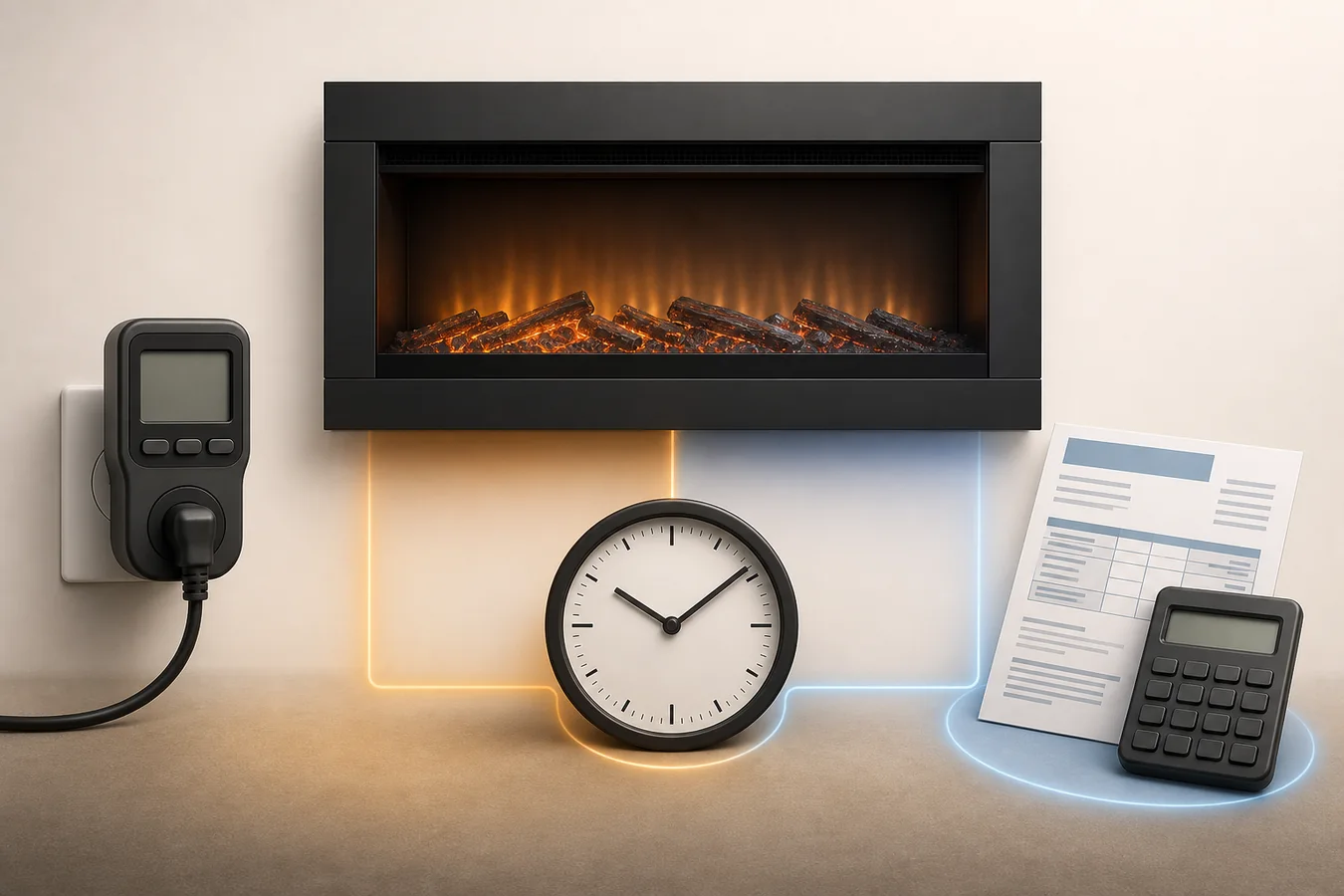
A 1,500W electric-fireplace heat setting costs 1.5 times your electricity price for each hour the heater is actually on. At an illustrative rate of 18 cents per kWh, that is 27 cents per active heater hour. A 750W setting at the same rate costs 13.5 cents, or about 14 cents.
Those are not automatic costs for every hour the flames are visible. A thermostat may cycle the heating element off during a four-hour session, and flame-only operation is a different electrical state. A defensible monthly estimate therefore needs the exact setting watts, active heater time, applicable electricity rate and number of use days.
Price one heater-on hour before you price a month
The U.S. Energy Information Administration defines one kilowatt as 1,000 watts and one kilowatthour as one kilowatt used for one hour. That gives you two transparent steps:
kWh = watts ÷ 1,000 × active hours
cost = kWh × applicable price per kWh
Use the power figure for the exact operating mode, model and electrical configuration you plan to run. Do not assume that every electric fireplace has the same settings. As current manufacturer examples, Napoleon lists 750W and 1,500W heat levels for its Lumi+ series, while Touchstone lists 750W and 1,500W heat settings for the named Chesmont 80034 model. Those values make useful arithmetic examples; they are not specifications for another fireplace.
Here is what one continuous heater-on hour costs at an illustrative 18 cents per kWh:
| Exact heat-setting draw | Energy for one active hour | Cost at 18 cents/kWh | Cost at your rate |
|---|---|---|---|
| 750W | 0.75 kWh | 13.5 cents (about 14 cents) | 0.75 × your rate |
| 1,500W | 1.50 kWh | 27 cents | 1.50 × your rate |
Replace 18 cents with the price that applies to the time and customer class on your bill. Then scale the active-hour result—not a generic “fireplace hour”—to the number of days you expect to use heat.
For example, a 1,500W setting that is active for three hours a day over 30 days uses:
1.5 kW × 3 hours × 30 days = 135 kWh
At the illustrative rate, the variable energy cost is:
135 kWh × 18 cents = 2,430 cents, or 24.30 dollars
The arithmetic is exact for those inputs. Whether those inputs describe your fireplace and room is the part that requires care.
The thermostat edits the clock
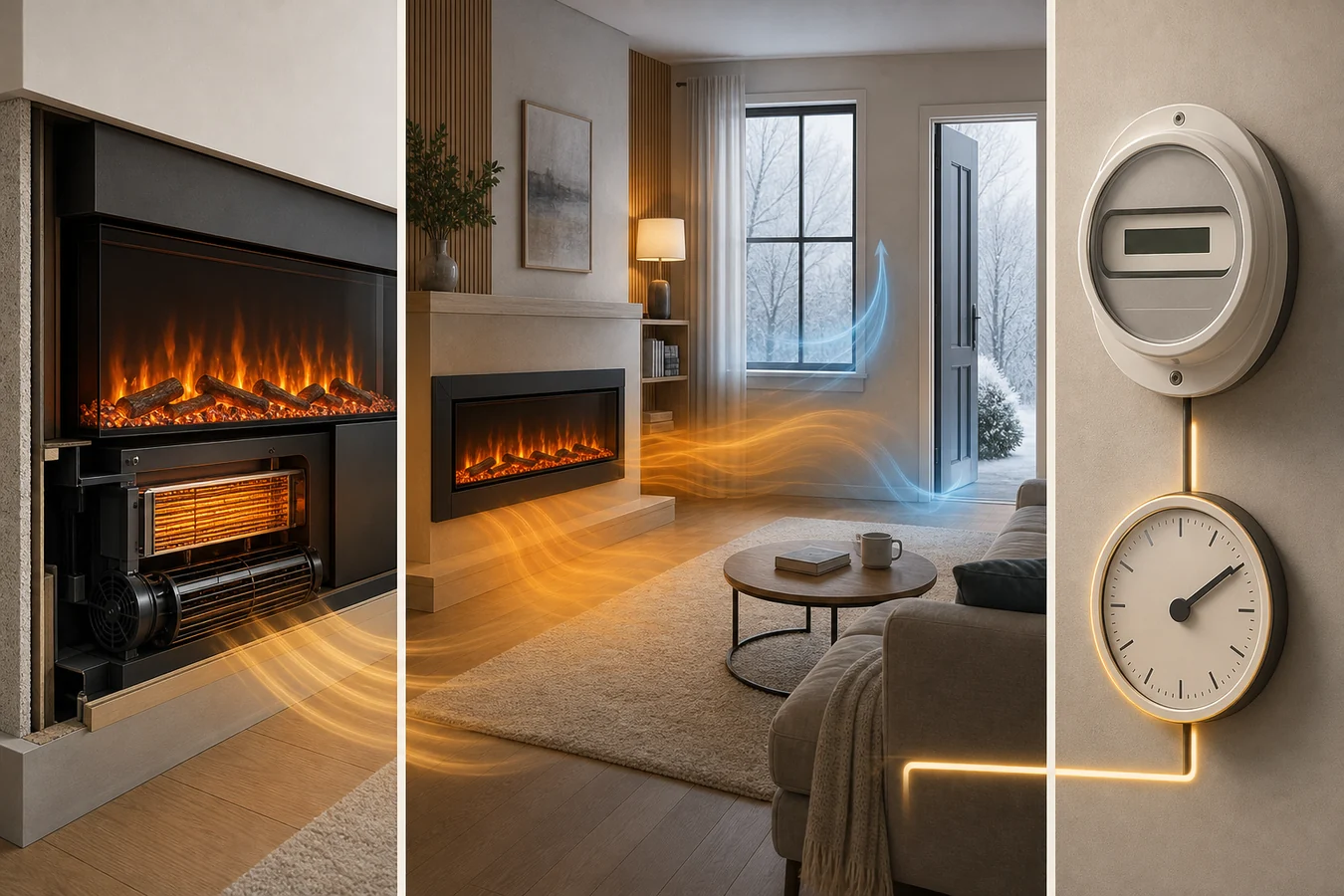
Wall-clock session time and active heater time answer different questions. Session time is how long the fireplace is on or visible. Active heater time is how long the high-draw heating state actually operates.
A current Dimplex BLF3451 service manual illustrates the distinction. It describes separate flame and heat controls, says the heater turns off when the set temperature is reached and cycles to maintain it, and specifies a 60-second fan delay after the heater is switched off. That behavior belongs to the named model, but it shows why four visible hours do not automatically equal four hours at the maximum heat-setting draw.
Consider one four-hour session using a known 1,500W heat setting and the same illustrative 18-cent rate:
| Planning view | Time assigned to 1,500W heat | Heater energy | Heater cost | What remains separate |
|---|---|---|---|---|
| Ceiling | 4.0 hours | 6.0 kWh | 108 cents | Any documented non-heater or standby draw |
| Expected after observation | 1.8 hours | 2.7 kWh | 48.6 cents (about 49 cents) | Any documented or measured draw while the element is off |
| Flame-only session | 0 heater hours | 0 heater kWh | zero heater cost | Flame-only cost is unknown until its own watts are known |
The ceiling protects a budget: it assumes the selected heat setting remains active for the full session. The expected figure needs evidence. You can time the heat indicator or cycle only if the manual makes that observation meaningful, or use a suitable plug-in power meter for a plug-connected model within the meter’s ratings and the appliance instructions. A whole-session meter reading is often more useful than trying to assign every fan, light and control load by memory.
Do not turn one mild-evening observation into a permanent duty-cycle percentage. Colder weather, an open doorway, a different thermostat setting or a larger heat loss can keep the element active longer. Preserve the date, room conditions and session length with the observation.
Flame-only time is a different appliance state
Some electric fireplaces let the visual effect run without heat. Napoleon describes the Lumi+ as usable with or without heat, and Touchstone says the flame and heat settings on the Chesmont 80034 operate independently. Neither visible product page establishes a universal flame-only wattage for every fireplace.
That leaves a simple rule: use flame-only watts only when the exact manual, label or a suitable measurement provides them. Never borrow 750W or 1,500W from a heat setting, and never add a guessed flame number on top of a manufacturer-rated total input for the same operating state.
Keep flame-only use on its own line:
flame-only kWh = exact flame-only watts ÷ 1,000 × flame-only hours
If exact flame-only watts are missing, the flame subtotal is unknown. You can still calculate the heater ceiling and expected heater cost; just do not present their sum as a complete appliance total. That is more useful than a precise-looking monthly number built from somebody else’s model.
A monthly estimate can be accurate and still miss the bill
The EIA notes that its published average retail electricity prices are calculated averages, not the rate charged to a particular customer. A customer’s rate can depend on location, customer type, amount used and when the electricity is used. Your current utility bill or tariff is therefore the better starting point.
Match the rate input to the question:
| Billing detail | Treatment in the estimate |
|---|---|
| Flat per-kWh energy and variable delivery charges | Combine the applicable per-kWh components if the bill presents them separately |
| Time-of-use rate | Price each session in the period when it occurs rather than using one blended number |
| Usage tier | Use the marginal tier the added kWh are likely to enter; keep a range if that is uncertain |
| Fixed monthly customer charge | Do not assign it to the fireplace if the charge would exist without the appliance |
| Taxes, riders or credits | Include only the portions that actually change with added kWh and that you can identify |
This produces an estimate of the fireplace’s variable electricity cost, not a guarantee of the total bill change. The bill also contains every other load in the home. Weather, billing-cycle length and rate changes can easily move the total while the fireplace estimate itself remains internally correct.
The same boundary applies to savings claims. Adding an electric fireplace is an additional load unless another heating load actually falls. If you are considering it as zone heat, use the site’s electric-fireplace heat and running-cost guide to test the room and displaced-heating assumptions before subtracting any supposed savings. Operating-cost arithmetic alone cannot prove that the room will stay comfortable or that the main system will run less.
Keep a ceiling and an expected number
One monthly number hides the uncertainty you most need to see. Keep two:
| Number to save | Inputs | What it tells you |
|---|---|---|
| Heater ceiling | Exact heat-setting watts × full planned session time × use days × applicable rate | A conservative variable-cost budget if that heat state stays active |
| Expected appliance cost | Observed or defensible heater-on time plus separately known flame/control use, scaled only to comparable days | A more realistic estimate with its evidence and conditions attached |
Before calculating, collect the exact heat-setting watts, planned wall-clock time, defensible active heater time and applicable electricity price. Add flame-only watts only when that separate input is known. Keep the rate and result in the same unit: multiplying by cents per kWh returns cents, while multiplying by dollars per kWh returns dollars.
Then enter the verified inputs in the Electric Fireplace Electricity Cost Calculator. It keeps heat and flame-only watts separate and shows the kWh and cost arithmetic. Use the ceiling to decide whether the worst reasonable session fits your budget; use the expected value to compare actual use later. If the two numbers are far apart, the gap is not an error—it is the thermostat and runtime uncertainty you should keep visible.