Maybe—but a “1,000 square feet” badge cannot answer the question by itself. It is a manufacturer coverage claim, not a shared capacity standard. Current product pages put almost the same 5,000-BTU output under very different area labels, which means the number needs context before it can guide a purchase.
Treat the badge as a reason to investigate, not as proof that one fireplace will hold your preferred temperature across an open floor plan or a small home. The useful decision needs four things: the exact model and electrical configuration, the complete claim wording, the physical zone you expect to warm and the job you expect the heater to perform.
Similar 5,000-BTU outputs can wear two different area badges
Two current manufacturer pages make the comparability problem visible.
| Current manufacturer source | Published heater facts | Published area wording | What the page can support |
|---|---|---|---|
| Real Flame Crawford Slim 8020E | 120V, 1,400W, 5,100 BTU | Supplemental heat for up to 1,000 sq ft | The named model may enter a supplemental-heat shortlist; the page does not prove a room result |
| Napoleon Cineview series | 120V, 1,500W, 5,000 BTU | Heats up to 400 sq ft | The named series carries a smaller area claim at nearly the same output |
| Dimplex 2026 US firebox table | Named families include different voltage/output configurations, including a 240V option up to 9,200 BTU | Up to 1,000 sq ft appears in the table | Voltage, output and exact model must travel with the area label |
Real Flame’s current Crawford page lists 5,100 BTU and 1,400 watts at 120 volts, then says the model provides supplemental heat for up to 1,000 square feet. Those qualifiers matter. “Supplemental” does not say the fireplace replaces the main heating system, and “up to” does not identify the room, weather or temperature target behind the number.
Napoleon’s Cineview page lists 5,000 BTU and 1,500 watts at 120 volts but says “up to 400 sq. ft.” The two outputs are close; the two area labels are not. That contrast does not prove that one manufacturer is right and the other is wrong. It proves that the area number is not directly comparable unless the underlying conditions and promise are also comparable.
Dimplex’s current US catalogue adds a second warning against separating the badge from the configuration. Its firebox table includes families with 120- and 240-volt paths and different published outputs, while 1,000-square-foot language appears in the table. A shopper cannot take the largest output from one configuration and combine it with the easiest connection from another.
The result is simple: keep the exact wording and product configuration intact. Never reduce all three sources to “electric fireplaces heat 1,000 square feet.”
Define the 1,000 square feet you expect to warm
Floor area describes a footprint. Heating happens in a volume with surfaces, openings and moving air.
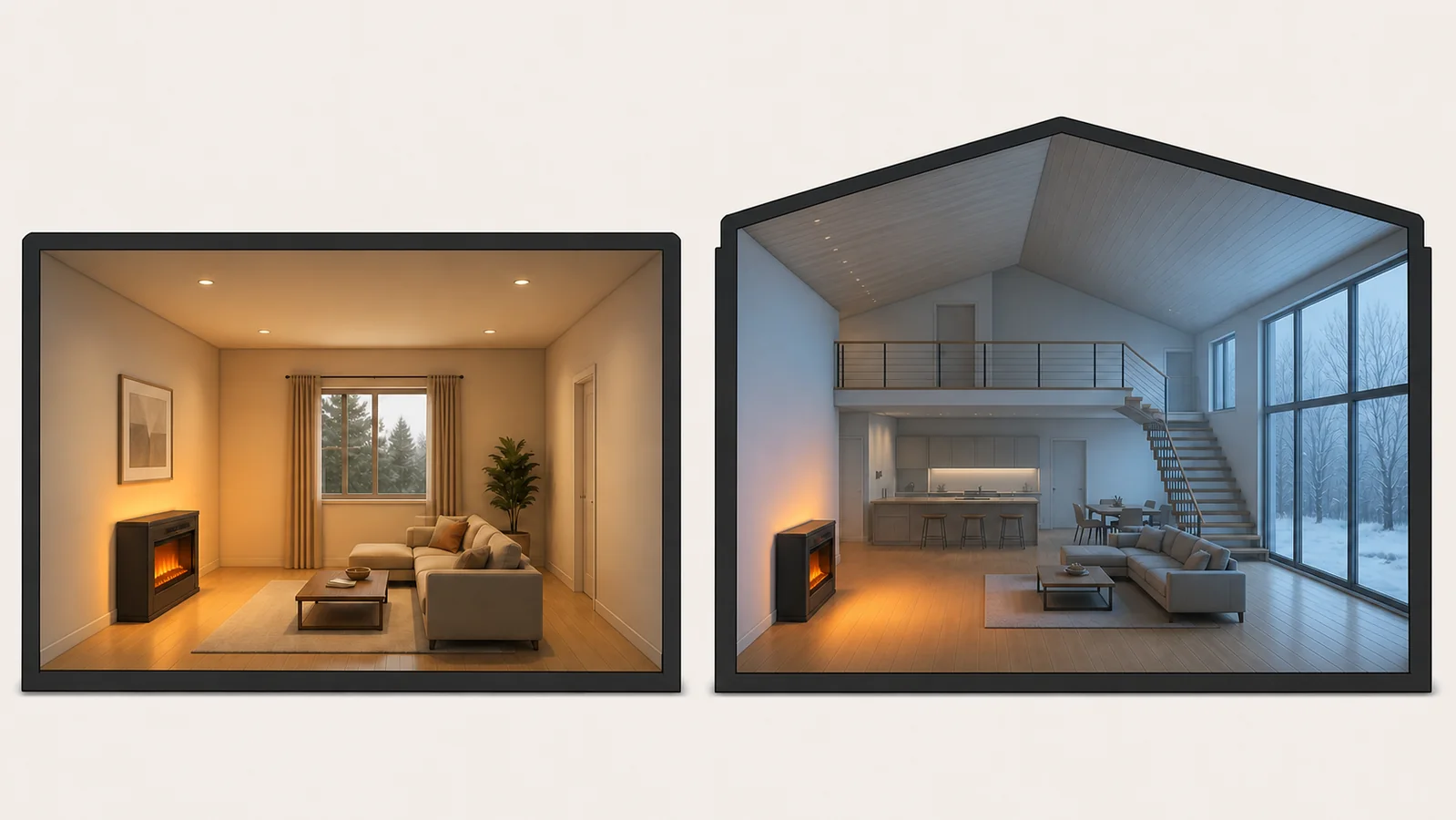
A closed living area with a modest ceiling and doors to adjacent rooms is a different target from an equally sized open plan with a tall ceiling, large exterior glass and an open stair. The second space contains more air and more routes for heat to leave the occupied zone. The fireplace may add the same number of BTUs per hour in both, yet the comfort result can differ.
“My home is 1,000 square feet” is especially ambiguous. The fireplace may face one room while bedrooms sit behind doors, a hallway turns a corner and an upper level connects through a stairwell. A local fan heater does not become a central distribution system because the house’s total floor area matches the badge.
Draw the heated boundary around the space you actually expect the fireplace to affect. Note whether it is one closed room, a connected open plan or the whole dwelling. Add ceiling height, exterior windows and doors, open stairs, frequent door openings and the role of the existing heating system. These are not decorative details. They determine how much of the heater’s output remains available to change comfort.
Outdoor conditions belong outside the product record. A claim that feels plausible on a mild evening may not establish performance during the coldest weather. The same is true of insulation and air leakage: they are room facts, not features supplied with the fireplace.
This does not require a homeowner to invent a heat-loss equation. It requires an honest boundary. When that boundary is vague, the 1,000-square-foot claim remains vague too.
The heating job decides how much proof you need
The word heat can describe three materially different expectations.
If the goal is to make the occupied part of a room feel more comfortable while the main system continues to operate, a manufacturer’s supplemental-heat claim can be a useful shortlist signal. You still need the exact heater mode, outlet location and airflow path, but you are not asking the fireplace to prove that it can carry the building’s full heat loss.
If the goal is to hold a closed room near a chosen temperature, the evidence threshold rises. Available output must exceed the room’s heat loss under the weather you care about, and the controls must support the intended operation. The coverage badge does not reveal either side of that comparison. Our guide to electric-fireplace heat and running cost explains how to keep the rating-plate ceiling separate from the room’s demand.
If the goal is to heat an open plan, several rooms or an entire 1,000-square-foot dwelling without relying on the primary system, the area badge is not enough to approve the purchase. ACCA describes Manual J as the ANSI-recognized method for residential heating and cooling load calculations, and ENERGY STAR tells homeowners to have contractors use a load calculation when sizing whole-home equipment. That is a different level of proof from a product-page coverage line.
The distinction also protects the word “supplemental.” A fireplace can add worthwhile comfort without maintaining every room at one set point. That can be a successful purchase, but it should not be reported as whole-home heating performance.
Choose the job before judging the claim:
- Local comfort: the area label may support discovery, provided the exact output and room path are compatible.
- Maintained room temperature: the claim needs room-load evidence, not a second retailer repeating the same badge.
- Primary or multi-room heat: the product page is insufficient proof; treat the heating system and distribution problem separately.
Those outcomes are not a ranking of fireplaces. They are different proof requirements for different promises.
Give the listing a coverage-claim passport
A useful record is short enough to build from any product page but strict enough to preserve what the page did—and did not—say.
Start with the manufacturer side: exact model or SKU, source URL and retrieval date; the complete coverage phrase; voltage and connection configuration; maximum watts or amps; published BTU; heater settings, thermostat language and the position of the warm-air outlet. Mark a field unknown when the page or manual does not provide it.
Then add the room side: the physical heated zone, not just total home area; ceiling and open connections; major exterior glass or doors; whether the zone closes; the winter condition that matters; and what the main heating system will continue to do. These are observations about the site, never specifications of the product.
Finally, state the job in one line: extra comfort near the occupied zone, maintaining a room temperature, or acting as primary/multi-room heat. The record can then return one of three decisions:
- Supplemental shortlist signal: the exact product and room path are plausible for extra comfort, while the badge remains a claim rather than a guarantee.
- Room-load proof required: the reader expects a temperature result, so a qualified load calculation or equivalent room-specific assessment must close the gap.
- Claim insufficient for the job: the listing does not identify enough output, configuration or room evidence to support the requested role.
Applied to Crawford 8020E, the product side reads: 120 volts, 1,400 watts, 5,100 BTU and supplemental heat for up to 1,000 square feet. The visible manufacturer page does not supply the reader’s ceiling, leakage, exterior temperature or desired room result. That record can support a supplemental shortlist. It cannot, by itself, promise that the model will maintain a 1,000-square-foot home at a chosen temperature.
The same method keeps the Cineview claim in its own lane: 120 volts, 1,500 watts, 5,000 BTU and up to 400 square feet for the named series. It is not evidence that every 5,000-BTU fireplace belongs in a 400-square-foot category; it is evidence that the manufacturer attached that wording to that series.
Let the missing field choose the next step
When the exact model, voltage or BTU is missing, go back to the current manufacturer manual or product page. A similar model and a retailer filter cannot supply the field.
When the product facts are complete but the cost is unknown, use the electric-fireplace running-cost calculator with the exact watts, your local electricity rate and the heater-on time you want to price. Do not enter the area badge as a substitute for watts.
When the expected result is a maintained temperature or primary heat, hand the heated boundary and exact product output to a qualified heating professional. The missing fact is room load, not another fireplace feature.
When a listing gives only “up to 1,000 sq ft” and none of the configuration or claim conditions needed for the job, leave it off the performance shortlist. The badge can stay in the manufacturer-claim field; it cannot occupy the verdict field.