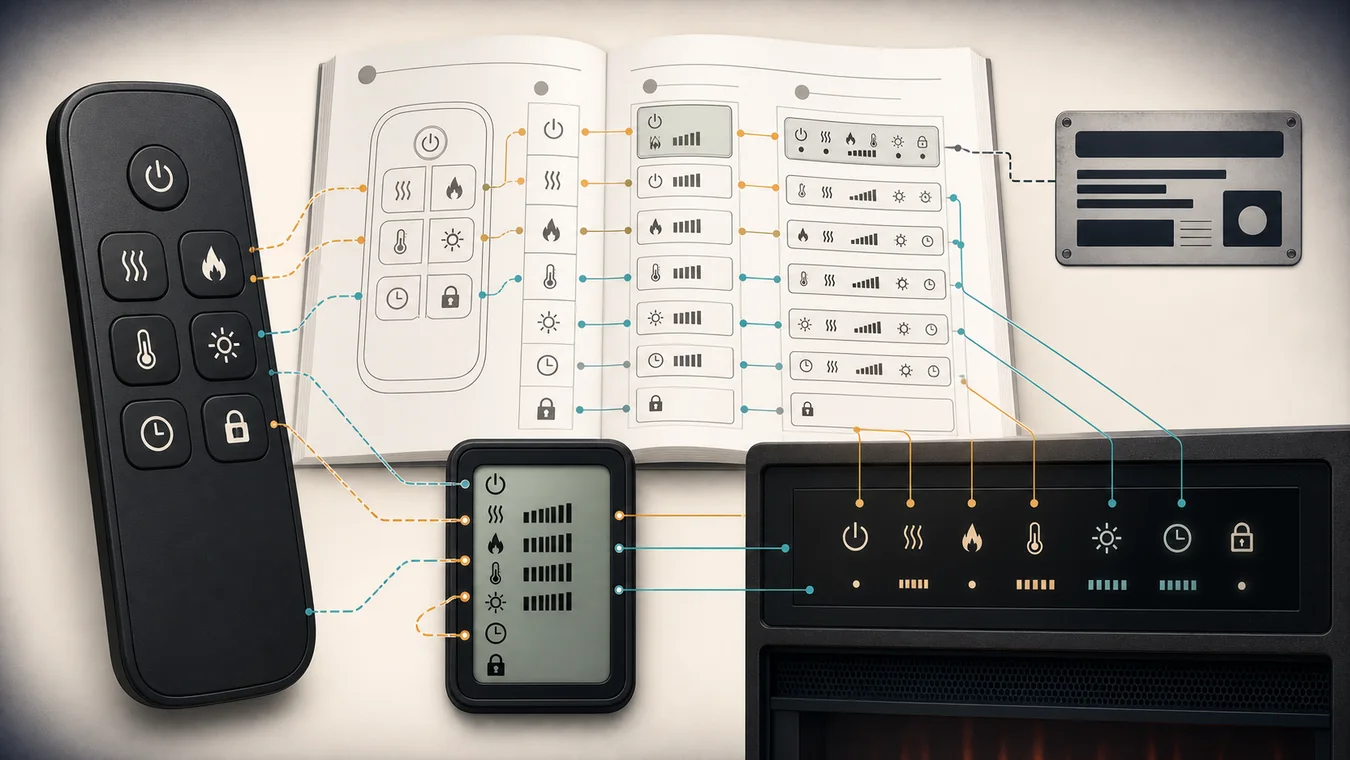
“Blower included” tells you that a fan exists. It does not tell you whether the fan can run without heat, how many heat levels you get, whether fan speed changes, how long the fan continues after shutoff, or how loud it will sound in your room.
It does not prove a higher wattage or BTU rating, either. Treat the blower badge as a reason to open the exact model manual—not as a reason to move the product to the top of your list.
The blower badge answers only one question
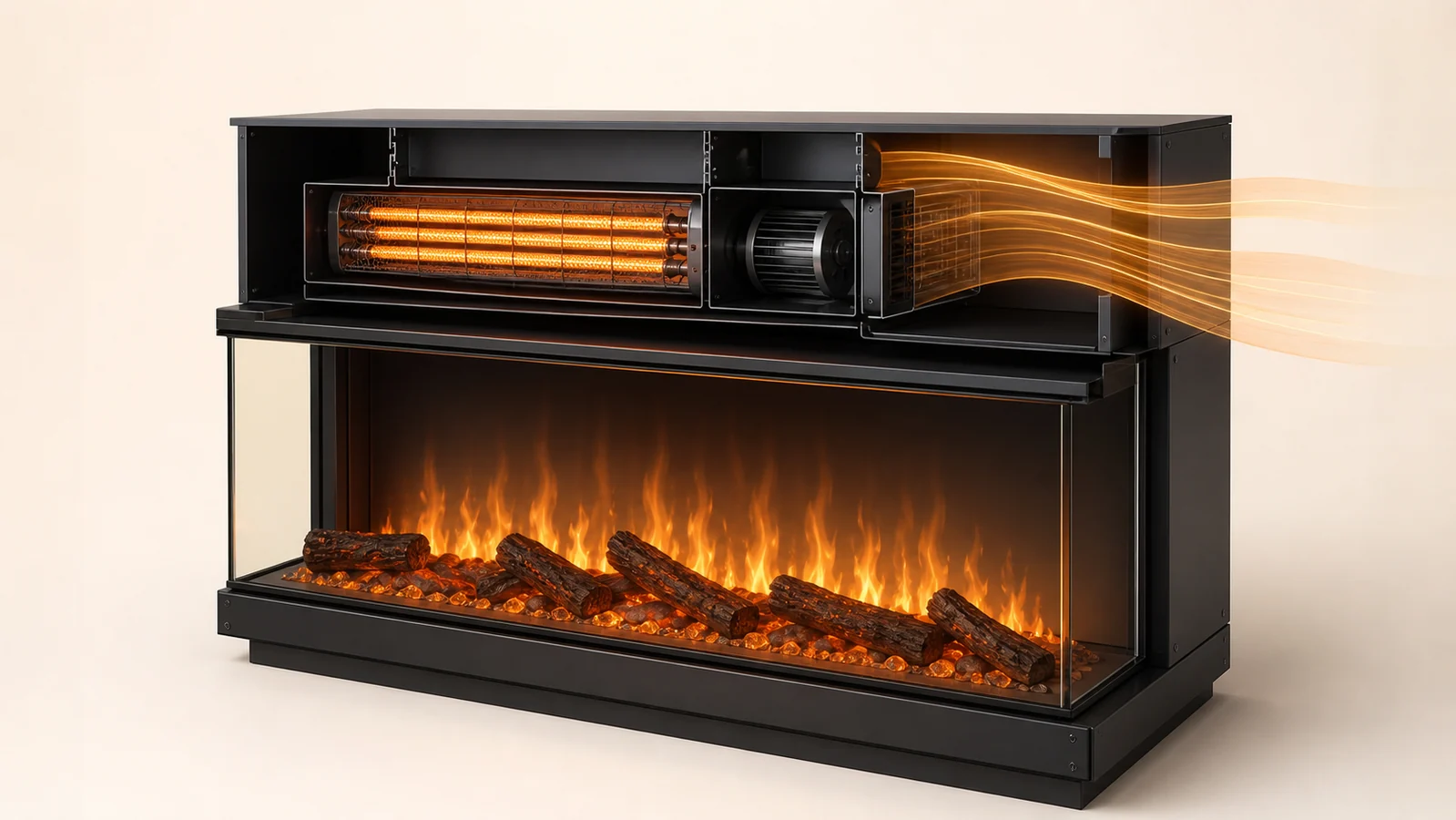
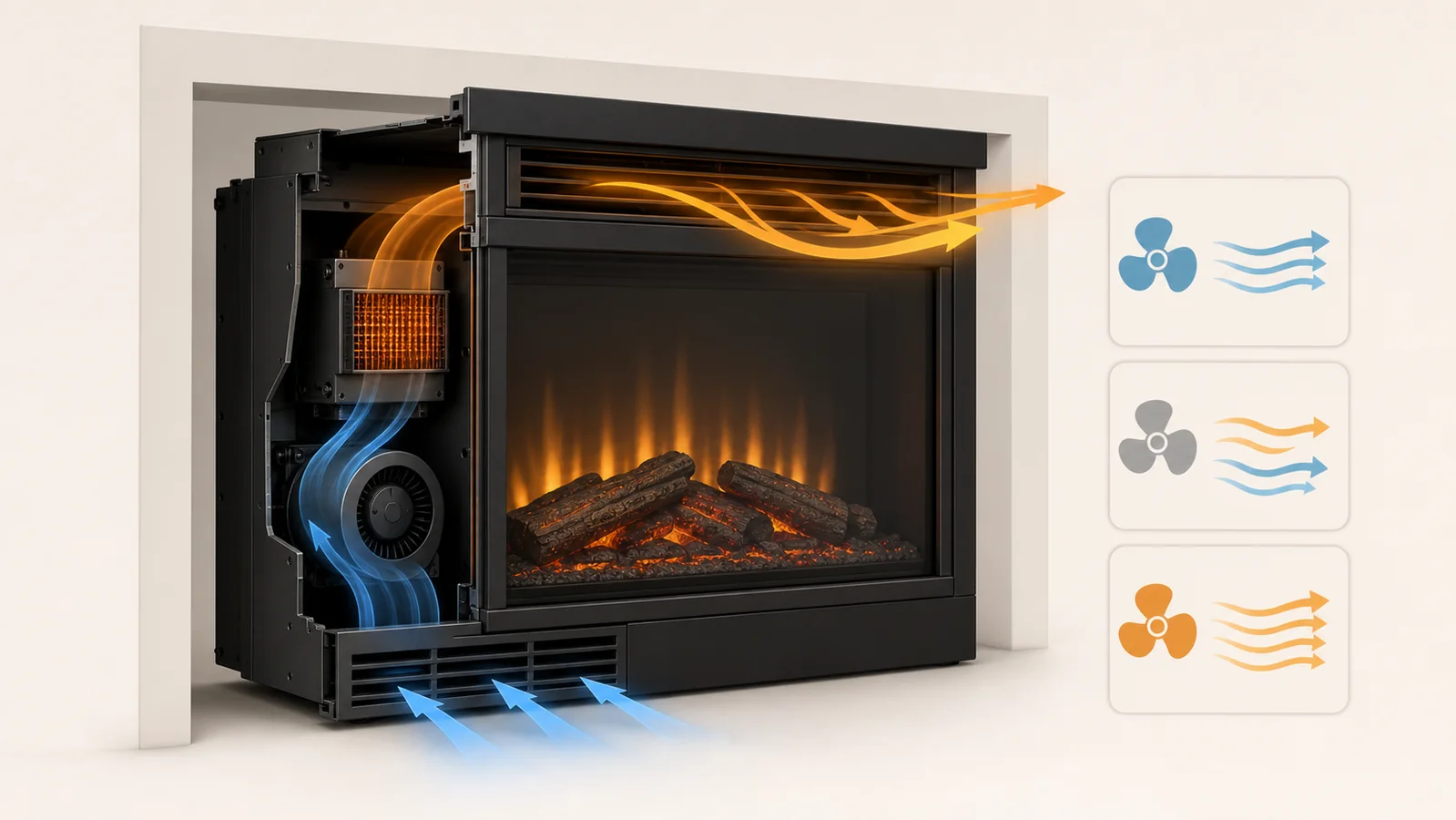
An electric insert’s heater converts electrical energy into heat. A blower moves room air across or past that heater and sends warmed air back into the room. The fan affects delivery, but it does not create extra electrical capacity.
Two products with blowers can publish similar maximum output and still behave differently. One may give you a true fan-only selection. Another may tie the fan to low or high heat. A third may let the thermostat stop the heating element while the fan continues. Those distinctions matter if you want occasional circulation, gentle background heat, a short burst of faster air, or less sound after pressing Off.
The feature filter also says nothing about fit. The insert still needs the correct opening, an unobstructed intake and outlet, the documented power path and a way to reach it for service. A sophisticated blower control cannot rescue a firebox that does not fit or an installation that blocks airflow.
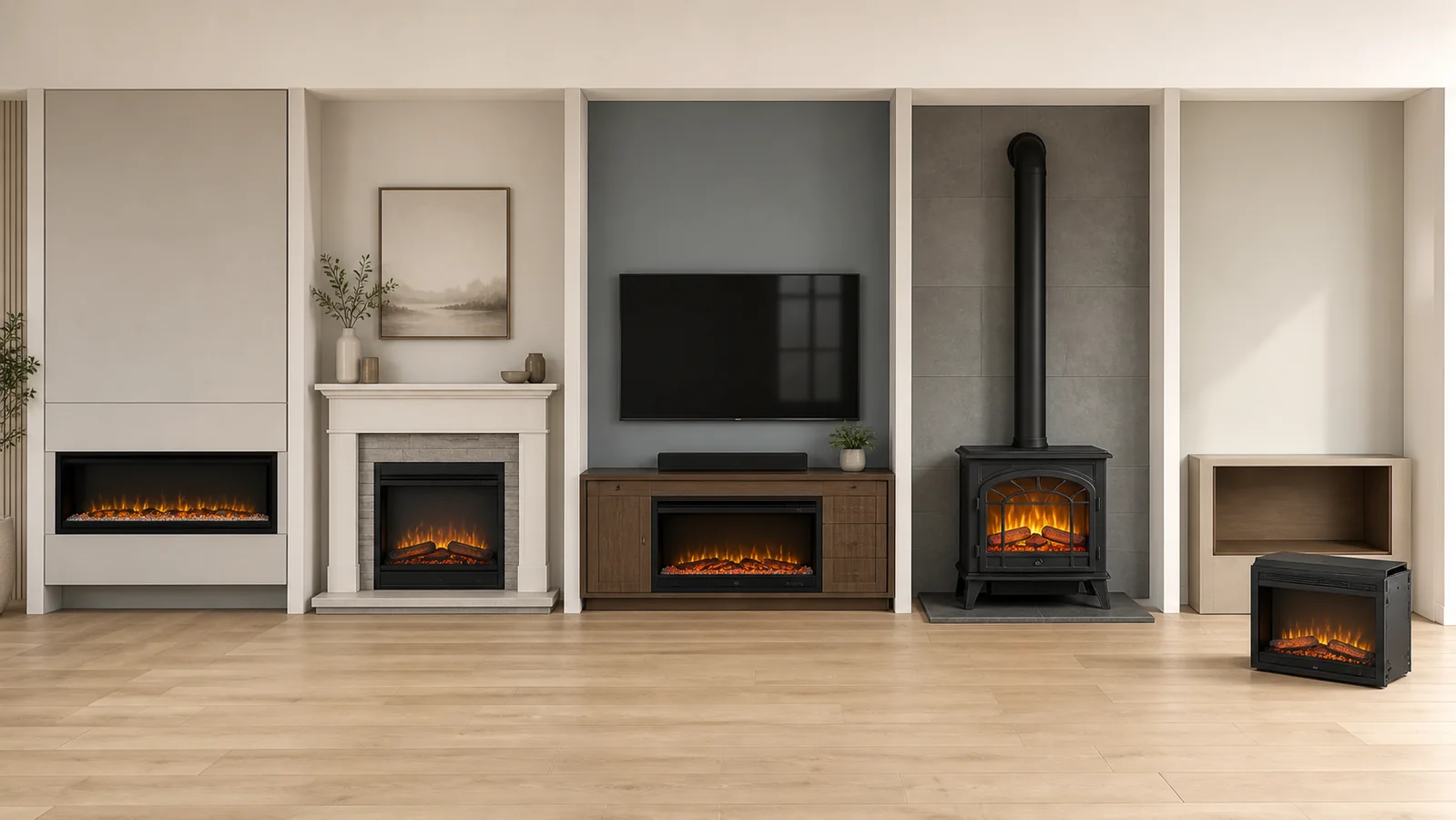
This is why our electric fireplace specification guide keeps function, dimensions, electrical facts and service access in separate fields. The word blower belongs in that record, but it cannot replace the rest of it.
Three manuals, three different control patterns
These current US examples are not a ranking or a complete market survey. They show why the exact manual has to travel with the model number.
| Exact model and source | Published output context | What the blower controls do | Important limitation |
|---|---|---|---|
| Dimplex XHD28L Manual 7216430100R05 |
120V, 1,465W, 5,000 BTU | Fan runs when heat is enabled; the element follows the thermostat. A below-room setpoint can run the fan without element heat. Two-minute run-on after heat-off. | No model-specific manufacturer dBA value located. Fan-only behavior uses the thermostat rather than a labeled fan button. |
| Napoleon Cineview 26 NEFB26H Manual W415-2945 D-0 |
120V, 1,465W in the manual; 5,000 BTU on the product page | FAN, thermostat, reduced-output ECO and timed 10/20/30-minute Boost. Boost uses full heat and a faster fan. Ten-second run-on. | No model-specific manufacturer dBA value located. The named modes cannot be applied to another Napoleon line. |
| Touchstone Fireplug 24 model 80070 Manual revision 20260302 |
120V, maximum 1,500W, 5,000 BTU | Low heat, high heat and Off. Fan moves cool air for ten seconds before heat starts and after heat stops. | Heater only works while the flame effect is on. No model-specific manufacturer dBA value located. |
The Dimplex XHD28L specification and R05 manual put the 1,465-watt and 5,000-BTU values beside a thermostat-linked control pattern. Heat and the flame display can operate independently, while a two-minute fan run-on is normal for that manual’s models. If you expect silence the moment you press Off, that operating detail may matter more than the word blower.
Napoleon’s current Cineview 26 page advertises ECO and Boost, but the operation manual supplies the useful distinction. FAN is a selectable state; ECO reduces output; Boost runs full heat with a faster fan for 10, 20 or 30 minutes. That is a different control proposition even though the manual’s 1,465-watt rating sits beside the same 5,000-BTU maximum shown for many 120-volt inserts.
Touchstone’s current Fireplug 80070 page identifies a coil-wire heater with blower. The March 2026 series manual then explains the sequence: cool-air pre-run, low heat, high heat and a 10-second cool-air run-on. It also says the flame effect must remain on for the heater to operate. A shopper who wants invisible heat with a dark display would therefore treat that relationship as a controlling field, not a minor preference.
The comparison does not establish a universal winner. It establishes three questions a retailer checkbox cannot answer: What state turns the fan on? What changes when you select another heat mode? What happens immediately before and after heat?
Sound is an unknown until a model source measures it
“Quiet,” “low noise” and a category-wide decibel range are weak evidence when they are not tied to the exact model, operating mode, distance and test method. None of the official sources used for the three examples above supplied a model-specific dBA value.
That does not prove the inserts are loud. It means this article cannot rank them for sound.
Run-on time is useful, but it is not a sound measurement. A two-minute fan cycle tells you that sound may continue after heat-off; it does not tell you its volume or tone. A faster Boost fan gives you another reason to ask about sound, but it does not predict how noticeable the mode will be beside a television or conversation.
If sound could disqualify a purchase, look for an acoustic value from the manufacturer that identifies the exact model and mode. If none exists, the decision remains conditional until you can hear the same model under the return or demonstration conditions available to you. A review can flag a recurring concern, but a comment about “my fireplace” cannot fill a missing model number, room, distance or fan state.
Watch for a second source of confusion: some products add electronic crackle audio. Touchstone’s Fireplug manual, for example, documents separate crackle-volume controls. A complaint about “noise” may describe that optional effect, the blower, cabinet vibration or airflow turbulence. Treat those as different causes instead of blending them into one quiet/noisy label.
The airflow path can fail before the heater does
An insert can fit across the front and still fail deeper in the opening. Record the body width, height and depth separately from trim dimensions and minimum opening dimensions. Then locate the air intake and warm-air outlet in the exact manual.
Do not let trim, a mantel lip, a hearth object or a cabinet panel cover a required vent. Do not assume that extra empty space behind the unit solves an obstructed front intake. The correct path depends on the model’s construction.
The Dimplex XHD28L illustrates why the manual belongs in the fit decision: its installation instructions call for air circulation below the unit and at least one-half inch behind it. That statement belongs to the covered XHD models; it is not a universal clearance for every electric insert. The Touchstone Fireplug 80070 instead publishes an 8-inch rough-opening depth for the 24-inch model. These values answer different questions and should not be substituted for each other.
Power and service access complete the eligibility check. A plug-in listing still needs a permitted, reachable receptacle and cord route. A hardwire option transfers work to the documented installation path and a qualified electrician; it does not automatically change heater output. Our plug-in-versus-hardwired guide separates those states before wall work begins.
Ask one practical service question before trim closes the opening: how does the exact blower/heater assembly become reachable if it needs inspection or replacement? If the answer requires removing the appliance or surround, the room plan has to preserve that route. A feature you cannot service without destroying finish work is not fully fitted.
Match the control pattern to the room
The useful control pattern depends on what you expect the insert to do.
| Intended use | Field that controls the decision | What keeps a candidate eligible |
|---|---|---|
| Supplemental warmth during normal room use | Exact voltage, watts/BTU, thermostat and heat levels | The documented output fits the intended supplemental job, and the thermostat behavior matches how you want heat to cycle |
| Short periods of faster air movement | Fan-only or Boost behavior and timer | A real named mode in the exact manual—not a generic claim that every blower has adjustable speed |
| Television, reading or conversation where sound matters | Model/mode-specific acoustic evidence plus run-on behavior | A comparable manufacturer value or a same-model demonstration/return path; otherwise sound stays conditional |
| Flame display without heat, or heat without the display | Heat/flame relationship | The manual explicitly permits the combination you want; do not infer it from a product photo |
| Built-in or existing-fireplace conversion | Opening geometry, intake/outlet, power path and service removal | Every physical and electrical field closes before fan features break a tie |
Maximum output is only one part of the supplemental-heat decision. Our guide to electric fireplace heat and running cost explains why watts, BTU and manufacturer area language still do not promise a room result. Insulation, ceiling height, outdoor conditions and the boundary of the space remain outside the blower badge.
Fan-only deserves equally careful wording. On the Cineview, FAN is a labeled state. On the XHD manual, the fan can run while the thermostat withholds element heat when the setpoint is below room temperature. Those may produce a similar immediate observation—moving air without active element heat—but they are not the same control design. Save the manufacturer’s words, because troubleshooting and expectations follow the actual control.
If you mainly want the flame display, confirm whether the fan stays off when heat is disabled. If you mainly want heat with no visible flame, confirm the reverse. Dimplex explicitly allows heat with its flame effect off in the reviewed manual; Touchstone explicitly requires its flame effect to be on before the heater will operate. A category page that says “flame works without heat” answers only half of that relationship.
A six-field record is enough to reject a weak listing
Before checkout, save one record for the exact model—not the retailer’s shortened family name.
- Exact model/SKU and current manual revision or retrieval date.
- Body and minimum-opening dimensions, intake/outlet location, trim effect and service-removal path.
- Permitted power connection, voltage, watts and BTU for the configuration you can actually use.
- Blower states: fan-only access, low/high heat, thermostat behavior, ECO/Boost and any selectable fan speed.
- Startup or run-on sequence, plus the documented relationship between heat and flame.
- Model-specific sound evidence. Write not published when the source supplies no comparable value.
The record can return a clean result. A candidate is eligible when fit, airflow, power and the needed control behavior are documented. It is conditional when a non-negotiable site or sound field still needs evidence. It should leave the shortlist when the listing and manual identify different models, a required mode is absent, airflow or service access fails, or a seller’s unsupported quiet claim is doing the work of a missing specification.
That last outcome is useful. An electric fireplace insert with a blower is not hard to find; the better purchase is the one whose exact manual explains what the blower will do in the room you actually have.