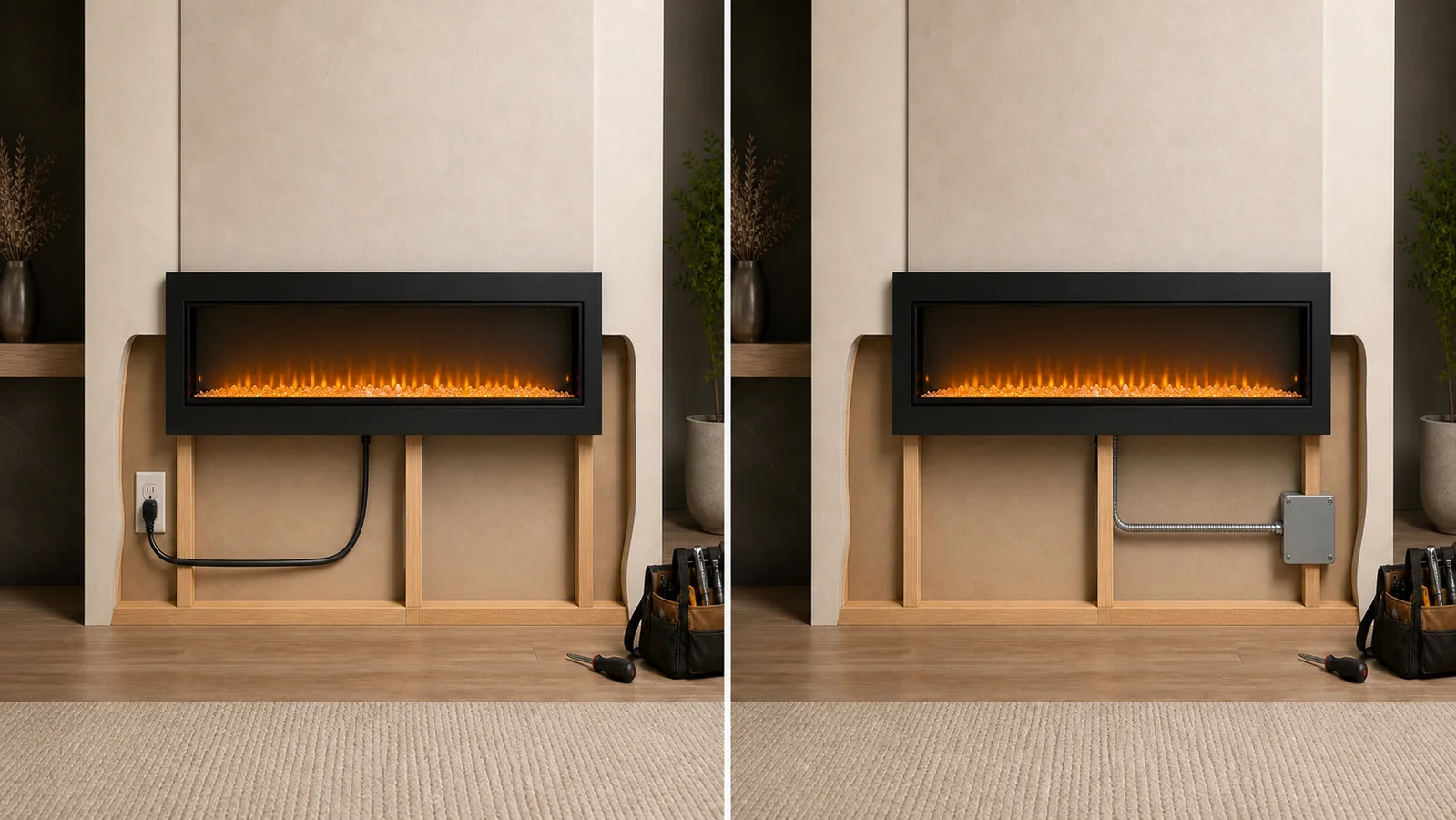
A hidden cable does not make an electric fireplace better, and a visible plug does not make one temporary or weak. The useful question is narrower: which power paths does the exact model permit, at what voltage, and what changes when you use each path?
The manual may describe a plug-only appliance, a hardwire-only built-in, a model that allows either connection at the same voltage, or a dual-voltage configuration with a different heater rating. Classify that state before you design the wall. If the current manual does not support the path you want, the product photo, retailer filter and an installer’s experience with a different model cannot fill the gap.
Classify the power path before choosing the wall
Use four states instead of a plug-in-versus-hardwire binary.
| Documented model state | What the source must show | What not to assume | Purchase response |
|---|---|---|---|
| Plug-in only | Supplied cord/plug, permitted receptacle and voltage | That the cord may be removed or concealed | Plan the approved receptacle and service route |
| Hardwire only | Hardwire instruction, voltage and required installer/service language | That an aftermarket plug kit exists | Put electrical scope and finish timing in the project plan |
| Same-voltage convertible | The manual permits plug and hardwire at the same published voltage | That hardwiring increases heater output | Choose by outlet visibility, service and project constraints |
| Voltage-dependent configuration | Distinct permitted voltage/connection modes and ratings | That every hardwired fireplace has the higher rating | Compare only the mode the site and electrician can support |
Touchstone’s current Fireplug PRO manual is an example of the third state. It allows the named series to use a grounded three-prong outlet or be hardwired, and it assigns hardwiring to a qualified electrician. That is evidence for that manual’s models—not permission to convert another fireplace.
Napoleon’s Allure series page also lists plug or hardwire operation at 120 volts and 1,500 watts. In that named line, hiding the connection does not create a higher published heater rating. Dimplex’s catalogue shows why a category filter is not enough: its model families include plug-in products, hardwired products and entries with optional 120-volt plug kits. “Optional” belongs in the record as a kit number and current availability, not as a plan to improvise a cord.
This is the same discipline used in our electric fireplace specification guide: copy an exact field from the current model source, preserve its scope and leave a missing field unknown.
Voltage—not the hidden cord—can change heater output
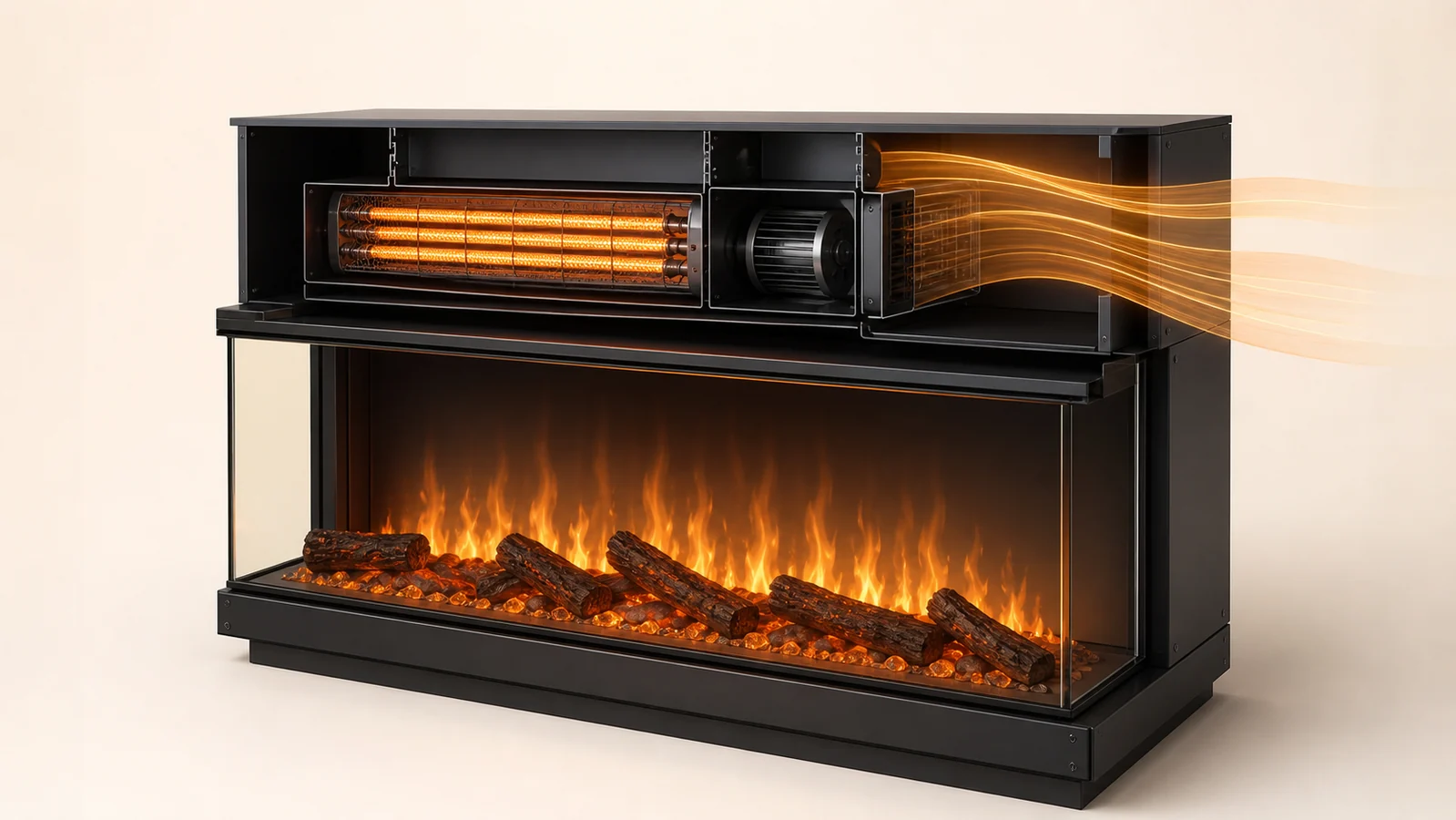
The strongest reason to read both the voltage and connection lines is Napoleon’s Element 42. Its current product page publishes 1,450 watts and 5,000 BTU for the 120-volt plug configuration, then 2,800 watts and 9,000 BTU for the 240-volt hardwired configuration. Those numbers belong only to Element 42.
The useful lesson is not “hardwire is hotter.” It is that a documented change in voltage and configuration can change the published heater rating. Allure supplies the counterexample: plug and hardwire are both presented at the same 120-volt, 1,500-watt rating. Two fireplaces can therefore share the word “hardwired” while having different electrical and heating consequences.
Record voltage, watts and BTU per permitted mode in separate cells. Do not combine the 120-volt convenience from one configuration with the 240-volt heat rating from another. If a product page highlights the larger number but the manual limits that mode to a connection your project cannot support, the larger number is not an available benefit.
Heat output still does not prove that a room will reach a target temperature. Insulation, ceiling height, outdoor conditions and the role of the primary heating system remain separate. This page only determines which manufacturer rating belongs to the power path you can actually use.
A plug-in fireplace still needs a planned receptacle
“Plug-in” removes some project work; it does not remove the room from the decision. Locate the permitted receptacle before approving the fireplace position. Copy the cord exit and length if published, plug orientation, direct-connection language and any access instruction from the exact manual. Then compare those facts with the wall, trim, cabinet and service route.
The Fireplug PRO manual says not to use a surge protector, extension cord or power tap for that series. A layout that only works after adding one of those devices is therefore not a plug-in solution for that product. It is a failed location or a reason to select a different documented configuration.
A renter may prefer a supplied plug because it avoids a permanent electrical change, but the lease does not override the product manual or building rules. A homeowner may prefer the same path because the appliance is easier to remove for service. Neither case proves that the receptacle can be hidden wherever a rendering looks clean. The exact product and site conditions still decide where the connection can be located and accessed.
Treat the plug, receptacle and cord route as part of the fireplace footprint. If furniture pinches the cord, the route crosses a walking path, the plug cannot reach without an unapproved extension, or the receptacle conflicts with the manual’s placement, stop trying to rescue the model with accessories.
Hardwiring changes the project handoff
Hardwiring can remove a visible cord and can support a manufacturer-documented voltage configuration, but it also transfers work into the electrical project. The Touchstone and Napoleon Element manuals assign hardwire work to qualified service or an electrician and require applicable codes to be followed. That is where this article stops: it does not choose a breaker, conductor, junction box, circuit route or conversion method.
Resolve the handoff before the wall is finished. Give the electrician the exact model/SKU and current manual—not a retailer title—and ask whether the documented voltage, circuit and connection mode can be supported at the intended location. If a separate plug kit or conversion part is required, confirm the exact part against the same model rather than assuming that a similarly named series uses it.
The mounting decision and the power decision meet at service access. A recessed or partially recessed fireplace may need to be removed differently from a surface-mounted unit, while a hardwired connection changes what must be disconnected during that service. Our recessed-versus-wall-mounted guide owns the geometry choice; the manual and electrician must close the electrical side for the exact installation.
Hardwire also belongs in the project schedule. If the desired path is discovered after framing, finish material or cabinetry closes the work area, a visually small specification can become demolition and rework. Conversely, choosing hardwire only for a clean photograph may add cost without changing voltage, output or the reader’s actual use case. Appearance is a tie-breaker after eligibility, not proof of value.
Pause the purchase or installation decision when the manual is missing, the model number on the listing and manual do not match, the product page and manual conflict, the desired voltage is not documented, or a conversion is proposed but not authorized. Those gaps need the manufacturer and a qualified electrician; they are not writing prompts for a DIY workaround.
Freeze one model in a power-path record
Create one row per candidate. Keep copied product facts separate from site conditions so an electrician’s site finding does not get rewritten as a manufacturer promise.
Record the exact model/SKU and manual revision or retrieval date; every permitted connection mode; voltage, watts and BTU for each mode; supplied cord and plug; optional kit number and current availability; circuit/dedicated-circuit wording; cord exit and receptacle constraints; service/removal route; required installer or conversion authority; intended mounting method; and the date by which the power path must be ready for framing or finish work. Mark each field documented, site condition or unknown.
The row can return four useful outcomes. A plug path is eligible when the model permits it and the room has a compliant receptacle and cord/service route. A hardwire path is eligible when the model permits it and the electrician accepts the exact site plan. Both paths are eligible when both survive, allowing appearance, serviceability, rental limits and cost to decide. The candidate is blocked when a controlling permission, voltage, circuit, kit or installer field remains unknown.
There is no category-level winner. If neither documented power path fits, step back to the types of electric fireplaces and change the model or installation relationship before the wall turns an unresolved field into an expensive commitment.