“Electric fireplace logs” looks like one product category. It is not always one product. A search shelf can place a self-contained electric log-set appliance beside an enclosed electric insert and a box of replacement or upgrade logs. Those objects can all show artificial timber, yet only one may include the ember bed, flame system, controls, power connection and heater the shopper expects.
Start with the exact model number and the owner manual, not the photograph. Confirm that the listing is a complete appliance. Then pair its physical dimensions with the opening dimensions or placement conditions stated by its owner, record the electrical route, and verify whether heat and flame-only operation are present on that exact model. If the class or one controlling field is missing, hold the purchase.
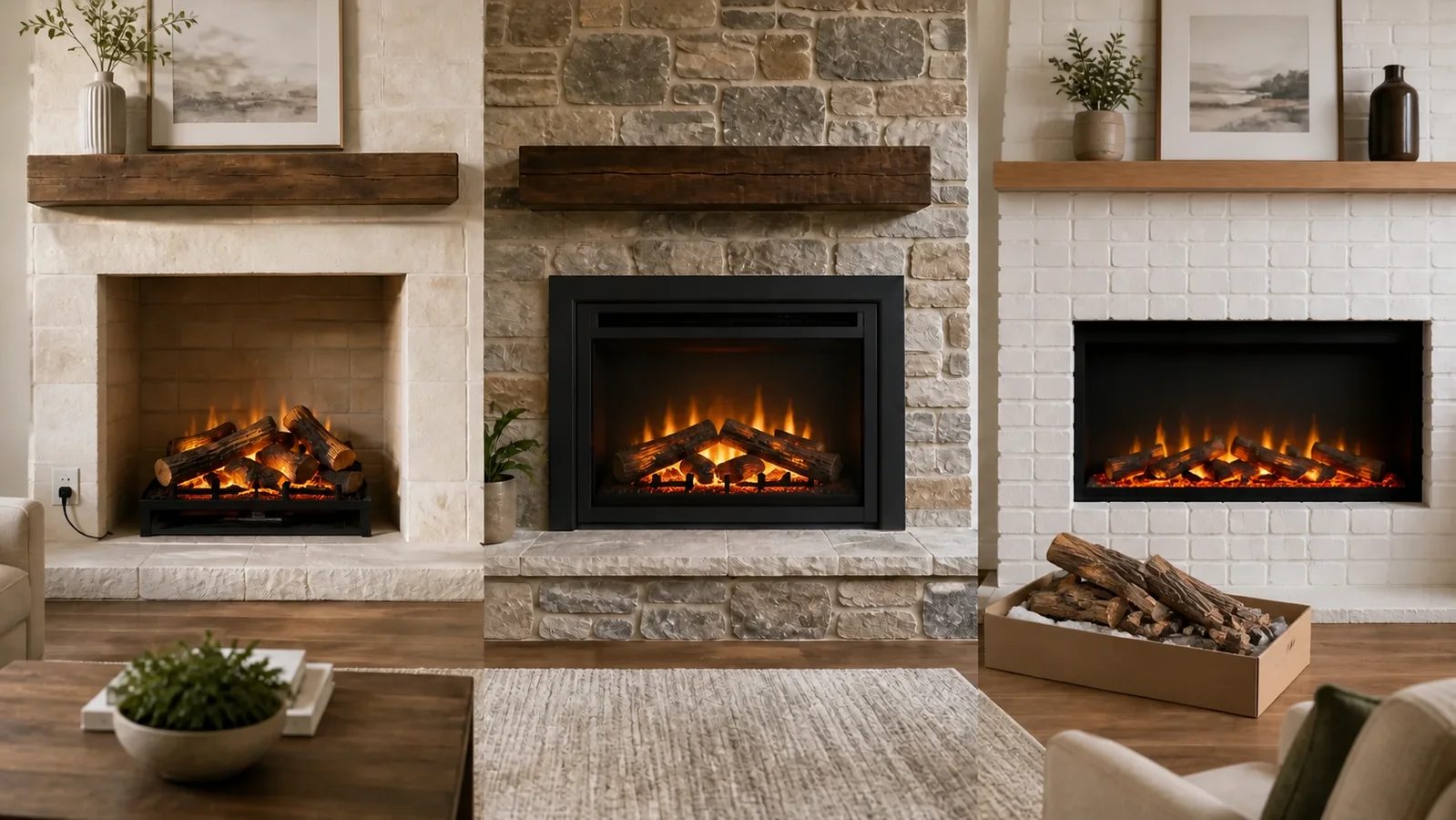
The search shelf can contain three different purchases
The first decision is not flame color. It is what the seller is shipping.
| Listing class | What should be in the box | How it uses the old opening | Evidence required | Typical wrong assumption |
|---|---|---|---|---|
| Self-contained electric log-set appliance | Logs, ember/flame mechanism, controls, power connection and any advertised heater in one model | Sits inside the opening and normally leaves the existing firebox visible as the visual background | Exact model, owner manual, appliance dimensions, placement/opening guidance and electrical fields | Every object called a log set includes heat or fits by nominal width |
| Complete enclosed electric insert | Firebox cabinet, viewing front and the components required by that model; trim may be included or separate | Occupies and visually closes more of the opening | Firebox dimensions, required cavity, trim coverage, ventilation/service and supply requirements | It is interchangeable with an open log set because both show logs |
| Replacement or upgrade log kit | Decorative logs or fuel-bed pieces intended for named compatible fireplaces | Does not create a working fireplace by itself | Compatible product family and installation instructions | A realistic product photo means the flame engine and heater are included |
This distinction is visible in current shopping results. Home Depot’s electric-log category lists complete appliances such as the Dimplex RLG20, but it also lists an ash-mat kit and a birch-log accessory for other Revillusion products. Modern Flames describes TruWood as an upgrade kit for compatible Modern Flames fireplaces. An accessory can be a legitimate purchase; it is simply the wrong first purchase when the opening has no electric appliance.
If the listing avoids an exact model number, never shows controls or electrical specifications, or speaks only about compatibility, do not fill in the missing appliance from the staged photo. Keep the product ineligible until the manufacturer identifies what the kit works with.
The site’s broader guide to types of electric fireplaces is the place to step back if an open log set is not actually the format you want.
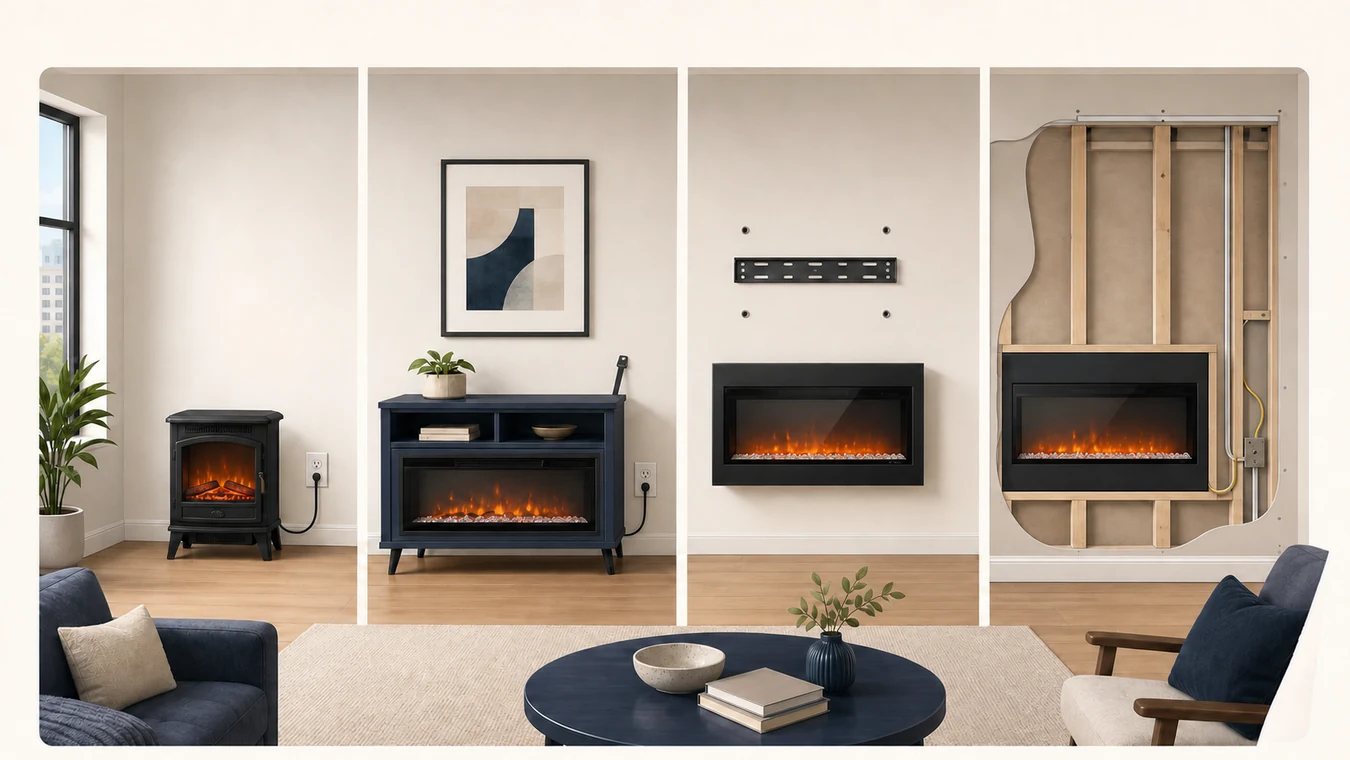
Measure the opening the appliance actually uses
A nominal “20-inch” or “27-inch” label is not an opening contract. It may describe a product family or approximate width, while height and depth still control placement. The back of a masonry firebox can also be narrower than its face, and a raised grate, projecting gas hardware or sloped firebrick can reduce the usable envelope.
The Dimplex RLG20 manual makes the difference concrete. It lists the appliance at 23.7 inches wide, 19.0 inches high and 12.5 inches deep. For optimal viewing, that same manual recommends an opening at least 24 inches wide, 22 inches high and 14 inches deep. Copying only “20-inch log set” from a product title would miss every controlling figure.
Napoleon’s Woodland NEFI27H product page is another exact-model example: the manufacturer lists it at 27 inches wide, 15.5 inches high and 14 inches deep. Those dimensions belong only to that model. They do not prove the next 27-inch listing has the same base, rear projection, air path or cord exit.
Create one opening record at the intended resting position:
- narrowest usable width, not just the front face;
- usable height after any fixed obstruction;
- flat usable depth from the final front position to the back limit;
- hearth or firebox-floor condition and level support;
- outlet location and a cord route that follows the exact manual; and
- any owner-stated viewing space, airflow, service or access condition.
Then place the product envelope and the owner-stated opening requirement beside that record. Do not silently turn appliance dimensions into minimum clearances. When a manual gives both, keep both. When it gives only appliance size, the missing placement condition remains unverified.
If the project has shifted toward a firebox with a finished front or surround, use the site’s electric fireplace insert size guide instead of stretching this open-log-set method into a different product class.
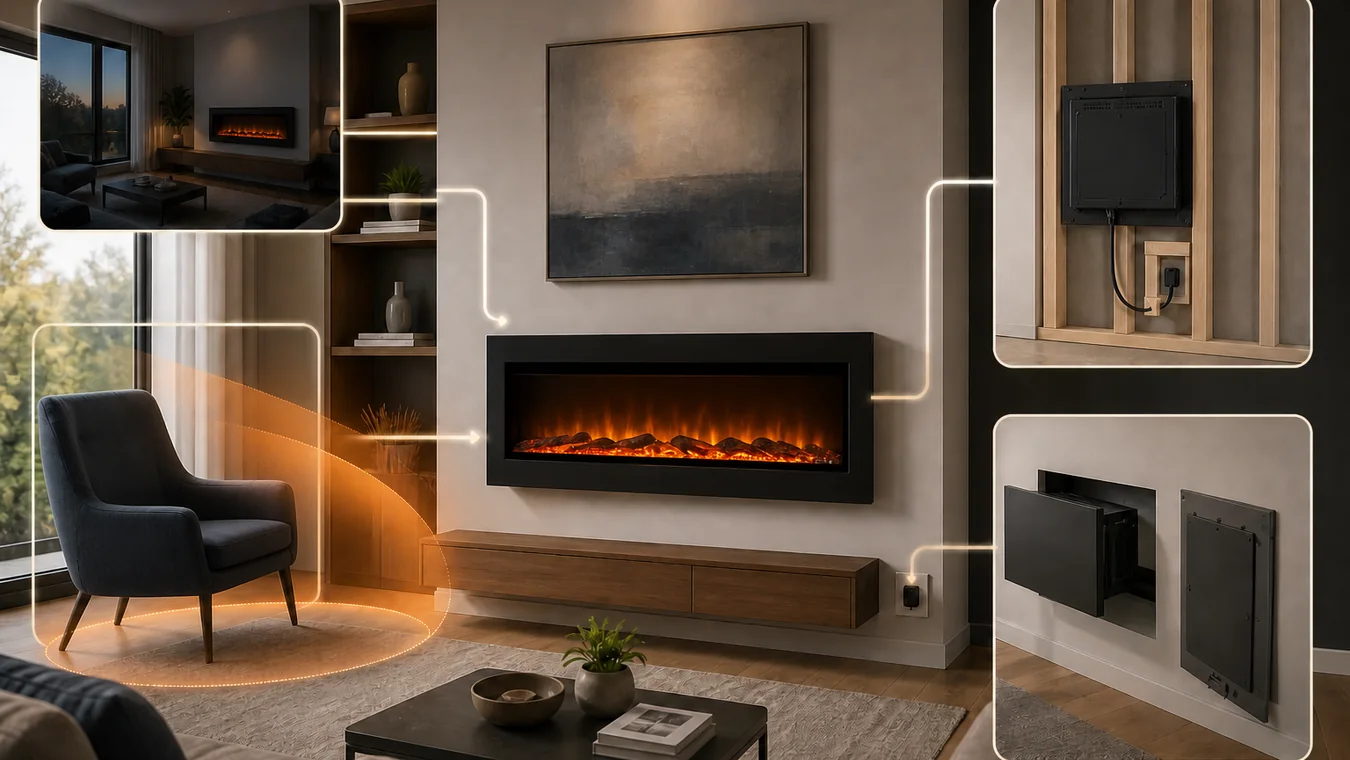
Close the electrical route before calling it plug-in
“Plug-in” describes one connection method; it does not prove that the planned outlet and circuit are ready for every log set. Read the electrical block in the exact owner manual before treating placement as settled.
For the Dimplex RLG20, the manual lists 120 volts, 12.5 amps, 1,500 watts and plug-in wiring. It states that a 15-amp, 120-volt circuit is required. A dedicated circuit is preferred but not essential in every case, and the manual says one is required if the breaker trips or fuse blows regularly with the heater operating because other loads may exceed the circuit rating. That conditional language is more useful than a universal “standard outlet” shortcut.
Napoleon’s current NEFI24H/NEFI27H manual lists 120 volts AC, up to 1,500 watts and a 15-amp grounded circuit for those two models. The NEFI27H product page says that model can be plugged into a 120-volt outlet or hardwired. That does not authorize a shopper to hardwire a different product, reuse old fireplace wiring or choose an installation method without the exact instructions and applicable electrical responsibility.
Record voltage, amps, watts and the published connection method as separate fields. Also record where the receptacle is, whether it remains accessible as required, and what other loads are on the circuit. If the route depends on a temporary extension, a hidden splice or an assumption about dormant gas-fireplace wiring, the purchasing record is not closed.
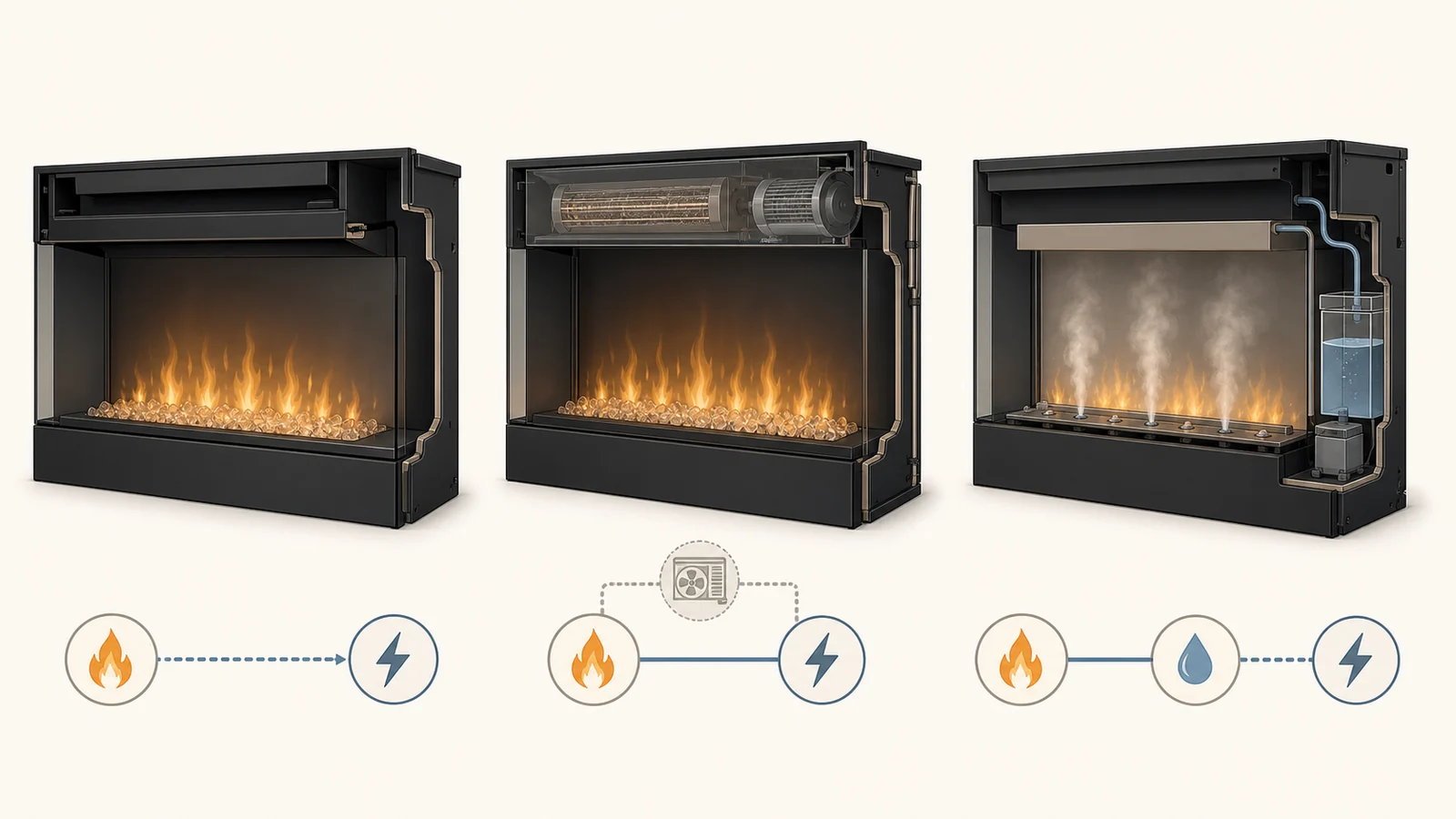
Heat is a model mode, not a category promise
The word “logs” does not answer whether the object heats. A decorative upgrade kit has no independent heater because it is not the appliance. A self-contained log set may include a heater, but its output, controls and ability to run the visual effect without heat belong to its exact model. An enclosed insert may offer a different supply and heat range again.
Napoleon publishes up to 5,000 BTU and 1,500 watts for the NEFI27H, together with adjustable heat controls. Dimplex publishes a 1,500-watt electrical input for the RLG20. These are useful model facts, not a category-wide room result. Room temperature change still depends on heat loss, layout, starting temperature, run time and how the product cycles. A retailer’s square-foot label should not choose the product class or become a guarantee for your room.
Write four separate entries on the product record: visual effect without heat, low/high or thermostatic heater modes, owner-published maximum input/output, and the exact discharge/air path shown by the manual. If the seller says “year-round ambiance” but the manual does not make control behavior clear, keep flame-only operation unverified until the owner documentation resolves it.
This also prevents a cheap accessory from appearing to beat a complete appliance on price. The accessory may have no power supply, controls or heater because those functions already belong to the compatible fireplace.
Decide what should happen to the old firebox
An open electric log set uses the existing firebox as scenery. Soot-stained brick, an uneven hearth, a bright receptacle or abandoned hardware may remain visible around it. That can look convincingly traditional in one opening and unfinished in another. The decision is architectural as much as electrical.
The Dimplex RLG20 manual, for example, says not to install that model in an existing opening prone to dampness. It also gives model-specific directions for sealing drafts and vents with non-fibrous insulation so chimney debris does not fall onto the unit. Treat those as RLG20 instructions, not as permission to seal every chimney or alter a former gas system. Unresolved moisture, venting, gas components or structural conditions belong with the relevant qualified professional before an electric appliance is placed.
Choose the desired finished result before chasing realism:
- Keep the open log-set path when the existing firebox is sound, its interior is part of the look, and an exact model closes the physical and electrical record.
- Change to a complete insert when you want a framed viewing front, trim coverage or a product that visually replaces more of the old opening.
- Return to broader existing-fireplace insert choices when dormant fuel, depth, surround coverage or project scope makes the class uncertain.
Neither branch is inherently better. They finish the opening differently.
Finish with one exact-model proof card
Do not leave the decision spread across browser tabs. Put one listing into a record with these fields:
- Identity
- Manufacturer, exact model, seller URL and current owner-manual URL.
- Product class
- Complete log-set appliance, enclosed insert, or compatible accessory. Record what functional components are actually included.
- Opening pair
- Your narrowest usable width, height and depth beside the product dimensions and every separate owner-stated opening or placement condition.
- Electrical route
- Voltage, amps, watts, plug-in or hardwire wording, receptacle location, circuit evidence and unresolved old-system work.
- Operating modes
- Flame-only behavior, heater modes, controls and owner-published output—without converting a room-size claim into a guarantee.
- Existing-firebox condition
- Support surface, moisture, debris route, dormant fuel/vent components and the part of the opening that will remain visible.
- Compatibility
- For any replacement logs, the exact supported fireplace family and the owner’s installation document.
Return PROCEED only when the listing is the complete class you intend to buy and each controlling field passes for one exact model. Return CHANGE CLASS when the object is merely an accessory or when the desired finished opening requires an enclosed insert. Return HOLD when identity, opening, electrical route, operating mode or compatibility is missing. A missing field is cheaper to resolve before checkout than after a convincing box of logs arrives without the appliance you thought was inside.