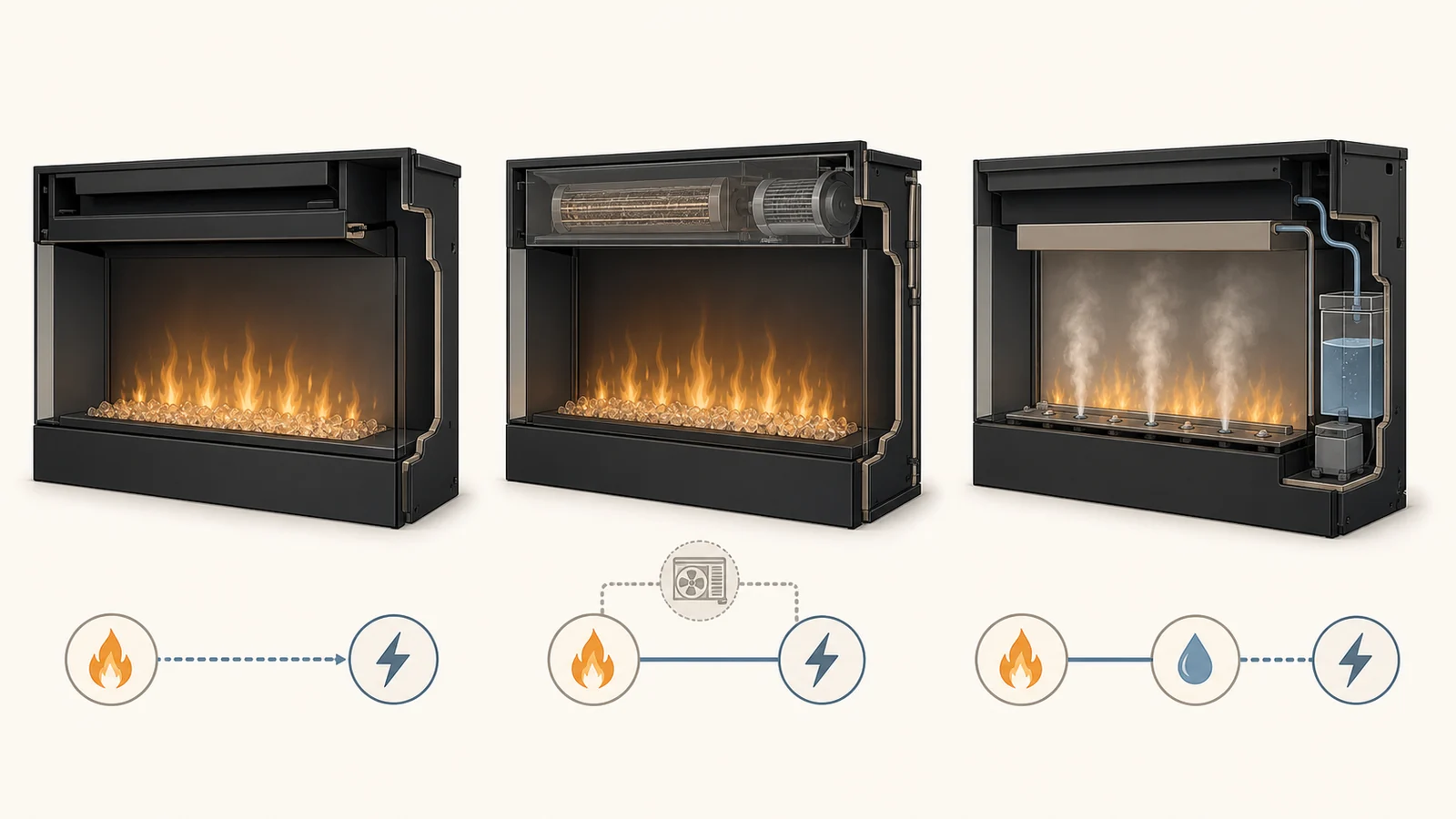
Sometimes—but “gas” tells you the fuel, not the power path. A gas fireplace may use household electricity for ignition or valve control, a blower, accent lights, a remote receiver, thermostat logic or connected features. A manufacturer-approved battery backup may keep the burner and a basic control path available while several of those other functions stop.
The reliable answer therefore belongs to your exact model and its current owner manual. Find the model and serial information, locate the manual’s power-outage section, and record each function separately. If the manual is silent or the approved backup arrangement is missing, do not assume that another fireplace’s standing-pilot, millivolt or battery behavior applies to yours—and do not improvise a manual-lighting method.
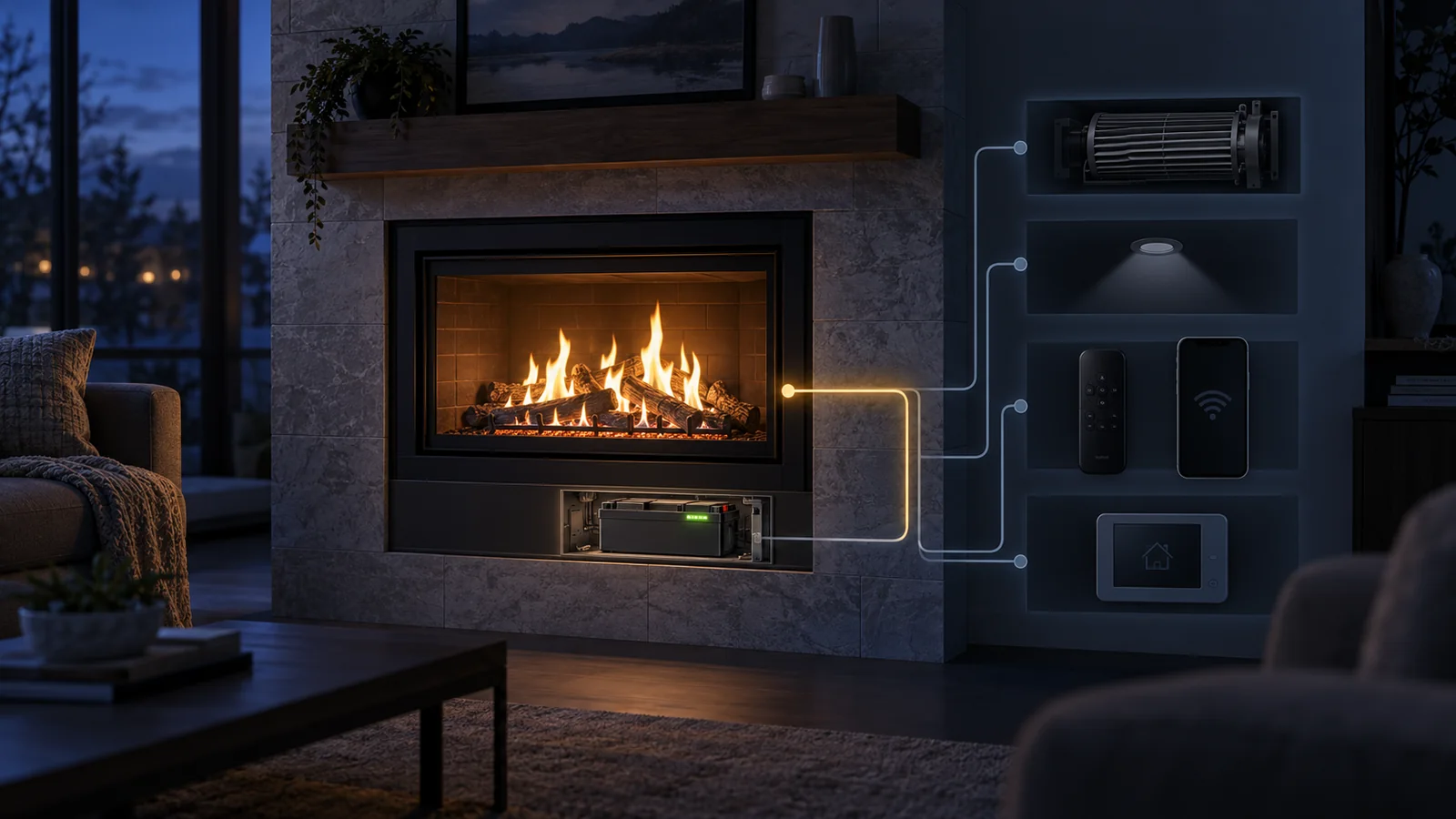
“Works” has to be split into separate functions
The useful question is not simply whether a flame appears. It is which functions remain available, by what documented power source, and with what limitations. Use one row per function so a single “yes” cannot conceal five unknowns.
| Function | Evidence to find | Result to record | What not to infer |
|---|---|---|---|
| Burner and basic on/off control | A section explicitly covering operation during a power outage | Documented available, documented unavailable or unknown | Gas at the house does not prove the appliance can ignite or control its valve |
| Backup supply | The manufacturer-specified battery pack, holder or other approved arrangement and its intended use | Backup required and identified, not required by this manual, or unknown | Batteries in a handheld remote do not prove the appliance has backup power |
| Blower or fan | The outage section or electrical notes naming fan behavior | Available, unavailable, not fitted or unknown | A working burner does not prove forced air will circulate |
| Accent lights and auxiliary features | An exact statement about lights, media lighting, flame adjustment or other accessories | Available, unavailable, not fitted or unknown | An illuminated flame does not prove every visual feature is powered |
| Remote, wall control, thermostat and app | Which control can issue a command in backup mode and which functions it can change | Basic control documented, limited control, unavailable or unknown | A live remote screen or phone battery does not prove the receiver or home network is working |
| Heat role | The manual’s listed use and any supplemental-versus-primary-heat statement | Supplemental comfort only, a different documented role, or unknown | Outage operation does not establish whole-home backup heat |
Do not upgrade “unknown” to “probably.” The model name, document revision and relevant manual section are part of every completed row. That discipline matters because two fireplaces sold in the same category can distribute power differently.
The matrix is also useful before purchase. Ask a dealer to complete it for the exact configuration being quoted. If a fan, light kit, remote or control package is optional, have the answer reflect the actual configuration rather than the best-equipped marketing image.
Identify the appliance before the lights go out
The fastest reliable route begins at the rating plate, not at the shape of the firebox or the logo on a remote. Record the full model, any suffix, serial number and market if shown. Then obtain the current owner manual for that identity. A family brochure or a manual for a similar-looking unit is not a substitute.
Heat & Glo’s current owner resource treats battery-backup operation, basic operation and rating-plate/manual retrieval as separate topics. It directs owners to find the exact model and serial information before choosing a manual. That sequence is the important part: identify first, then read the operating contract that belongs to the installed appliance.
In the manual, search for “power outage,” “battery backup,” “electrical,” “fan” and the name of the control system. Record the document number and revision date with the answer. If the manual describes more than one control option, identify which option is actually installed. A section that begins “if equipped” cannot be converted into a feature claim without that confirmation.
If no current manual can be matched, send the manufacturer or authorized dealer the model and serial information and ask one narrow question: which current document controls outage operation for this exact appliance and configuration? That is a useful hold. It is safer—and faster—than interpreting a pilot flame, receiver box or battery tray from appearance.
Two current manuals show why “battery backup” is not enough
Current first-party documents provide a useful contrast, but only inside their named scopes.
| Manual example | What the document supports | What is lost or limited | Proper conclusion |
|---|---|---|---|
| Heat & Glo 6KX/8KX, Rev. L, 3/26, IntelliFire Touch | A battery-backup system enables operation during a power outage | Fan, lights and other auxiliary functions that require household 110–120V power; battery backup is for emergency outage use | These named models have documented limited operation; do not transfer the result to another model |
| Regency U1500E-11 | The manual distinguishes the burner from the 120V blower supply and requires its specified backup batteries for outage operation | The fan will not operate during the outage | “Fireplace operates” and “blower operates” are different answers on one model |
The current Heat & Glo 6KX/8KX owner manual is unusually clear about the split. Its IntelliFire Touch section documents backup operation, then names fan, lights and other household-AC auxiliary functions as unavailable. It also says the batteries are for an emergency outage rather than a primary long-term power source. Nothing in that example establishes runtime for a battery set or an identical arrangement on a different line.
Regency’s current U1500E-11 manual reaches a similar purchase consequence through model-specific wording: it separates the burner’s need for 120V from the blower’s and states that the fan will not operate during an outage. The manual also makes the backup batteries a condition of outage operation. That is not permission to add batteries to an unnamed unit; it is proof that the backup arrangement belongs in the exact-model record.
These examples answer the broad search question without creating a broad rule: some gas fireplaces have a manufacturer-documented outage path, and some lose meaningful powered functions while using it. Your model still needs its own row.
A live remote is not proof that every control still works
A handheld remote may have its own batteries. That proves only that the handset can power itself. The appliance can still depend on a receiver, ignition/control module, wall control or household network, and backup mode may accept fewer commands than normal operation.
Separate the control chain into three fields:
- Command source: wall switch, remote, appliance switch, thermostat or app.
- Appliance-side receiver/control: the component the manual says can accept the command during an outage.
- Allowed functions: basic on/off, flame adjustment, thermostat mode, blower, lighting or connected control.
Heat & Glo’s owner resources list basic fireplace operation and IntelliFire app, wireless wall switch and touchscreen-remote controls as distinct systems. Its 6KX/8KX manual then limits how certain remote functions should be used on backup power. The lesson is not that every remote behaves that way. It is that a control surface and the functions behind it need separate evidence.
The same applies to an app. A charged phone does not preserve a home router, Wi-Fi bridge or appliance module. Unless the exact manual explicitly documents connected control during an outage, mark it unknown or unavailable. Basic burner operation can still be valuable even when automation disappears, but the purchase claim should say so plainly.
No blower changes what “heat” means
An operating burner can still produce heat when a model’s blower is unavailable, but that does not guarantee the same room-air movement or the same comfort you experience under household power. The exact appliance design, installation and room conditions matter. Without field evidence, do not publish a percentage loss, room-size promise or battery-runtime estimate.
This distinction becomes important if outage resilience is deciding a purchase. Define the job before treating a flame as success:
- Visible flame and some local comfort: limited burner operation may satisfy the goal if the exact manual supports it.
- Normal fan-assisted room circulation: a manual that disables the fan has not satisfied this goal.
- Automatic thermostat or remote management: it remains unproven until the backup-mode control path is documented.
- Primary or whole-home heat: do not infer it from outage operation. The current Heat & Glo 6KX/8KX manual, for example, says those covered models are not intended as a primary heat source.
If you are still choosing fuel, put this function record beside the gas versus electric fireplace decision. That comparison owns infrastructure, heat role, local operating rates, maintenance and combustion-safety obligations. For the electric side of the heat question, the electric fireplace heat guide explains why nameplate output and room heat loss remain separate from a simple “does it heat?” claim.
Make the outage claim part of the purchase record
Do not settle for “battery backup included” on a quote or product page. Ask for a completed record tied to the exact unit:
Gas-fireplace outage card
Manufacturer and exact model: ______
Serial/market or quoted configuration: ______
Current owner manual, document number and revision: ______
Ignition/control system exactly as named: ______
Manufacturer-approved backup supply and location: ______
Burner/basic on-off during outage: documented available / unavailable / unknown
Blower: available / unavailable / not fitted / unknown
Lights and auxiliary functions: available / unavailable / not fitted / unknown
Wall control, remote and thermostat functions: ______
App/Wi-Fi functions: available / unavailable / not fitted / unknown
Manual’s heat-role limitation: ______
Manual section or manufacturer/dealer confirmation: ______
For a unit already in the house, keep that card with the manual where it can be reached without opening the fireplace. Follow only the manufacturer’s owner-access instructions. If you smell gas, see damage or cannot match the appliance to a current document, stop trying to establish outage behavior and use the manufacturer, dealer, gas supplier or emergency path appropriate to the condition.
For a purchase, make the dealer’s answer describe the quoted controls and options. If the advertised backup covers ignition but not the blower or connected thermostat you care about, the fireplace may still be a good fit—just not for the job implied by a blanket “works without electricity” claim.
That evidence can change a broader project. The electric-to-gas replacement guide owns the separate appliance, fuel, vent, framing, power and qualified-owner scope. If the outage limitation changes the direction of the project, the gas-to-electric conversion guide owns removal and post-removal electric-format decisions. And if you return to electric, compare electric fireplace types by wall, opening or floor before you compare brands.
The completed outage card is the answer. Either the exact manual documents the burner, backup and lost-feature states you need, or it names the unresolved question that prevents you from relying on the fireplace.