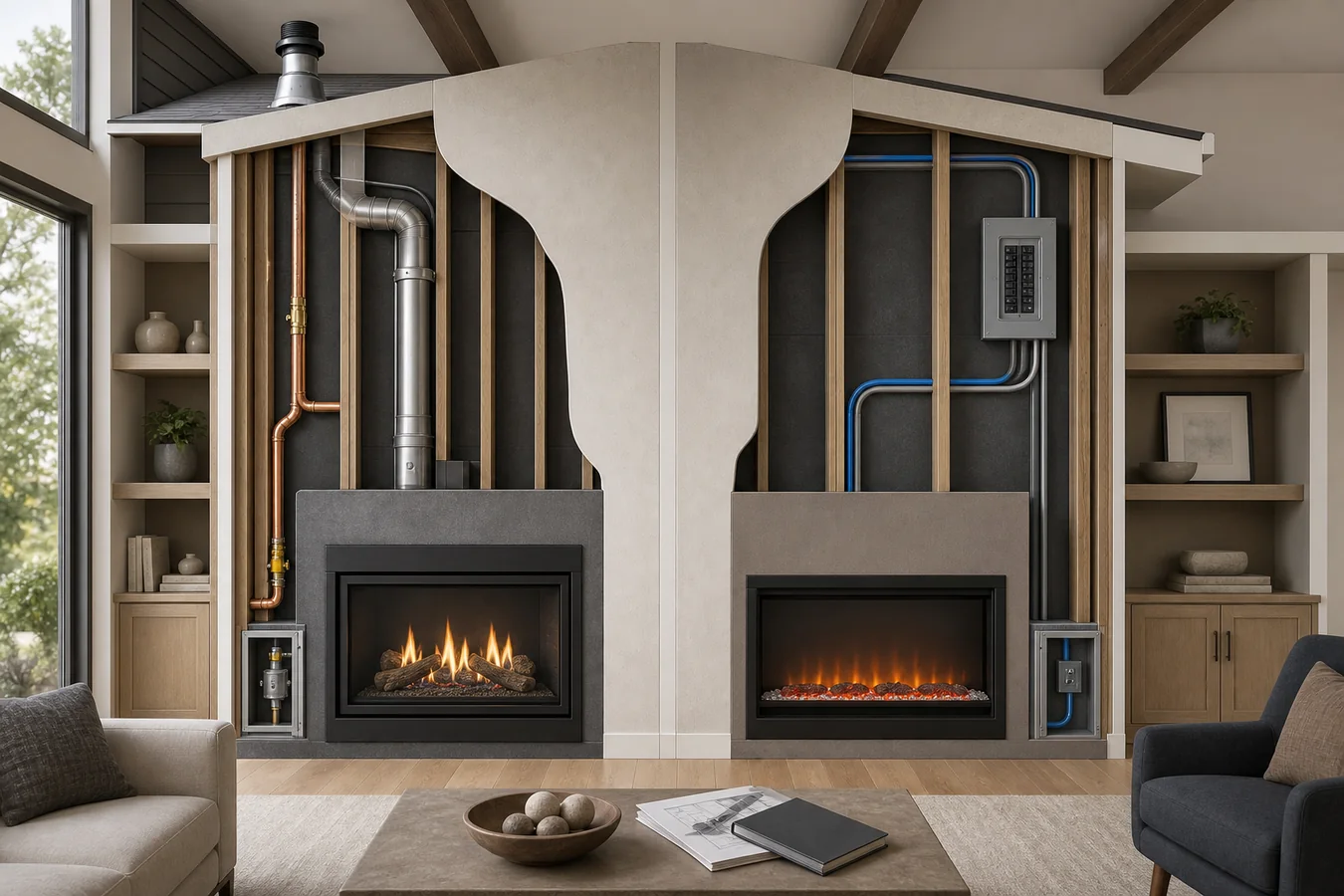
Do not begin a gas vs electric fireplace decision with flame photos. Begin with the wall. A usable gas path needs the right fuel, an allowed appliance and venting arrangement, and people authorized to install and service it. A usable electric path needs the exact model’s voltage and connection method, a suitable circuit, and a wall or opening that preserves airflow and access.
If the house supports both, the choice becomes clearer: gas belongs on the shortlist when a real combustion flame and a higher exact-model heat output justify the added fuel, venting and service responsibilities. Electric belongs on the shortlist when the priority is no onsite combustion, flexible visual operation and a project that fits the documented electrical path. Neither fuel wins on operating cost until you compare two exact inputs with your own rates.
Three house facts can end the comparison early
The first comparison is not gas against electric. It is each project against the house you have.
| House fact | Gas path | Electric path | What closes the field |
|---|---|---|---|
| Permission to alter the property | Gas line, vent and firebox work may require owner, association, permit and licensed-trade approval | A plug-in unit may be reversible; a new circuit, hardwiring or framed recess is still an alteration | Written property authority plus local permit/trade scope |
| Fuel and exhaust route | Natural gas or propane supply and the exact appliance’s approved venting/combustion arrangement must be feasible | No combustion vent is needed, but the model’s air path and electrical route still need space | Site review against the exact installation manual |
| Electrical capacity | Ignition, blower, lights or controls may still require electricity even though the burner uses gas | Voltage, amperage, plug/hardwire method and circuit instructions belong to the exact configuration | Current manual, panel/circuit review and responsible electrical authority |
| Intended heat job | Gas models can offer substantially higher outputs, but the exact model and room load decide usefulness | Many electric fireplaces are supplemental resistance heaters; some are decorative or offer higher-voltage configurations | Documented output/input plus a realistic room heat requirement |
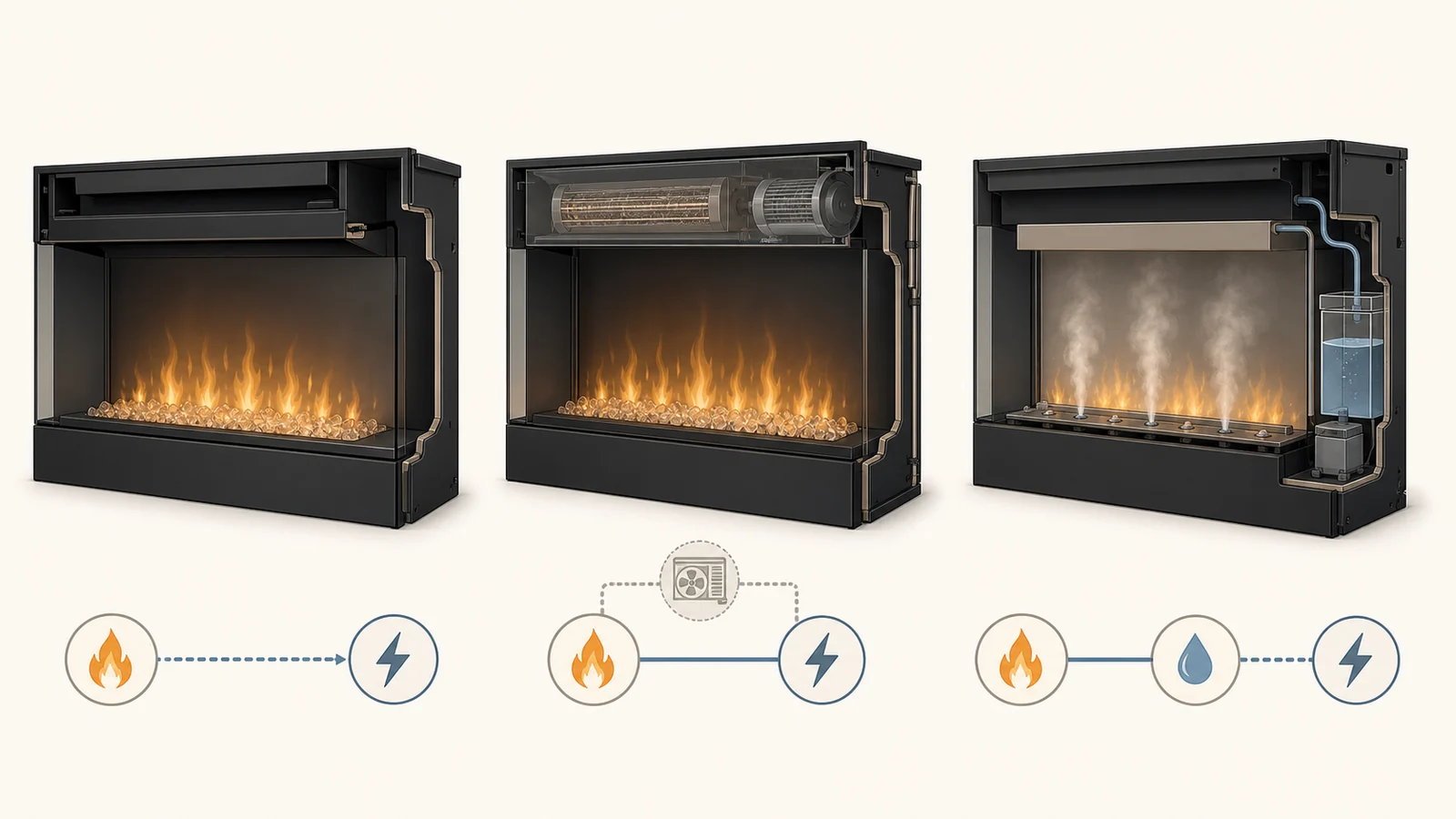
| Flame without heat | A real gas flame necessarily burns fuel and produces heat and combustion products | Many electric models can show a flame effect without the heater, but control combinations vary | Exact operation table |
| Routine ownership | Fuel system, glass, vent/combustion path and professional service remain part of ownership | Air inlets/outlets, media, controls and electrical condition remain part of ownership | Owner’s manual and a service-access route |
No gas service does not automatically prohibit propane, and no chimney does not automatically prohibit every gas fireplace. It does mean the gas option has acquired a fuel-storage or vent-design project that must be priced and approved. Vent-free is not a magic blank row; appliance listing, room conditions and local rules still control it.
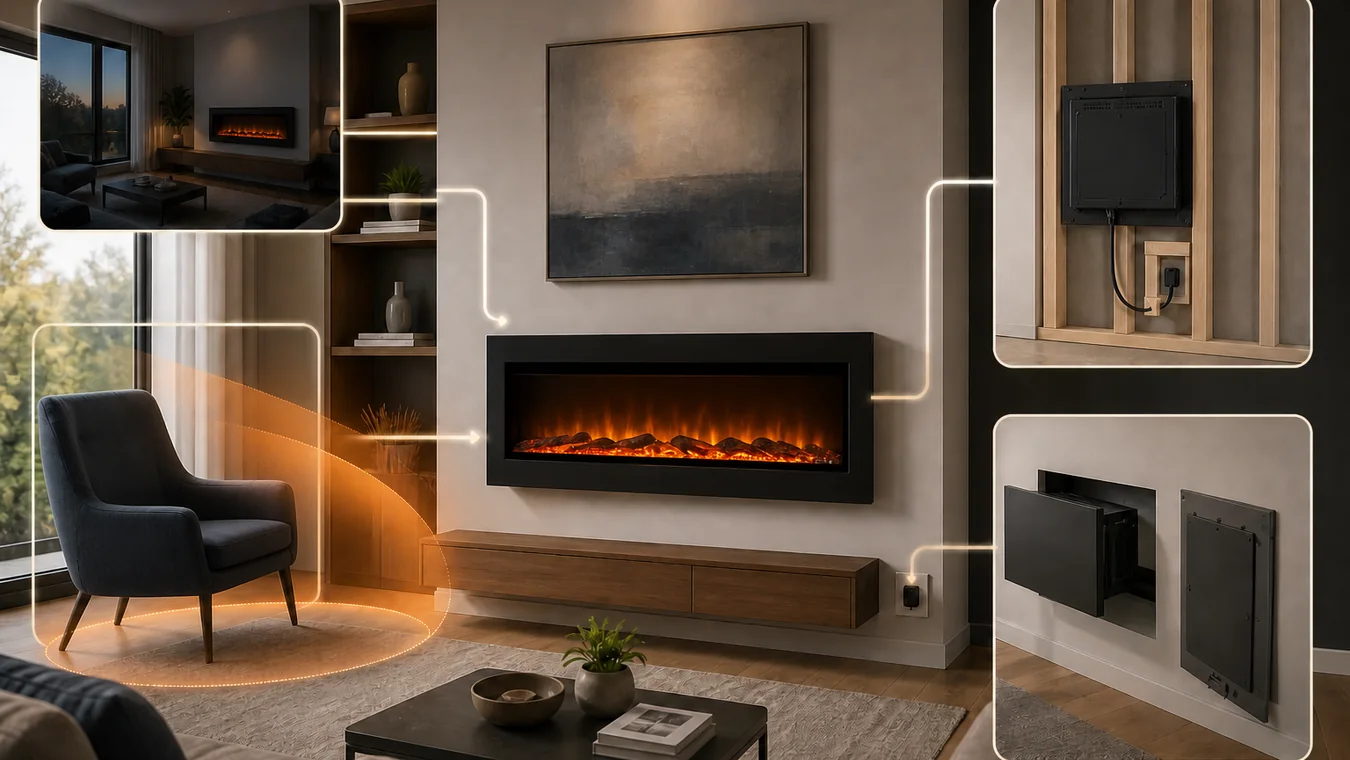
Likewise, an outlet near the wall does not approve every electric fireplace. Napoleon’s Cinema-series manual, for example, identifies its named models as 120V, 1,500W appliances for a grounded 15A circuit. Other electric fireplaces use different voltages or connection methods. Use the exact model, not the category, to decide whether the existing electrical path survives.
If fuel, venting, circuit capacity or alteration authority is unresolved, the answer is not “pick the easier one.” It is to close that field before comparing products.
Heat is an exact-model question, not a fuel badge
Gas usually has the wider high-output range, but a useful comparison needs three separate values: appliance input, documented heat output and the room’s heat demand. They are not interchangeable.
A current manufacturer example shows the scale without establishing a category rule. Napoleon lists maximum heat output of 37,000 Btu for its Elevation X 36 gas model and 45,000 Btu for the Elevation X 42. The cited Cinema electric manual lists 1,500W input for its named 120V models. Using the U.S. Energy Information Administration’s energy conversion, 1.5 kW sustained for an hour is equivalent to 5,118 Btu of energy. That arithmetic does not turn input into a guaranteed room-heating result, and neither example can be assigned to another fireplace.
Decide what “heat” means in this room. Occasional warmth near a seating area is different from holding temperature in an open-plan room on a cold night. Ceiling height, exterior glass, insulation, air leakage and adjacent openings can overwhelm a nominal output. Our guide to whether electric fireplaces give off heat separates the appliance ceiling from the room demand; use it before accepting a square-foot slogan.
Then read the candidate documents. Record gas input and stated output or efficiency in their original labels. For electric, record voltage, watts, connection and any stated output as one configuration. The electric fireplace specifications guide explains why those paired fields must not be flattened across models.
Compare operating cost with your two bills
“Gas is cheaper” and “electric is more efficient” can both distract from the number that matters: the marginal cost of operating the exact candidate where you live. Electricity and natural-gas prices vary by place and rate structure. Use the current rate on your bill or utility tariff rather than a national article’s average.
For a known electric heating input:
electric cost per heater-on hour = rated watts ÷ 1,000 × electricity rate per kWh
For a natural-gas appliance when the manual gives input Btu per hour:
gas fuel cost per burner-on hour = input Btu/h ÷ 100,000 × gas rate per therm
For propane:
propane fuel cost per burner-on hour = input Btu/h ÷ 91,452 × propane price per gallon
EIA defines one therm as 100,000 Btu and one gallon of propane as 91,452 Btu for energy comparison. These formulas price fuel entering the appliance. They do not say how much useful heat reaches the room. Compare delivered heat only when the exact documents provide a compatible output or efficiency basis; otherwise keep the result as cost per operating hour for the named configuration.
Separate fixed utility charges as well. If the home already keeps natural-gas service for other appliances, the fireplace may not create the monthly customer charge. If the fireplace would be the only reason to retain or add gas service, that fixed charge belongs in the decision. Do the same with time-of-use electricity, demand charges where applicable, propane delivery or tank costs, and pilot consumption if the exact gas control uses a standing pilot.
The result may change with use. A flame-only electric mode can consume far less than its maximum heater rating; use its documented draw if the manufacturer provides it. A modulating gas fireplace may not run at maximum input every minute. A maximum-input comparison is a ceiling, not a prediction of a season.
Installation cost follows the missing infrastructure
National installed-price ranges hide the most important variable: what the house already has.
In a home with a serviceable gas line, a compatible existing opening and an approved vent route, a gas insert may be a contained professional project. In an all-electric room with no fuel line or vent route, the same choice can expand into fuel service, exterior penetration, framing, finish and permit work. The fireplace price did not cause that difference; the missing infrastructure did.
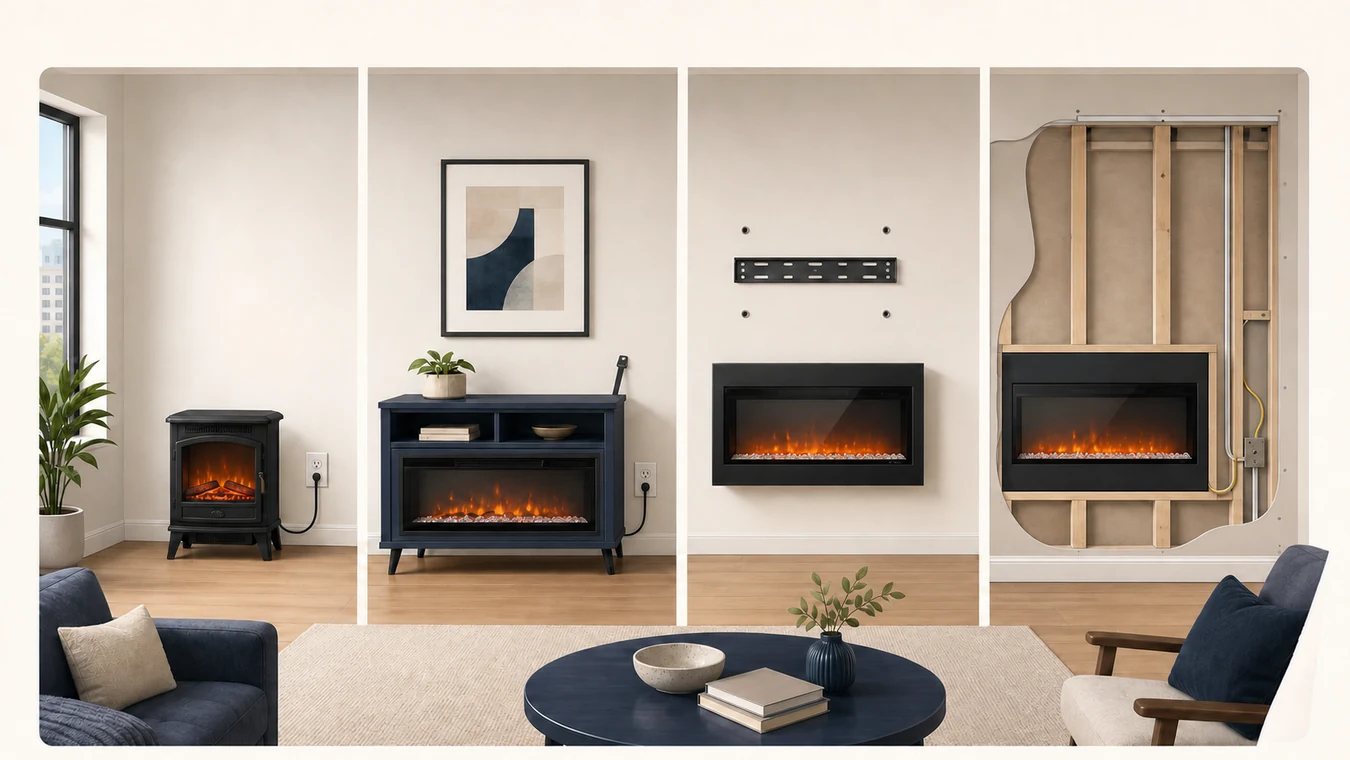
Electric can reverse the pattern. A listed plug-in fireplace placed as its manual allows may need little trade work. A large built-in model that requires a new 240V circuit, wall framing, finish changes and relocated electronics is not a plug-and-play project. The useful unit comparison starts only after the power path and installation method are fixed. If the electric format is still open, choose among wall, opening and floor relationships in the types of electric fireplaces guide before asking for quotes.
Ask for comparable written scopes. Each quote should identify the appliance configuration, fuel or circuit work, venting, framing/finish, permit responsibility, commissioning, removal of existing equipment and the service access left behind. A low appliance price and an incomplete scope are not a lower installed cost.
Maintenance and safety are different obligations
Gas adds combustion responsibility. The U.S. Department of Energy’s building-science guidance calls for ventilation air and combustion-safety testing so other exhaust equipment does not backdraft a fireplace. The U.S. Consumer Product Safety Commission advises annual inspection and service of home heating systems, including chimneys and vents, by a trained technician. It also recommends CO alarms on every level and outside sleeping areas.
Those are not reasons to reject every gas fireplace. They are ownership costs and safety duties that a generic comparison table often compresses into the word “maintenance.” The exact gas manual may also require glass, burner, pilot, vent or control inspection and may reserve work for a qualified technician.
Electric removes onsite fuel combustion and its exhaust path, but it does not remove appliance rules. Keep heater inlets and outlets clear, follow the approved cord or hardwire method, preserve access, and stop using a unit with a damaged connection or abnormal operation until the responsible service path closes the problem. Do not convert “no combustion” into “no electrical load” or “maintenance-free.”
Outage heat and flame-without-heat can break a tie
An electric fireplace needs electricity for its flame effect, controls and heater. Gas outage behavior is model-specific. Some systems use battery-backed ignition and natural convection; others lose blowers, lights, apps or control functions, and some may not operate as the shopper expects. Valor, for example, states that its current gas fireplaces use battery-powered remotes and receivers to keep heating during an outage while some added features may not work. That evidence belongs to Valor’s documented configuration, not every gas fireplace.
If outage heat matters, ask the gas manual four questions: can the burner ignite without mains power, what batteries or standing-pilot state are required, which controls remain available, and how much heat reaches the room without a blower? For electric, plan a separate outage heat source rather than assuming an ordinary home battery can support a high-draw resistance heater.
Year-round visual use points the other way. An electric model with a documented flame-without-heat mode can provide ambience without deliberately heating the room. Gas cannot create a combustion flame without burning fuel. If summer flame use is central, verify the electric operation table and keep it as a genuine decision advantage.
Put two candidates on one record
Do not finish with “gas is realistic, electric is easy.” Put one exact gas configuration and one exact electric configuration on the same record.
| Field | Gas candidate | Electric candidate | Hold when |
|---|---|---|---|
| Exact identity | Brand, model, fuel and manual revision | Brand, model, voltage/configuration and manual revision | A seller page cannot identify the applicable manual |
| House path | Fuel, vent type/route, electrical needs and installation authority | Voltage, current, plug/hardwire method, wall/opening and installation authority | The site has not been reviewed against the manual |
| Heat | Rated input, stated output/efficiency and control range | Watts, stated output, modes and room role | A square-foot claim is standing in for exact data |
| Operating rate | Local gas therm or propane gallon rate; fixed service/tank charges separated | Local kWh rate and time-of-use/tier treatment | A national average is being treated as the bill |
| Installed scope | Appliance, gas, vent, finish, permit, commissioning and removal | Appliance, circuit, framing/finish, permit and removal | Quotes exclude different necessary work |
| Ownership | Inspection/service, CO alarms, vent/burner/glass/control access | Air path, connection, cleaning and control/service access | Finished work blocks routine service |
| Tie-breakers | Real flame, exact outage operation, higher documented heat where applicable | Flame without heat where documented, no onsite combustion, lower physical commitment where applicable | A category promise replaces the exact model |
If only the electric column closes, build an electric shortlist. If only gas closes, build a gas shortlist. If both close, compare total project scope and the operating pattern you will actually use. If either column still contains an unknown about authority, fuel, vent, circuit or exact-model operation, that unknown—not the prettier flame—is the next decision.