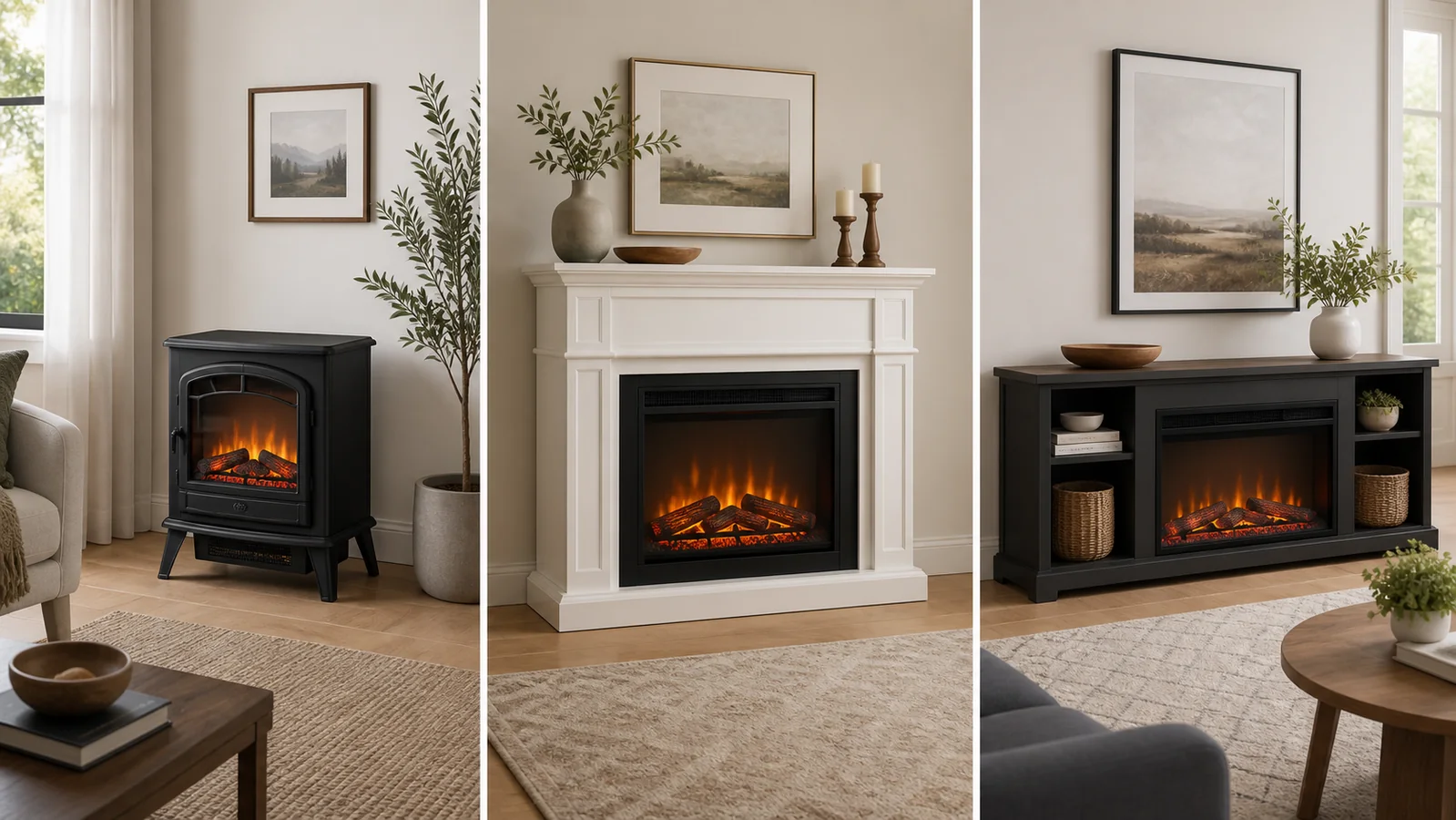
“Freestanding” sounds like one compact, portable product. In current stores, it can describe a small stove-shaped heater, a full mantel package weighing about as much as substantial furniture, or a media console designed to carry a television and store equipment. They all sit on the floor, but they do not ask the same thing from the room.
Choose the object before comparing flame colors. A stove is the appliance-only path. A mantel package is a traditional focal-point furniture path. A media console adds TV, storage, cable and anchoring duties. After that choice, compare one exact model’s assembled size and weight, outlet route, heat/air path and manual. “Plug-in” does not make those commitments disappear.
Freestanding tells you where it sits—not what you are buying
The shopping label describes a relationship to the room: the product is supported by the floor instead of being framed into a cavity or hung as the main support method. It does not promise a small footprint, easy carrying or permission to place a TV on top.
| Format | Best starting role | What occupies the room | What “movable” can mean | First veto to check |
|---|---|---|---|---|
| Stove-style appliance | Flame effect and supplemental heat without a furniture surround | Appliance width, depth and the operating space required by its manual | The cooled, unplugged appliance may be repositioned if its instructions and weight allow | Stable floor, outlet/cord path, heater inlet/outlet and portable-heater warnings |
| Mantel package | A traditional fireplace-like focal point | Assembled surround, firebox, top and anti-tip relationship | A furniture move, not automatically a casual appliance move | Assembled dimensions/weight, top-load language, anti-topple instructions and service access |
| Media console | Fireplace plus television support or equipment storage | Cabinet, doors/shelves, TV base, cables, firebox and restraint system | Furniture movement or disassembly; stored devices and cables move too | TV size/weight/base limits, storage ventilation, cord management, tip restraint and firebox access |
Current product pages show why the distinction matters. The Real Flame Silverton mantel package is listed at 48 by 13 by 41 inches and 101 pounds assembled. Its page includes an anti-topple device, limits the mantel to 30 pounds and says not to place a TV on it. Those are Silverton facts, not a rule for every mantel.
Walker Edison’s Cottonwood media console is listed at 47.5 by 15.5 by 27 inches and 91.3 pounds. Its named product page allows a TV up to 55 inches and 40 pounds, provides storage and cord management, and includes tip-restraint hardware. Similar weight does not make these two pieces interchangeable: one prohibits the TV use that helps define the other.
A stove-shaped unit starts from a different contract. Twin Star describes its Powerheat CFI-470-12-03 as a portable metal appliance that requires attaching the legs and plugging it in. That example establishes the appliance branch for that model; it does not make every freestanding fireplace light, assembled or safe to carry.
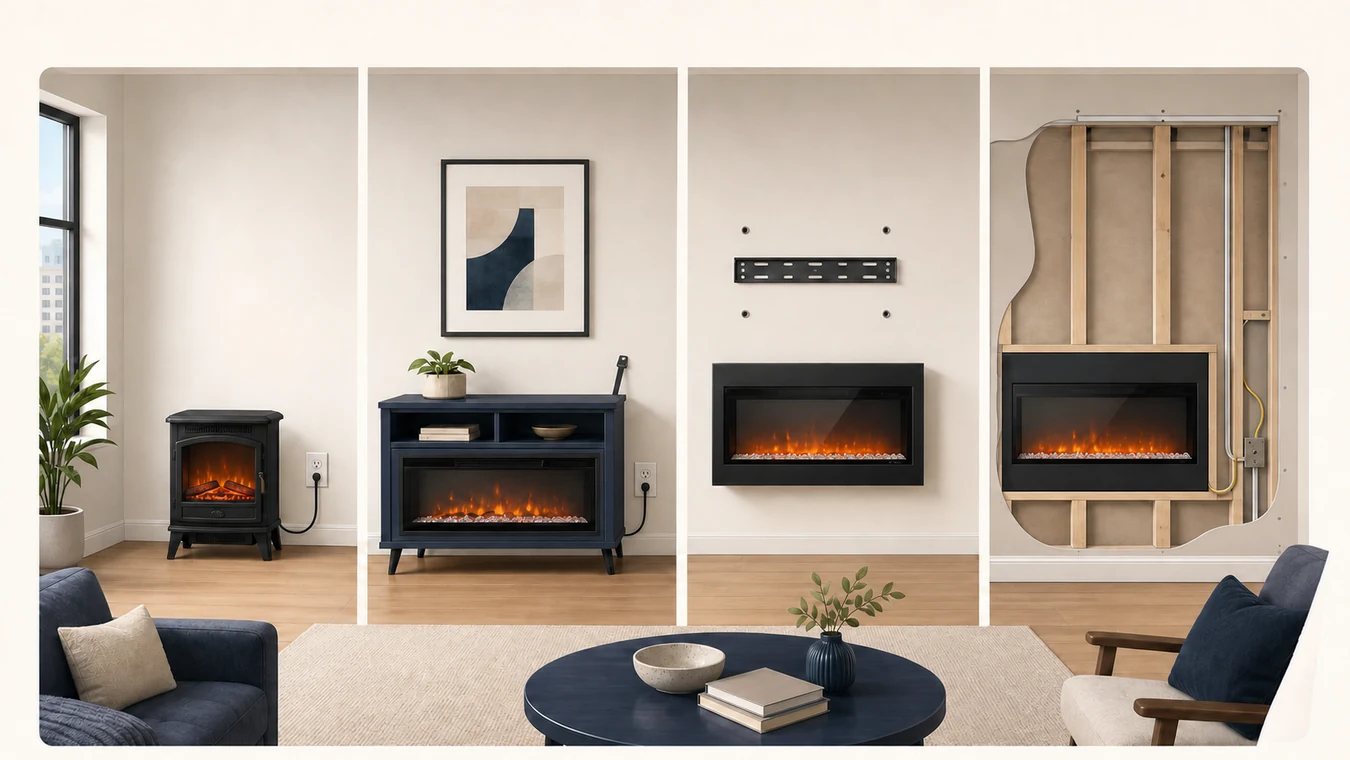
If your actual choice is still “wall, opening or floor,” step back to the types of electric fireplaces guide. This page begins after floor support is the intended relationship.
Portability has a cost after assembly
Replace “Is it portable?” with “What kind of move do I expect?” The answer changes which facts matter.
A seasonal adjustment within the same room may only require a cool, unplugged appliance and a short clear route. Even then, the manual, weight, leg or caster design and floor surface matter. Dimplex’s support guidance says freestanding units can be moved after unplugging and careful handling; it does not say every assembled surround should be dragged across a floor.
A room-to-room move adds doorway width, stairs, turns and a safe way to handle the object. A compact stove and a 101-pound mantel package may both be “freestanding,” yet one can be a manageable appliance while the other is an awkward furniture lift. Do not infer lifting points from decorative trim, a glass door or the mantel top. If the manual does not describe movement, ask the manufacturer or plan to disassemble the piece as its instructions require.
A move to another home adds hardware, packaging and reassembly. Mantel and media packages often arrive as furniture kits around a separate firebox. Save the current instructions, label hardware and decide whether the firebox must be removed before the cabinet moves. An anti-tip connection must also be released and later restored correctly; it is not a nuisance to quietly omit because the piece may move again.
This is the real portability tradeoff. The stove path usually preserves the smallest move burden. A mantel preserves a traditional focal point at the cost of more assembled furniture. A media console makes the floor area do two jobs, but the television, shelves, cords and restraint system become part of every relocation.
Let the outlet choose a practical location
Many freestanding electric fireplaces are marketed as plug-in products, but the exact electrical field still belongs in the model record. Dimplex says most of its electric fireplaces use a standard 120-volt outlet, advises against extension cords and power strips, and notes that some high-wattage or built-in models may need a dedicated circuit. Read the current manual instead of borrowing that wording for another product.
Locate the receptacle before approving the furniture position. Record the cord exit, cord length if published, plug orientation and whether the connection remains accessible. A cabinet that covers the receptacle or requires a cord across a doorway has not solved the placement problem. Do not route a cord under a rug or hide a power strip behind the unit to rescue the layout.
For a stove-style product used as a portable room heater, the CPSC portable-heater safety sheet provides a useful screening boundary: stable level placement, three feet from combustible items, no extension cord or power strip, and no unattended operation. That is not a universal installation clearance for every electric fireplace. The named fireplace manual can impose different or additional conditions, and it remains the controlling product document.
Furniture packages add another layer. The outlet route has to coexist with doors, adjustable shelves, stored electronics, the tip-restraint connection and firebox service access. A clean product photo rarely shows all of those movements. Sketch the cable and access path alongside the cabinet before treating a flush-looking placement as workable.
Heat coverage belongs to the exact model
Do not choose stove, mantel or media console from a room-size badge. The format describes the object; the heater facts belong to the firebox inside it.
The same two furniture examples make the problem visible. Real Flame publishes 1,500 watts, 5,100 BTU and “up to 1,000 sq ft” for the Silverton. Walker Edison publishes 4,600 BTU and “up to 400 square feet” for the Cottonwood. Those figures are claims for two named products under the manufacturers’ own assumptions. They do not establish a mantel-versus-console law, and they do not guarantee performance in your room.
Copy voltage, watts or amps, BTU if supplied, thermostat behavior, heater outlet location and any stated room claim from the exact current source. Then keep room conditions separate: ceiling height, insulation, outdoor temperature, open doorways and the role of the main heating system can change the result. “Supplemental heat” is a more useful starting expectation than treating a marketing area as a sizing certificate.
If heat is central to the purchase, use the electric-fireplace heat and running-cost guide before letting furniture style decide. Flame-only operation, when documented, can make a unit useful for ambience without adding heater output, but it does not fix an unsuitable outlet, blocked air path or unsupported TV.
Build one room contract before comparing finishes
Give each candidate one record with three blocks. Keep copied product facts and measurements from your room in separate columns.
Room job: choose one primary reason for using the floor area—compact ambience/supplemental heat, a traditional focal point, or television/storage furniture. Secondary benefits can break a tie; they should not blur the main duty.
Physical and furniture contract: record assembled width, depth, height and weight; base or foot shape; required floor condition; door and shelf movements; top/TV limits; restraint or anchoring instructions; cord exit and outlet; and the path needed to reach controls or remove the firebox. Mark each field documented, measured or unknown.
Heat and use contract: record voltage, wattage or amperage, published BTU, heater intake/outlet, thermostat and flame-only behavior, plus the manufacturer’s exact room-language without rewriting it as a promise. Add the manual revision or retrieval date so the record can be checked later.
The format decision then becomes straightforward. Prefer a stove-style appliance when the room needs the smallest object and future repositioning matters more than storage. Choose a mantel package when the goal is a traditional focal point and its weight, top-use and anti-tip rules work without pretending it is a TV stand. Choose a media console only when the exact television, base, load, storage, cable and restraint duties all close together.
Finish, flame media and remote features belong after that screen. If no floor-supported format can complete the room job without an unknown or conflict, browse the electric fireplace types hub and change the relationship to the room rather than forcing “freestanding” to mean more than the evidence supports.