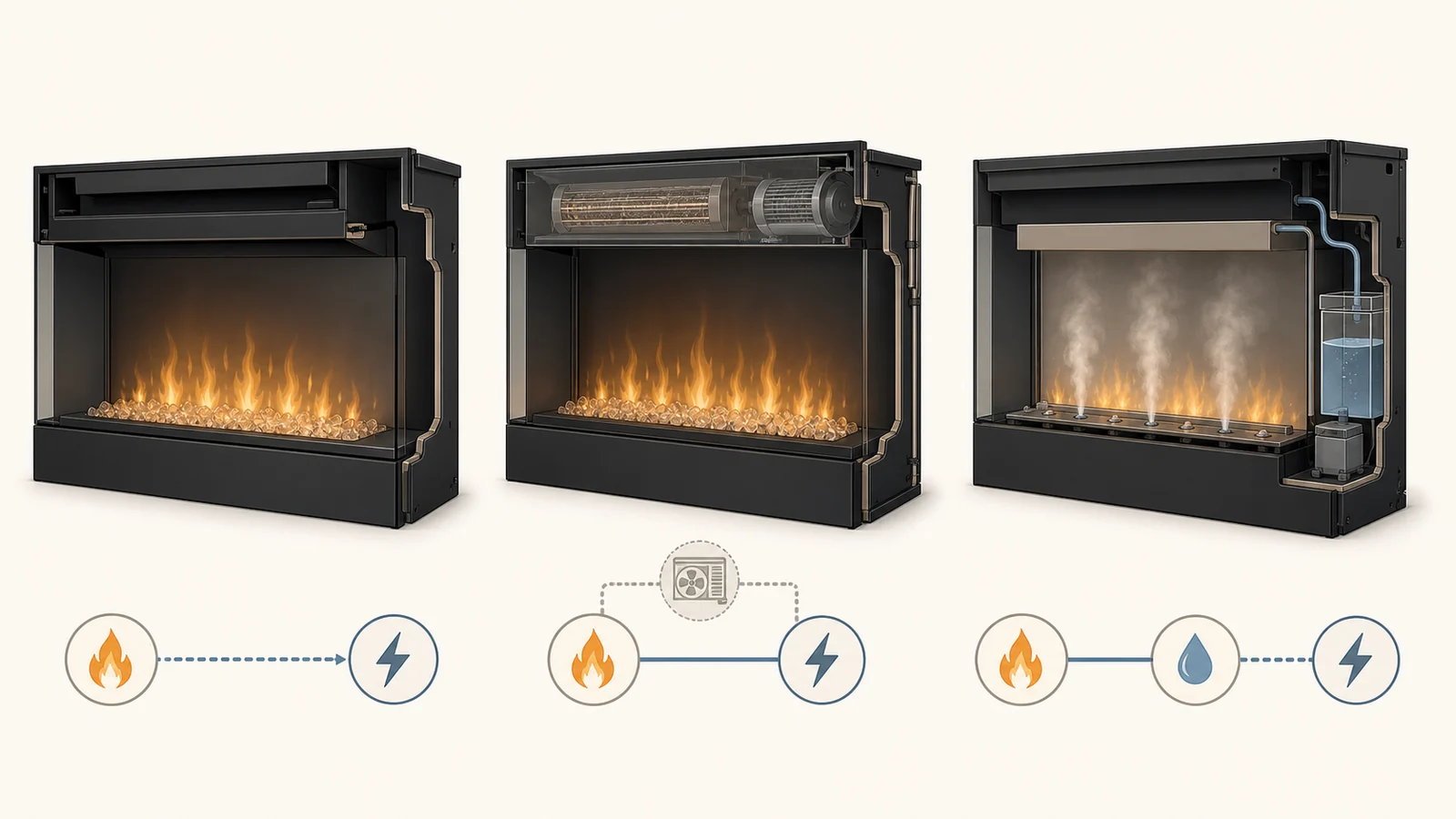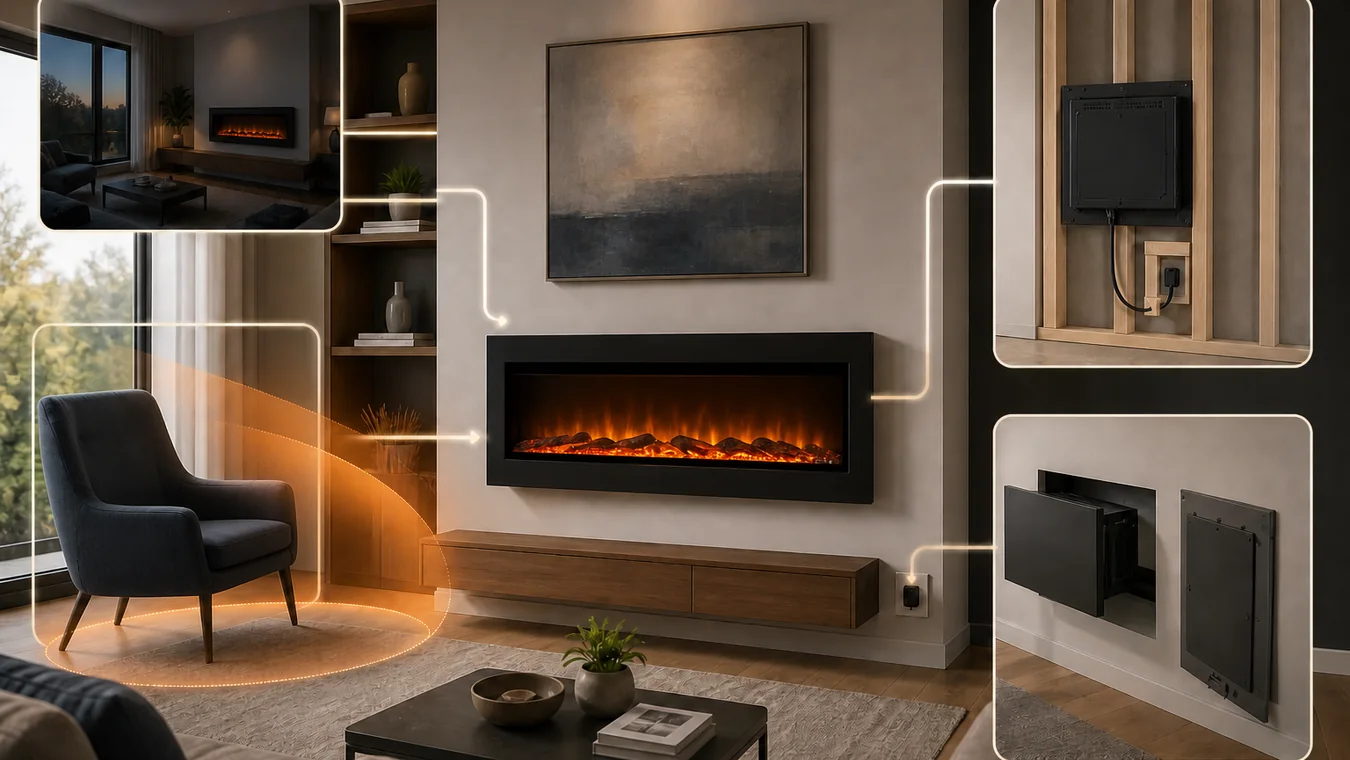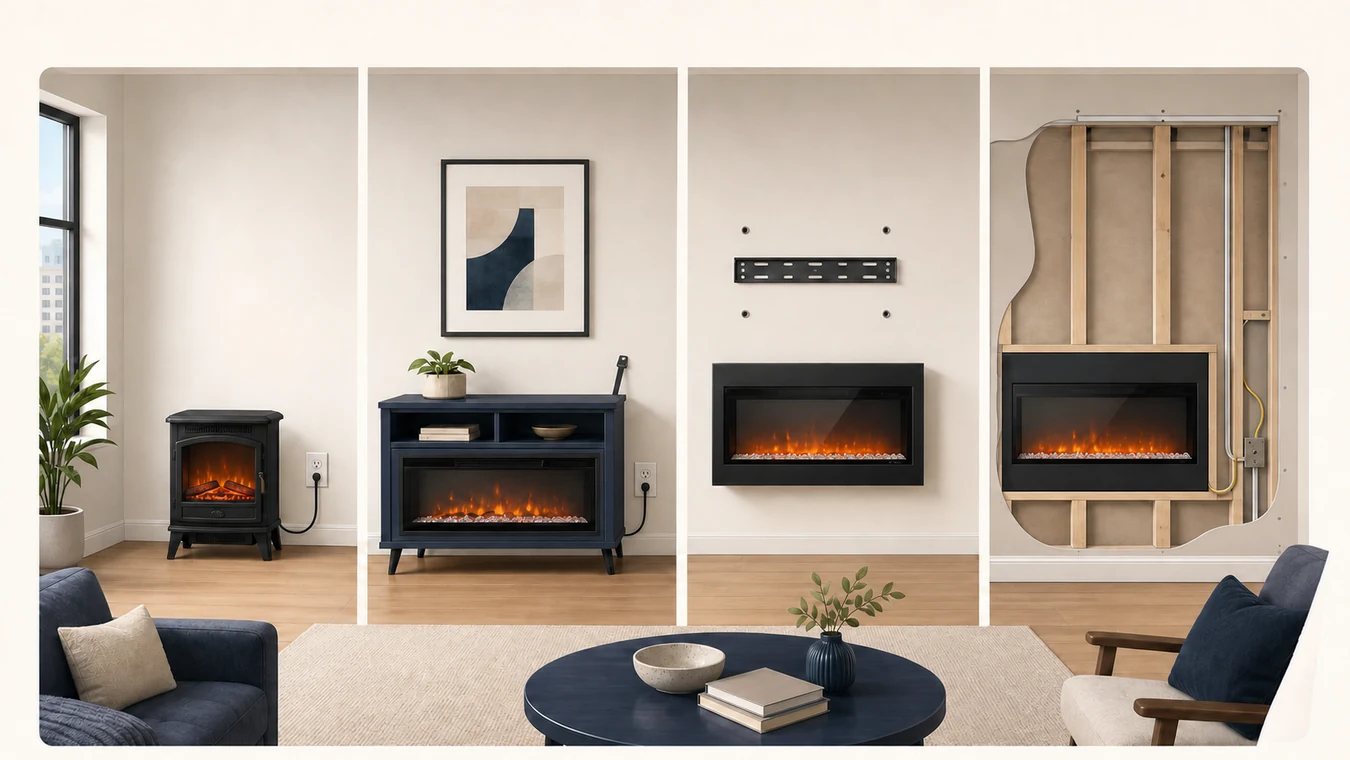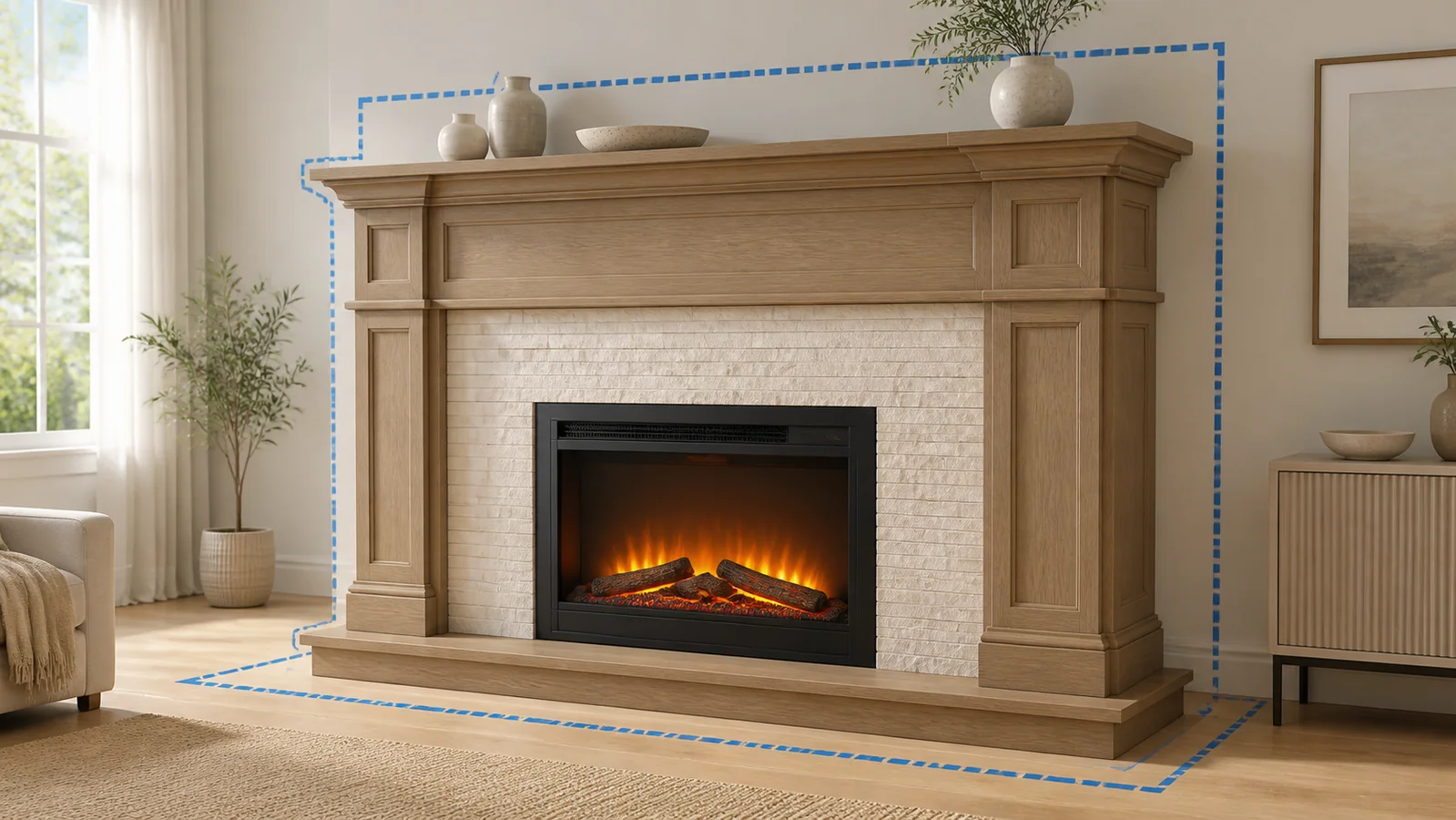
A 28-inch firebox does not make a 28-inch fireplace. Dimplex’s Fieldstone package pairs a 27-3/8-inch-wide XHD28L firebox with a mantel that is 54-5/8 inches wide, 42-5/8 inches high and 12-7/8 inches deep. The number in the firebox name describes the appliance inside; the assembled mantel decides how much wall and floor the room must surrender.
Copy the full package width, height and depth before comparing finishes. Then give the top one documented job, trace the outlet and anchor, make sure the cartons and assembled furniture can reach the room, and find out whether the firebox can be removed or replaced. If one of those fields is missing, the package is not ready to buy for that location.
A 28-inch firebox can become a 54-inch piece of furniture
Mantel packages combine at least two objects: an electric firebox and the furniture around it. Some product pages lead with the firebox inches, some with the mantel width, and some with a style name. None of those shortcuts replaces the complete assembled dimensions for the exact SKU.
Three current manufacturer records show how different the contracts can be. They are examples of fields to verify, not product recommendations.
| Named package | Documented assembled package | Other facts that change the decision | What the example proves |
|---|---|---|---|
| Dimplex Fieldstone GDS28L8-904ST | 54-5/8 W x 42-5/8 H x 12-7/8 D in | Includes a 27-3/8 W x 23-1/2 H x 7-1/2 D in XHD28L firebox; mantel and firebox ship in two cartons | Firebox width cannot stand in for furniture width or depth |
| Real Flame Silverton G8600E-W | 48 W x 41 H x 13 D in; 101 lb assembled | 23.5 W x 20 H x 8.75 D in firebox; 30 lb mantel limit; no TV on the mantel; six-foot cord; anti-topple device; two boxes | Size, top use, power route and stability are separate purchase fields |
| Ameriwood Home Elmcroft 2105911COM | 64 W x 37.76 H x 10.9 D in | 30 lb mantel limit; wall anchor included; two adults recommended; standard plug; replacement inserts offered | A shallower cabinet can still demand more wall width, labor and a restraint plan |
The labels follow each manufacturer’s page, so do not rearrange width, height and depth to match a retailer’s convention without checking. Recheck the current model page or manual before ordering; a finish or firebox variant may have a different record.
If you have not yet decided whether the room needs a mantel, stove, media console or another installation relationship, use the types of electric fireplaces guide first. The rest of this page begins after a mantel package is the intended object.
Give the mantel top one permitted job
A broad shelf can look like furniture for a television, but visible area is not permission. Start by writing the job you expect the top to perform: decorative display, light storage, a television base, or no load beyond the supplied design.
Now look for two separate facts. The first is a weight limit. The second is explicit language allowing the intended object. Silverton illustrates why both matter: Real Flame lists a 30-pound mantel limit and separately says not to place a TV on that model. The number does not cancel the prohibition.
Elmcroft also lists a 30-pound mantel limit, but that shared number does not make the two tops interchangeable or establish TV permission for either package. A load rating answers how much; product language answers what and where. Keep the intended use on hold when the second answer is absent.
This distinction also prevents an accidental category switch. If the real job is television support plus equipment storage, compare products documented for that role rather than forcing a decorative mantel to behave like a media console. The freestanding electric fireplace comparison separates those floor-supported formats before model selection.
Mock up the cabinet where the room will fight it
Tape the exact assembled width and depth on the floor at the proposed wall. Add a vertical mark for the package height. The simple rectangle is only the first pass; the useful test looks for the things a product photograph removes.
Start at the back. Baseboard or shoe molding may keep a flat cabinet from reaching the wall and push its front edge farther into the room. Do not notch the furniture or remove trim to rescue a model unless the instructions and the person responsible for the site support that change. Mark the package where it can actually stand.
Move up the wall. Check window and door casing, receptacles, switches, thermostats, returns and any existing shelf. A 64-inch-wide package can clear the floor yet cover a control at shoulder height. The mantel height also changes the usable wall above it, even when no television is planned.
Then walk past the mockup. Put a box or chair at the two front corners so the 10- or 13-inch projection cannot disappear into a flat tape line. Open nearby doors, carry an ordinary basket through the route and reach the controls from the seat where the fireplace will be used. This is not a universal clearance test; it exposes room conflicts before they become delivery-day surprises.
Power belongs on the same drawing. Copy the cord length and exit location when the manufacturer supplies them, locate the actual receptacle, and preserve whatever access the current instructions require. Silverton’s six-foot cord is useful evidence for Silverton only. It does not prove another package reaches the same outlet, and “plug-in” does not justify an extension cord hidden behind furniture.
Finally, mark the heater inlet and outlet, control access and the route used to remove the firebox. Do not bury one of those movements behind a flush-looking furniture position. The electric fireplace specifications guide explains why overall, firebox, opening, power and service fields keep their own labels.
The cartons and anchor belong in the fit decision
The final location may fit the assembled fireplace while the route to it does not. Record the number of cartons, their published dimensions and weights when available, the number of people the manufacturer calls for, and whether assembly should happen in the destination room.
Dimplex identifies the Fieldstone mantel and firebox as two cartons. Real Flame also says Silverton ships in two boxes and requires assembly. Dorel says the Elmcroft ships flat in one box but recommends two adults for assembly and movement. Box count alone therefore cannot predict an easy delivery. Stairs, landings, doorway turns and the weight of individual cartons can control the plan.
Make a route from the delivery entrance to the assembly location. Use the carton measurements, not the finished depth, when a box must pass through a door. If the product will be assembled away from its final wall, verify that the finished width, weight and safe handling points still allow the last move. Decorative trim, the glass front and the mantel shelf are not assumed lifting points.
The restraint is part of the finished location, not leftover hardware. Silverton includes an anti-topple device; Elmcroft includes a wall anchor. Read the exact instructions before approving the wall, and confirm that the required attachment can coexist with the outlet, baseboard and firebox access. The CPSC’s Anchor It guidance explains the general furniture tip-over risk, while the named product instructions control its hardware and attachment method.
If the route or required anchor cannot close, the answer is not “assemble carefully.” Change the location or package before ordering.
Plan for the firebox to age before the furniture
The surround may still suit the room years after a heater, control board or flame system needs service. Before treating the package as a long-lived furniture purchase, identify the appliance inside it.
Write down the firebox model separately from the mantel SKU. Find the current warranty for each part, the access direction, the fasteners or trim that must be removed, and whether the manufacturer documents a compatible replacement. Dorel’s Elmcroft page says replacement inserts can be ordered; that statement is useful for that product, but compatibility and availability still need to be confirmed when replacement is required.
Do not infer the same path from a photograph showing a rectangular insert. A firebox can be physically separate yet trapped by an anchored cabinet, wall finish, inaccessible plug or undocumented opening. If the source does not show how service or removal works, ask the manufacturer before making the furniture difficult to move.
This lifecycle check changes the purchase even when every dimension fits. A package with documented removal and replacement can preserve the mantel if the appliance ages. A package with no documented service path asks you to accept the possibility that one failed component retires the whole furniture piece.
Approve only a complete package record
Use one row for each exact SKU. Product facts come from the current manufacturer source; room facts come from your measurements. Mark a controlling blank as unresolved rather than filling it with a category average.
| Record line | Evidence to capture | Passing result |
|---|---|---|
| Assembled body | Complete package W/H/D and weight, with labels | Full body fits the marked wall and floor position |
| Top job | Intended object, explicit permission, load and placement limits | The exact intended use is documented, not inferred from shelf size |
| Room conflicts | Baseboard, trim, controls, doors, traffic and nearby furniture | The real standing position preserves every required movement |
| Power and operation | Connection method, cord exit/length, receptacle, inlet/outlet and controls | The documented route works without an improvised connection or blocked air path |
| Stability | Supplied restraint and exact attachment instructions | The intended wall/location can accept the required restraint |
| Delivery and assembly | Cartons, route, helpers, assembly location and final move | The package can reach its position without relying on decorative parts as handles |
| Firebox future | Firebox identity, access, warranty and replacement evidence | Service or removal remains possible after the furniture is placed and anchored |
The first failed line chooses the next move. A room conflict may mean relocate. A prohibited top job or impossible assembly route means change package. A missing controlling fact means hold and get the exact documentation. Use buy-ready only when every product field is documented and every room field is measured for the same model and location.
That final label does not certify installation. It proves something more useful at the shopping stage: the electric fireplace with a mantel has earned its place as a complete piece of furniture, not merely as a firebox that looked small enough online.