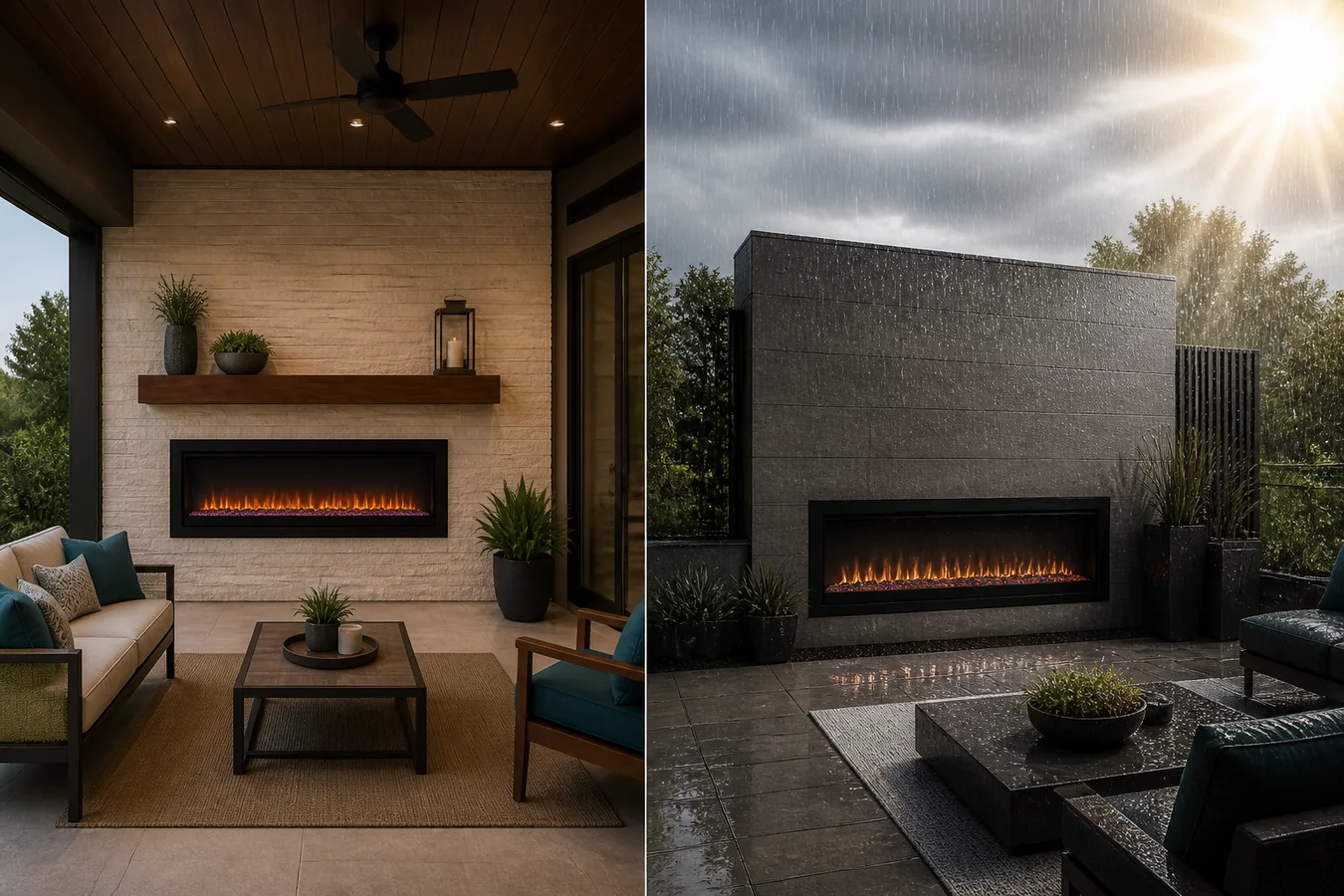
Choose the location before the outdoor electric fireplace. “Outdoor rated” might mean certified for a covered exterior installation, or it might describe a weather-resistant appliance with its own framed-wall and water-management requirements. It does not give every model permission to sit in direct rain, harsh sun or an improvised outdoor enclosure.
First decide what reaches the proposed wall: overhead rain, wind-driven spray, dew, reflected pool water, direct afternoon sun and seasonal debris. Then decide whether the feature must provide heat or only a flame display. An indoor-only product is out. An outdoor model remains only a candidate until its current manual and warranty match those exact conditions.
Draw the weather boundary around the wall
“Covered patio” is not a complete location. A deep roof with sheltered side walls creates a different exposure from a shallow pergola facing prevailing rain. An uncovered masonry wall creates a different problem again. Record the physical path instead of choosing the most reassuring label.
| Location condition | What to observe at the proposed face | Exact model evidence needed | What remains unresolved without it |
|---|---|---|---|
| Roofed and side-sheltered | Roof depth, open sides, wind direction, splash and condensation | Product/manual language that includes this covered exterior condition | Whether “covered outdoor” actually includes the placement |
| Covered but open to driven moisture | Rain angle, irrigation, pool splash, runoff above and water collecting below | Exact limits plus required flashing, drainage, enclosure or setback details | Whether the wall can keep water out of the appliance and power path |
| Open to sky | Direct rain, snow, dew, freeze/thaw and debris | Explicit documentation for that exposure—not merely an outdoor badge | Whether the product is eligible at all |
| Strong direct or reflected sun | Hours of exposure, west-facing heat and glare off glass or paving | Temperature, sunlight, cover and display-visibility instructions | Whether heat buildup, glare or cover use changes the location |
Do not upgrade an indoor fireplace by adding an overhang after purchase. The product itself must carry the right outdoor scope. Shelter is then checked against that scope; it does not manufacture a certification the appliance never had.
Three outdoor products, three different contracts
Current manufacturer pages show why one outdoor category filter cannot finish the decision.
| Named current product surface | Outdoor wording | Heat role | Sun/weather clue | Power/wall clue | Ownership clue |
|---|---|---|---|---|---|
| Dimplex Ignite Outdoor / Ignite Bold | Certified for covered outdoor installations; Bold sell sheet requires overhead protection and sends installation details to the manual | Heater-equipped; flame can also run for ambiance | Covered condition is explicit | Exact Bold manual controls the selected configuration | Dimplex currently distinguishes a one-year outdoor warranty from five-year indoor coverage |
| Touchstone Sideline Outdoor/Indoor 50, model 80017 | Outdoor/indoor model for porch, patio or similar use | No heater | Current page warns about direct-sun heat behind the glass and describes a breathable cover when not in use | Recessed or wall-mounted; current page/manual document the exact outdoor power path | Model-specific cover, glass/media access and warranty must stay in the record |
| SimpliFire Forum SF-OD43/SF-OD55 | Outdoor heat-free feature; product page emphasizes weather-oriented materials | No heater | Manual describes weather resistance and says direct sun can diminish the flame presentation | Manual calls for a framed wall and model-specific outdoor GFCI connection | Wall, water-management and service documents remain part of ownership |
Dimplex’s current Ignite outdoor page limits its promise to covered exterior installations and gives outdoor use a different warranty period from indoor use. The current Ignite Bold sell sheet also calls for overhead protection and routes full installation detail to the owner’s manual. Location is a purchasing fact, not an installation footnote.
Touchstone’s current model 80017 page takes another path: it is a no-heat outdoor/indoor display, supports its documented wall relationships and includes outdoor power language. The same page warns that direct sunlight can raise temperature behind the glass and tells owners how to cover the unit when it is not operating in hot or sunny conditions. Those conditions belong only to model 80017 unless another exact document repeats them.
SimpliFire’s Forum product page describes a heat-free fire feature with coated components, corrosion-resistant materials and UV-resistant logs. Its linked owner documentation adds the framed-wall, sunlight and electrical contract. Weather-oriented materials are useful evidence; they are not a universal waterproof rating.
If the intended product family is not yet settled, the types of electric fireplaces guide separates appliance, installation and presentation labels before model screening.
Decide whether the fire feature must heat anyone
An outdoor fireplace search mixes two different jobs: create a visible focal point or make people feel warmer. Touchstone 80017 and SimpliFire Forum explicitly take the first path; they are heat-free. Dimplex’s current covered-outdoor Ignite offer includes heat.
Write the job down before comparing flame effects. If the patio needs ambiance during warm months, a no-heat model may remove an unwanted function. If occupants expect supplemental warmth, a no-heat model fails immediately. A heater-equipped model still does not promise comfortable seating across an open patio: wind, outdoor temperature, distance and enclosure change what occupants feel.
Use the electric fireplace heat-output guide to interpret a named product’s watt and output fields without turning a room-coverage headline into an outdoor result. If heating the seating area is the primary project, compare the fireplace with equipment designed and documented for that outdoor heating task rather than assuming the visual centerpiece will do both jobs well.
Power, wall and water belong in one project
A weather-resistant face does not make the electrical path weatherproof. Copy the exact model’s permitted plug-in or hardwire method, circuit/protection language and connection location from its current manual. Then have the site-specific exterior electrical work designed to the applicable requirements. A nearby indoor receptacle, extension cord or generic “GFI plug” description is not a completed outdoor power plan.
The Touchstone 80017 owner’s manual documents plug-in and hardwire paths for that model. The Forum manual available from its official product page likewise describes a supplied GFCI cord or a hardwire option, with outdoor hardwiring requiring GFCI protection. These examples show that outdoor products can offer more than one connection path; they do not authorize the same path on another model.
If those terms are unfamiliar, the plug-in versus hardwired electric fireplace guide separates product documentation from site electrical work. Keep that decision tied to the final outdoor model and location.
The wall must close at the same time. Record whether the appliance is surface-mounted, recessed or built into a framed outdoor wall; which finish edge and service opening its drawing requires; and how the exact document manages water around the opening. Do not let stone or tile hide a connection, glass fastener, media route or removable part. The wall-mounted electric fireplace fit guide can screen projection, support and access, but outdoor water and sun conditions still come from the outdoor model’s manual.
Outdoor ownership changes after the wall is finished
Direct sun can affect more than temperature. It can also wash out a flame display, turning an expensive focal point into dark glass during the hours the patio is used. SimpliFire’s Forum documentation advises positioning for lower ambient light, while Touchstone’s current 80017 page connects direct sun with temperature and cover use. Observe the wall at the actual time of day before freezing its orientation.
Decide where a remote, app-connected control device, media and any protective cover live when they are not in use. A cover instruction must include when the product may be covered and how ventilation remains available; never improvise it from a generic patio-furniture cover. Record how glass, media, controls and serviceable components are reached after the surround is complete.
Finally, read the outdoor warranty as an outdoor warranty. Dimplex’s current Ignite outdoor surface advertises one year outdoors versus five years indoors. Another brand or model may define coverage differently. Save the exact warranty, model and purchase record that apply to the location you are actually building.
Freeze one location-model card before ordering
Use one card per exact model. Patio observations and manufacturer facts should never be blended into a vague “outdoor ready” note.
| Record field | What belongs in the card | Evidence that closes it | Result when it does not close |
|---|---|---|---|
| Exact identity | Brand, series, model, size and current manual revision | Manufacturer product page plus applicable manual | Hold until identity and document match |
| Outdoor scope | Exact wording: covered outdoor, weather resistant, or another documented class | Current model/manual/certification language | Change model if the location exceeds the stated scope |
| Real exposure | Roof and side shelter; rain/spray/dew path; sun/reflected heat; seasonal conditions | Observed location plus responsible site review | Add shelter/reposition or change model |
| Intended job | Ambiance only or supplemental heat; flame visibility at use time | Exact heat capability plus real use scenario | Reject a no-heat model for a heating task |
| Power path | Permitted connection, protection, circuit and location | Exact manual plus site-specific electrical plan | Hold; do not substitute a generic outlet assumption |
| Wall and water | Approved wall relationship, opening/finish labels and required water management | Exact drawing/manual plus site plan | Redesign before finish work |
| Controls and service | Remote/control storage, cover instruction, glass/media access and appliance removal | Current operating/service instructions | Reposition or preserve access |
| Outdoor warranty | Outdoor term, exclusions, registration and required records | Current written warranty for the exact model | Price ownership risk with the real term, not the indoor headline |
Keep the model when its documented outdoor scope contains the real exposure and every other field closes. Add shelter or reposition when the model allows that protected condition and the project can genuinely create it. Choose another model when the desired location or heat role exceeds the contract. Hold when the decisive evidence is missing.
A patio can be ready for an outdoor fireplace idea and still be wrong for a particular outdoor fireplace. Freeze the location first; let the exact product earn the wall around it.