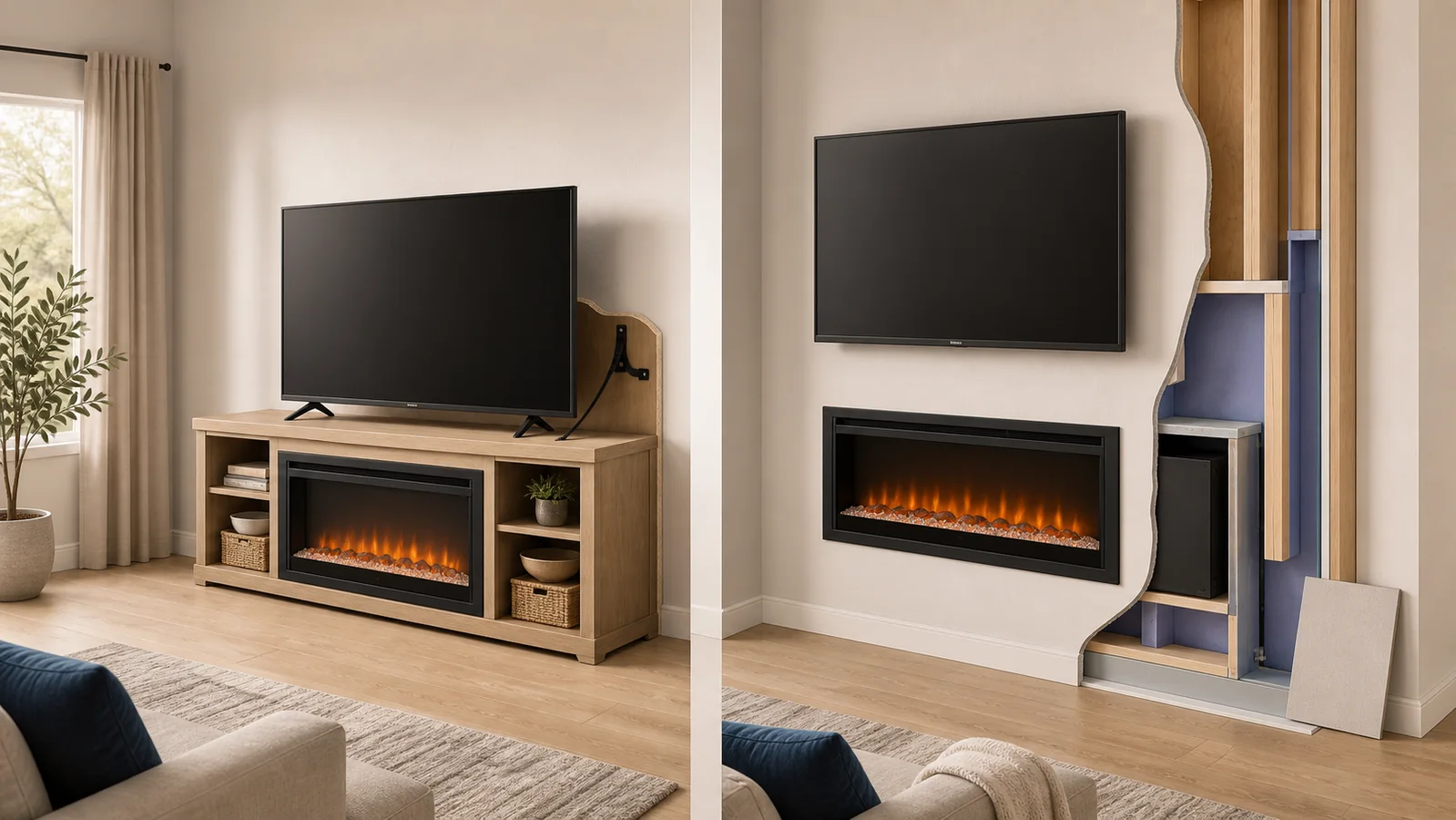
An electric fireplace under a television can arrive as 112 pounds of assembled furniture, or it can begin with an opening in the wall. The finished photos may look related. The commitments are not.
A fireplace TV stand is the conservative path when the exact cabinet, television, route, restraint and outlet all close without changing the room. A built-in wall becomes credible only after the cavity, television mount, power, finish and future service path are measured and authorized. If either path depends on an unresolved controlling fact, keep that path on hold rather than choosing from appearance alone.
The console asks the floor to do the work
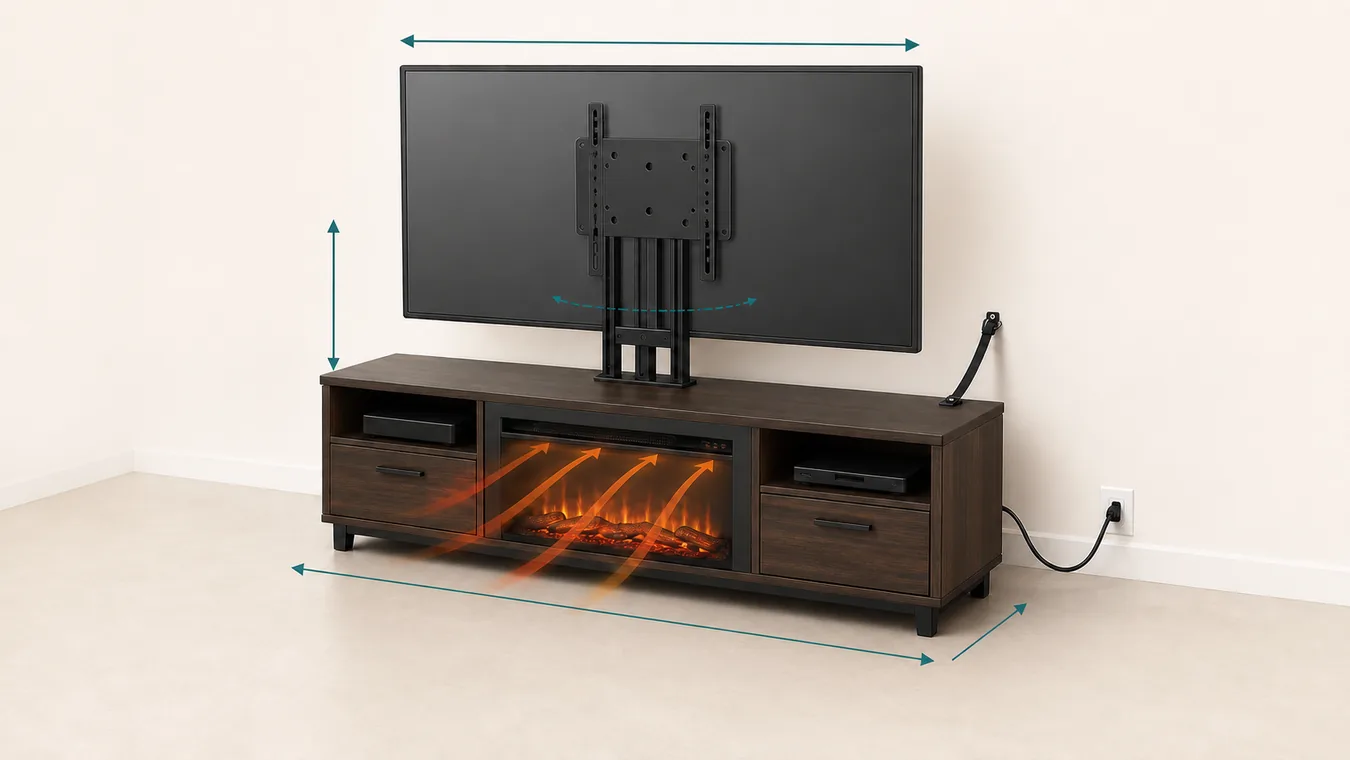
A fireplace TV stand combines three jobs in one product: supporting or organizing television equipment, storing media, and housing an electric firebox. That bundle can reduce construction, but it does not make the purchase plug-and-play. The cabinet is still a large piece of furniture with model-specific limits.
Two current manufacturer records show the contract. They are not recommendations or category averages.
| Exact console | Documented furniture facts | Decision consequence |
|---|---|---|
| Real Flame Tramore 13055E-WHT | 62 W × 27.75 H × 18.25 D in; 112 lb assembled; TV up to 60 in and 100 lb; assembly required; two boxes; anti-topple device; two adjustable side shelves | The path needs 18.25 inches of floor depth, a realistic delivery and assembly route, a compatible TV, anchoring and an outlet plan |
| Napoleon Bella NEFP26-3120WN | 65 W × about 26 H in; TV up to 70 in and 120 lb; assembly required; firebox and console ship in two boxes; media compartment, wire management and soft-close doors | The format supplies storage and TV support, but each limit remains tied to this exact model |
The Tramore page also lists a 120-volt, 1,400-watt plug-in firebox with maximum stated output of 5,100 BTU per hour. Those electrical facts do not tell you that a receptacle is in the right place. The cord still needs the route allowed by the current instructions, without being pinched behind the cabinet or treated as permission for an improvised extension.
Bella demonstrates a different problem: two official sources disagree about a controlling dimension. The current product page reports 16.50 inches of depth, while Napoleon’s W415-3080 specification sheet reports 17-13/16 inches. Do not silently choose the smaller number. Confirm the current exact package before marking the floor; until then, its depth is unresolved.
A diagonal screen limit is not the same as actual television fit. The TV’s real width, feet or base position, weight and manufacturer placement requirements still have to work on the documented top. The U.S. CPSC’s Anchor It guidance also says to use furniture designed to support a TV and to anchor the television and furniture according to the manufacturers’ instructions. A wide-looking top is not evidence.
The built-in path moves the burden behind the finish
A built-in removes the media cabinet from the floor, but it does not remove the work. It transfers the burden to the wall assembly, independent television support, power route, finish and future access.
“Built-in” also covers very different depths. The Touchstone Sideline Elite series manual lists a 49.75 W × 19.75 H × 5.5 D-inch body for the 50-inch model and a 48.75 W × 18.25 H × 5.5 D-inch rough opening. The current model page supports recessed or surface-mounted paths, while its documentation provides plug-in or hardwire routes. Dimplex’s Revillusion RBF36 is a deeper built-in: its official specification sheet lists a 41.375 W × 35.5 H × 16.375 D-inch body and a hardwire path with an optional plug kit.
Those examples prove only that “built-in electric fireplace” is not one wall contract. The exact model manual must control the opening, support, clearances, power and service access. The fireplace body dimension cannot be substituted for the framed opening, and neither number approves cutting an existing wall.
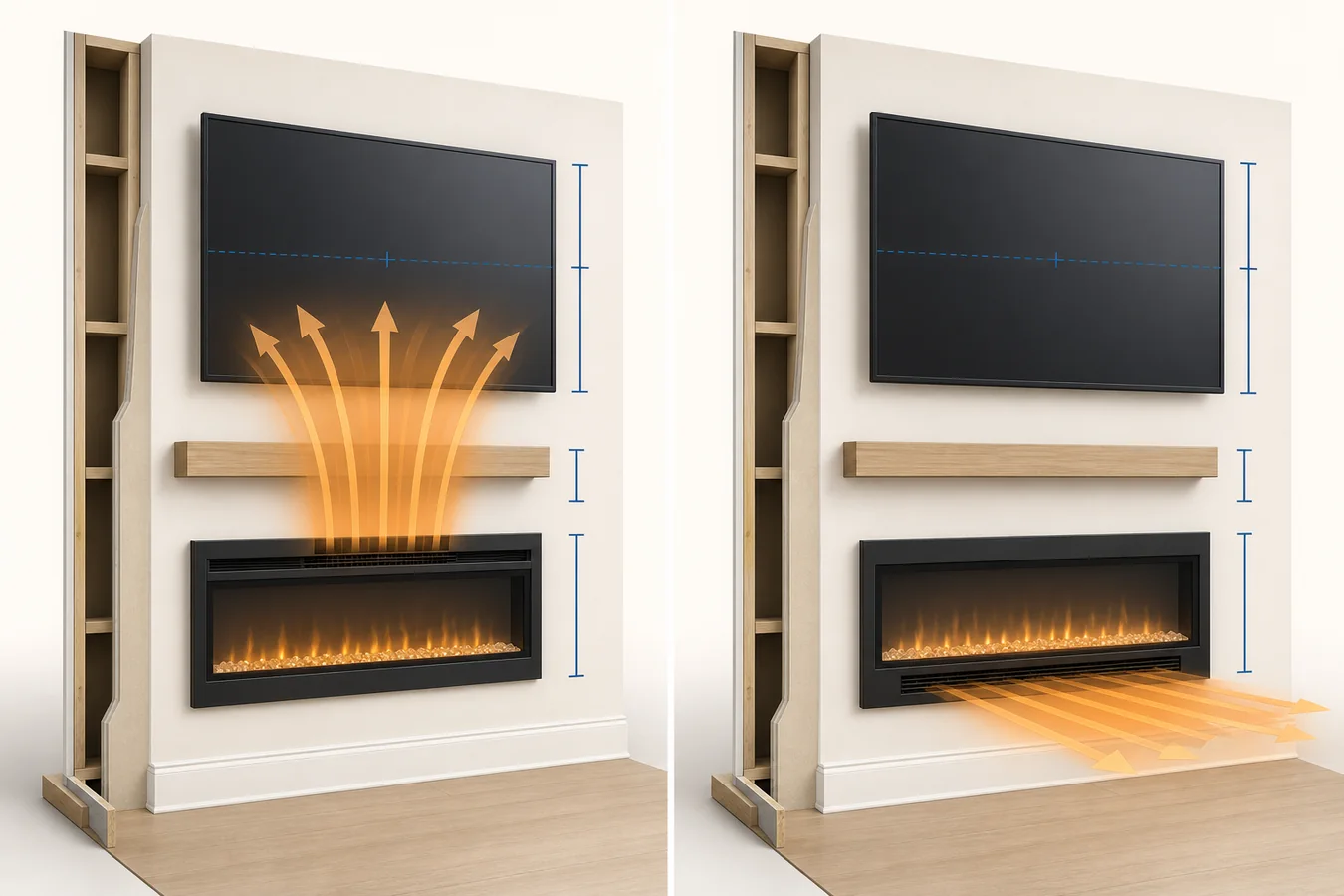
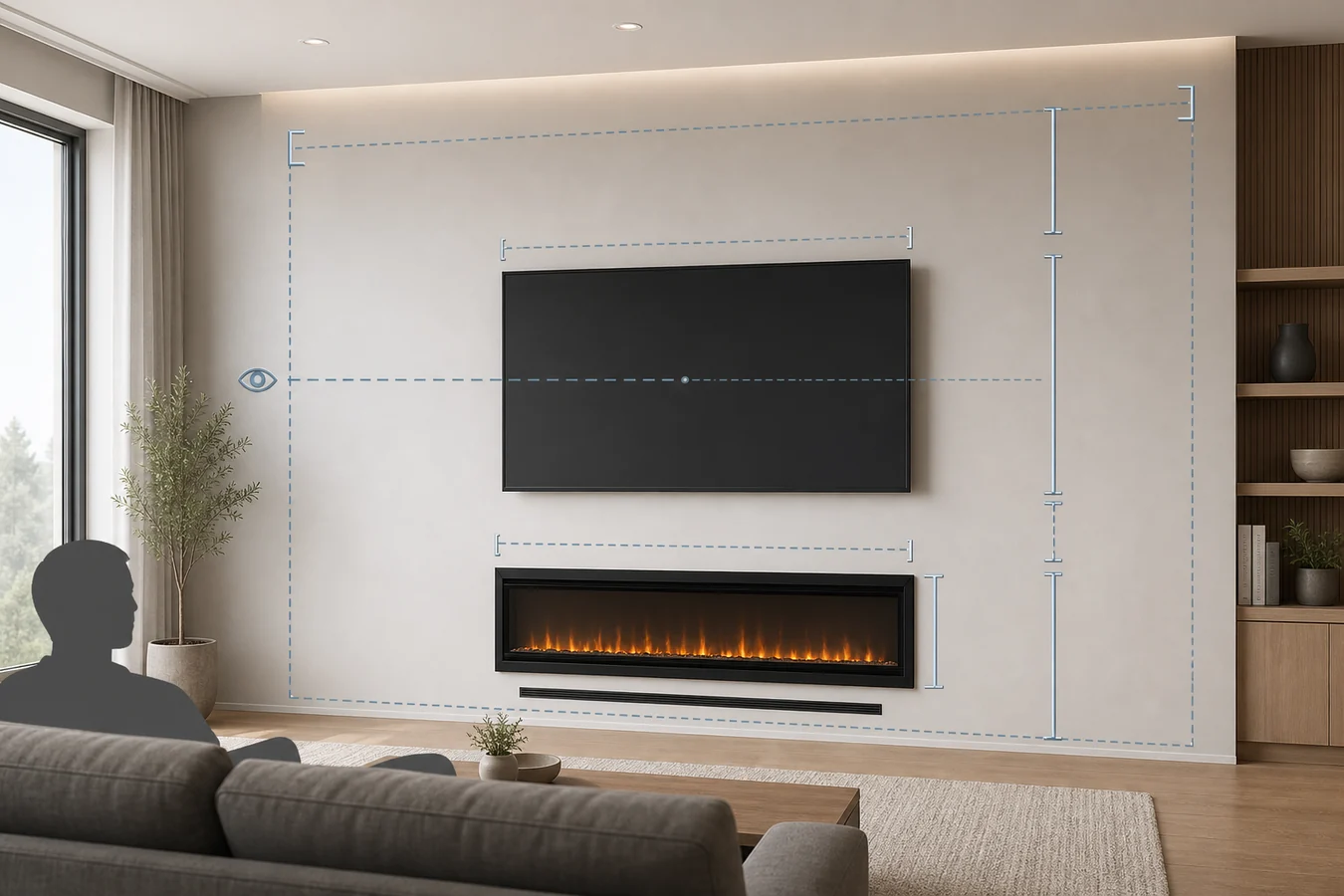
The television is a separate installed object on this path. Its mount, wall attachment, cable route, viewing position and relationship to the heater must close independently. Use the electric-fireplace-and-TV-wall planning guide when the decision has reached wall width, screen position and vertical layout. This page decides whether that project path should exist at all.
The apparent absence of furniture can also hide future labor. A control, heater or flame component may eventually need service. If trim, stone, millwork or the television blocks the documented removal direction, a clean built-in appearance has converted ordinary appliance access into finish demolition. Service access belongs on the wall drawing before materials are ordered.
Compare commitments, not flame effects
Flame colors and media beds can be compared after the path is viable. First compare what the room must carry for years.
| Commitment | Fireplace TV stand | Built-in TV wall |
|---|---|---|
| Room ownership | Uses documented floor depth and cabinet width | Uses wall-cavity depth plus the finished wall assembly |
| Television | Exact cabinet must permit the TV’s size, weight and placement | TV needs its own mount, attachment, cable route and viewing geometry |
| Storage | Model-specific shelves, doors and cable management may be included | Storage is separate furniture or custom construction |
| Delivery and assembly | Cartons, helpers, assembly location and finished moving path must close | Appliance delivery is only one part; wall and finish materials add separate logistics |
| Stability or structure | Follow the exact anti-tip and TV instructions | Wall opening, support and television attachment need property and trade authority |
| Power | A plug-in label still needs a usable documented receptacle route | Exact model may allow plug-in, hardwire or a specific kit; connection scope is model and site specific |
| Finish | Usually removable without repairing the wall beyond approved anchors | Trim, drywall, tile, stone or millwork may be part of the installation contract |
| Service and replacement | Furniture may move, but weight, anchor and firebox access still matter | Removal direction must survive the finished wall and television layout |
| Reversibility | Higher when the route, restraint and outlet remain workable | Lower once framing, wiring and finish are committed |
This is not a cost table. Local labor, wall conditions and finish choices are too specific for a responsible universal number. It is a dependency table: the better path is the one whose required evidence and authority you can actually close.
Let the first immovable condition choose the path
Start with the condition you cannot solve by changing finishes.
If you rent, expect to move, lack permission to alter the wall or do not yet have an authorized framing and electrical plan, the built-in path is not ready. A documented TV stand may remain viable, provided the floor footprint, TV, restraint, route and receptacle work. “Freestanding” does not waive anchoring or product instructions.
If the room cannot give up roughly the cabinet depth in a traffic path, a console may fail before storage and style matter. That does not automatically approve a recess. You still need to establish what is inside the wall, whether the exact firebox depth can be accommodated, who approves the change and how the finished assembly will be serviced.
If the television must sit on furniture and the room needs concealed media storage, begin with consoles explicitly documented for those jobs. Do not convert a mantel shelf or decorative surround into a TV stand from appearance or a generic load number. If you are actually choosing among mantel, media-console and other fireplace formats, settle that type decision first; the types-of-electric-fireplaces guide keeps those product relationships separate.
If the television needs an independent mount, the room can support an authorized project, and custom wall proportions matter more than movable storage, the built-in path earns further design work. The wall plan must still be based on the exact firebox and television rather than a social-media composition.
An integrated mantel package is a third furniture commitment, not a compromise inferred from these two. The electric-fireplace-with-a-mantel guide covers its full package footprint, top permission, assembly and future firebox access.
Freeze one evidence record before design work starts
Put one exact console candidate and one exact built-in candidate on the same record. Manufacturer facts are documented. Room facts are measured. Property and trade decisions are authorized. Anything else is unresolved.
| Evidence line | Console path needs | Built-in path needs |
|---|---|---|
| Exact identity | Console and firebox model with current source date | Firebox model, current manual or spec revision, and installation mode |
| Space | Full assembled W/H/D and weight against the real floor and wall position | Appliance body, rough opening, wall assembly and documented access against the real site |
| TV | Actual TV dimensions and weight plus explicit furniture permission and placement | TV and mount identity, attachment authority, cable route and viewing position |
| Room work | Delivery turns, cartons, helpers, assembly position, baseboard and doors | Wall contents, framing and support, finish transitions, and responsible installer or trade |
| Stability and power | Exact restraint plus permitted cord and receptacle route | Exact support plus documented plug or hardwire path and responsible electrical scope |
| Future access | Furniture movement, anchor release and firebox removal evidence | Control, heater or firebox removal direction preserved after finish and TV installation |
| Conflict state | Every controlling value agrees or is reconfirmed | Every controlling value agrees with the current model, manual and site plan |
Mark CONSOLE_READY only when every console line is documented or measured for the same cabinet, TV and location. Mark WALL_READY only when every built-in line is documented, measured and authorized for the same firebox, wall and TV plan. BOTH_READY means the room genuinely supports either path; design preference can then decide. Any blank, conflict or missing authority returns HOLD for that path.
The useful difference is not that one option is simple and the other is premium. One asks the room to accept a specific piece of furniture. The other asks the room to become part of the appliance installation. Choose the first irreversible line you are prepared to own, then compare products inside that path.