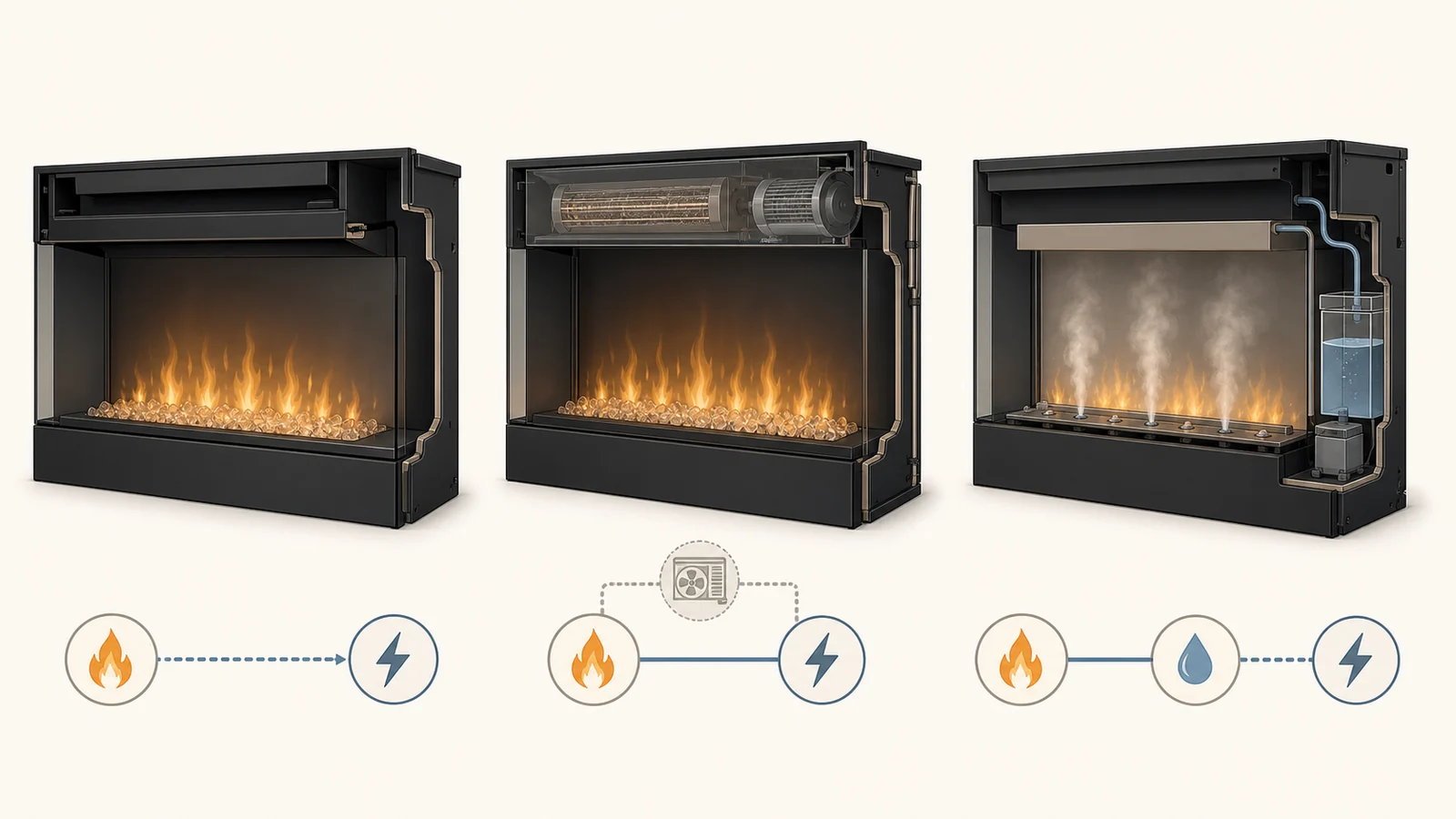
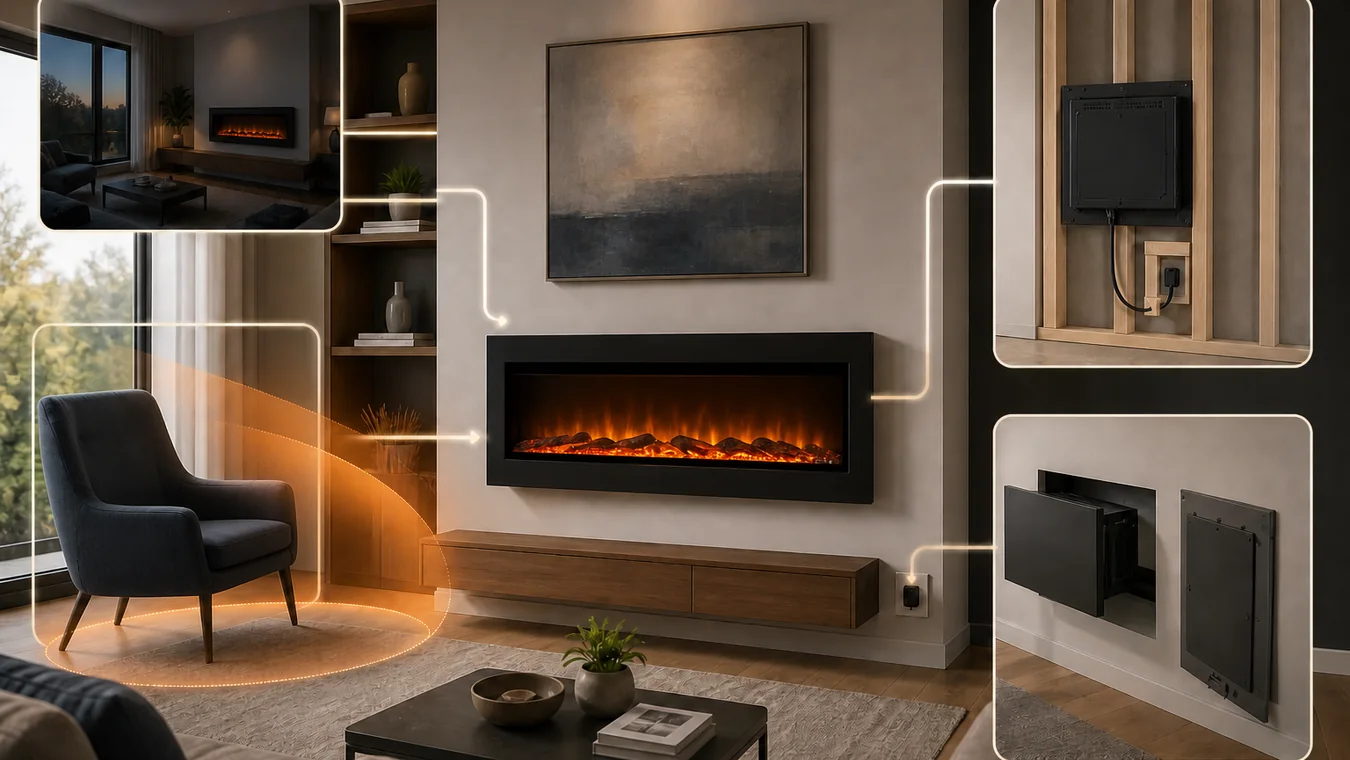
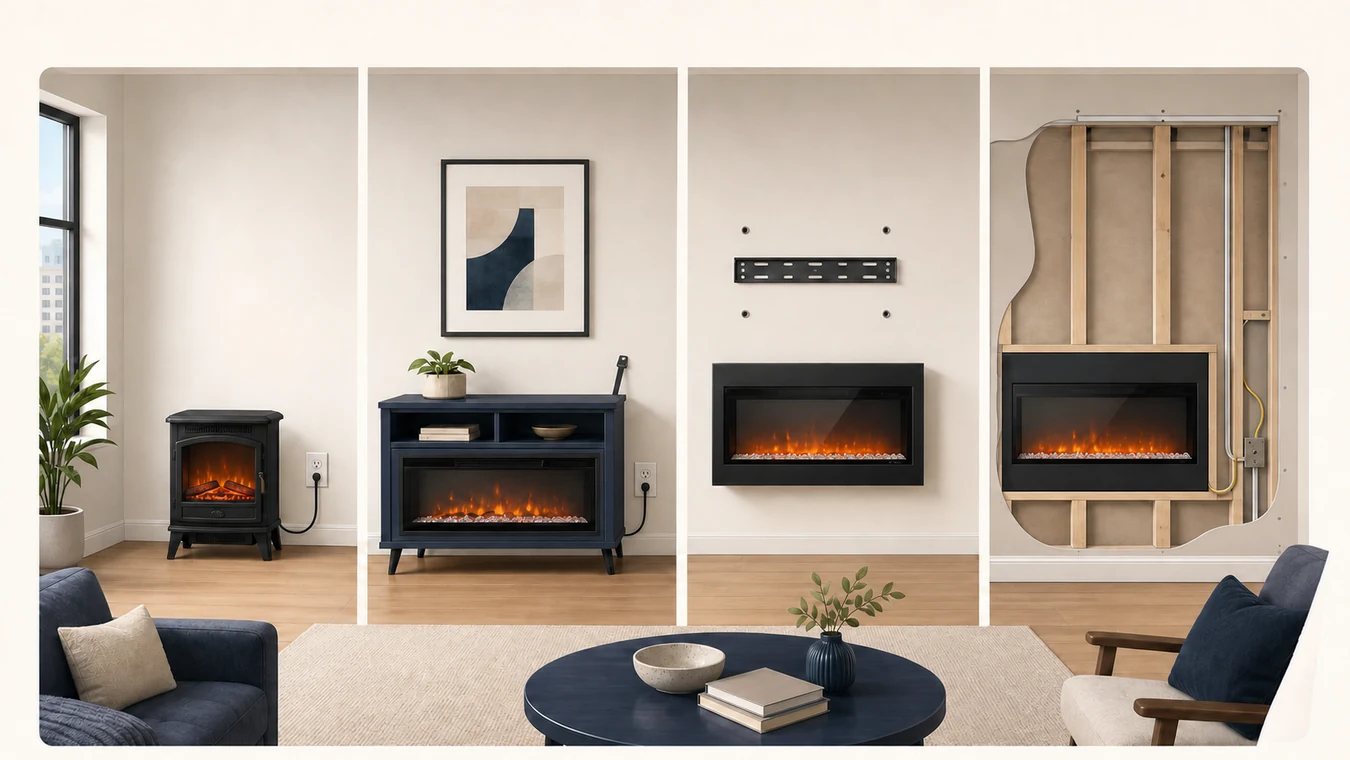
An electric fireplace surround is not one standardized product. The same phrase can describe a factory-matched trim or panel kit, a mantel furniture package that may already include the fireplace, or the finished wall built around a separate firebox. Those three purchases use different dimensions, documents and handoffs.
Before comparing style, ask what arrives in the box and which exact fireplace controls the fit. Record both product identities, the opening and visible overlap, the air outlet, the service route and who owns the wall or furniture support. If the seller cannot answer those fields, the surround is not ready to order.
Ask what arrives in the box
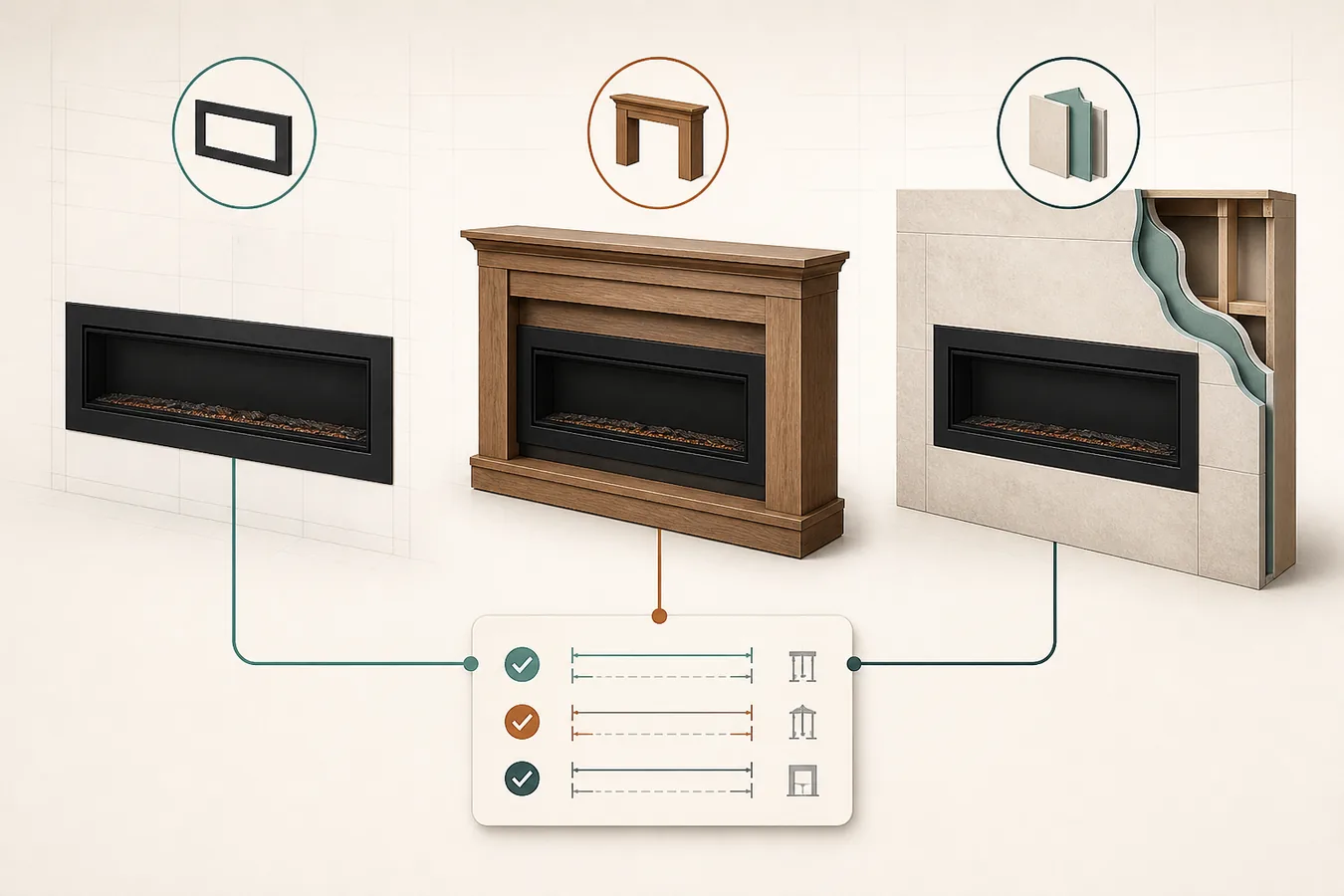
A search result can show three nearly identical room scenes while selling three materially different things. One listing supplies only the visible metal frame. Another supplies a large furniture envelope and a firebox. A third is inspiration for work that no fireplace manufacturer is selling as a complete surround at all.
| What surround means | What you may receive | Controlling identity | Evidence before an order |
|---|---|---|---|
| Factory-matched trim or panel system | Metal frame, panels, brackets or decorative exterior around a separate fireplace | Exact fireplace family, model and compatible accessory | Current compatibility list, accessory document, included-parts list and visible dimensions |
| Mantel or furniture suite | Freestanding or floating furniture; the firebox may be included or sold separately | Exact suite item plus the exact included or approved firebox | Package contents, full furniture dimensions, support or anti-tip instructions and service access |
| Site-built finished surround | No packaged surround; a trade builds framing, substrate and finish around a chosen unit | Exact fireplace model and its current installation document | Model drawing, opening and finish relationship, air path, service route and written project scope |
The distinction changes the first useful question. For a matched accessory, ask “Which exact models accept it?” For furniture, ask “Is the fireplace included?” For site-built work, ask “Which current model document controls the opening and finish?” A color or nominal width cannot answer any of them. If the underlying appliance format is not settled yet, choose that first with the types of electric fireplaces guide; surround compatibility begins after the format becomes an exact product.
A matched frame borrows its identity from the fireplace
A factory surround is usually an accessory contract, not generic décor. Dimplex’s current Storm Surround collection, for example, names the fireplace families it is designed to pair with and describes a system of frame, brackets and decorative exterior. That is evidence for those named pairings only—not permission to fit the surround around any appliance of similar advertised width.
Accessory documents make the same point at model level. Dimplex’s Ignite XL trim document maps trim products to specific fireplaces. The useful identity is therefore a pair: fireplace model + accessory model. If either half is missing, a visually plausible frame remains an unverified purchase.
Do not reduce the check to outer width. A trim can cover an edge without correcting the opening, projection, attachment or service relationship behind it. Save the current accessory document with the order record, and verify that its market and revision match the fireplace being purchased.
A mantel suite can be much larger than its firebox
Furniture uses a different boundary. Touchstone’s current surround mantel collection describes freestanding and floating mantels with the fireplace included. In that contract, the surround is not a cosmetic accessory for a firebox you already chose; it is a room-scale product package.
Other mantel listings can sell the furniture without the firebox, so “fits electric fireplaces” is still not an exact pairing. Record the suite item, every carton or component, the included firebox model if there is one, and the complete assembled dimensions. Then confirm the base, wall support or anti-tip method, permitted top use, control reach and the path for removing or servicing the firebox.
The electric-fireplace mantel guide treats that larger furniture footprint as the room decision. It should not be replaced with firebox width. A suite can fail at a doorway, baseboard, outlet or circulation path even when the firebox itself would fit the wall.
A site-built finish starts with a model, not a sketch
A tile, stone, wood or painted wall around an electric fireplace is not automatically a manufacturer surround. It is a small construction project whose visible opening must be derived from the exact appliance and current documentation. A rendering can choose proportions and finish; it cannot establish the appliance opening, permitted finish relationship or removal path.
Dimplex’s current RBF24DLXWC specification illustrates why identity matters: compatible trim options and the finished-surround relationship are written for one exact model. Those fields cannot be borrowed for another Dimplex firebox, much less another brand.
Use the electric-fireplace framing guide to transfer a chosen model’s dimensions and installation path to the builder. The article you are reading does not supply framing or finish instructions. Its job is to prevent the design from moving ahead while the controlling model or document remains unresolved.
Put both identities on one order record
The order record below works for all three meanings of surround. Complete only the rows that apply, but do not delete an unresolved field. A blank is not evidence that the field is unimportant; it is a named reason to pause the order or hand the question to the manufacturer, retailer or trade who controls it.
| Record field | Matched accessory | Mantel suite | Site-built finish |
|---|---|---|---|
| Fireplace identity | Brand, exact model and current compatible-accessory source | Included firebox model or separately approved fireplace | Exact model and current installation document |
| Surround identity | Accessory model, style and finish | Suite or furniture item and version | Drawing revision, material scope and responsible trade |
| What is included | Frame, panels, brackets, fasteners and exclusions | Furniture, firebox, media, hardware and exclusions | Framing, substrate, finish, trim, paint and cleanup scope |
| Geometry | Fireplace body, opening, overlay, projection and finished face | Full width, height, depth, base and firebox opening | Manual-derived opening, finished reveal, projection and edge details |
| Air and heat path | Nothing covers the model’s intake or outlet | Package preserves the designed outlet and room clearance | Finish and adjacent elements follow the exact manual |
| Service path | Accessory can be removed as documented | Controls and firebox remain reachable or removable | Access survives after wall and finish are complete |
| Support and power | Required wall or fireplace attachment plus exact power path | Floor or wall support, anti-tip provision and outlet location | Wall support and electrical work assigned to qualified scopes |
| Release decision | Order only when the exact pair is documented | Order only when package contents and room footprint are complete | Release drawings only after the model and trade handoff are fixed |
The neutral fields in the electric-fireplace specifications guide help freeze the appliance side of this record. The surround still needs its own identity and package contents; a complete fireplace specification cannot prove third-party accessory compatibility.
Keep the air outlet and service path visible on paper
Surround shopping is dominated by visible surfaces, but two invisible routes can decide the project. The first is the model’s air and heat path. The second is the route used to reach controls, media, fasteners or serviceable parts after the decorative layer is complete. A surround that looks correct in elevation can still be wrong if it blocks either route.
Do not solve that risk with a universal clearance copied from another fireplace. Find the exact model in the manufacturer’s current product-resource owner or the equivalent first-party library, then attach the controlling document. Ask the retailer or manufacturer to resolve any conflict between an accessory page and the fireplace manual before purchase.
For site-built work, make the access boundary part of the written scope. The wall contractor, electrician and fireplace installer should know which surface remains removable, who performs final appliance placement and testing, and who restores the finish if access is needed. This is a coordination requirement, not a DIY instruction.
Order the pair, not a surround in isolation
The order is ready when the product contract is named and both identities are frozen. A matched accessory needs a current compatibility source. A mantel suite needs complete package contents and furniture dimensions. A site-built finish needs the exact fireplace document and a written construction handoff.
If appearance is settled but model, opening, air path or access is blank, keep the design and stop the purchase. For a site-built project, the installation-cost scope guide can carry the unresolved wall, finish and electrical work into comparable written quotes instead of hiding it inside a single total.
The final choice is not “the surround that looks best.” It is the fireplace-and-surround pair whose package, geometry, air path, service route and responsibility all agree on the same record. Once those facts are fixed, style becomes a safe comparison rather than a substitute for compatibility.