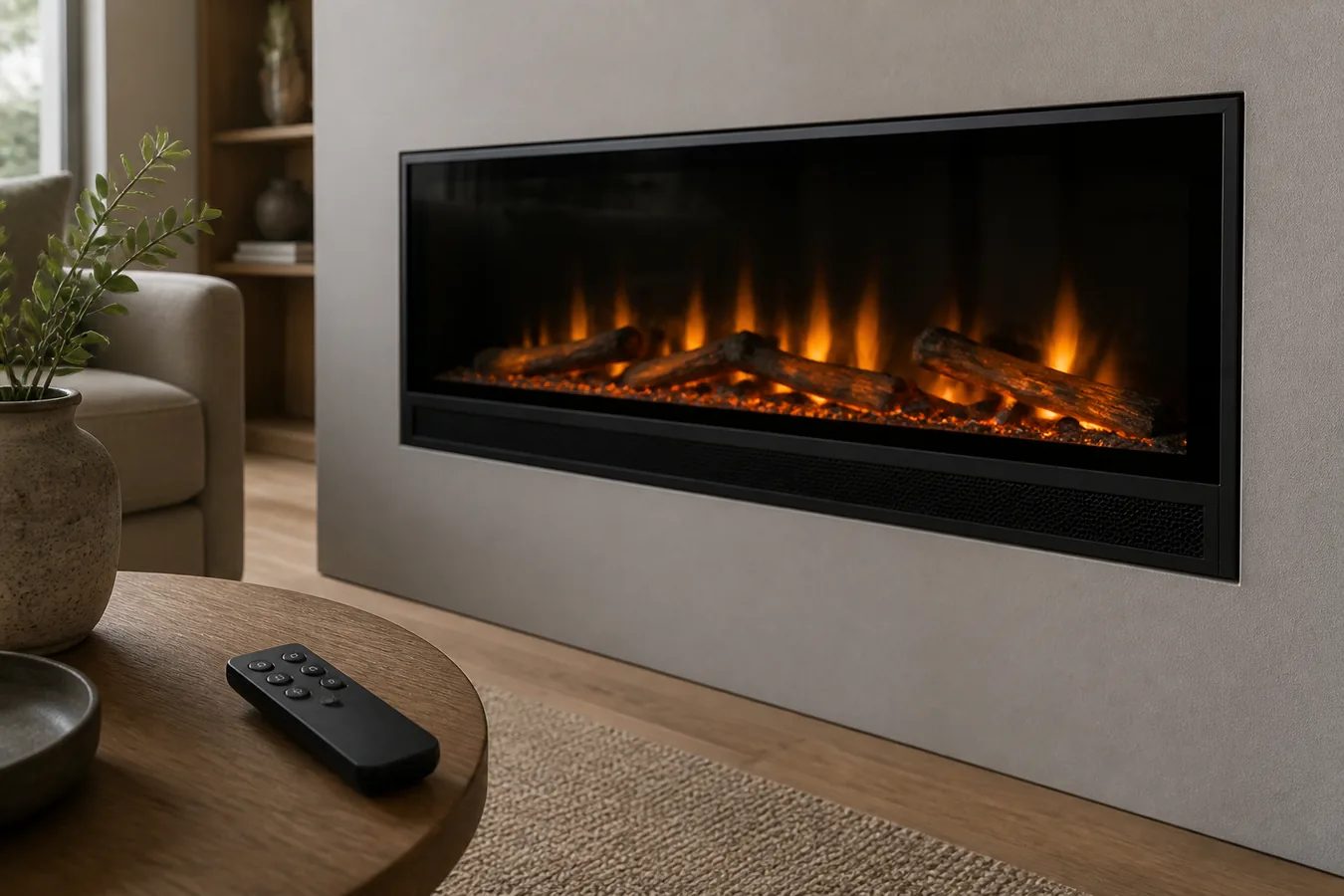
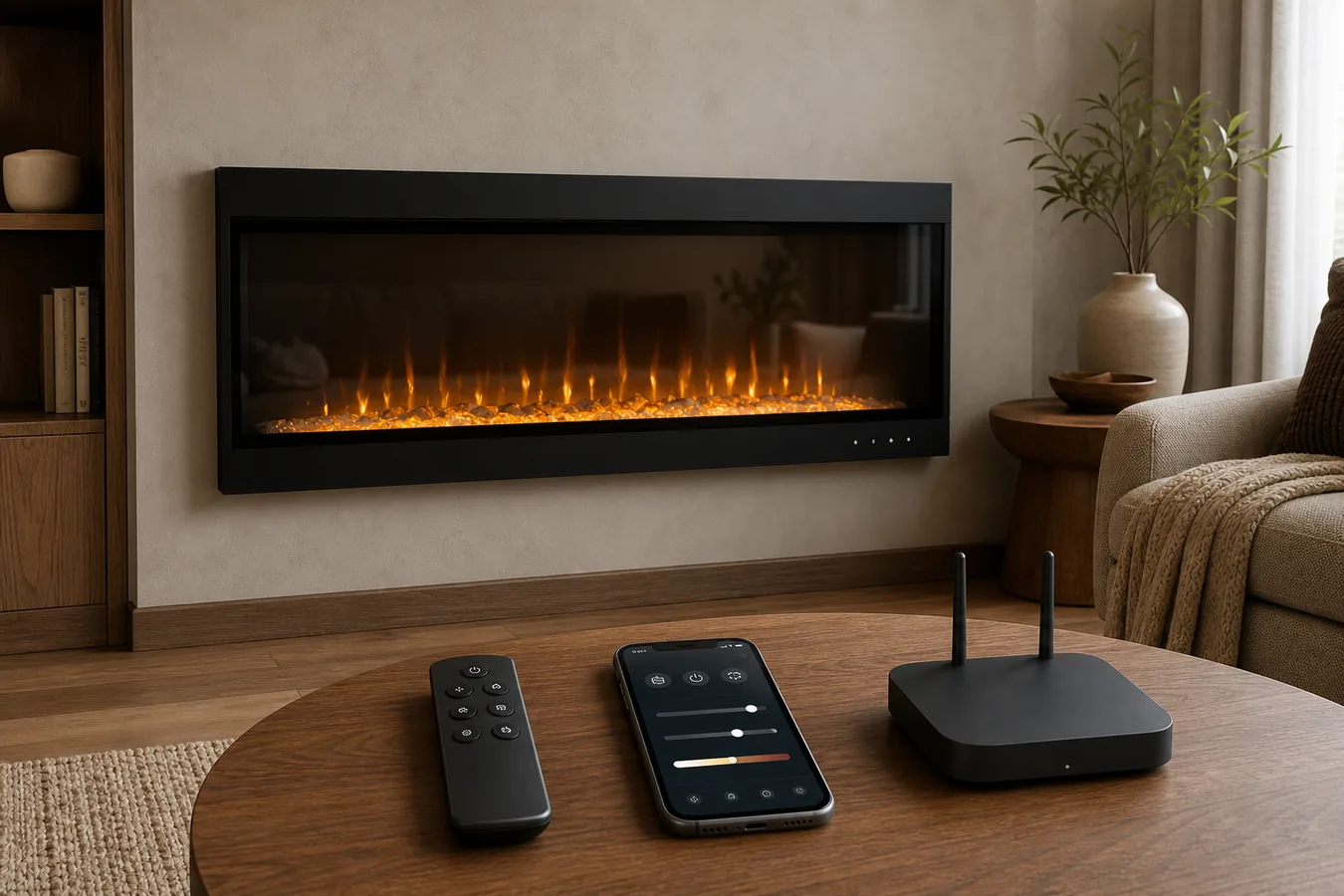
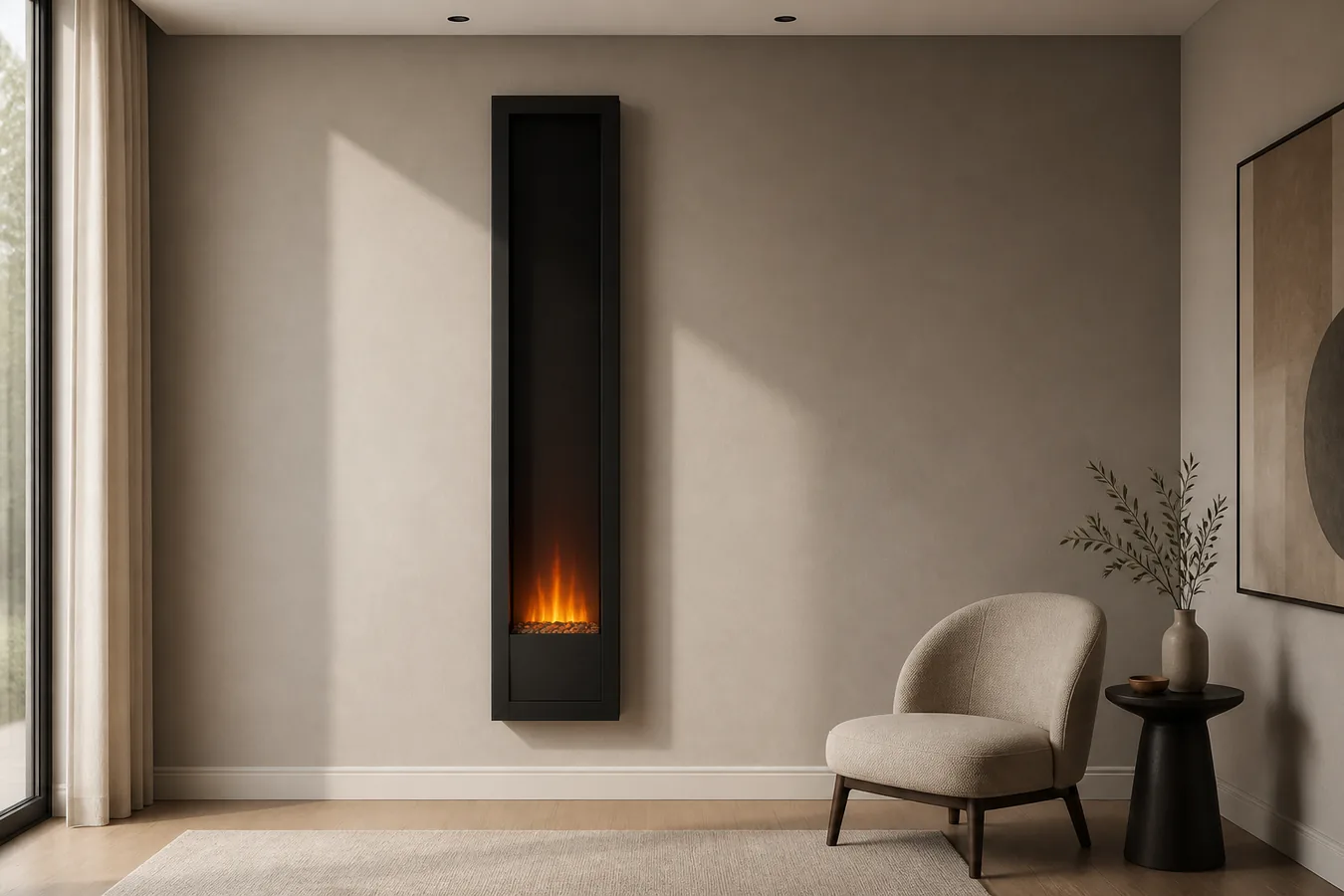
The flame video is probably showing the fireplace at its best: straight on, in a dim room, with the exposure set for bright embers and a dark firebox. Your room will also see it from the sofa, under a window, at midday and while the flame is off.
So do not begin with “Which electric fireplace is the most realistic?” Begin with two narrower questions: What real fire do I want it to resemble, and from which seats must that resemblance hold? A deep wood-log fire, an open three-dimensional flame, a gas-style traditional box and a wide modern ribbon are different targets. A fireplace can be convincing at one of those jobs and wrong for another.
Choose the target first. Then ask for the same exact unit in a front view, your main-seat angle, bright room light and flame-off state. If the seller or showroom cannot supply those views, the visual decision is not finished—even if one clip looks excellent.
Decide what “real” means before comparing flames
Realism is a match to a reference, not a feature that every buyer sees the same way. Someone replacing the sight of a masonry wood fire may care about depth behind the logs and a dark interior. Someone building a contemporary feature wall may prefer a wide band of color and movement that does not imitate a traditional hearth at all. Calling the second one less realistic misses the design brief.
Use this matrix to choose the first branch. It does not rank products; it tells you what evidence would make each visual promise credible in a room.
| The fire you want to evoke | Visual relationship to look for | The view that can disprove the match | Useful result |
|---|---|---|---|
| Deep traditional wood fire | Logs with visible depth behind and around them; an interior that still reads as a firebox | Main-seat angle and flame-off view reveal whether the logs, back wall and panel still form one scene | Traditional deep-firebox shortlist |
| Open, three-dimensional flame | Light and a physical medium such as mist create volume that is not confined to a flat rear image | Side and corner views reveal whether the selected product actually supports the planned viewing geometry | Open three-dimensional shortlist |
| Traditional gas- or wood-style image | Video or layered imagery supplies recognizable flame patterns while physical logs and an ember bed carry the foreground | Daylight and off-axis views reveal the screen/panel relationship; flame-off shows what remains | Virtual traditional shortlist |
| Wide contemporary ribbon | Movement, reflections and media create a designed linear effect rather than a masonry-fire imitation | The longest everyday viewing distance and bright side light show whether the visual scale suits the wall | Modern linear-effect shortlist |
If two people in the household choose different rows, settle that disagreement before comparing models. Brightness, extra colors or a larger nominal size will not turn one reference fire into another.
If the physical format is still open—existing fireplace, deep built-in box, slim wall unit, three-sided corner or freestanding stove—start with the types of electric fireplaces guide. The flame system cannot rescue a firebox that has the wrong relationship to the wall and seats.
Three flame systems solve different visual problems
Current manufacturer pages make the contrast concrete. Their appearance claims are commercial claims, not an independent ranking, but their descriptions identify the physical system a buyer needs to evaluate.
| Current source-bound example | Documented visual medium | What remains physically in the scene | What to verify in your room |
|---|---|---|---|
| Dimplex Revillusion built-in family | A translucent flame panel and full-depth presentation are used to make flames appear within the logs, with a view toward the back of the firebox | Physical logs and the selected firebox interior | Whether the panel, logs and back wall still read as one scene from the principal seat and in daylight |
| Dimplex Optimyst collection | Water mist/vapor and light create a three-dimensional flame-and-smoke effect; formats vary by product | Media, water-vapor hardware and the exact product’s enclosure or opening | Whether the exact front/left/right/bay relationship matches the seats—and whether its water, heat and service duties fit |
| Napoleon Elevation X 42 NEFB42LCD-MF | HD gas and wood flame video on a rear LCD is combined with layered visual technology | Split-oak logs, an ember bed and a documented reflective-panel/log option without the main flame | Whether video, layers and foreground stay coherent from the seat, in bright light, with sound off and with the flame off |
The current Dimplex Revillusion owner describes a traditional wood-fire reference: a translucent panel, full-depth box, logs and a visible interior. That makes it relevant to the first row, but it does not prove that every viewer will prefer it or that every Revillusion model shares the same dimensions, power and controls. Resolve those exact identities in the Dimplex Revillusion model guide after the format survives the visual check.
The current Dimplex Optimyst collection uses a different medium: water mist and light. The collection includes multiple physical formats, and its e-MatriX branch includes front, left, right and bay relationships. That variety is precisely why “water vapor looks three-dimensional” is not a complete order decision. If this visual branch wins, move to the water vapor electric fireplace guide to close water supply, heat and service access for the exact model.
Napoleon’s current Elevation X 42 product owner documents another approach: gas and wood flame video on a rear LCD, layered with additional visual elements, in front of physical logs and an ember bed. It also documents built-in crackling sound and a reflective-panel/log presentation without the main flame. Those are facts about that exact model, not proof that all screen-based fireplaces behave alike. The holographic and virtual fireplace guide handles exact display, control, wall and service ownership after a screen or projection branch is chosen.
No row wins automatically. The question is whether the medium supports the fire you meant to imitate without fighting the room.
A polished front-facing video skips the views that matter
An honest comparison keeps the unit and conditions as stable as practical. Otherwise one fireplace receives a dark, tightly framed hero clip while another is judged from a bright room and an oblique phone recording.
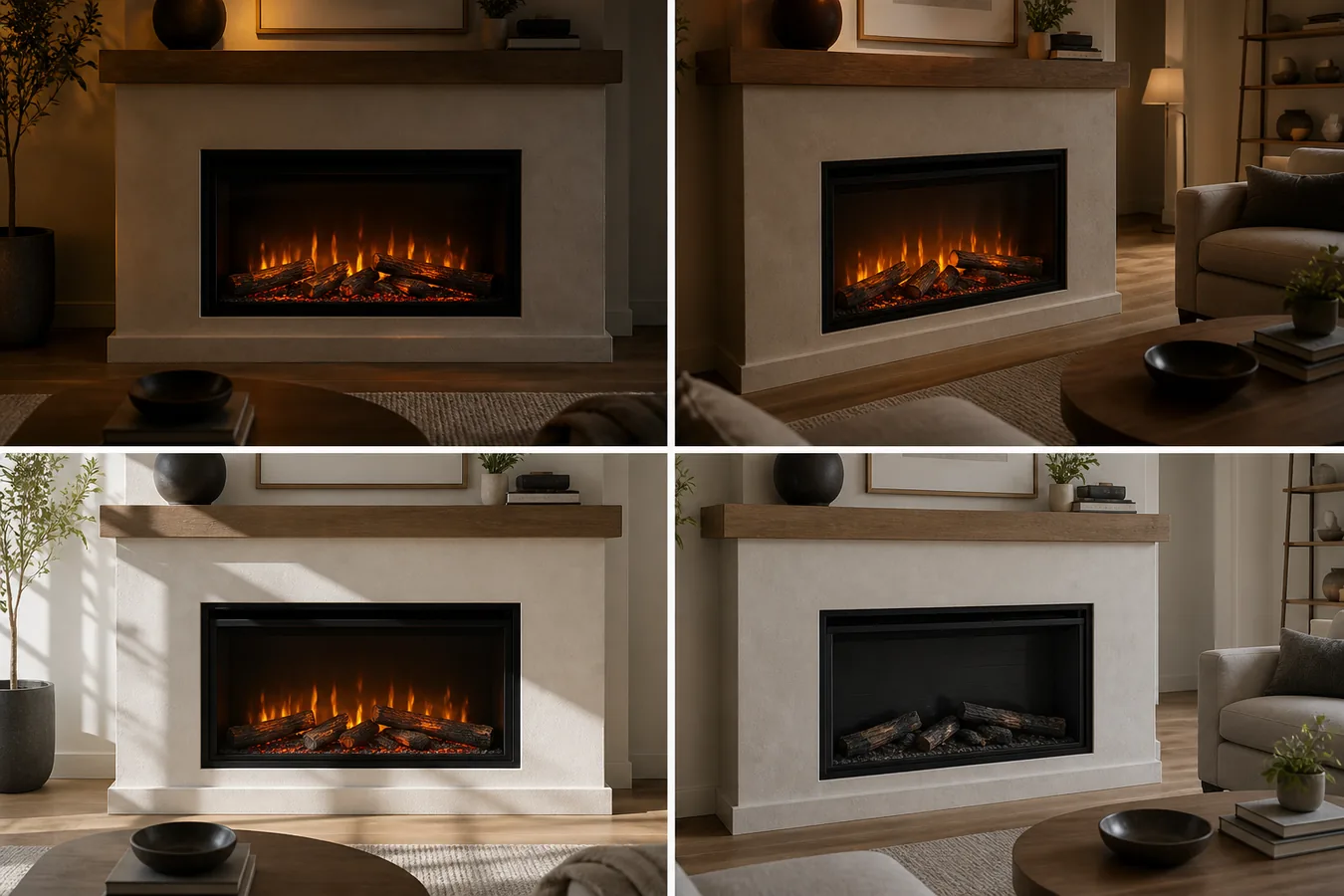
Ask for one continuous phone video of the exact model and media configuration. It should begin straight on in normal room light, move to the principal-seat position, pause at the most oblique everyday angle, show the fireplace with nearby daylight or room lighting on, and end with the main flame switched off. Keep the whole firebox in frame. Ask the sender not to add a filter, cut between scenes or substitute another size.
That request is more useful than asking whether the flame is “3D” or “ultra realistic.” It can expose five different mismatches:
- the flame appears detached from the logs at the main seat;
- a reflective or display surface becomes dominant in side light;
- the flame loses too much contrast during the hours the room is actually used;
- the physical logs, ember bed or interior look wrong when the effect is idle;
- the exact media configuration in the quote is not the one shown in the demo.
The video does not need to prove that a product is perfect. It needs to show the conditions that would make you reject it. If a critical view is missing, leave the candidate in matched-view evidence required rather than filling the gap with a different model’s video.
The fireplace is still furniture when the flame is off
For much of the day, the fireplace will be a dark rectangle, a log arrangement, an ember bed or a reflective interior. That idle scene occupies the same focal point as the active flame, so it belongs in the visual decision.
Look at the logs from normal standing and seated distances. Do they have the scale and arrangement your reference fire calls for? Does the back of the firebox reinforce the intended depth, or does it reveal a panel you would notice every morning? In a contemporary linear wall, do the crystals, driftwood or other media still look intentional without color and motion?
Physical media are not universally interchangeable. A manufacturer’s optional log set, ember material, panel or glass may apply only to named models and quantities. Do not plan to fix an unconvincing idle scene with aftermarket media until the exact manual or accessory owner permits it. First decide whether the supplied scene is acceptable; then verify any change against the exact product.
This is also where daylight belongs. Direct sun across glass is not a fair comparison with a dark showroom, but it may be the room you own. Capture the ordinary condition rather than the most flattering one. If the fireplace will mostly run after sunset, weigh the evening view more heavily—but still accept the daytime object that remains on the wall.
Sound can support the scene or reveal the trick
Crackling is a separate layer, not proof of a realistic flame. The Elevation X 42 source explicitly documents built-in crackling sounds. The opened Revillusion and Optimyst collection owners do not establish one universal included sound package for every member, so their exact model records must answer the question.
Hear the candidate from the main seat with the crackling on, then off. Repeat that with the heater off so a fan does not get confused with the effect’s audio. The useful questions are ordinary: Can the sound be disabled? Is its level adjustable? Does it repeat in a way you notice? Do local controls or the included remote keep that choice available without an app?
A buyer who dislikes synthetic crackling may prefer a strong silent scene. Another may accept a screen-based flame only when the logs and sound complete it. Neither preference creates a category winner. It changes which fields must be documented on the exact model.
Shortlist the room proof, not the showroom adjective
Once a format survives, attach the evidence to the model you may actually buy: full model and size, visual medium, installed media, front view, principal-seat view, daylight view, flame-off view and sound state. A different size, optional log set or software generation is not a substitute.
Send a request this specific:
Please send one unedited phone video of the exact model and included media in the quote. Show the full firebox from straight on, from the main seating angle, with normal room lights or daylight, and with the flame switched off. Please include ten seconds with the crackling sound on and ten seconds with it off, and confirm the model number shown.
That answer gives you something a “most realistic” badge cannot. It shows whether the fireplace is convincing in the room you will use, not merely in the frame someone chose for the advertisement. If the exact-model evidence never arrives, do not replace it with confidence. Keep the visual decision open and move no further than the format you can actually prove.