A cast iron electric fireplace is not a performance class. It is first a claim about what the appliance is made from. Until that claim points to an exact component and an exact current model, it tells you nothing dependable about weight, voltage, heat output, placement or service.
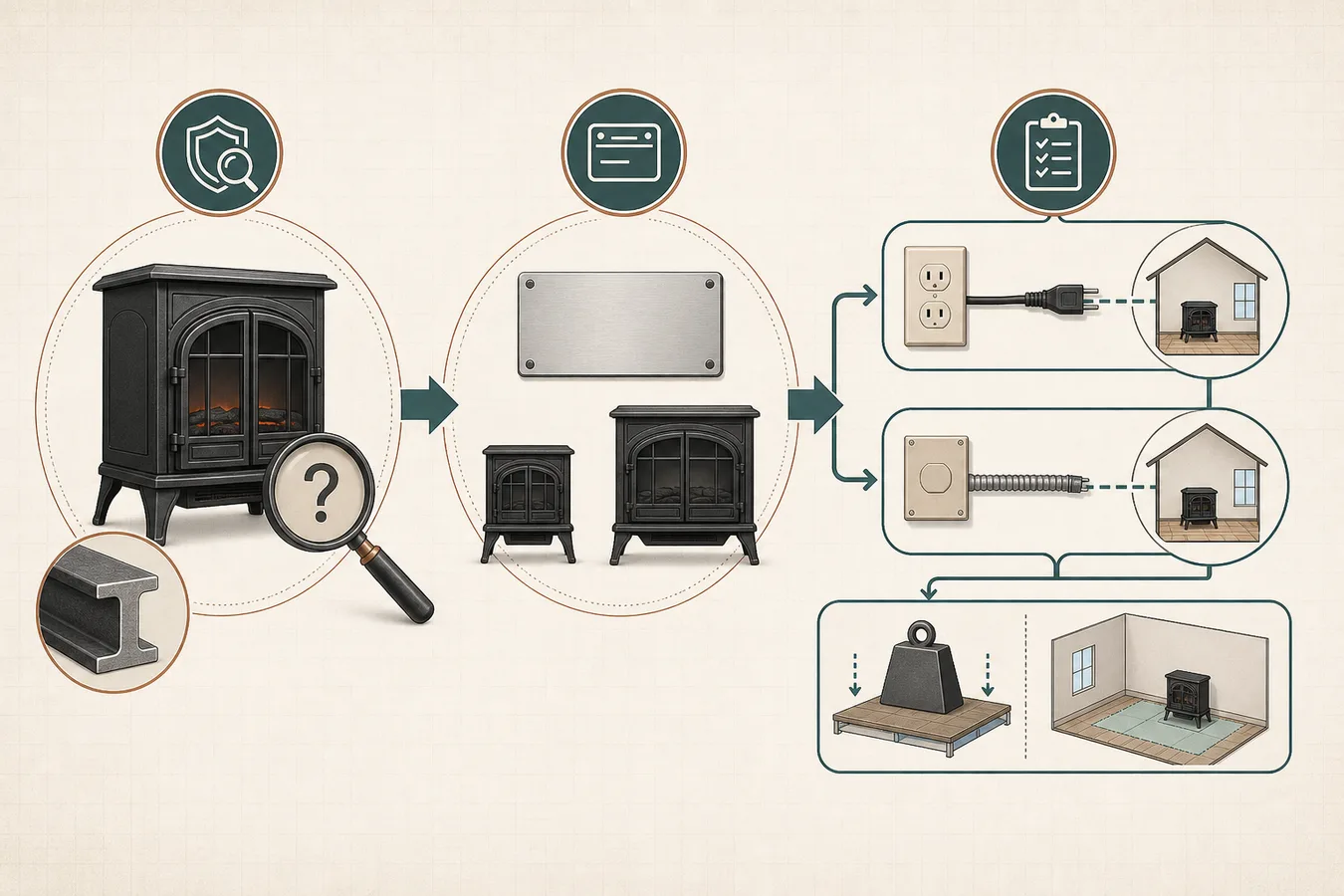
The short answer is to require three kinds of proof before keeping a candidate: the manufacturer must say what is cast iron; the rating label and current documentation must identify the same appliance; and the electrical and room facts must be read separately from the material. A stove silhouette, retailer filter or traditional finish cannot close those gaps.
Make the word “cast iron” point to something
“Cast iron” can carry at least three meanings in a search result. It may describe the appliance body or specific structural pieces. It may be shorthand for a traditional stove look. Or it may be a retailer’s filter value applied without a visible construction statement on the product page.
Only the first meaning is a material claim, and even that claim needs an owner. The current Amantii page for its E-50-HO and E-70-HO freestanding series calls the construction heavy-duty cast iron. Its current document library also labels the E-50 and E-70 as cast-iron freestanding models and provides repair documents for cast-iron pieces. Together, those sources make the phrase traceable for that series. They do not prove the construction of a similar-looking fireplace from another listing.
Ask the material question in nouns, not impressions: cast-iron body, door, legs, side panels or decorative trim? A manufacturer may answer at series level, in the construction field, or through a parts and repair owner. A listing that never names the component leaves you unable to compare it with a steel firebox in a cast-look surround. Photographs cannot reliably settle that difference, especially when the finish is intentionally textured.
Treat the material field like voltage or required opening: copy it only from a source that names the same appliance. The electric fireplace specification guide explains why each field needs its own source and unit. If a seller says only “cast iron style,” “cast iron finish” or shows the item under a cast-iron filter, record the construction as unresolved.
The suffix decides which fireplace you are reading about
The current Amantii product page uses E-50-HO and E-70-HO. The current Lynwood documentation page groups cast-iron files under E-50 and E-70, while the manufacturer’s discontinued-documentation page separately lists E50-NA and E70-NA. Those are close strings, but proximity is not identity.
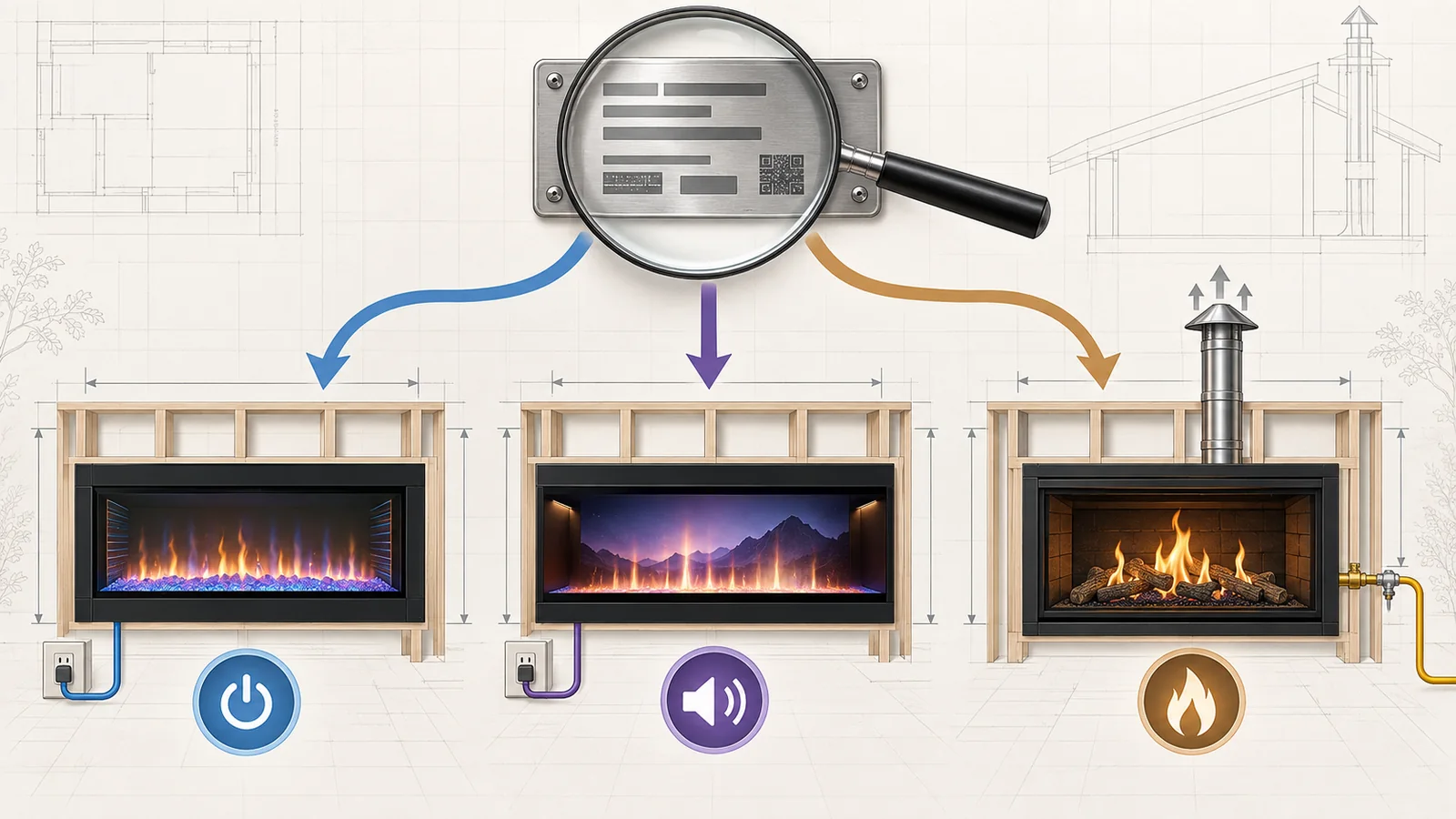
Start with the complete rating-label string on the physical unit or the manufacturer’s current product record. Open the live documentation index rather than an old search-result PDF. Then confirm that the manual or specification sheet names the same model family and reflects the same voltage options, controls and dimensions. If the suffix or document status still conflicts, hold the candidate and ask the manufacturer which current file controls.
Write one identity line before transferring any specification: brand, complete model, market, document title, document date or revision, and live source URL. This takes less time than untangling a mixed note later. It also exposes a common failure immediately: the product page is current, but the only specification being copied belongs to a retired near-match.
That is also the point at which the general manual search ends. The electric fireplace manual guide can help admit an official document, but this page owns the narrower question: does the document preserve the cast-iron construction claim and the current product identity at the same time?
Voltage changes the heater path, not the material
For the current Amantii example, the manufacturer describes a 120-volt standard plug-in path rated at 5,000 BTU and a 240-volt hardwired path rated up to 20,000 BTU. The larger number comes from a different electrical configuration documented for that product. It is not evidence that cast iron itself raises heat output.
This distinction prevents two bad shortcuts. First, a 120V listing cannot inherit the 240V output simply because the cabinet looks identical. Second, a product described as cast iron cannot inherit either output from a different model. Record voltage, watts, amperage and heat output from the same current sheet, then identify whether the value belongs to plug-in or hardwired operation.
A hardwired option is also not permission to improvise a conversion. The exact current manual, product configuration, branch circuit and applicable electrical work still control. The 240-volt electric fireplace guide owns the broader decision about when a higher-voltage path is justified; a material keyword does not answer it.
Weight enters the room plan before flame settings
The current imperial specification sheets list 132 pounds for the E-50 unit and 145 pounds for the E-70 unit. Those figures are useful because they change the questions to settle before delivery: route, stairs, handling, floor protection, final level surface and future service access. They do not establish a universal “cast iron weight,” and they do not decide whether a particular floor or person can support the move.
The current product page also marks the series for indoor use only. A freestanding silhouette should not be read as permission for a porch, covered patio or other outdoor location. Preserve the location rating exactly as published.
Appearance belongs in a separate column. The traditional electric fireplace guide can help define the room’s visual goal, while the freestanding electric fireplace guide owns format, mobility and placement tradeoffs. Neither style nor format proves that a cabinet is cast iron. Conversely, verified cast-iron construction does not tell you whether the flame presentation will satisfy a realism preference.
Keep only candidates that complete one evidence card
Use one card per candidate. The two named rows below show how current first-party facts can close the record; they are not a recommendation or a fit decision.
Do not score missing fields as neutral. A blank material scope means the title claim is unproved. A blank model status means the manual may be obsolete. A blank voltage path means the heat figure has no usable owner. The correct result is a precise hold, which tells the seller or manufacturer exactly what must be supplied.
| Candidate record | Material claim scope | Current identity and status | Weight and location | Electrical path | Admissible next decision |
|---|---|---|---|---|---|
| E-50-HO product / E-50 current documents | Manufacturer states heavy-duty cast-iron construction; current library includes cast-iron-piece repair documentation | Current product page plus current Lynwood E-50 manual/specification owner; keep retired E50-NA documents separate | 132 lb unit; indoor-only | 120V plug-in at 5,000 BTU, or documented 240V hardwired path up to 20,000 BTU | Keep only after the local label, suffix, current manual, dimensions and planned electrical path agree |
| E-70-HO product / E-70 current documents | Same manufacturer-owned series claim, tied to the larger current model | Current product page plus current Lynwood E-70 manual/specification owner; keep retired E70-NA documents separate | 145 lb unit; indoor-only | 120V plug-in at 5,000 BTU, or documented 240V hardwired path up to 20,000 BTU | Keep only after the local label, suffix, current manual, dimensions and planned electrical path agree |
| Generic “cast iron” listing or retailer filter | Unknown: may indicate construction, appearance or taxonomy | No exact current model/manual pair | Unknown | Unknown; do not borrow values from a similar stove | Hold. Ask for the rating label and current manufacturer documents, or reject the candidate |
Complete the card with the exact dimensions and clearances from the current sheet or manual before planning the room. If any field is filled from a different model, an archived document or an unsupported seller phrase, the card is not nearly complete—it has failed at that row.
That gives “cast iron” a useful but limited job. It can admit a documented construction claim into the decision. It cannot select the voltage, promise heat, erase the model suffix, make an indoor product outdoor-ready or replace the room plan. Keep the candidate only when all of those owners agree on the same current fireplace.