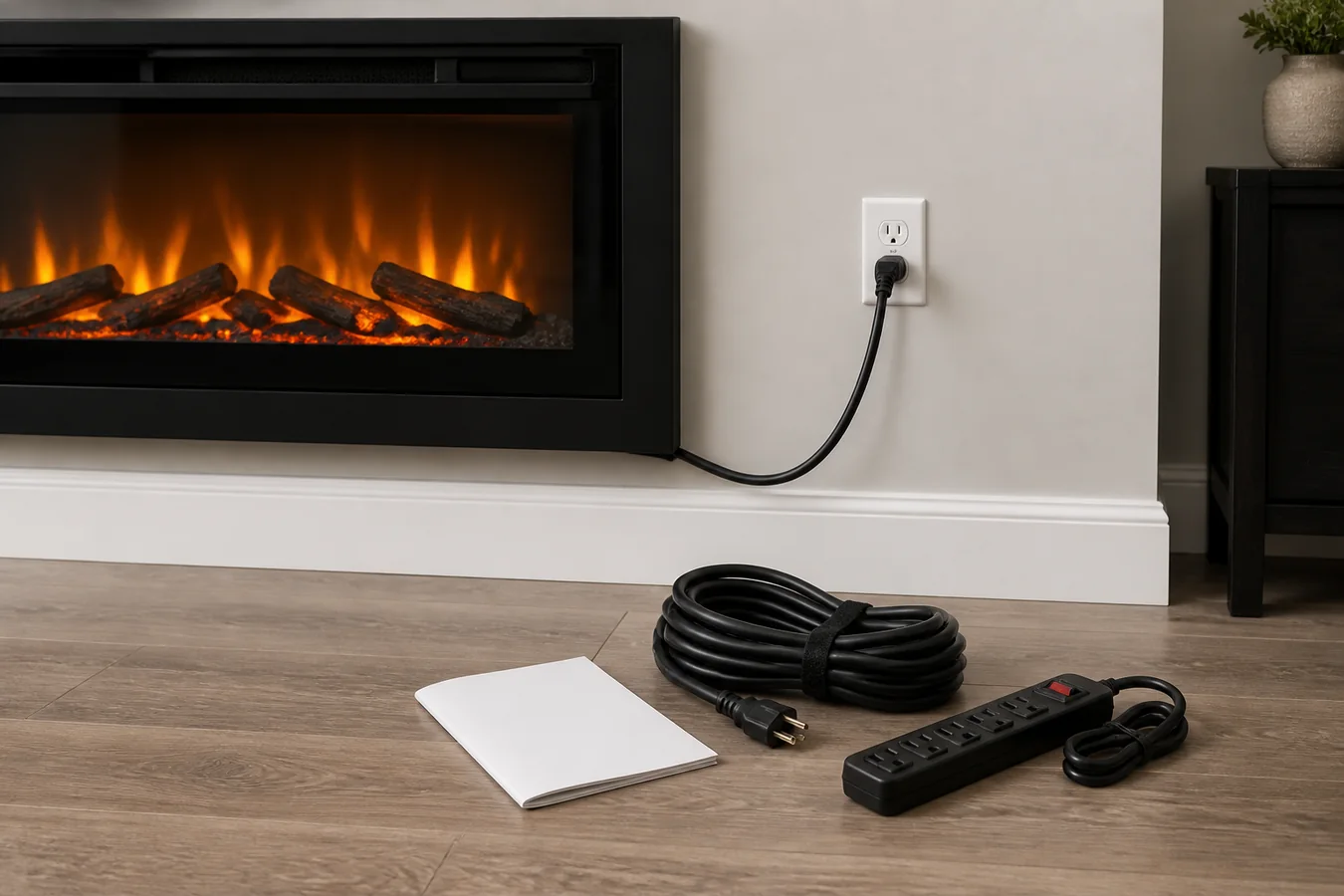
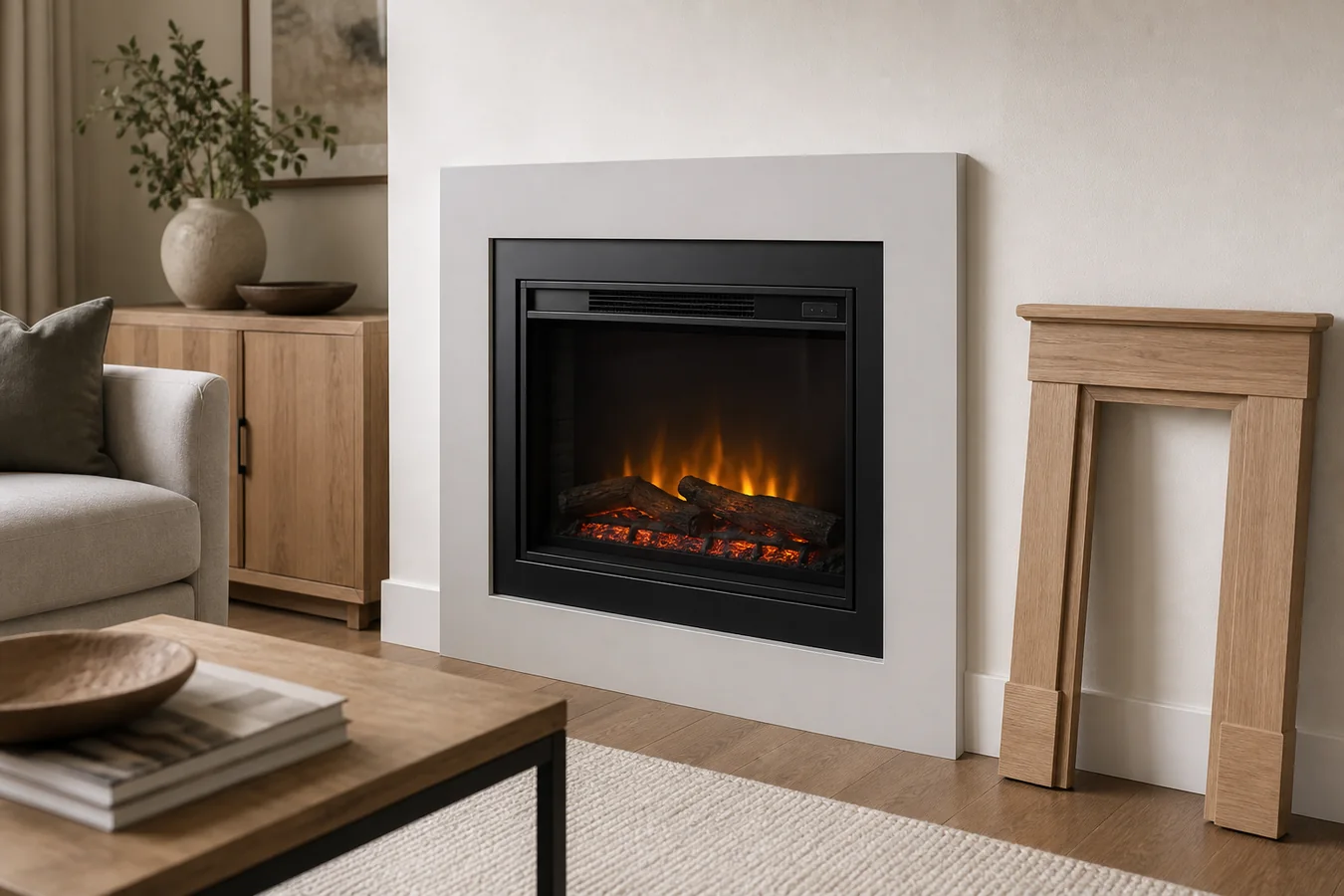
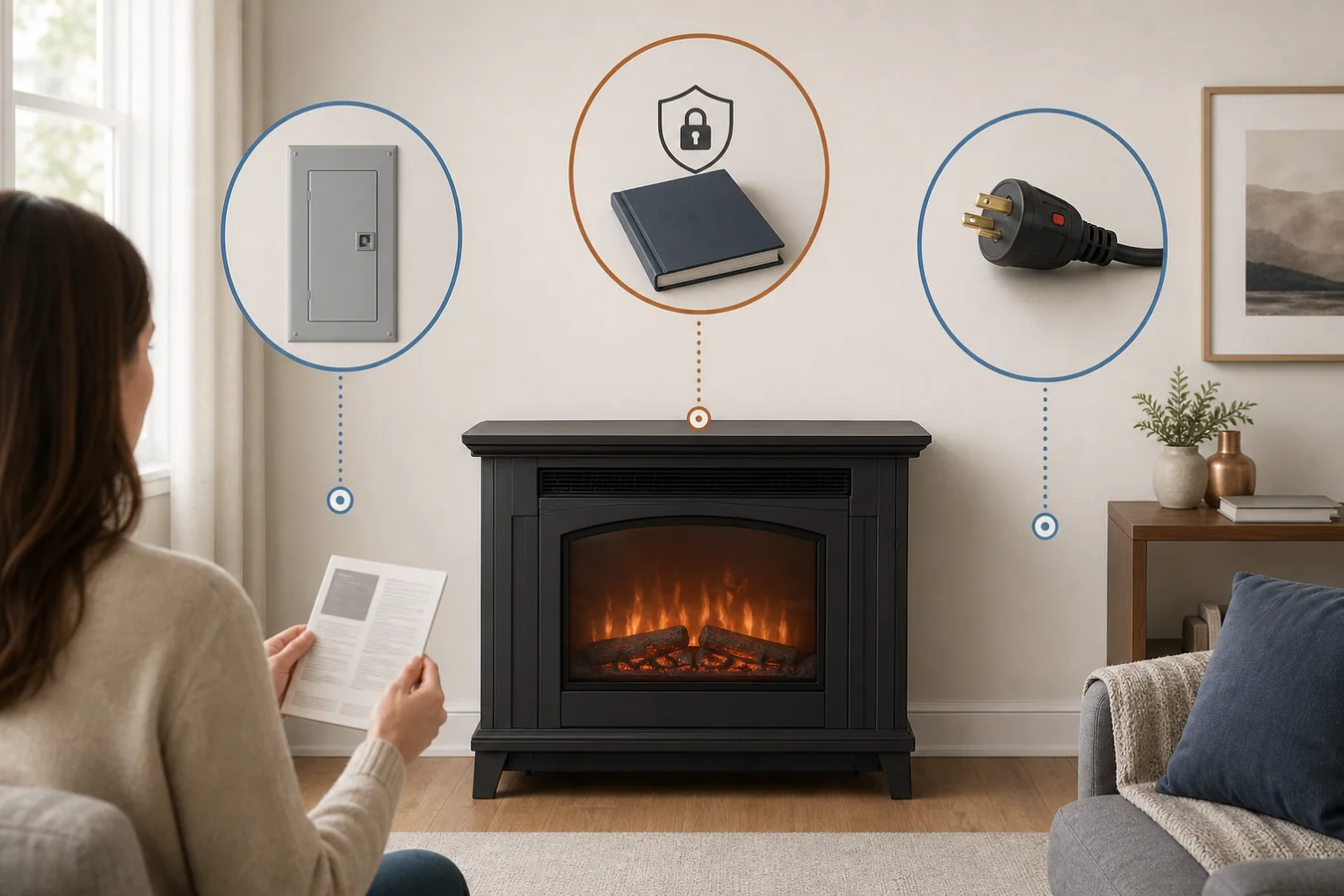
A 240 volt electric fireplace earns its place in a project only when three things are true: the exact model documents a meaningful change from its 120V mode, your heating job needs that change, and the current manual supports a project path you can settle before finish work.
If the exact model produces the result you need at 120V, a 240V rough-in buys project work without buying a useful outcome. If the product page and current manual do not agree, the larger number is not permission to keep building.
Start with the model/SKU and its current documents. Then compare mode-specific watts, BTU per hour, connection, manufacturer circuit and conductor wording, project stage, the room task, and the 120V fallback. The result should name the precise ready path or hold instead of collapsing every missing field into “ask an electrician.”

Make 240V earn its place in the project
| What the current record says | Decision | What changes it |
|---|---|---|
| The rating-label model and current controlling manual are not matched | Exact-model manual required | A current manufacturer document whose applicable-model list includes the complete model/SKU |
| The document does not publish a separate 240V output | 240V output not documented | A model-bound watt and BTU pair; a category or merchant maximum cannot fill the gap |
| The modes are documented, but 120V already serves the accepted flame or comfort job | 120V path only | A different named heating job—not a preference for the larger maximum number |
| Useful 240V output is established, but connection, circuit, conductor, or configuration wording is missing or conflicting | Connection or circuit hold | Exact manufacturer wording reviewed by the qualified person responsible for the work |
| The governing fields are complete, but the documented work cannot yet be placed in the project sequence | Rough-in timing hold | A confirmed point before finish work when the exact-model requirements can be implemented |
| The product record aligns, but no qualified owner has accepted the electrical/install decision | Electrical authority required | The manufacturer, electrician, or other qualified project owner closes the field in their scope |
| The exact model, useful output delta, heating job, governing fields, timing, and authority all agree | Exact-model 240V path ready | A later model, manual, room task, or project change reopens the affected field |
This is deliberately narrower than a plug-in versus hardwired decision. Connection is one governing field here; it is not a shortcut to the answer. Search phrases such as “220V electric fireplace” are not permission to replace the voltage stated on the exact rating label or manual.
Two current models show why the label is not the decision
Two manufacturer records show how much can hide behind the same dual-voltage description. They are examples of documentation quality, not product recommendations.
| Exact product record | 120V mode | 240V mode | Decision issue |
|---|---|---|---|
| Napoleon Element 42 NEFB42H-BS-1 | Plug-in; 1,450 W; 5,000 BTU | Hardwired; detailed bullet states 2,800 W and 9,000 BTU | The same current page’s summary specification area states 3 kW and 10,000 BTU. Resolve the controlling number before the electrical path is fixed. |
| Valor GE4 | 1,400 W; 4,700 BTU/h | 2,800 W; 9,400 BTU/h; manual says hardwired | The manual says the voltage switch is set before installation and assigns electrical installation to a qualified electrician. |
The current Napoleon Element 42 page is useful precisely because it exposes both a mode difference and a source-page conflict. Choosing 10,000 instead of 9,000 BTU because it is larger would manufacture certainty that the page does not provide.
The current Valor GE4 installation manual supplies a cleaner pair, but its numbers still belong only to GE4. Neither record proves what another 240V fireplace produces or how it connects.
The exact-model discipline is the same one used in the electric fireplace specifications guide: keep voltage, watts, BTU, connection, model identity, and document revision as separate fields. A category label cannot fill an empty cell.
Extra output needs a named heating job
Flame first
If the accepted result is visual flame with little or no heater use, the higher heater ceiling may not improve the experience you are buying. Keep flame behavior and heater output as separate decisions.
Local comfort
If the task is occasional warmth around one seating area, compare the exact 120V mode with that modest job before adding project scope. A higher maximum can be real and still unnecessary.
A defined heat contribution
If the fireplace is expected to make a material contribution in a larger or harder-to-heat room, the documented 240V delta becomes relevant. It does not become a room-performance guarantee. The heat and running-cost guide separates the appliance rating from the room’s heat demand, while the 1,000-square-foot claim guide shows why an area label needs operating conditions and a named job.
Do not call 240V “more efficient” from voltage alone. Compare the exact mode watts and the result you intend to use. A higher-output mode can deliver more heat at its maximum while also drawing more power at that setting.
The 120V fallback belongs in the decision
A dual-voltage model gives you an alternative that a maximum-output comparison can hide. Write down the result you would accept from its 120V mode. If that result closes the flame or comfort task, the value of 240V must come from a real remaining heat need—not from avoiding the feeling that you chose the smaller number.
The fallback also exposes project timing. A manufacturer may permit one mode by plug and another by hardwire, or may set other model-specific conditions. Those facts affect who must act and when, but this page does not design the electrical path. Use the exact current manual, then place the complete installation relationship with the electric fireplace installation handoff.
If 120V is acceptable now but a future heating job might justify 240V, record that as an unresolved future requirement. Do not convert it into a circuit specification from a generic article.
Hand off a product decision, not a voltage label
| Field | What belongs in the record |
|---|---|
| Exact product identity | Brand, complete model/SKU, market, and rating-label voltage wording |
| Current controlling document | Manufacturer URL, document title, revision/date if shown, and applicable model list |
| Mode pair | 120V and 240V watts, BTU/h, and connection exactly as published; no blanks filled from another model |
| Manufacturer electrical fields | Copy the exact circuit, conductor/neutral, and voltage-selector or configuration wording; leave interpretation to the qualified electrical owner |
| Named heating job | Flame only, local comfort, or a defined heat contribution—plus the result accepted at 120V |
| Project state and owner | Planning, rough-in, or finished wall; manufacturer and qualified electrical/install authority responsible for unresolved fields |
| Conflicts and outcome | Any page/manual disagreement and one precise ready path or hold from the value gate above |
If the controlling manual is missing, use the electric fireplace manual guide to match the document to the rating-label model before asking for electrical work. If two current manufacturer fields conflict, send the record to the manufacturer and preserve the answer with the project documents. The useful next step is not “install 240V”; it is to close the one field that prevents the exact model’s higher-output benefit from becoming a safe project decision.