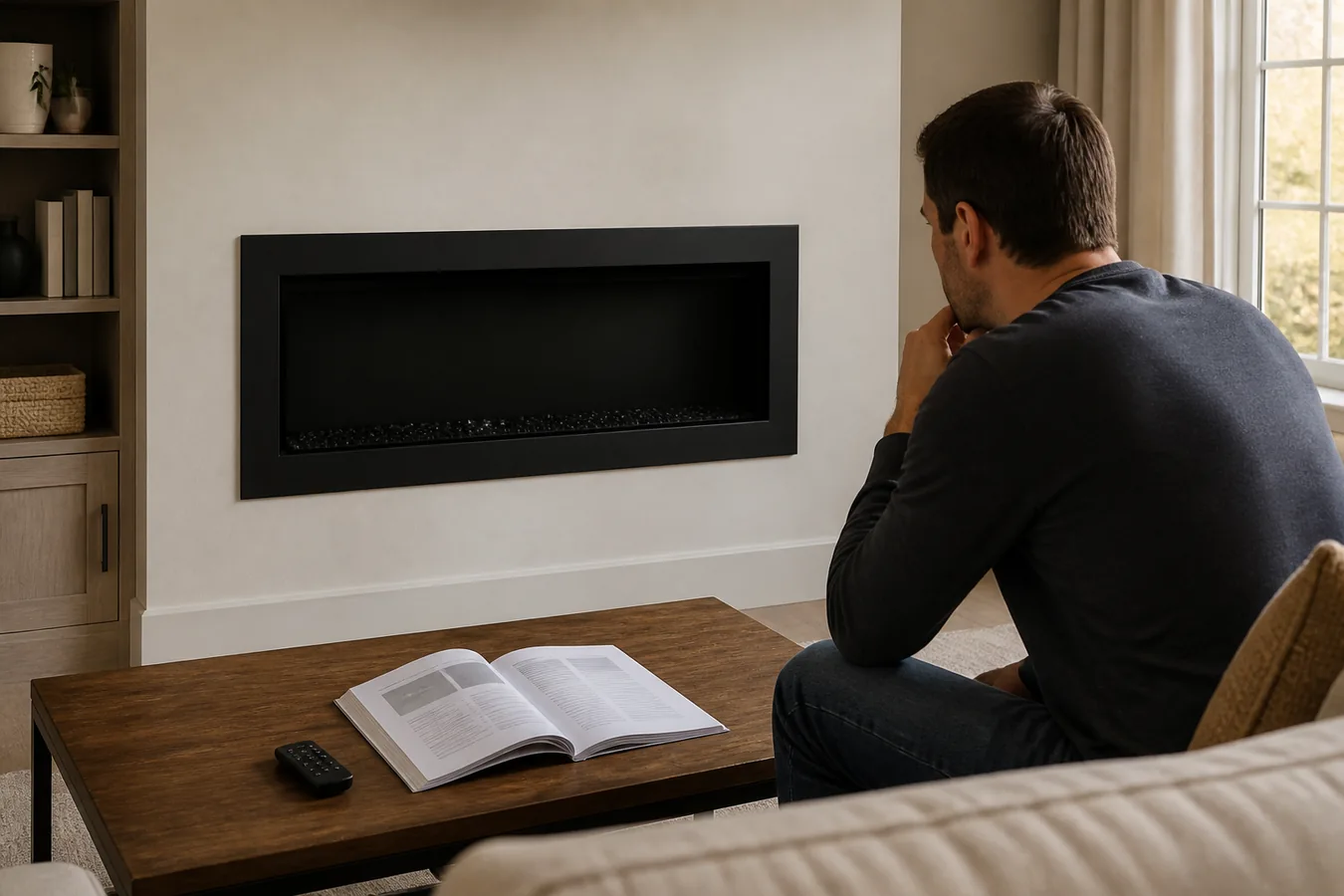
Did only the heat stop, or did the flame, display, and controls go dark too? That distinction is more useful than counting how many minutes the fireplace ran.
If the flame effect stays on while the heater stops near a set temperature, the thermostat may be doing exactly what the manual describes. A programmed timer can also create an intentional shutdown. A model-documented protective cutoff needs that model’s response. If the controls go dark, a breaker trips, or the same shutdown returns after the authorized action, stop treating it as a routine setting change.
Do not diagnose the appliance from elapsed time alone. Record the exact model, what stopped, which settings were active, and what the current owner manual says should happen next.
Name the stop before naming the cause
| What you observe | What to record next | Where the decision goes |
|---|---|---|
| The flame and display remain on, but heat stops near the selected temperature | Room/set temperature shown by the exact control and the manual’s thermostat behavior | Possible expected thermostat cycle; do not reset until the manual says this is abnormal |
| The appliance shuts down at a selected duration | Timer or schedule shown on the appliance, remote, or supported app | Confirm a documented timer event before treating it as a fault |
| The heater stops after heat operation and the exact model documents an overheat indicator or cutoff | Indicator, visible exterior air path, clearance condition, and the exact reset text | Follow only the model-authorized cool-down or reset; record recurrence |
| Flame, display, and controls all go dark, with no confirmed timer event | Connection type, visible plug/cord state, breaker symptom, and current manual | Manufacturer or power-path review; do not assume a heater-only cause |
| A breaker trips, or there is smoke, a burning odor, water exposure, or visible damage | Stop condition and who has authority: manufacturer, landlord, electrician, or qualified service | Keep the appliance out of use until that owner clears it |
| The same shutdown returns after the exact authorized action | Time, mode, settings, indicator, and number of recurrences | Manufacturer service rather than repeated resets or internal repair |
This matrix routes an event; it does not name a failed component. If the rating label and current document are not matched, start with the electric-fireplace manual guide. A displayed code also needs its own model context—the E3 code guide shows why identical characters can mean different things on different products.
Temperature and time settings can imitate a failure
An electric fireplace can stop because it reached an instruction, not because it failed. Touchstone’s current Wi-Fi control guide, for example, gives the temperature control a shutdown-temperature function and gives the timer a shutoff function. That proves the two events are designed into the products covered by that guide; it does not prove your fireplace uses the same buttons, range, or sequence.
Look at the state, not just the silence. If the flame effect and controls remain available while the heater cycles around a documented setpoint, record that as a thermostat event. If the unit stops at the duration shown by its timer, clear or change that setting only as the exact manual permits. A remote or app screen is supporting evidence only when it belongs to the same model and is actually controlling the appliance.
The interval is not the diagnosis. “It shuts off after ten minutes” can describe a timer, room-temperature response, restricted airflow, a protective cutoff, or loss of power. Add the mode and the state of the display, flame, and controls before drawing any conclusion.
A protective cutoff is a boundary, not a diagnosis
Dimplex’s current electric-fireplace support page tells owners to use the exact manual for clearances and notes that a blocked ventilation slot can trigger overheat protection on models it covers. The same support owner describes a five-minute main-power reset for its stated case. That is a Dimplex support instruction, not a universal reset interval.
Even documents from one manufacturer can return the heater differently. The BF39STP owner manual describes a power-off, five-minute reset and says continuing reset need should be taken to Dimplex. A service manual for that model describes the heater reactivating after cooling. Those documents have different purposes and wording, so a generic article should not choose the more convenient behavior for another fireplace.
Without opening the appliance, record only what the owner is meant to see: whether a curtain, furniture, built-in finish, or other obstruction conflicts with the exact intake, outlet, and clearance instructions; whether the manual names a user-accessible filter or indicator; and whether an overheat symbol or message appeared. Do not remove panels, probe a sensor, bypass a cutoff, or turn a recurring protection event into a parts experiment.
If the current owner manual authorizes a cool-down or reset, follow that exact sequence and note whether the same event returns. If it returns, the useful fact is recurrence. EcoSmart’s current Switch troubleshooting assigns repair to qualified service and publishes its own model-family reset sequences—another reason not to transplant a sequence from one fireplace to another.
The broader electric-fireplace safety guide owns the stop conditions for smoke, burning odor, damage, water exposure, or repeated breaker behavior. Those observations outrank the convenience of getting the flame effect back on.
Darkness at the controls changes the owner of the problem
When the flame, display, and controls all disappear, the observation is no longer “the heater stopped.” It may still be a documented timer event, but if no timer explains it, preserve the whole-unit state instead of converting it into an overheating claim.
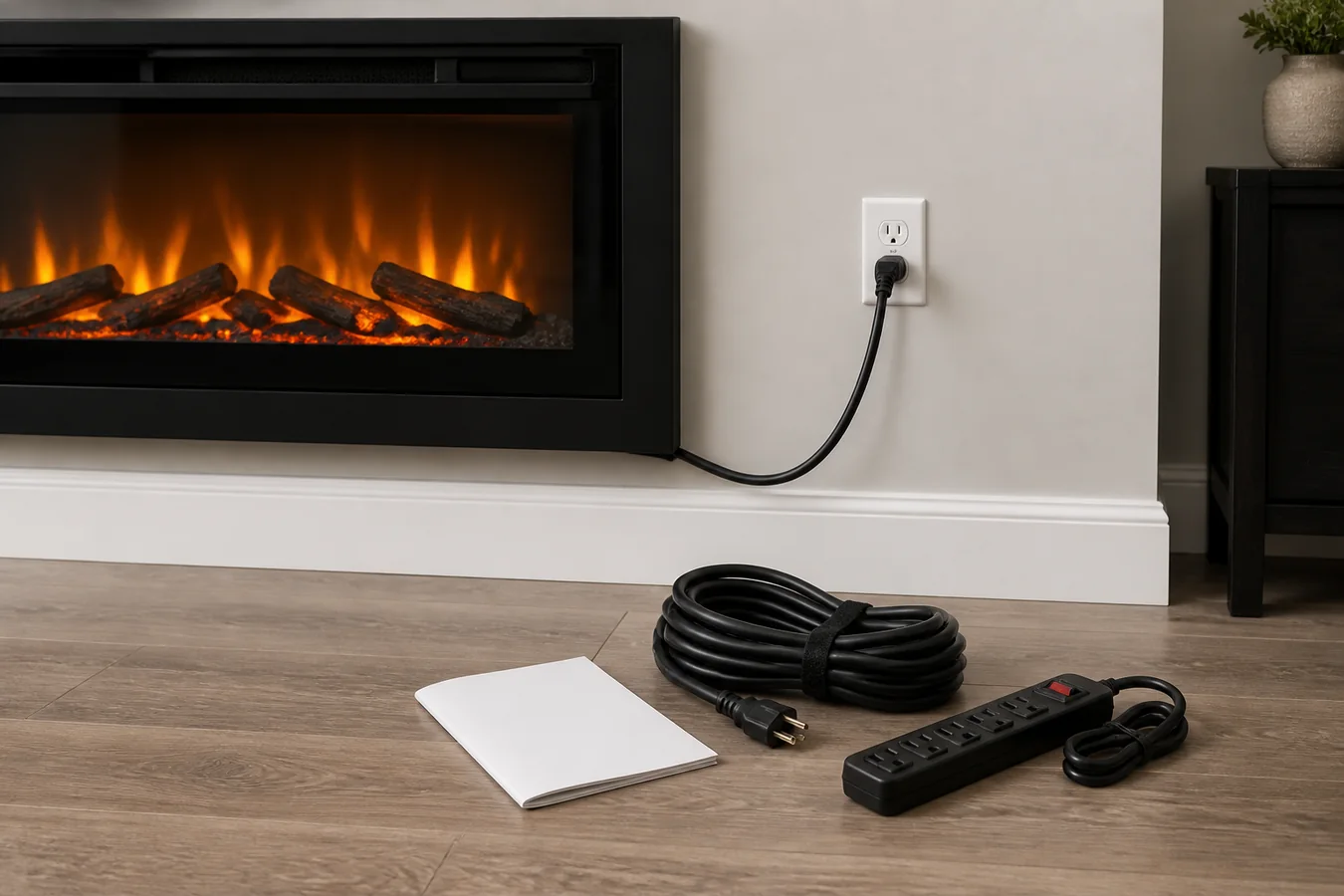
Record whether the exact model is plug-connected or hardwired. For a plug-connected model, note only visible conditions the owner manual permits you to observe: whether the plug remains seated and whether the cord, plug, or outlet shows damage. For a hardwired model or a breaker event, do not create a live electrical test from an internet article. The plug-in-versus-hardwired guide explains why those two power paths have different owners before installation; after a recurring shutdown, the model manual, manufacturer, landlord, or electrician must decide the next electrical step.
A breaker that trips again, a hot or damaged connection, smoke, a burning odor, or water exposure is not evidence that the fireplace needs “one more reset.” Leave it off and place the observation with the responsible qualified person. If the household circuit remains on but the appliance is dark, manufacturer support can use the exact model and event record without you guessing which internal part failed.
Give support an event they can recognize
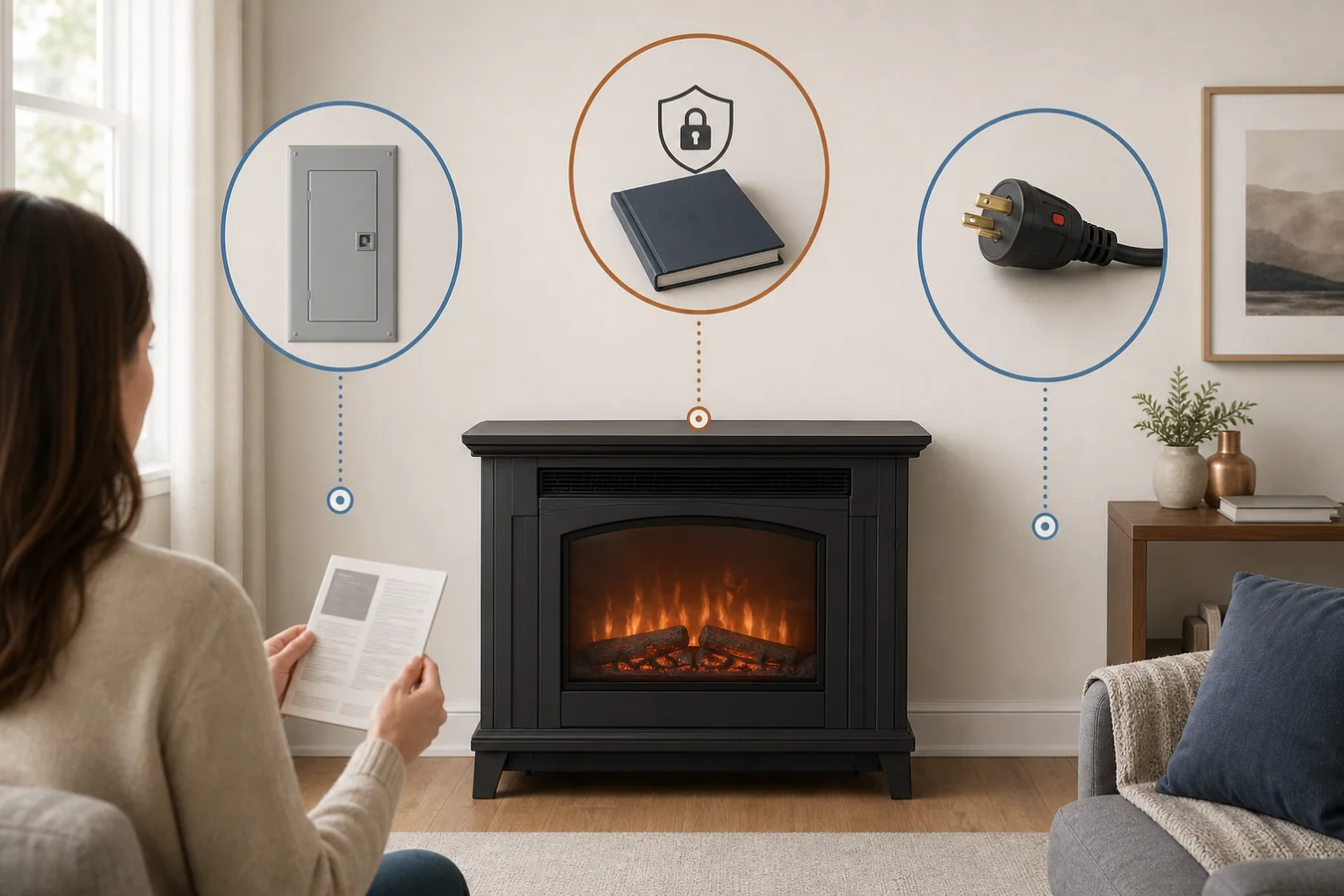
Capture the shutdown while the details are still fresh. A photo of the rating label and display can help, but copy the text as well; glare and cropped photos often hide the suffix that separates two models.
| Record field | What belongs in it |
|---|---|
| Product identity | Brand, full model/SKU, market if known, and rating-label photo |
| Controlling document | Current owner-manual URL, title, revision/date, and the page that describes the control or cutoff |
| What stopped | Heater only; flame and display too; controls unresponsive; or household breaker/circuit symptom |
| Event context | Date/time, operating mode, how long it had been running, and whether the event repeated |
| Settings | Heat level, displayed set temperature, timer/schedule, and whether control came from panel, remote, or supported app |
| Appliance message | Exact code, symbol, indicator light, or “no message” |
| Exterior condition | Only visible, manual-authorized intake/outlet, clearance, plug, cord, or damage observations |
| Authorized action | Exact manual step followed, or “none found”; never a reset borrowed from another model |
| Result | Normal control event; model-authorized reset held; shutdown recurred; power authority required; or exact manual still missing |
If a specification label is unfamiliar, use the electric-fireplace specifications guide to preserve the manufacturer’s field names rather than translating them into guesses. Send support the completed record and ask which current document and service owner apply to that exact model. The answer can be a normal thermostat or timer event, an authorized model procedure, or a named service boundary. What it cannot be is a component diagnosis inferred from the number of minutes before the screen went dark.