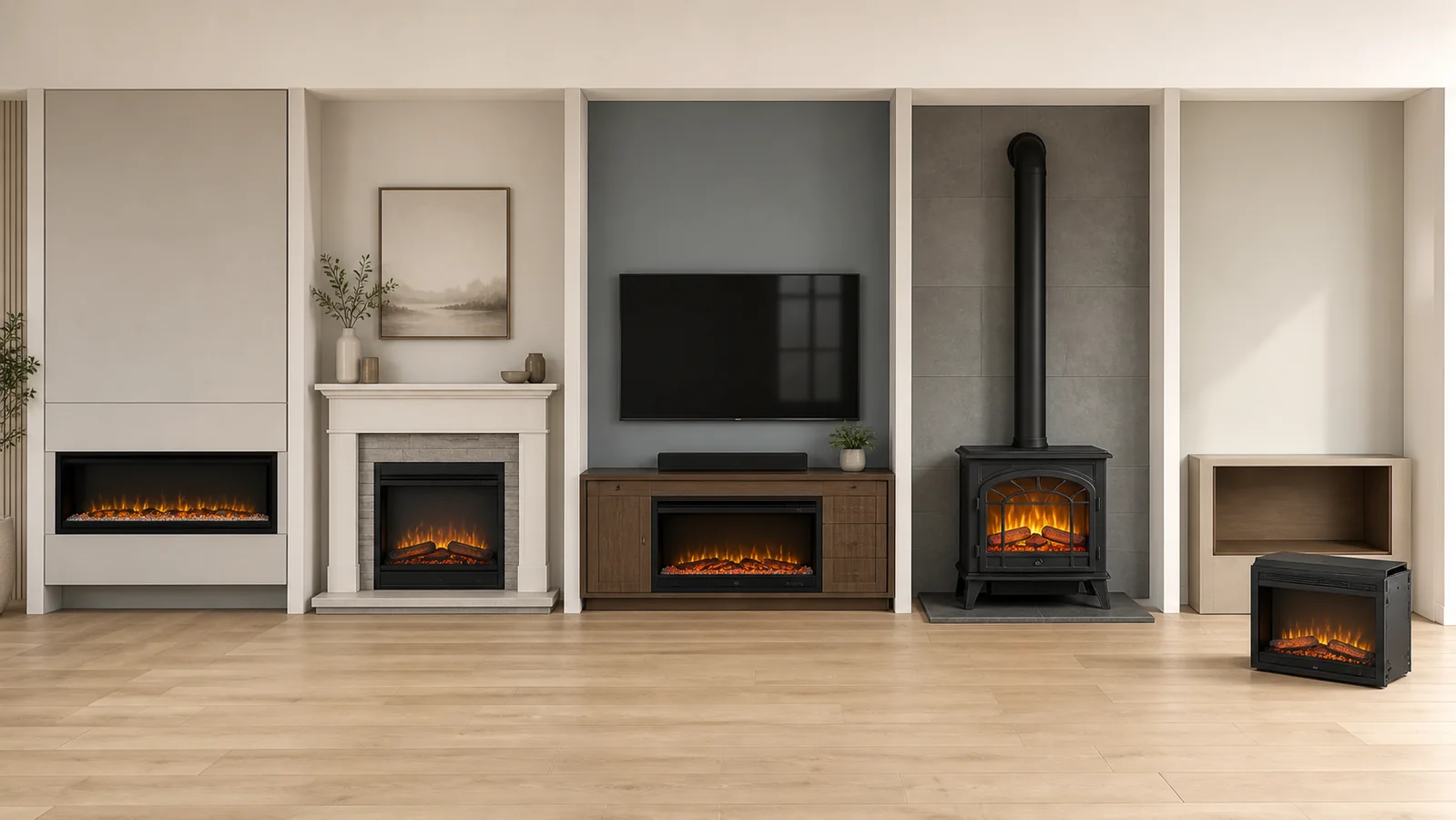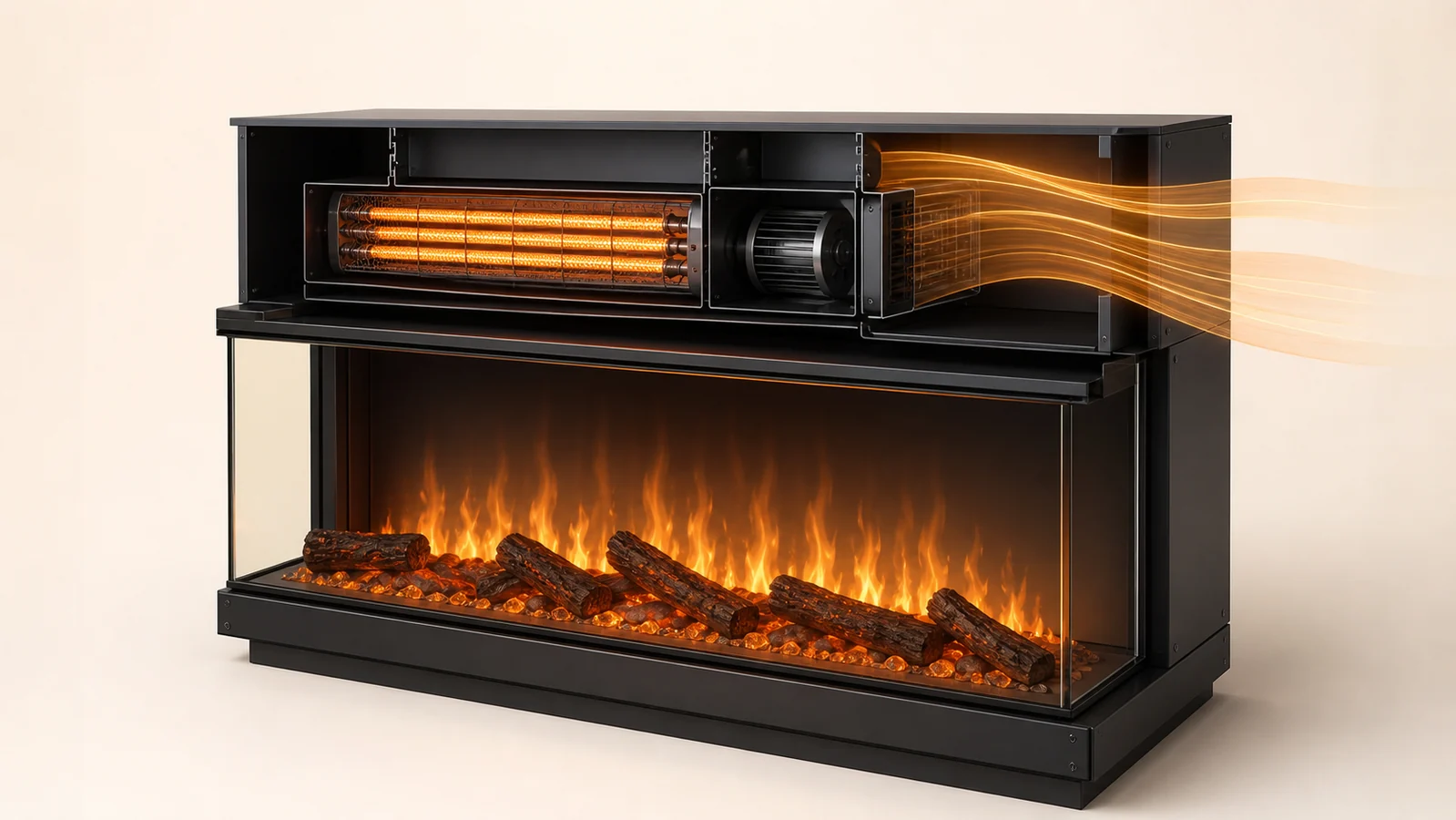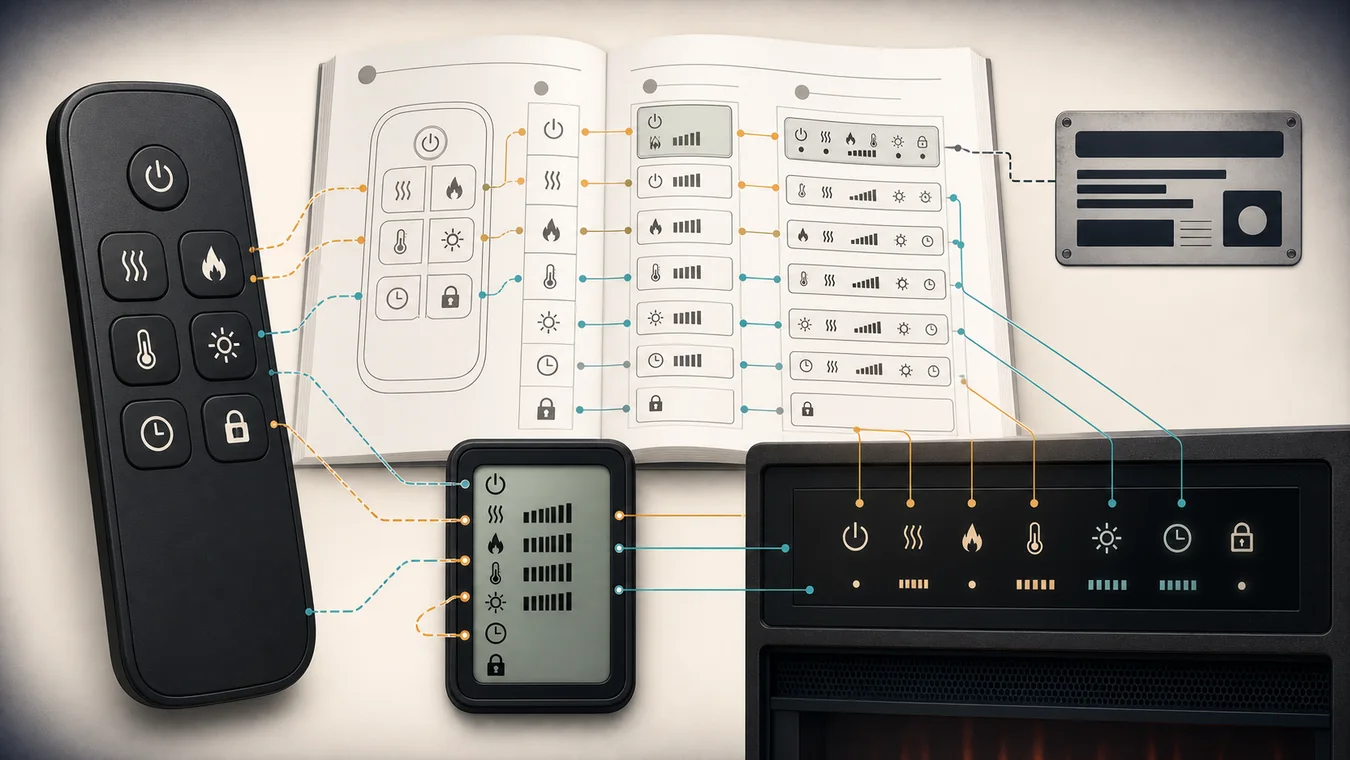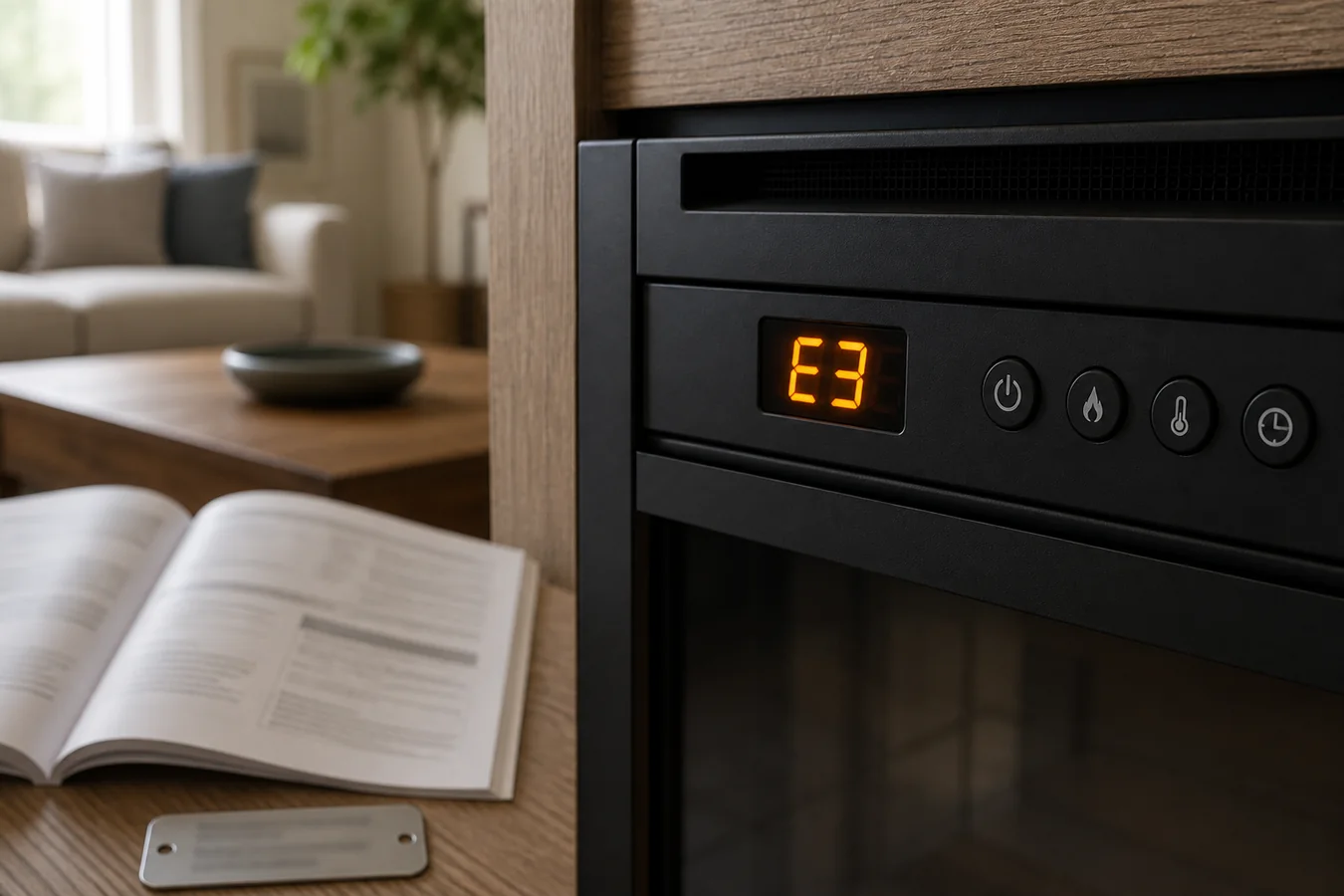
An E3 display does not have one electric-fireplace meaning. In the Escea LE-Series guide, E3 is an overheat shutdown. In the manual for Allen + Roth model 2315FM-23-931, it means the heater override is engaged. In the IHP manual that covers the Superior ERL3000 family, E3 is the snow-white ember-bed color.
Those are not competing diagnoses. They are three different manufacturers using the same characters for three different jobs. Your first move is therefore not a universal reset. It is to match the full model number, the applicable manual and the moment when E3 appeared.
If the appliance is smoking, smells scorched, shows visible damage, has been wet or repeatedly trips a breaker, stop using it and follow its manufacturer or qualified-service path. A code lookup should never delay a safety response.
Three manuals give E3 three different jobs
| Documented appliance | Where E3 sits in the manual | Meaning for that model | Correct first move |
|---|---|---|---|
| Escea LE-Series User guide 630743_1 |
Error Codes | The fireplace has shut down after overheating | Follow that guide’s cooldown and off/on instruction; contact a technician if E3 persists |
| Allen + Roth 2315FM-23-931 Item 4976260 |
Heater Override and Troubleshooting | Heater override is engaged, so the heater is disabled | Use the exact control-panel override instructions in that model’s manual |
| IHP P/N 901042-00 Rev. D Includes ERL3060/3072/3084/3100 |
Ember Bed Light setting | E3 selects the snow-white ember-bed color | Treat it as a normal display state; use the ember-bed control if another color is wanted |
The table is deliberately model-bound. It does not say an Escea sequence works on an Allen + Roth unit, or that every E3 following a color-button press is harmless. It shows why a generic error-code list cannot be the owner of the answer.
The exact sources are the Escea LE-Series user guide, the Lowe’s page for item 4976260 and model 2315FM-23-931, its 38-page manual mirror, the Superior ERL3000 model page and the linked IHP Rev. D operation manual.
Read the screen as an event, not a vocabulary word
Before power-cycling a unit that is otherwise safe to approach, preserve the evidence that a reset may erase. Photograph the display. Copy the brand and full model or SKU from the appliance label. Note whether E3 appeared at startup, after requesting heat, after pressing a control, or after the unit had run for a while. Record whether the flame effect, ember lights, local buttons and heater still respond.
Do not keep an abnormal heater running merely to reproduce the code. The goal is to capture what already happened, not to stress the appliance.
Next, verify that the manual cover or model list includes the exact identity. A family name, nominal width or visually similar firebox is not enough. Manual revisions can also change control logic. The electric fireplace specifications guide explains how to keep a model, configuration, field and source attached instead of borrowing data from a neighboring product.
The event often reveals the code’s role before it reveals its meaning. A message that appears after prolonged heat and stops the heater belongs on an error path. A message created by a deliberate long press may be a lock or override. A value that changes E1, E2, E3, E4 as the ember-bed button is pressed looks like a setting family. These clues select the section of the exact manual to read; they do not replace it.
An overheat code earns a pause—not a teardown
For the Escea LE-Series, the official guide says an overheating fireplace shuts off and displays E3. Its owner instruction is narrow: wait a few minutes for the fireplace to cool, reset the heater by turning it off and on, and contact a technician if the error persists.
Keep every part of that instruction inside the LE-Series boundary. It is not evidence for a 15-minute or 30-minute universal wait, a wall-plug reset, or an internal cleaning procedure on another appliance. Even on the named model, a recurring code is the point where the guide moves the case to a technician.
The same guide’s troubleshooting table notes that a stalled or slowed fan can be associated with a heater that is not working, then directs the owner to Escea or the retailer; inspection and cleaning details are assigned to technicians. That distinction matters. A visible blanket covering an external outlet is an obvious condition to remove only when it can be done safely. Opening the firebox, reaching into a blower path or replacing a sensor is a repair decision, not a search-result shortcut.
If you are comparing how a fan behaves in normal operation rather than diagnosing a fault, use the electric fireplace insert blower guide. Blower existence, speed control, heat interlock and shutdown behavior are separate fields and still need their own model evidence.
A locked heater can leave the flame effect working
The Allen + Roth 2315FM-23-931 manual gives E3 a different job. Its heater-override feature disables heater power to prevent accidental or unwanted heat operation. The troubleshooting row says that when E3 appears on the control panel, the heater override is engaged and sends the owner back to that section.
That means E3 on this exact model is not, by itself, proof of overheating or a failed temperature sensor. The heater can be intentionally unavailable while the visual functions remain usable. Repeatedly unplugging the unit, cleaning vents or shopping for a sensor would miss the documented state.
Use the control-panel sequence printed in the applicable manual, not one copied from another Allen + Roth fireplace. Related models use different buttons and hold times. If the model identity is uncertain, the display does not respond as the manual predicts, or local controls have a wider failure, stop treating the case as a known override. The electric fireplace remote guide separates transmitter, onboard-control and receiver evidence without assuming that a replacement remote will solve the appliance state.
A changing E-number may be a color menu
The official IHP manual P/N 901042-00 Rev. D covers several linear fireplaces, including Superior ERL3060, ERL3072, ERL3084 and ERL3100. In its operation tables, E1 through E7 are ember-bed colors. E3 is snow white; EE is automatic color rotation; E0 turns the ember-bed light off.
Context makes this branch visible. E3 appears alongside other E-values, changes when the ember-bed control is used and can be present while heater status is shown separately as H0, H1 or H2. On these named models, resetting the appliance to “clear” E3 would be trying to clear a normal selection.
Do not generalize the menu to every Superior product or every linear fireplace. Confirm that the exact model appears in the manual’s model list and that the screen behavior matches the documented control path. If E3 appears after a different event or is accompanied by abnormal heat, odor or shutdown behavior, the color table alone does not close the case.
Escalate the appliance, not the guess
When the exact manual does not define E3, the result is manual required, not “probably overheating.” Search the manufacturer’s support library using the complete model and region. If the manual is missing, ask support to identify the document and code definition in writing. A useful support request includes the model and serial, a photo of E3, the control or operating event immediately before it, which functions still work, and the manual title or revision already checked.
Stop using the appliance when there is smoke, a burning or melting odor, visible cord or plug damage, water exposure, repeated breaker trips, unusual arcing, or a persistent fault that the manual assigns to service. Disconnect power only when the exact instructions and the situation make that safe. Do not remove fixed panels, bypass a lock, probe live parts or substitute a fuse, sensor, blower or control board based on a generic code page. The electric fireplace safety guide owns the broader operating-state and stop-signal decision.
The final answer should fit one line: exact model and manual, where E3 appeared, what it means in that document, and the one authorized next action. If any of those fields is blank, keep the appliance on the manual or support path—the missing field is more useful than a confident guess.