For a 1,500-watt electric fireplace rated at 120 volts, the familiar calculation is 1,500 ÷ 120 = 12.5 amps. That is a useful estimate for the published maximum input. It is not an exact answer for every electric fireplace—or even every operating mode on one fireplace.
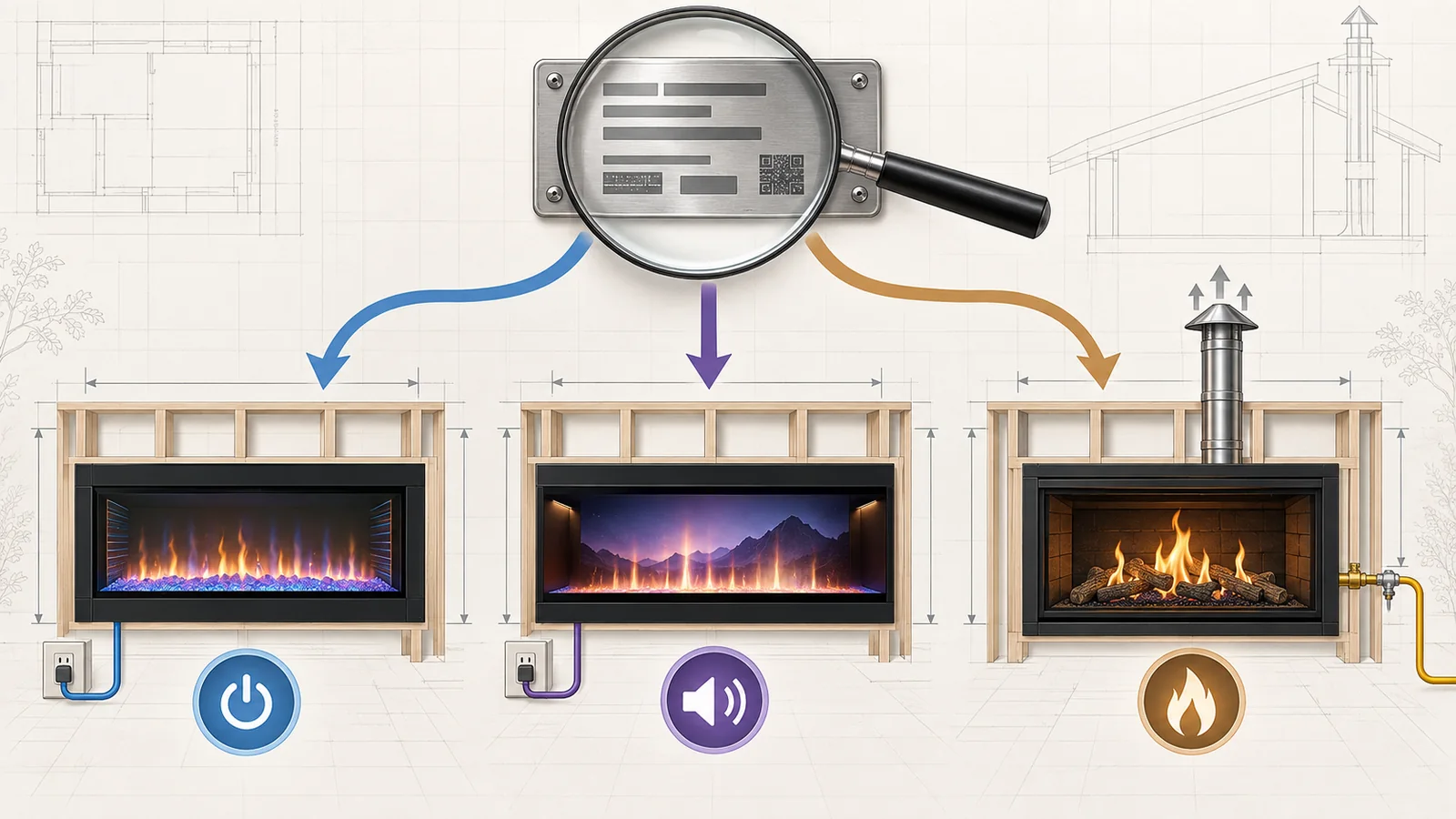
The exact model may list amperage directly. A dual-voltage model can publish a different current for each voltage. A manual may also print “15 amp” when it is describing the circuit the fireplace requires, not the current the appliance is rated to draw.
Use this order: take the model’s listed amps first; calculate only when the document gives watts and volts but no amps; leave the answer unknown when the model, voltage or operating state is missing. Keep the manufacturer’s circuit sentence in a separate field.
There are three honest labels for the answer
The number matters less than its label. “12.5 amps” can be a manufacturer specification or your own watts-to-volts quotient, and those are not interchangeable evidence.
| Answer label | When it is earned | What you can write | What stays separate |
|---|---|---|---|
| Manufacturer-listed | The exact model document or rating label states amps for the selected voltage/configuration | “Listed: 12.5A at 120V” | Required circuit, connection method and actual in-home measurement |
| Estimated from watts and volts | Amps are absent, but the exact model publishes watts and voltage for the same state | “Estimated: 12.5A from 1500W ÷ 120V” | AC power-factor effects, other states and manufacturer circuit language |
| Unknown | Model, market, voltage, state, amps or matching watts are missing or conflicting | “Amps: unknown until the exact document is matched” | Everything a generic category average would otherwise guess |
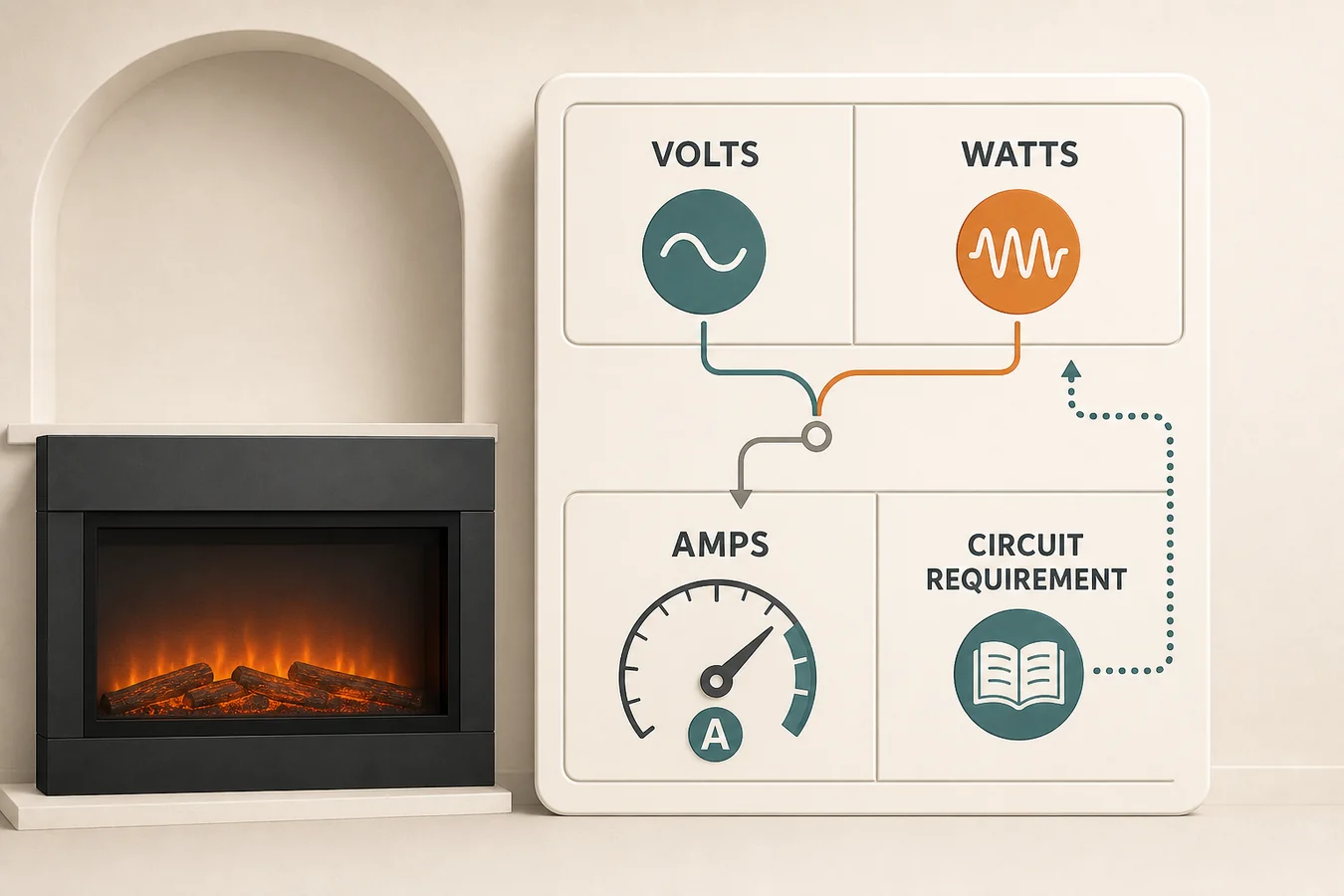
The circuit requirement never becomes a fourth way to estimate draw. It belongs beside the answer so the next person can see both facts without merging them.
Dimplex XHD turns 12.5A and 15A into two different facts
One page of the current Dimplex XHD23/26/28/33 manual is enough to break the category shortcut. The electrical specification lists 120V, 12.5A, 1465W and plug-in wiring. Immediately below it, the manual says a 15A, 120V circuit is required; it describes a dedicated circuit as preferred and makes it required after regular heater-related trips or blown fuses.
Both amp figures belong in the record, but they answer different questions:
- 12.5A is the manufacturer’s listed appliance amperage for the covered XHD models.
- 15A is the circuit rating stated by the manual.
Calculating 1465W ÷ 120V gives about 12.2A. That cross-check must not overwrite Dimplex’s listed 12.5A value. The difference is exactly why the exact document outranks a tidy calculation.
The broader electric fireplace specifications guide keeps voltage, watts, amps and connection in separate columns for the same reason. Here, the job is narrower: label the current answer before it travels into another decision.
Use W ÷ V only when the amps field is empty
A U.S. Department of Energy-supported electrification factsheet expresses the basic relationship as volts × amps = watts and watts ÷ volts = amps. For a document that gives 1,500W and 120V but no current, the simple estimate is:
1,500W ÷ 120V = 12.5A estimated
If the same exact model publishes 2,500W at 240V, keep that as another line:
2,500W ÷ 240V = about 10.4A estimated
Do not use the second voltage merely because it makes the current number smaller. It has to be a permitted configuration for the exact model and project. For the separate project choice—whether higher voltage produces a worthwhile result before finish work—use our 240-volt electric fireplace guide.
The word estimated matters. Electric fireplaces use AC and may combine a resistance heater with a fan, controls and lighting. Department of Energy technical material explains why AC current can include a reactive component that is not represented by real watts alone. A manufacturer-listed amperage therefore wins when it exists. A W/V quotient is not a clamp-meter result, a breaker calculation or proof of actual draw in a home.
“Maximum 1,500W” also limits the estimate to the published maximum input. It does not prove what the fireplace draws with flame only, low heat, a cycling thermostat or another mode.
Voltage and operating state must stay on the same line
Dimplex’s current Ignite Aspire ASP48 specification publishes two complete pairs. It also says the fireplace can operate with flame only or with flame and heat, but the cited specification does not provide a separate flame-only amp figure.
| ASP48 configuration | Published watts | Published amps | State boundary |
|---|---|---|---|
| 120V | 1500W | 12.5A | Published electrical rating; do not assign it to flame-only operation |
| 240V | 2500W | 10.4A | Separate voltage configuration; do not combine its amps with 120V watts |
| Flame only | Not stated in the cited specification | Unknown | Mode exists, but its current is not published here |
That last row is not a defect in the record. It prevents a common leap from “the heater is off” to an invented fraction of an amp. If flame-only usage is important to a purchase or energy estimate, find an exact model source that publishes it or keep the value unknown.
The connection method stays attached too. A model may be plug-in, hardwired or convertible, but that label cannot be used to infer current. The plug-in versus hardwired guide deals with which path the model permits and what the project must support.
Some manuals use “amps” to describe the required circuit
Manufacturer tables are not always normalized databases. Touchstone’s wall-mount manual for models 80001, 80002 and 80026 lists 120V and maximum 1500W. In the Amps row it prints “15 AMP Grounded Circuit,” and the installation text later says to use the fireplace on a 120V, 15A grounded circuit.
That document supports a 15A circuit requirement. It does not give us a clean basis to report “the fireplace draws 15A.” The correct current line is either a clearly labeled 12.5A estimate from maximum watts and voltage, or unknown if the decision requires manufacturer-listed rather than estimated current. The circuit sentence remains exactly what the manual says.
Touchstone’s 2026 BurnBrite 80073/80074 manual is a second warning. Its specification table lists 120V, maximum 1500W and “15 AMP” in the amps row. Do not silently change that manufacturer field to 12.5A, but do not present it as a measured operating draw either. Preserve the wording and document revision; ask the manufacturer which meaning controls if the distinction changes the project.
This is where the dedicated-circuit decision begins, not where it ends. The dedicated-circuit guide compares required, recommended, preferred and conditional manual language without treating amperage as the whole answer.
Carry one sentence into the next decision
The usable output is a sentence, not a bare number. For the XHD example, it reads:
Dimplex XHD23/26/28/33, manual 7216430100R02: manufacturer-listed 12.5A at 120V; 1465W; plug-in. The same manual requires a 15A, 120V circuit and gives separate dedicated-circuit wording.
For a model without listed amps, replace “manufacturer-listed” with “estimated from ___W ÷ ___V,” name the operating state and leave any missing field unknown. If the model offers more than one voltage, write one sentence per configuration.
That line can now move safely: into the specifications comparison, the permitted connection decision, the 120V/240V project choice or the exact circuit review. It cannot choose a breaker, wire, outlet condition or installation method by itself. The number has done its job when the next person can tell exactly where it came from—and which question it does not answer.