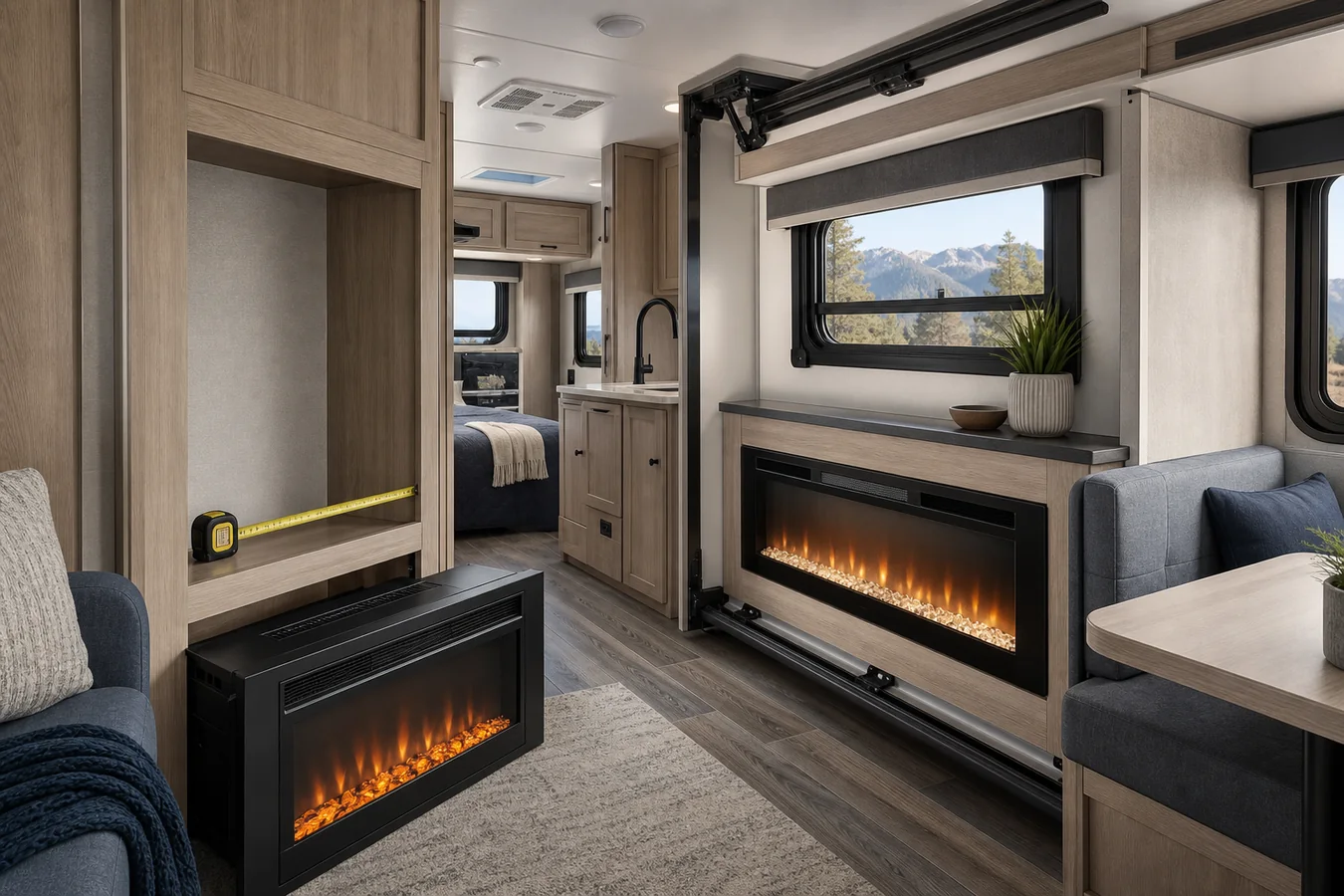
A 26-inch RV electric fireplace does not necessarily need a 26-inch opening. The number in a product name may describe the visible face, while the cabinet must accommodate a different body and cutout. The same model also brings a specific 120-volt load, airflow path and operating contract.
Begin with one fork: is this a replacement, or is the RV getting a new bay? For a replacement, preserve the old model label and the way its trim meets the cabinet before browsing. For a new bay, choose and document the exact candidate before the cabinet is committed. If the old identity, clear opening, power source or slide-out state is unknown, a nominal size is not enough to order.
Start with what is already in the RV
| Project branch | Record before shopping | Evidence to keep | Do not use as a substitute |
|---|---|---|---|
| Replacing an installed fireplace | RV make/model/year; old fireplace brand, model and rating label; clear opening width, height and depth; visible face/trim; outlet and cord route; fixed wall or slide-out | Label photos, opening measurements, view of trim/fasteners and the applicable component manual | Listing title, exterior face width or “looks like the same unit” |
| Creating a new bay | Proposed wall state; exact candidate SKU; manufacturer cutout/body/trim drawing; 120-volt rating and permitted connection; hot-air and service path | Current product page, exact manual and a responsible site plan | A cabinet opening built around a category or screen-size estimate |
Measure the clear opening at the narrowest usable points, not across trim that will be removed. Keep width, height and depth as separate fields. Photograph the rating label before the old unit leaves the bay; a discontinued or superseded model name can be more useful than a ruler when locating the correct documentation.
If the label is missing, stop treating the face as the identity. The Forest River component-manual library is one example of how an RV owner can work from the coach and installed component toward an applicable document. Another manufacturer may use a different owner-resource path. The useful outcome is the exact old model or an explicit unknown—not a confident guess.
Two “26-inch” fireplaces, two different openings
Two current products make the nominal-size problem concrete. These are dimensional examples, not recommendations or claims that either unit replaces the other.
| Exact current product | Published overall size (W × H × D) | Published cutout (W × H × D) | Published electrical/heat fields | What the comparison changes |
|---|---|---|---|---|
| Greystone by Furrion WF2613L | 27.625 × 21.5 × 3.125 in | 26 × 20.5 × 6.125 in | 120 V, 15 A, 1,400 W, 4,600 BTU/h | Its 26-inch name sits beside a 27.625-inch overall width and a 26-inch opening width |
| RecPro RP-FPC-26 | 26 × 21.75 × 7.75 in | 24.25 × 20.75 × 6 in | 120 V, 15 A; 750/1,500 W heat modes | Its 26-inch overall width sits beside a 24.25-inch opening width and a different depth relationship |
The current Lippert page publishes the WF2613L dimensions and ratings. The current RecPro page publishes the RP-FPC-26 dimensions, plug-in description and heat modes. The labels sound close; the openings do not. A bay that accepts one body may leave the other too wide, too narrow, too shallow, too tall or unable to cover the finished edge correctly.
Copy four geometries when the documents provide them: visible face, appliance body, required cutout and trim/fastener relationship. Compare each with the actual opening. Do not mix the face from a retailer image with a cutout from a similarly named manual. If the exact trim or mounting detail is absent, mark it unknown and ask the manufacturer or responsible installer before ordering.
Our electric fireplace insert size guide explains the broader opening-measurement logic. In an RV, add the old component identity and the wall’s travel state to that record; residential insert dimensions alone cannot close this decision.
Treat heat mode as an RV power event
Flame-only operation and heater operation are different use decisions even when they share one appliance. The listed Furrion FF-series manual publishes 120 V, 12 A and 1,465 W for its covered models, with flame-only and flame-plus-heat operation. WF2613L publishes 120 V, 15 A and 1,400 W. RP-FPC-26 publishes 120 V, 15 A and 750/1,500 W heat modes. Each set of numbers belongs only to that named model or manual family.
Record the voltage, current and wattage for the mode you intend to use. Then compare that documented load with the real RV circuit and operating plan. “It has a normal-looking plug” does not establish circuit capacity, and a 120-volt label does not say what other loads share the RV’s available supply. If the source does not close the permitted connection or the site cannot support the documented load, the candidate is on electrical hold.
The Furrion FF-series manual hosted by Forest River uses a grounded cord and plug for its listed models, sends new circuit or outlet work to a certified electrician and warns against an extension cord. That is a model-family contract, not a wiring template for every RV fireplace. If the candidate offers more than one documented connection path, use the plug-in-versus-hardwired fireplace guide to classify the product, then let the exact manual and qualified electrical review close the RV-specific work.
A published BTU figure also does not guarantee comfort in a particular coach. Outdoor temperature, insulation, floor plan and the RV’s primary heating system remain separate. Use the electric fireplace heat-output guide to interpret a named rating; keep “supplemental heat” and “flame ambiance” as different goals in the order record.
A slide-out turns “off” into a travel state
A fixed cabinet has an operating location. A slide-out cabinet has at least two states: extended for camping and stowed for travel or storage. The fireplace must have a documented answer for both.
The Furrion FF-series manual says its listed fireplace should not operate in a stowed slide-out and recommends tying the safety-cutoff wires to the slide-out activation system. It also calls for the slide-out to be fully extended during operation. Those instructions do not transfer to a different series merely because the fireplace looks similar.
For a fireplace in a slide-out, record the exact operating permission, the stowed/travel restriction and the documented cutoff or interlock responsibility. A wall switch, remote “off” state or household habit is not the same as a specified travel-state control. This article does not explain how to wire that function; the applicable RV/fireplace documentation and responsible installer must own it.
If the candidate manual is silent, mismatched to the SKU or unavailable, use a slide-out hold. Do not solve the missing contract by promising never to press the remote while traveling. For a fixed-wall location, record that site fact rather than borrowing the FF-series slide-out rule as a universal requirement.
Keep the fireplace removable after the trim goes back
A body can fit the opening while the finished bay still fails. Hot air needs the path defined by the exact model, intake and exhaust areas must remain available, and nearby upholstery or curtains cannot be treated as harmless decoration. The Furrion manual addresses hot-air direction, soft furnishings, airflow and proximity cutoff for its listed models. RecPro publishes a one-inch side-clearance statement and thermal/proximity protection for RP-FPC-26. Neither becomes a clearance number for another product.
Trace what will happen after the trim is installed. Can the approved outlet or connection still be reached as required? Can the face, glass or appliance be removed without destroying the cabinet? Are model and rating labels accessible for service? Can a technician reach the fasteners and documented service points? Does the extended slide-out leave the hot-air path clear of seating, bedding and window coverings?
Keep manufacturer dimensions separate from RV observations. “Six-inch cutout depth” is a product field; “the bay has 6.25 inches before a brace” is a site field. A responsible installer must decide whether the structure, finish and connection can accommodate the exact product. The order record should never turn the difference between those fields into permission to cut, relocate wiring or remove structure.
Controls and replacement parts belong to ownership too. Record the supplied control type, exact remote or parts reference when published, and how the fireplace will be removed if a control, heater or display needs service. A flush finish that traps the appliance is not a clean installation plan; it is deferred demolition.
Build the order record from the candidate, not the category
Use one record per exact SKU. Keep copied manufacturer facts next to their source and date; keep RV measurements and site findings in a separate column.
| Record field | What belongs in it | Evidence that closes it | Outcome if it does not close |
|---|---|---|---|
| Existing identity | RV details plus old fireplace brand, model, rating label and applicable manual | Label/photo and owner or component documentation | Evidence hold; do not infer a replacement from face width |
| Candidate identity | Exact brand, series, model/SKU and current manual | Manufacturer page plus matching manual | Choose another model or hold |
| Opening and face | Clear opening W/H/D; candidate body, cutout, face/trim and fastener relationship | Measured bay plus exact drawing/specification | Cabinet plan must change, or choose another model |
| Electrical load | Permitted connection; voltage, amps and watts for intended mode; real site/circuit finding | Exact manual plus qualified RV electrical review | Electrical hold |
| Heat role | Flame-only or heater use; published model rating | Exact product/manual and real use goal | Choose another model if the required mode is absent |
| Wall state | Fixed wall or slide-out; extended operating state and stowed/travel rule | RV observation plus exact applicable manual | Slide-out hold if any controlling state is unknown |
| Air path | Intake, hot-air discharge, exact clearances and nearby furnishings | Exact model instructions plus site review | Change bay or model |
| Service path | Outlet/connection access, trim removal, fasteners, glass/media and appliance removal | Exact service information plus finished-bay plan | Change the finish/service plan before ordering |
| Final status | Every controlling field documented and mutually compatible | Complete record reviewed by the responsible parties | Hold or apply the specific change above until every controlling field closes |
A candidate may be a plausible drop-in only when the exact opening, face, body, power, wall state, airflow and removal records all agree. “Candidate for responsible review” is deliberately narrower than “fits”: it authorizes the next professional/site check, not installation or cabinet work. If the record points to cabinet change, electrical hold, slide-out hold, a different model or missing evidence, keep that result visible and change the plan before the order is placed.
If no exact RV product survives, step back to the types of electric fireplaces and reconsider the product relationship instead of forcing a nominally similar face into the bay.