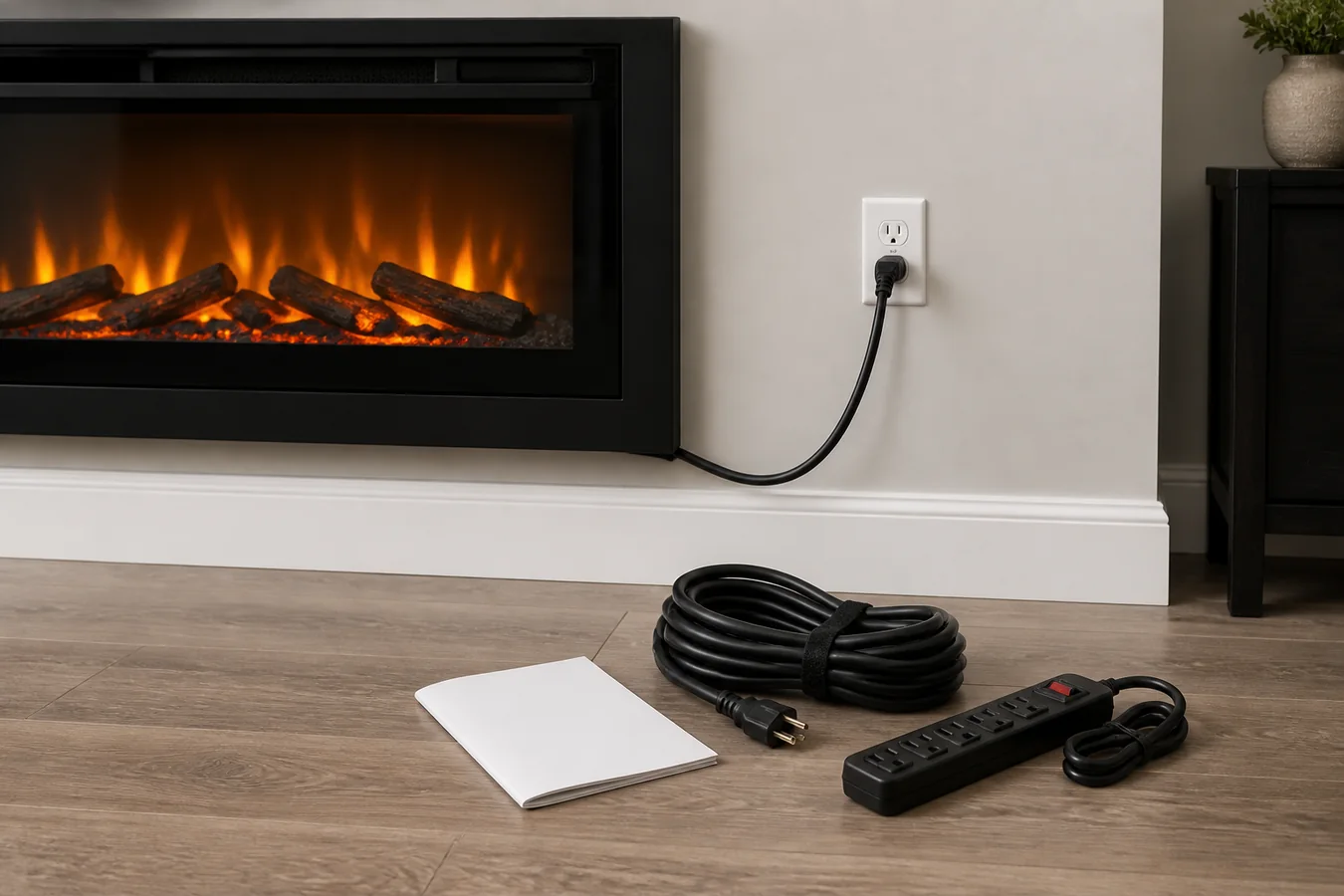
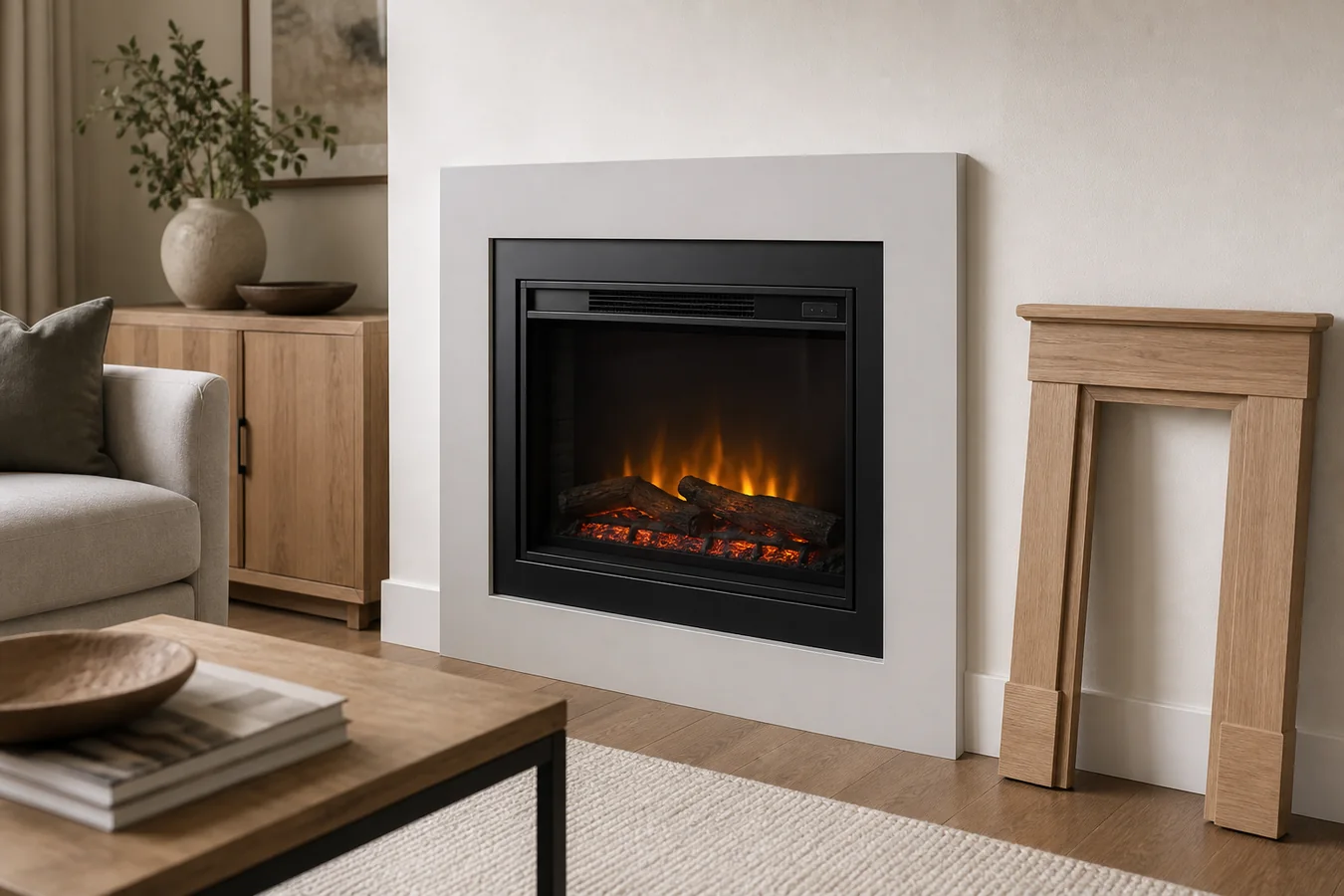
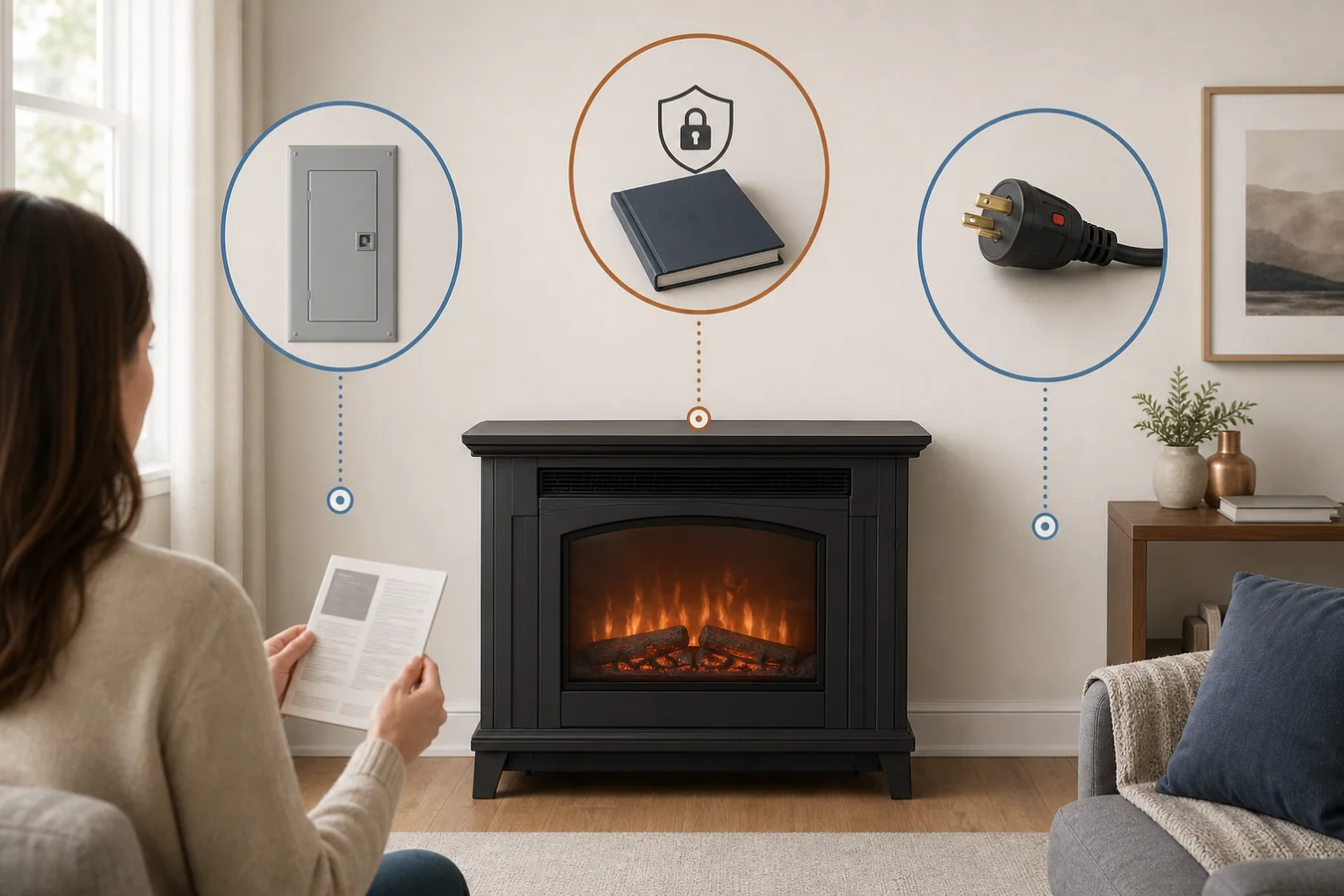
A dark patch in the flame effect is not yet a bulb order. Depending on the exact electric fireplace, the light source may be a replaceable lamp, an integrated LED or log-set assembly, or part of a wider flame/control problem.
Start with the rating label and the current owner manual for that model. If the owner document names a lamp or light bulb, gives its specification and describes owner maintenance, you can build an exact replacement record. If it describes an LED or illuminated log-set assembly, or keeps the procedure in service documentation, a look-alike retail bulb is the wrong path.
Leave the appliance intact when the document does not settle the light-source type or owner access. A panel that appears removable is not evidence that a bulb sits behind it.
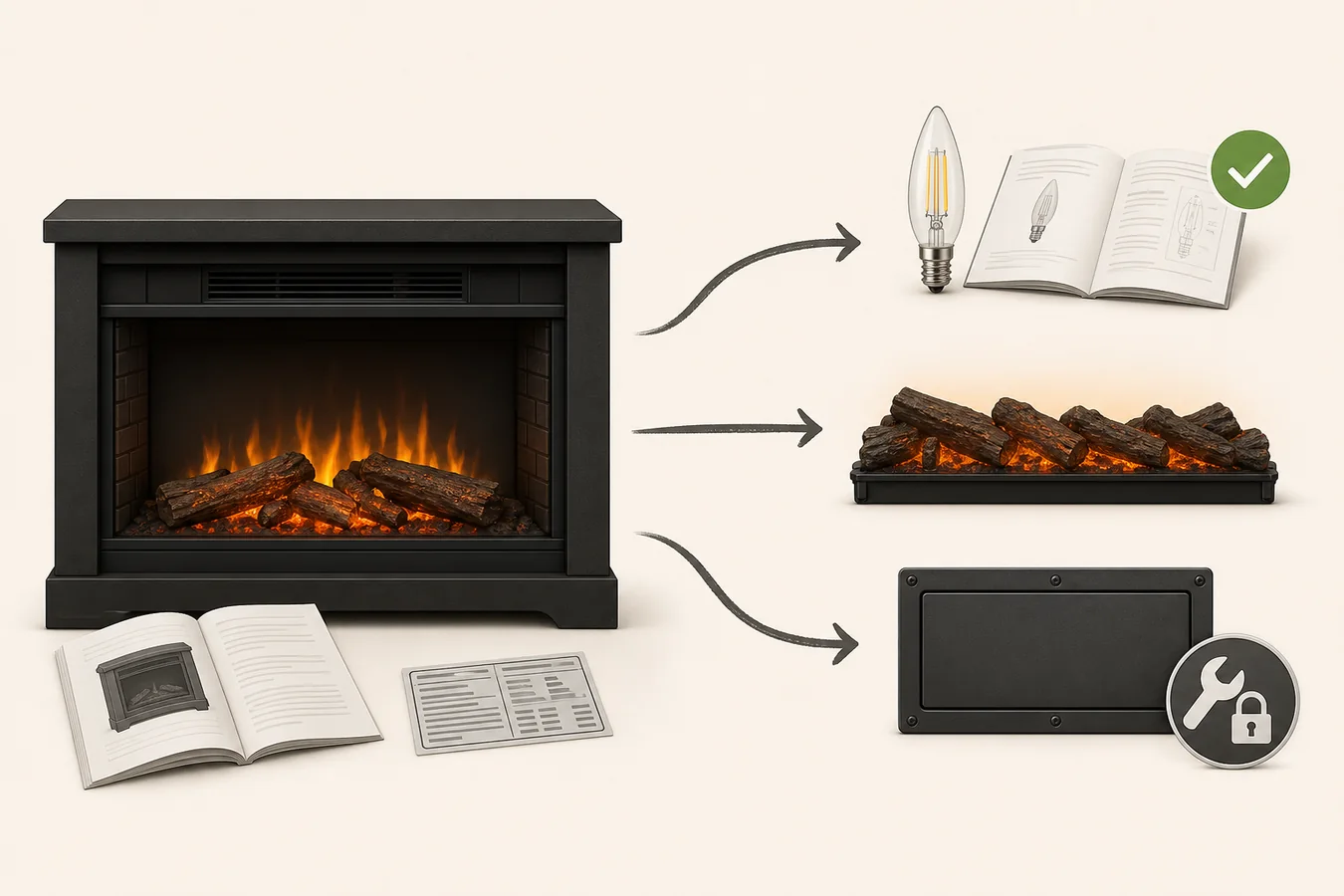
A dark patch can belong to three different light systems
Use the model and document before the shopping result. The same visible complaint can produce very different next actions.
| What the exact record shows | What you actually have | What can move forward | What remains on hold |
|---|---|---|---|
| The owner manual names a lamp or bulb and gives an owner replacement path | Owner-replaceable lamp for that model | Record every stated electrical and physical field, then use the documented access path | Any unstated wattage, voltage, shape, quantity or substitute |
| The owner or support document says the LED log set has no replaceable bulbs | Integrated illuminated assembly | Identify the exact assembly and the manufacturer’s current replacement or support route | Retail bulb shopping and individual LED substitution |
| The owner manual lists an LED assembly, but replacement appears only in a service manual | Service-documented assembly | Send the exact model, symptom and document references to the responsible service channel | Treating the service procedure as owner permission |
| The flame or log lighting is dark, but the owner document does not identify the light source | Unresolved light system | Ask the manufacturer to identify the model-specific part form and access owner | Opening a likely panel or ordering by appearance |
| Display, onboard controls or household power also stopped | A broader event than an isolated flame light | Preserve what stopped and route the whole-system symptom first | Calling it a burned-out bulb |
| The official part record says the named lamp or assembly is no longer available | Obsolete-part path | Ask for a manufacturer-confirmed supersession, assembly option or service disposition | Increasing wattage, changing lamp technology or using an unverified substitute |
The distinction is not theoretical. Dimplex technical support tells owners to use the maintenance instructions for the exact fireplace and notes that its LED log sets do not contain replaceable bulbs. Yet a different Dimplex owner manual identifies ordinary lamps and a specific owner-maintenance route. Brand alone does not answer the question; the model document does.
The broader electric-fireplace specifications guide explains why model identity, part form and service responsibility belong in the same decision. Here, those fields apply only to the flame-light system.
The symptom should narrow the document, not choose the part
Describe what is still working before naming a failed component. “One side of the ember bed is dark while the rest of the flame effect and controls still operate” is useful. “The bulb is burned out” is a diagnosis the observation has not earned.
An isolated dark zone points the document search toward flame lighting, but it does not identify a socket, LED strip, connector, driver or log-set assembly. A completely dark flame effect while heat and controls remain available is a different record. If the display, onboard controls or household circuit also stop, move to the repeating-shutdown classification before treating the event as a lamp problem.
Intermittent behavior deserves time and control state as observations: which mode was selected, what stayed lit, what stopped first and whether the result returned without touching the appliance. Do not use those observations to prescribe an internal test. They help the manufacturer or service provider choose the correct document and owner.
The manual itself also needs a reliable identity. Product-family names can cover several widths, revisions or light systems. Match the model/SKU and market, and use the manual-matching guide when a search result looks close but the rating label does not agree.
A real bulb specification has more than a base size
A socket family such as E12 is only one field. Before ordering, the model-bound record may also need lamp quantity, voltage, wattage or maximum wattage, lamp shape or manufacturer part number, and any instruction about replacing a set. The controlling manual decides which fields exist.
The Dimplex BF39DXP/GPR owner manual is a useful exact example. It specifies four small-base E12 lamps rated at 60 watts and supplies a model-specific light-bulb replacement section. Those numbers establish a path for the listed models; they do not establish a default bulb for Dimplex fireplaces, much less for every electric fireplace.
The document role matters inside that example. The same manual says there are no user-serviceable parts inside while separately giving the named lamp-maintenance procedure. The narrow lamp instruction does not open the rest of the appliance to owner repair.
When a marketplace listing says that a bulb “fits most electric fireplaces,” compare it with the exact record rather than with the old lamp’s appearance. A physically similar base does not resolve voltage, wattage ceiling, heat tolerance, quantity, optical position or access authority. If the manufacturer lists a part number, keep it beside—not instead of—the electrical fields, because a number can be revised or superseded.
LED can mean a replaceable assembly without meaning owner-replaceable
“LED” describes a light technology, not the size of the repair. It may appear as part of a log set, flame bed, strip or board. The assembly can be replaceable at the product level while still being outside owner maintenance.
A current Touchstone Forte 80006 product record describes an LED flame display, and Touchstone maintains both a model-manual index and separate model-family support documents. That tells you to identify the model and document role; it does not turn every LED support file into a homeowner procedure.
The difference is especially clear in SimpliFire documentation for SF-OD43 and SF-OD55. The owner manual identifies an LED assembly in the parts information, while the multi-step LED-board work appears in a separate service manual. For those models, finding the component and finding owner permission are two different events.
If the only relevant procedure is labeled for service, keep the panel closed. Record the exact assembly wording and document URL, then ask the manufacturer who owns diagnosis, ordering and installation. The public procedure you found is evidence of a service path, not authorization to perform it.
Obsolete parts change the job before a tool comes out
A correct historical part can still be the wrong current order. Manufacturer records may mark a lamp or LED item as discontinued or no longer available. An older SimpliFire SFE-ST service-parts sheet, for example, shows that exact part status can change over the life of a fireplace.
Do not convert “unavailable” into permission to increase wattage, change lamp technology, bypass an assembly or choose a visually similar part. Ask whether the manufacturer recognizes a superseding part, a complete assembly, an approved service option or no supported replacement. Keep the answer tied to the model and serial/date-code range when the manufacturer uses one.
This is also where appearance and maintenance split. Dust on a viewing panel can make a flame seem dim, but cleaning access belongs to the exact surface instructions, not to the light-source replacement path. Use the separate electric-fireplace cleaning guide if the symptom changes after the surface is identified; do not remove media or a panel as a diagnostic shortcut.
Turn the dark flame into a support-ready record
A useful handoff fits in one compact block:
Exact model/SKU and serial or date code — owner-manual title/revision — observed dark area and what still works — document’s light-source noun — lamp or assembly part number — quantity/base/voltage/wattage/shape where stated — owner-access instruction or service-only boundary — current, superseded or obsolete status — manufacturer or service owner for the next action.
Photograph the rating label for the support conversation, but do not post a serial number publicly. Attach the document URL and quote the short line that identifies the light source or access role. A support agent can work with “SF-OD55, owner manual lists LED assembly, service manual contains board procedure, left side dark, controls and heat still operate” more reliably than with “I need an electric-fireplace bulb.”
The record can close in several legitimate ways: an owner-manual lamp specification ready to verify and order; an integrated assembly routed to the manufacturer; a service-document-only job; a broader control/power symptom; or an obsolete part awaiting a confirmed disposition. If model identity, specification or access authority remains blank, that blank is the decision. Do not fill it with a category-wide bulb rule.