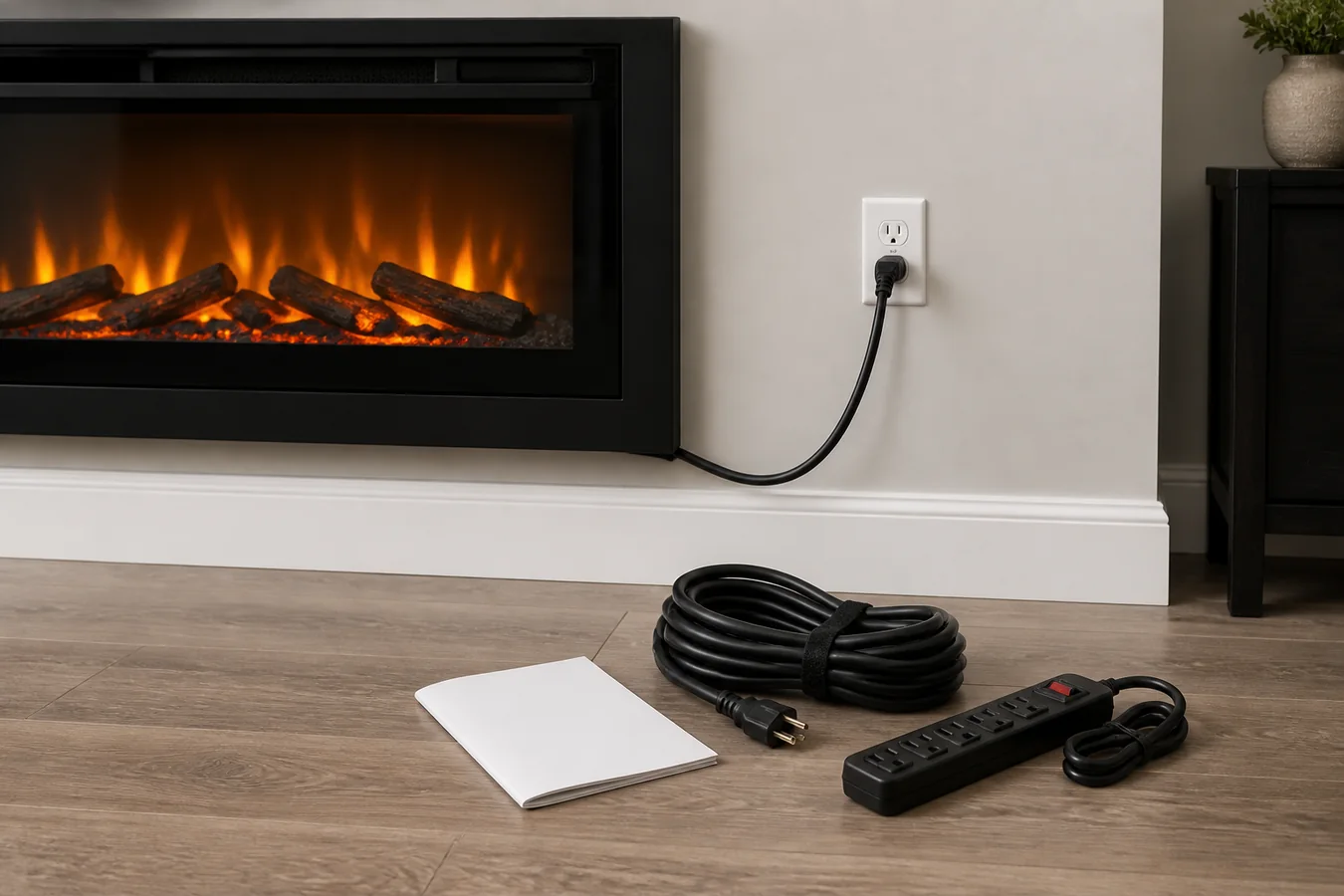
When an electric fireplace starts making noise, the most useful detail is not whether you call it a buzz, rattle, hum or grind. It is what the fireplace was doing at that moment.
If there is smoke, a burning odor, sparking, visible cord or plug damage, or breaker behavior, stop using the unit and follow the exact manual or manufacturer route. Do not keep changing modes to collect more evidence.
For an otherwise stable unit, use only its ordinary controls and note whether the sound appears with heat and fan on, continues with flame-only, happens in standby or after shutoff, or follows a documented crackle control. Keep the case closed. That mode line tells you which document and support owner should see the event; it does not identify a failed part.
Put the noise on an operating-mode line
| What you can reproduce without opening the unit | Mode line | Document that controls the next decision | What the observation does—and does not—settle |
|---|---|---|---|
| The sound follows the exact model’s crackle on/off or volume control | Intentional-sound control | Exact owner manual and control description | Treat it as a documented feature only within those settings; another sound remains unresolved |
| It begins only when heat or the fan is selected and stops when that mode stops | Heater/fan-on | Exact owner manual, current manufacturer support and any named service route | Routes the event to the heater/fan branch; does not prove a blocked inlet, loose part or failed motor |
| It continues with the flame effect running while heat is off | Flame-only | Exact owner manual and model support | Keeps heater instructions out of the record; does not distinguish flame mechanism from audio or another model-specific system |
| It appears only in standby or after flame and heat controls are off | Standby/off | Exact owner manual and manufacturer support | Preserves the timing; does not make a general cool-down or electrical diagnosis |
| The sound arrives with a dark display, lost controls, repeated shutdown, cord/plug damage, breaker behavior, smoke, odor or sparks | Whole-unit event | Exact safety/power instructions and responsible support or emergency authority | Ends routine sound comparison; the wider event owns the next action |
| The model, market or document revision cannot be matched | Identity unresolved | Current official manual owner or manufacturer support | Stops at exact model manual required; a near-match cannot authorize access or a part |
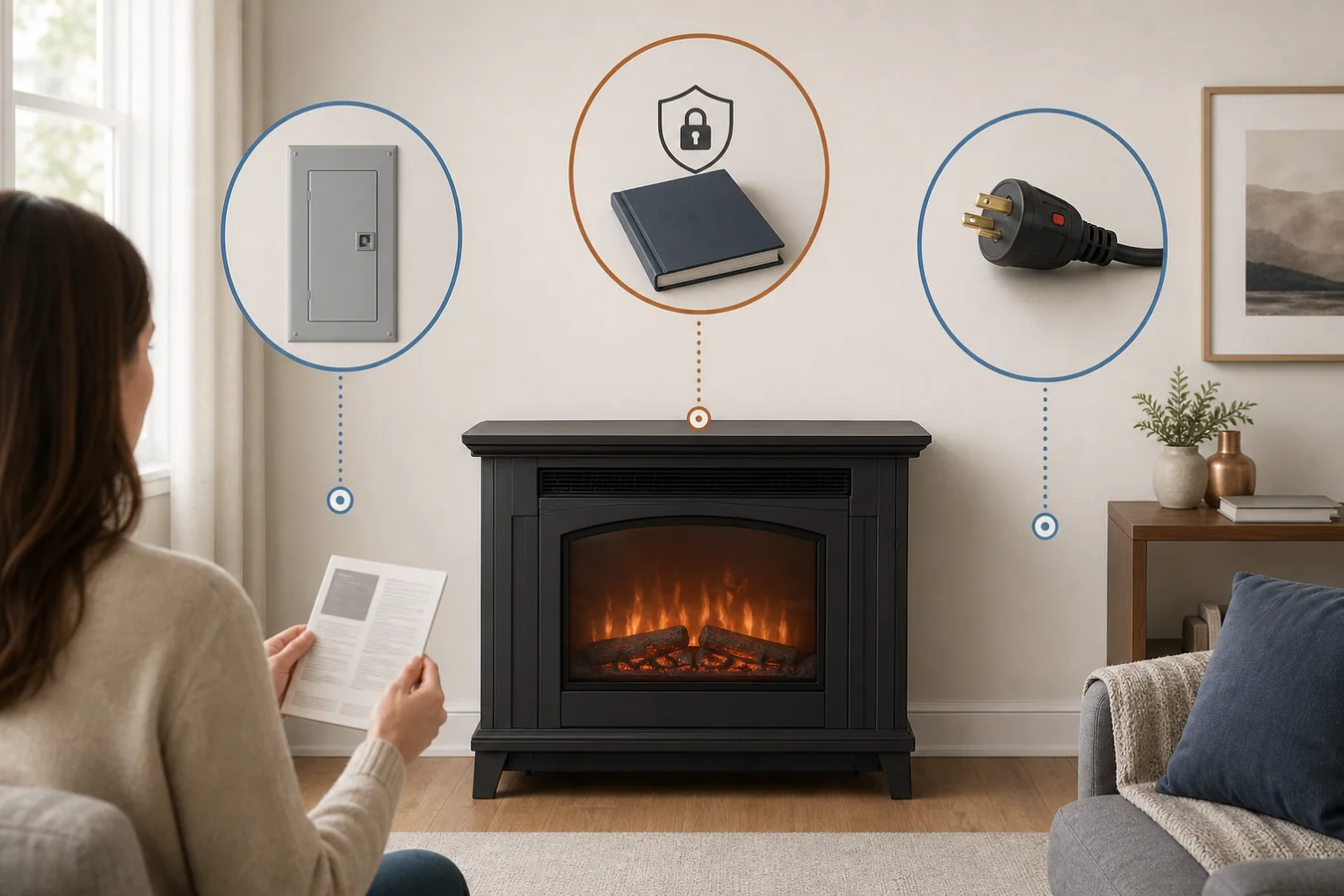
The electric fireplace specifications guide explains why model identity, control state and service responsibility are separate fields. For this problem, write all three on the same line before looking at a parts diagram.
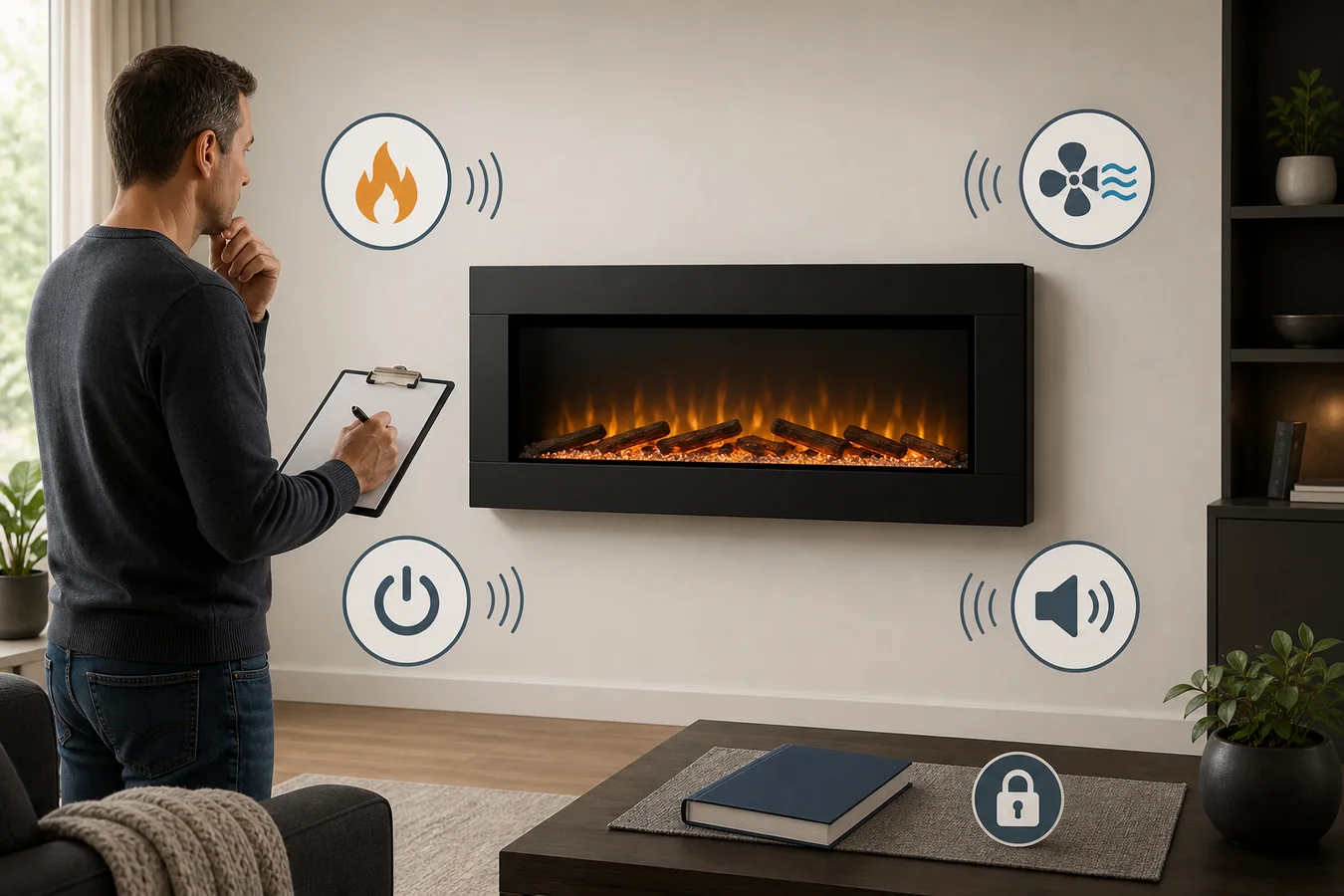
The sound word is weaker evidence than the mode
Two people can use “buzz” for different sounds, and a phone microphone can change their character again. Use the word as a description, not as the name of a component.
Add when it began, whether it is continuous or intermittent, which normal control changes it, and whether the display, flame effect and heat remain available. A short recording from the normal listening position can help support recognize the event. State the mode aloud at the start so the clip does not become an anonymous noise file.
Location is also an observation with limits. “Louder near the lower-right front while heat is selected” is useful. “The blower bearing is bad” is a conclusion. Do not move the unit, remove media or open a panel to make the location more precise unless the exact owner manual explicitly makes that an owner task for this symptom.
Crackling may belong to the controls
Some electric fireplaces intentionally add a fire sound, so crackling is not automatically an abnormal symptom. The distinction still has to come from the exact model documentation rather than from the appearance of the flame.
The Touchstone Sideline Elite PRO manual, revision 20250312, documents a fire-crackle function that can be turned on or off and set to three volume levels. On a covered model, a sound that follows those controls belongs first to the intentional-audio record. A sound that ignores the control, appears in a different operating state or changes character still needs its own mode line.
If sound is part of a purchase decision rather than a new symptom, use the separate crackling-sound guide to compare mute, volume and control ownership before ordering. This page does not score realism or audio quality.
Heater-on and heater-off need different records
Dimplex technical support begins its noise routing by separating a sound heard only when the heat and fan are running from one that continues when the fan is off. That split is useful beyond the page only as a recording method: it tells you which mode to report, not which Dimplex part—or any other brand’s part—has failed.
Exact SimpliFire documents show why the distinction matters. The Allusion Slim owner/install manual, Rev C 9/24, lists excessive noise while the heater is on separately from grinding or rubbing when the heater is off. Its matching service manual, Rev B 8/24, carries internal service work in a different document role.
Finding a service-manual procedure therefore answers “is there a model-specific service path?” It does not answer “may the owner perform it?” Keep the owner manual, service manual and current manufacturer support as separate references. If a search result shows the right family but the rating label or revision does not agree, match the official electric-fireplace manual before applying even the symptom category.
Give support one repeatable sound event
Send one line that another person can replay conceptually:
Exact model/SKU and market — owner-manual title and revision — sound in your own words — first occurrence — heat/fan state — flame-effect state — intentional-sound setting — standby/off timing — display/control/power behavior — visible external change — short recording filename — owner document, service document or support page that appears to control the next step.
If the unit repeatedly shuts down or the controls and household power change, route that wider event through the repeating-shutdown guide instead of burying it inside a noise report. If only the sound changes with one normal mode and everything else remains stable, preserve that narrower fact.
The record may finish at a documented sound control, a heater/fan support branch, a flame-only branch, a standby/off support question or a service-document-only handoff. If the exact model, mode or document owner is still blank, send the blank to the manufacturer. A guessed component is less useful than an unresolved field they can actually close.