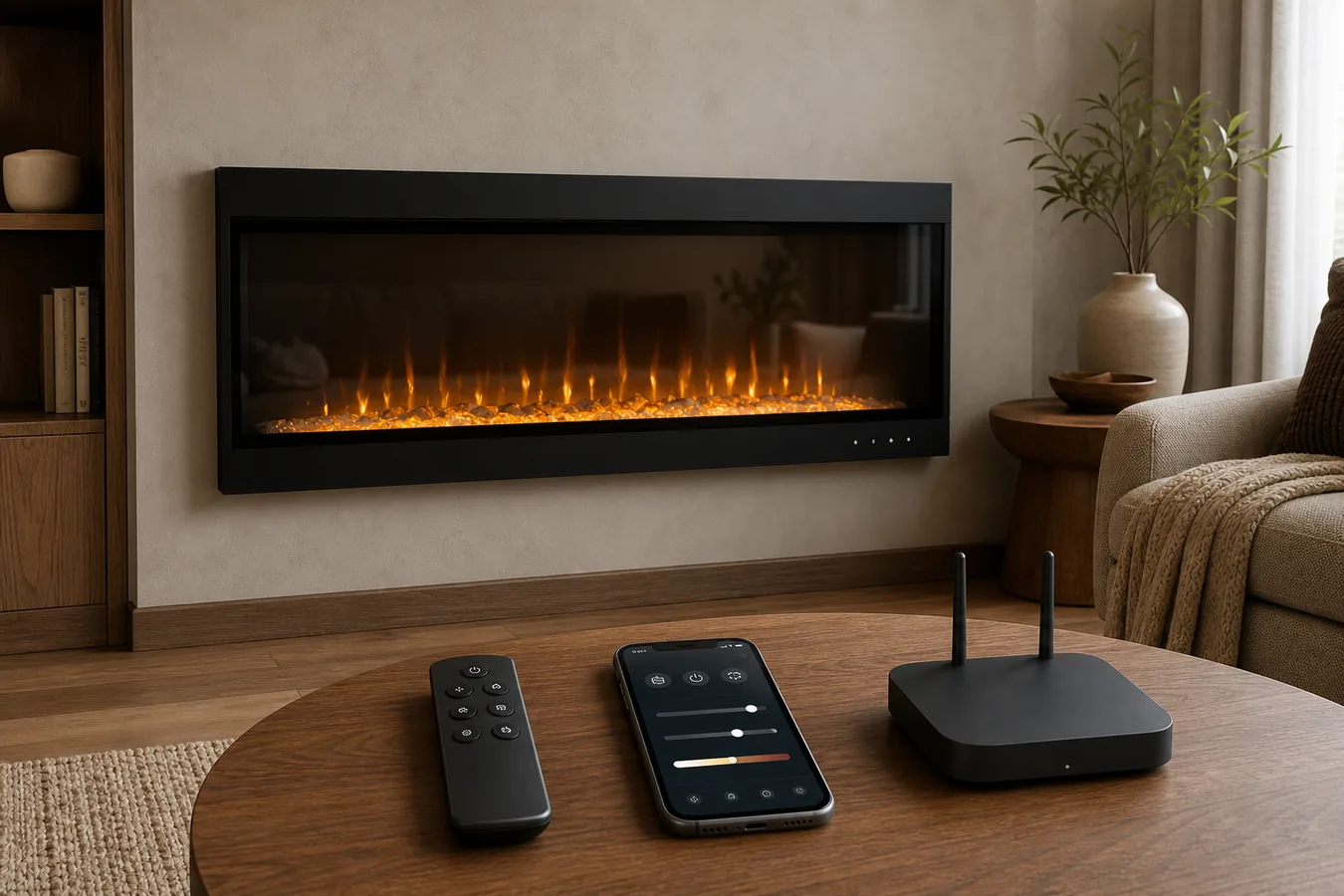
A listing that says “crackling sound” answers the least demanding question: whether the seller or manufacturer says a sound feature exists. It does not tell you whether the sound can be muted, how many volume choices you get, whether the control lives on the fireplace or only on a remote, or what happens the next time the unit starts.
Treat those as product fields, not demo details. For one exact model, record the sound source, mute/off behavior, volume settings, control surfaces and remembered or reset state. If the applicable manual cannot close a field that matters in your room, the sound feature is not ready for the final shortlist.
Start with silence. A candidate that can always become quiet through an acceptable documented control path may be worth hearing in person. A candidate whose mute or startup behavior remains unknown should not win because one video has an appealing soundtrack.
A sound badge answers only the first question
“Sound included” can describe several different arrangements. The speaker may be built into the fireplace, sound may depend on an accessory, or a product family may offer sound only on selected models. The listing-level phrase does not decide which arrangement belongs to the item in your cart.
The first useful line in your record is therefore the full model or item number and the applicable manual revision. Put the sound source beside it: integrated, included accessory, optional accessory, app dependent or not documented. Do not borrow the sound controls from a fireplace that looks the same or shares a collection name.
A current series page can still be useful. Napoleon’s current Elevation X series page, for example, advertises built-in speakers and crackling sound. That closes feature presence for the stated series scope. It does not, by itself, close the exact mute, volume or startup fields for the unit you are considering. “Sound present, controls unresolved” is a legitimate result.
Keep that record beside the broader electric fireplace specifications guide. Sound does not replace dimensions, electrical requirements, installation clearance or heat facts; it is one model-bound field within the same product identity.
Silence is the first sound control to verify
The useful first audition is not the most dramatic crackle. It is whether the fireplace can become quiet in the way the household needs. A shared wall, sleeping child, television, conversation or late-night flame-only use can turn a pleasant effect into friction if mute is buried or unavailable.
Define the acceptable quiet path before comparing products. Some households will accept a dedicated button on the supplied remote. Others need mute at the fireplace because remotes get misplaced. An app-only sound control may be acceptable for one buyer and a dependency for another. The documentation should tell you which path exists; the room decides whether that path is good enough.
Volume is a separate field. “Adjustable” does not say whether the product offers two states, several fixed steps or a wider range. Write the documented choices exactly and resist translating them into loudness. Low, medium and high are control labels, not measured decibels and not a promise that “low” will suit a particular room.
If the quiet path depends on a handheld controller, preserve its exact identity with the fireplace record. A future lost-controller problem belongs to the exact-model remote replacement process, not to a visually similar remote or a generic code list.
The same crackle promise can hide three control depths
Current first-party manuals make the difference concrete. The comparison below describes only the named document scope. It does not rank the sound, speaker or brand.
| Current manual scope | Sound and mute | Volume depth | Documented control surface | Startup or memory field |
|---|---|---|---|---|
| Touchstone Sideline Elite Pro manual rev. 20250312; items 80057, 80058, 80059, 80061, 80062 and 80063 | Crackle sound on/off | Low, medium and high | Control panel and wireless remote provide the same listed functions | Do not infer beyond the applicable manual section; keep unresolved if this field matters |
| Dimplex Optimyst Pro Box CBX1500 manual | Sound on/off | Remote offers five volume settings or off | Remote provides deeper adjustment; manual control provides sound on/off | Keep the exact required state unresolved unless its owner states it |
| Dimplex Optimyst E-Matrix owner manual | Minimum setting turns sound off | Increase/decrease control | Use only the controls documented for the named manual scope | Last sound level is retained across the manual’s stated standby/off behavior; do not extend that to an outage |
Touchstone’s current Sideline Elite Pro manual is unusually explicit for this task: it names the covered item numbers, lists crackle sound on/off and gives three volume settings, while stating that the panel and wireless remote functions are the same. That is enough to close those fields for a matching item and revision. It is not evidence about another Touchstone series.
The current Dimplex Optimyst Pro Box manual shows why “remote included” is not a trivial note. For CBX1500, the remote offers five volume settings or off, while manual control provides sound on/off. A buyer who wants fine adjustment at the unit would reach a different conclusion from a buyer who is comfortable keeping the supplied remote available.
The current Dimplex Optimyst E-Matrix manual adds another dimension: it documents adjustment down to off and says the last sound level is retained through the power-state behavior it describes. That is a model-manual fact, not a category promise. These rows are valuable because they leave blanks visible rather than filling them with assumptions.
Startup behavior can change the room
Mute proves that silence is possible now. Startup behavior decides whether that silence survives the next normal use. A fireplace may remember the last level, return to a default, or leave the behavior unstated in the material you found. Those outcomes create different routines even when every candidate has a mute button.
Ask the question narrowly: after the exact standby or off action described in this manual, what sound state returns? Preserve the wording and power state. A statement about ordinary standby does not establish what happens after a breaker is switched, power is interrupted or the appliance is reset.
If the manual states that the last sound level is retained and you prefer a quiet default, the practical response is simple: mute the sound before ending the session and confirm that the documented behavior matches your routine. If the manual says nothing, contact the manufacturer with the full model and revision or test the exact unit. Do not upgrade silence from unknown to guaranteed.
This field matters even when the crackle is excellent. Repeatedly correcting an unwanted startup state is an ownership cost. Conversely, a remembered low setting may be convenient for someone who wants the effect every time. The record does not decide the preference; it exposes the behavior that preference must accept.
Keep sound separate from flame, heat, remote and app
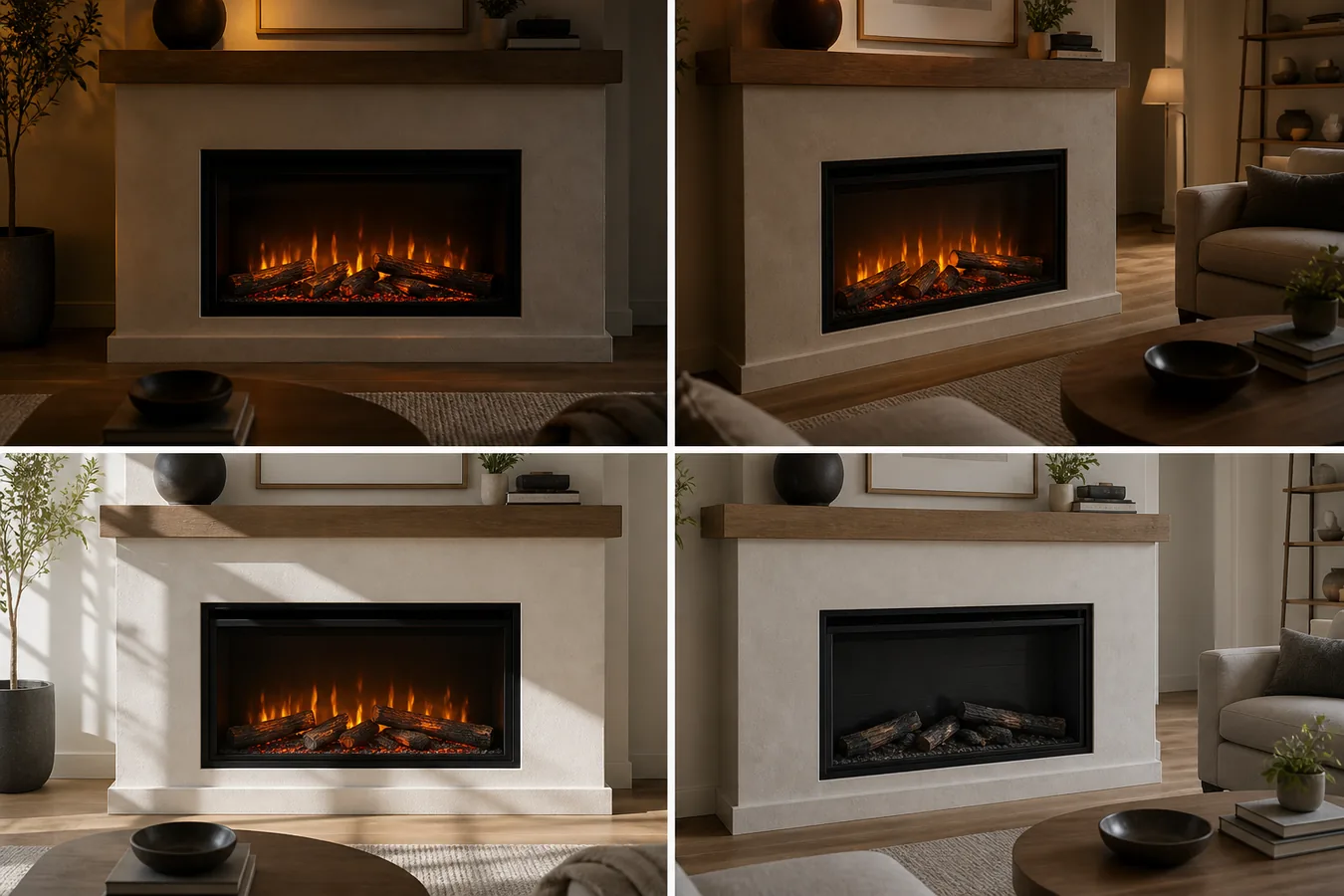
Crackle can support a fire impression, but it cannot prove that the image looks convincing from your seat. Use the realistic electric fireplace guide for flame medium, view angle, daylight and flame-off appearance. This page asks only whether the sound feature is controllable enough to keep.
Sound also does not establish a relationship with heat. Unless the exact manual says otherwise, do not assume the effect turns on with the heater, can run with flames only, or has its own independent state. Record those relationships from the same control table that names the sound function.
A phone icon creates another possible boundary. If an app owns a sound choice that the panel and remote do not, record the app, account and local fallback separately through the smart electric fireplace control path. “App control” is not automatically better; it changes what must remain available and maintained.
These handoffs prevent one attractive feature from swallowing the product decision. A candidate can have well-documented sound and still fail physical fit. It can have a convincing flame but an unacceptable quiet path. It can have an app yet leave sound control dependent on a phone. Each result belongs to its own evidence.
Close one model before listening to the demo
Use one card for the item you might actually order. Copy facts from current first-party owners and keep the source date. A collection icon or merchant filter may start the record, but it cannot finish it.
| Field | What to record for one exact model | Ready when | If it stays open |
|---|---|---|---|
| Product identity | Brand, full model/item number, market and applicable manual revision | Every later field names or explicitly includes that identity | Exact model/manual required |
| Sound source | Integrated speaker, included accessory, optional accessory, app dependency or not documented | The ordered configuration supplies the stated path | Accessory or implementation unresolved |
| Quiet control | Exact mute/off action | The household accepts where and how silence is reached | Sound present, quiet control unresolved |
| Volume | Listed settings or adjustment method, without converting labels into decibels | The documented range is enough for the intended routine | Volume depth unresolved |
| Control surfaces | Fireplace panel, supplied remote and/or official app | At least one acceptable path owns every required action | Controller dependency unresolved |
| Return state | What the exact manual says after its named standby/off action | Remembered or reset behavior fits the routine | Startup behavior unresolved |
Only after those rows close is a listening demo ready to answer the subjective question: do you like this sound in this room? Listen from the normal seat at the lowest setting you expect to use, then at the level you would choose for everyday flames. That experience belongs to the exact unit and room; it should not be published as a universal sound ranking.
An unresolved row is not a bad-product verdict. It means the available owner has not yet earned the sound feature for your decision. Ask the manufacturer for the applicable manual or a written model-specific answer, and preserve that response with the item number.
Choose silence first. If the exact fireplace can become quiet through an acceptable control, offers enough documented adjustment and returns in a state you can live with, its crackle effect has earned the right to influence the shortlist.