F18V66L looks like the end of an identification problem. In search results, it is often only the beginning. The same string can lead to an appliance manual, a mantel or TV-console assembly document, a used insert, or a remote advertised as compatible. Those pages are not describing the same layer of the product.
The strongest surviving document is an Ameriwood/Dorel instruction booklet numbered 8095096COM. It names the F18V66L electric fireplace and documents a 120-volt, 1,400-watt insert with two local switches. That makes it a useful manual candidate. It does not prove that every suffix, furniture package, remote listing or nominal 18-inch replacement matches the unit in front of you.
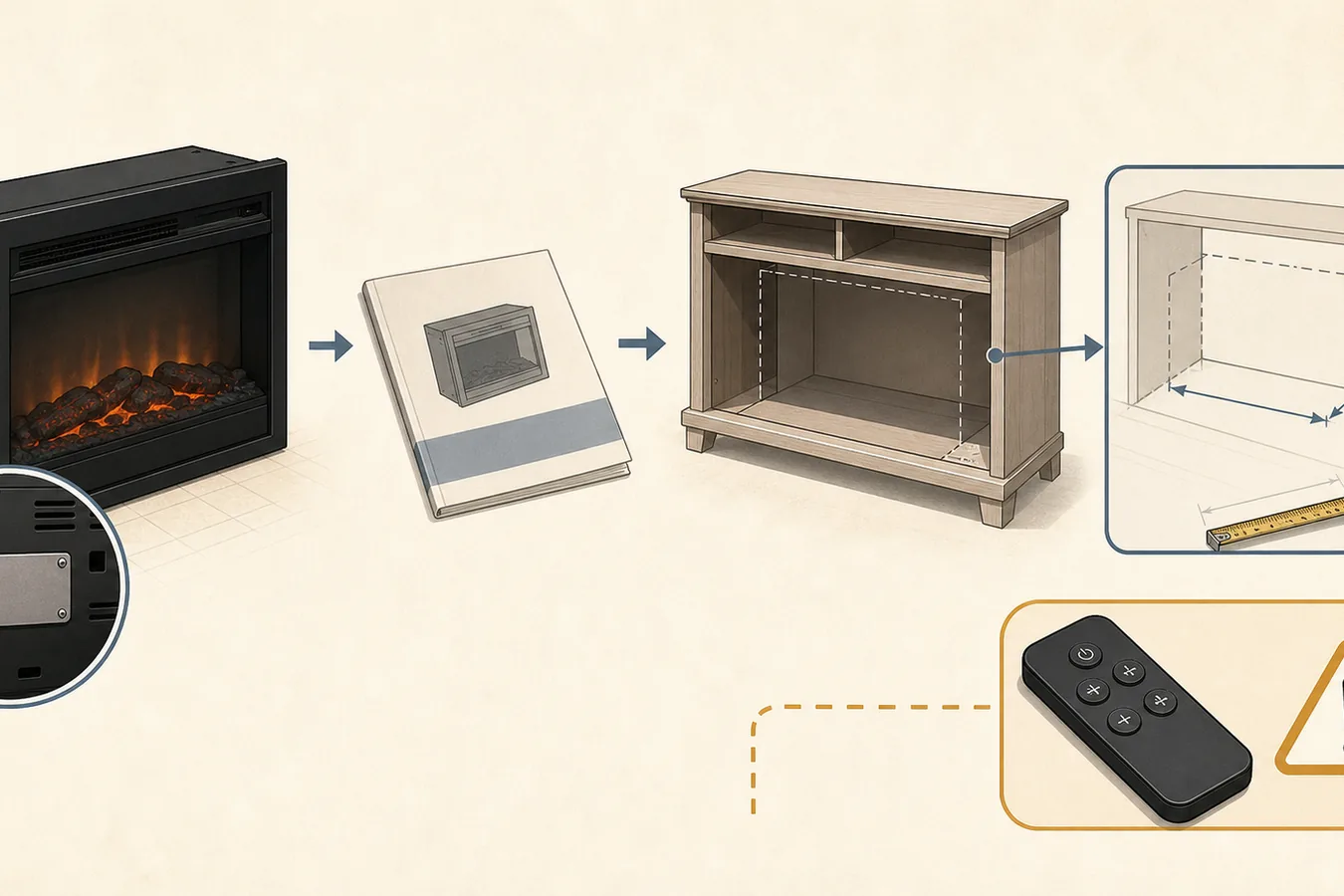
Before operating, servicing or replacing the insert, keep four identities separate: the fireplace rating label, the instruction booklet, the furniture that holds the insert, and any accessory or replacement offer. If one layer does not match, stop there. Do not let a familiar picture or the phrase “18-inch insert” bridge the gap.
One model number, four identities
Use the first column as evidence to capture, not as a shopping list. The outcome is the first row that cannot be closed.
| Evidence layer | What to record | What it can decide | Hold when |
|---|---|---|---|
| Fireplace appliance | Every character on the rating label, including any suffix; voltage, frequency and watts | Whether a manual or support record names the installed appliance | The label is missing, unreadable or differs from the document |
| Instruction booklet | Booklet number, model printed on its cover, language/market and document date if shown | Which operating, maintenance and safety instructions control | Search finds only a near-name or different suffix |
| Mantel or TV-console furniture | Furniture model/SKU, assembly manual, rear opening and mounting pieces | How the insert is retained and what opening actually exists | Only the fireplace model is known |
| Control interface | Visible buttons/switches and any original remote/receiver evidence, without opening the appliance | Whether a control claim even belongs to this version | A seller listing conflicts with the local controls or manual |
| Replacement geometry | Face, chassis, opening, depth, brackets, airflow route and cord exit | Whether a candidate is worth a full compatibility check | The only dimension is a nominal “18-inch” label |
| Current condition | Working, control issue, no heat, damaged cord, water exposure or another specific symptom | Whether the next owner is the manual, manufacturer support, qualified service or replacement research | The symptom requires opening or rewiring the appliance |
If all six rows close, you have either a confirmed manual match or a measured replacement brief. If the suffix, control layout or furniture identity conflicts, pause on that exact conflict instead of guessing.
What the 8095096COM booklet actually controls
The manufacturer-hosted F18V66L instruction booklet is unusually useful because it identifies both the appliance model and the booklet number. Once those match the installed unit, it establishes a narrow set of facts:
- electrical rating: 120 VAC, 60 Hz and 1,400 watts;
- power connection: a six-foot three-wire cord and a properly grounded wall outlet;
- cord rule: no extension cord or relocatable power tap;
- furniture relationship: the appliance is inserted from the rear of a completed mantel, centered, then retained with the mounting hardware described by the furniture assembly;
- local interface: separate
FLAMEandHEATERswitches at the upper-right of the appliance; - owner maintenance: periodic cleaning/vacuuming of the fan/heater area with the unit off and unplugged;
- service boundary: electrical repair or rewiring belongs to qualified or licensed service.
That list is a limit as much as a specification. The booklet does not give you permission to reuse an unfamiliar remote, bypass a damaged cord, move the insert outdoors, or assume another 18-inch chassis will fit the cabinet. It also tells owners not to operate a damaged unit and to route water-exposed or electrical conditions to qualified service.
The clearance sketch, mounting relationship and power instructions should be read in the PDF itself. Rewriting one cropped diagram into a universal replacement dimension would throw away the cabinet context that makes it meaningful.
A suffix or remote claim is a conflict, not a shortcut
The manufacturer-CDN booklet uses F18V66L. Search also surfaces a mirrored booklet associated with F18V66L-8. That is enough to require suffix discipline; it is not enough to declare the two documents interchangeable.
Write the installed label exactly as printed. Then compare it with the model on the booklet cover and the product identity inside the document. A suffix may represent a furniture package, revision or another production distinction, but the public evidence reviewed here does not close that meaning. Leave it unresolved until Ameriwood confirms it or an exact shipped document settles it.
Remote listings create the same trap. The 8095096COM booklet documents two local switches and does not describe a remote-control workflow. That does not prove that every product carrying a similar suffix lacks remote hardware. It does mean a marketplace phrase such as “for F18V66L” is not sufficient evidence of a receiver, signal method or pairing procedure.
If the installed unit came with an original remote, record both sides of the remote, the battery compartment, any model markings and the fireplace label. If it did not, do not add a remote merely because the seller’s title repeats the fireplace model. The broader electric fireplace remote guide explains the three identities that must match before ordering.
If the unresolved layer is the document itself, use the electric fireplace manual guide to reject a near-name, wrong-market or wrong-purpose PDF before carrying any instruction forward.
The cabinet is a second product
F18V66L is the fireplace appliance. It can appear inside a larger furniture product whose own SKU controls the wood panels, rear opening, brackets, fasteners, cord route and anti-tip requirements.
The F18V66L booklet itself describes approaching a completed mantel from the rear, sliding the appliance into the opening, centering it and reattaching mounting brackets. A retailer record also identifies F18V66L as the fireplace inside a much larger TV stand. Neither source makes the fireplace model the furniture model.
This distinction matters most when the original insert has failed. Removing the old appliance may reveal an opening that is wider than the chassis but narrower than the visible face, brackets that sit behind a front frame, or a cord exit that depends on the cabinet back. A replacement can share a nominal merchandising width and still miss one of those relationships.
If you are deciding whether to keep the furniture at all, the electric fireplace TV stand versus built-in guide owns that format decision. This page assumes the cabinet is staying and asks what evidence a replacement must satisfy.
Build a replacement brief without guessing
Do not shop from “18-inch insert.” Build a drawing with separate measurements and label every one as an actual field observation:
- Visible face width and height. This controls coverage of the finished opening, not the chassis fit behind it.
- Metal chassis width, height and depth. Measure the box that must enter the cabinet; exclude decorative projections only when the drawing labels them separately.
- Clear cabinet opening. Record width, height and usable depth at the tightest points, plus any rear panel, shelf or cable obstruction.
- Mounting geometry. Photograph and measure bracket/tab positions, screw pattern, setback from the face and how the appliance is prevented from moving.
- Air and service space. Preserve the intake/exhaust path and every clearance in the exact controlling manual. Do not copy a clearance from a candidate product onto the old cabinet.
- Cord and outlet relationship. Record cord exit side, available path, outlet location and whether the cabinet can retain direct wall-receptacle access without an extension cord.
Attach the rating-label photo and control-layout photo to that drawing. The result is not yet a compatible replacement; it is a brief that can reject obvious mismatches before a seller or manufacturer performs a full check.
Our electric fireplace specification field guide shows why overall size, viewing area, required opening, depth and power cannot stand in for one another. If this insert is being moved into a different masonry opening rather than returned to its furniture, start again with the existing-fireplace insert guide.
Follow the first break in the evidence line
When the label and 8095096COM booklet match and the unit is working, use only the documented controls and owner-maintenance actions. No replacement decision is required.
When the exact model matches but the unit has a symptom outside those owner actions, move the complete identity record to the electric fireplace repair guide. A damaged cord, water exposure, internal electrical work or rewiring is not a generic DIY branch.
When the suffix, control layout, booklet or furniture identity conflicts, open a manufacturer support ticket before buying a remote, part or insert. Ameriwood’s current help center accepts photos and short videos with a ticket. Send one compact packet:
- full fireplace rating label;
- full furniture label/SKU;
- booklet cover and booklet number;
- front control layout and any original remote markings;
- one wide photo showing how the insert sits in the cabinet;
- the exact symptom or replacement question;
- measured face, chassis and opening drawing.
Ask support to confirm the controlling document, the meaning of any suffix, the documented control configuration and whether a current part or replacement path exists. Do not translate silence into compatibility.
If support cannot close the product identity or a service path is unavailable, keep the old unit’s measurements and mounting evidence intact. You now have a measured replacement brief, which is far more useful than the model name alone—and precise enough to stop a near-size purchase before it becomes a cabinet problem.