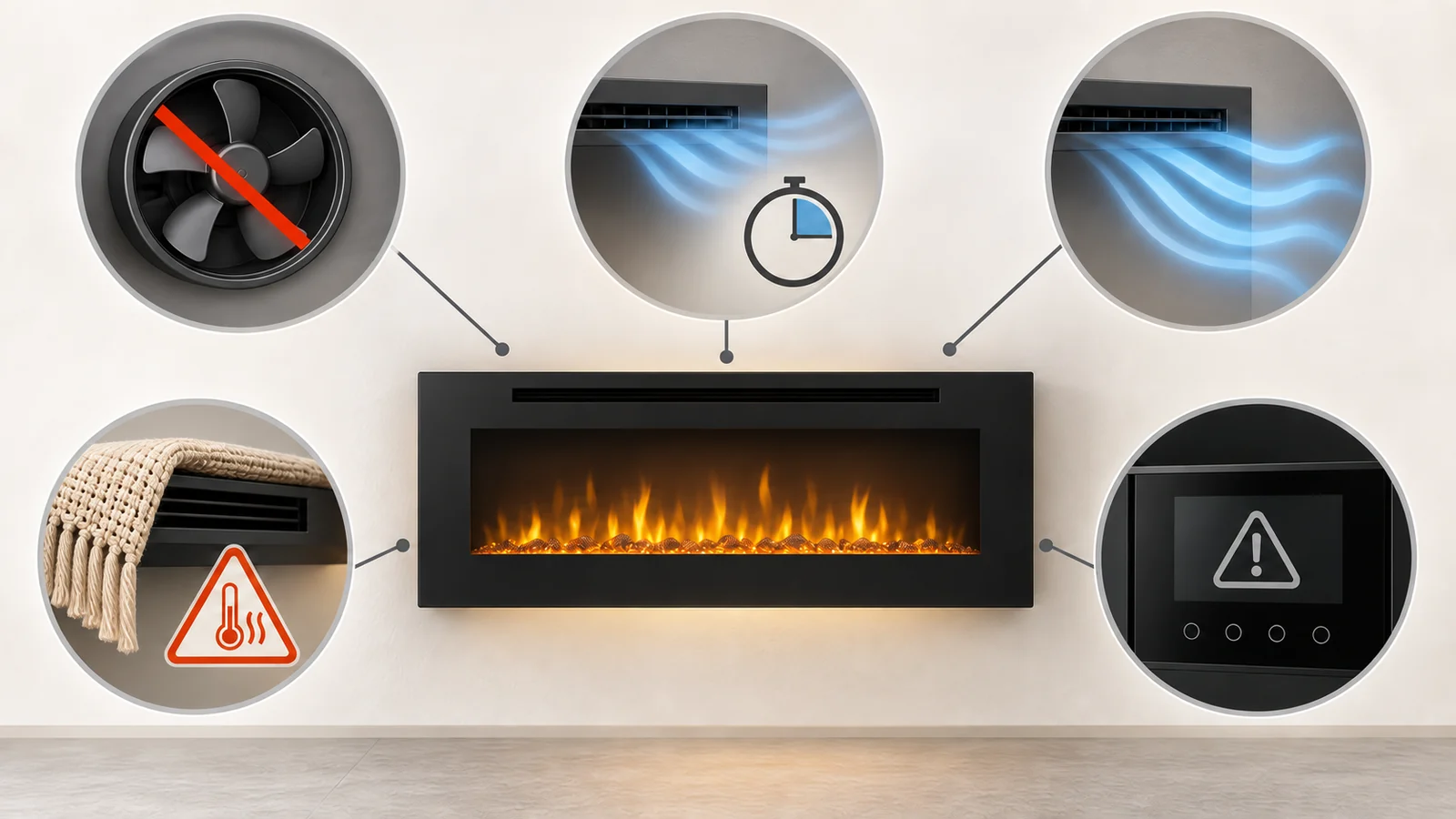
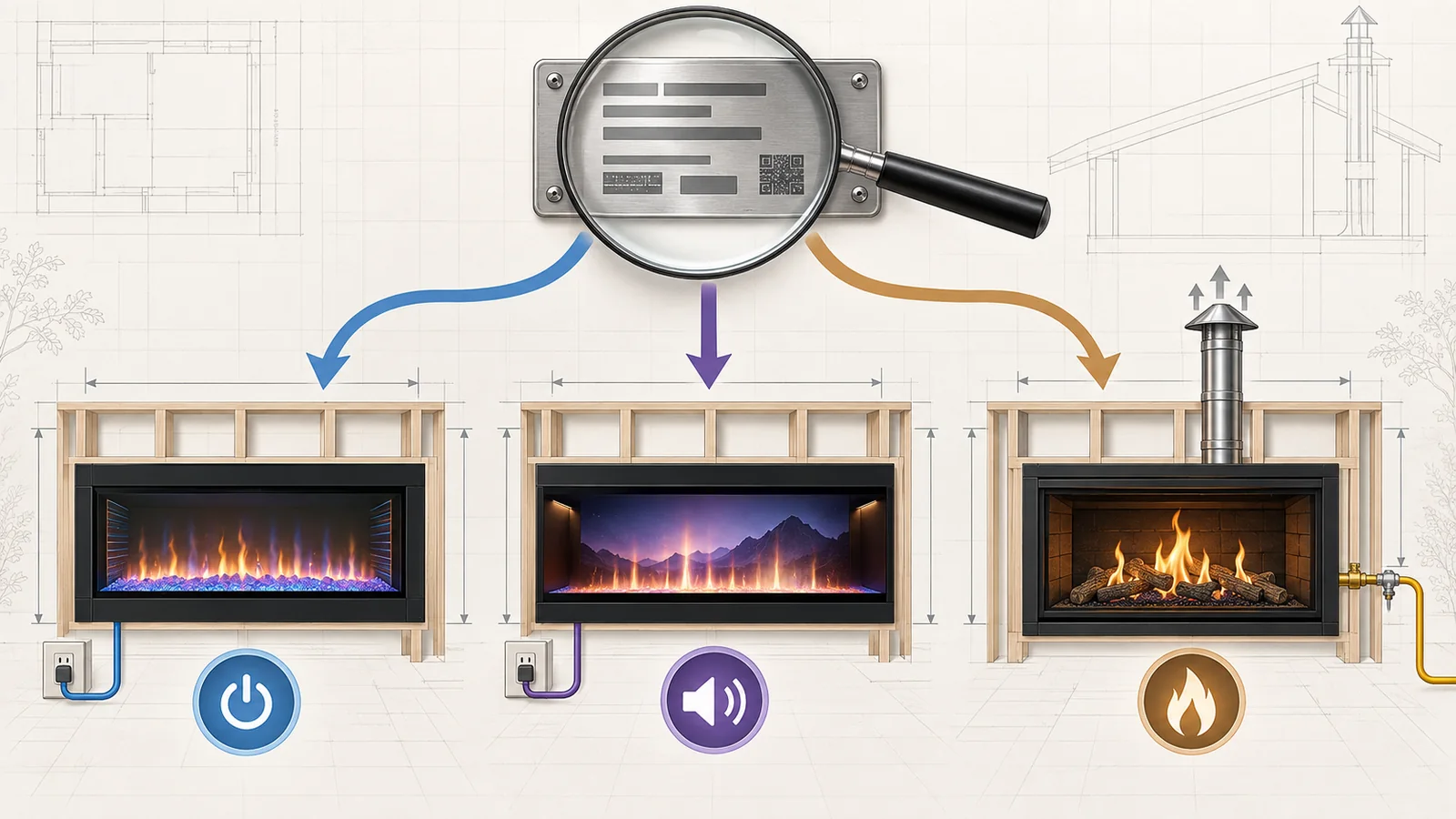
Electric fireplace repair starts with a label, not a screwdriver. Before a panel comes off, record the full model or SKU, serial number or date code, and the exact state of the appliance: what still works, what does not, and whether the controls or household power changed.
Then check the exact model for a recall and warranty path. Find the owner manual and, if the manufacturer provides one, the service or parts document for that same identity. Perform only the external setting, cleaning or reset action the owner manual assigns to the owner. Internal wiring, boards, heater assemblies and part replacement belong wherever the model-specific manufacturer document places them.
That sequence can end in an owner-documented check, an immediate recall stop, a manufacturer or qualified-service handoff, an exact-part quote, or a replacement comparison. If the model remains unknown, none of the later branches is ready.
A repair starts before the first screw comes out
A support case needs more than a product category and a symptom. Dimplex’s current US customer-service form, for example, asks for the model number, serial number or date code, purchase information and a description of the issue. Its support library also separates current and legacy manuals. That is a useful model for the record, although the fields and service process for another brand may differ.
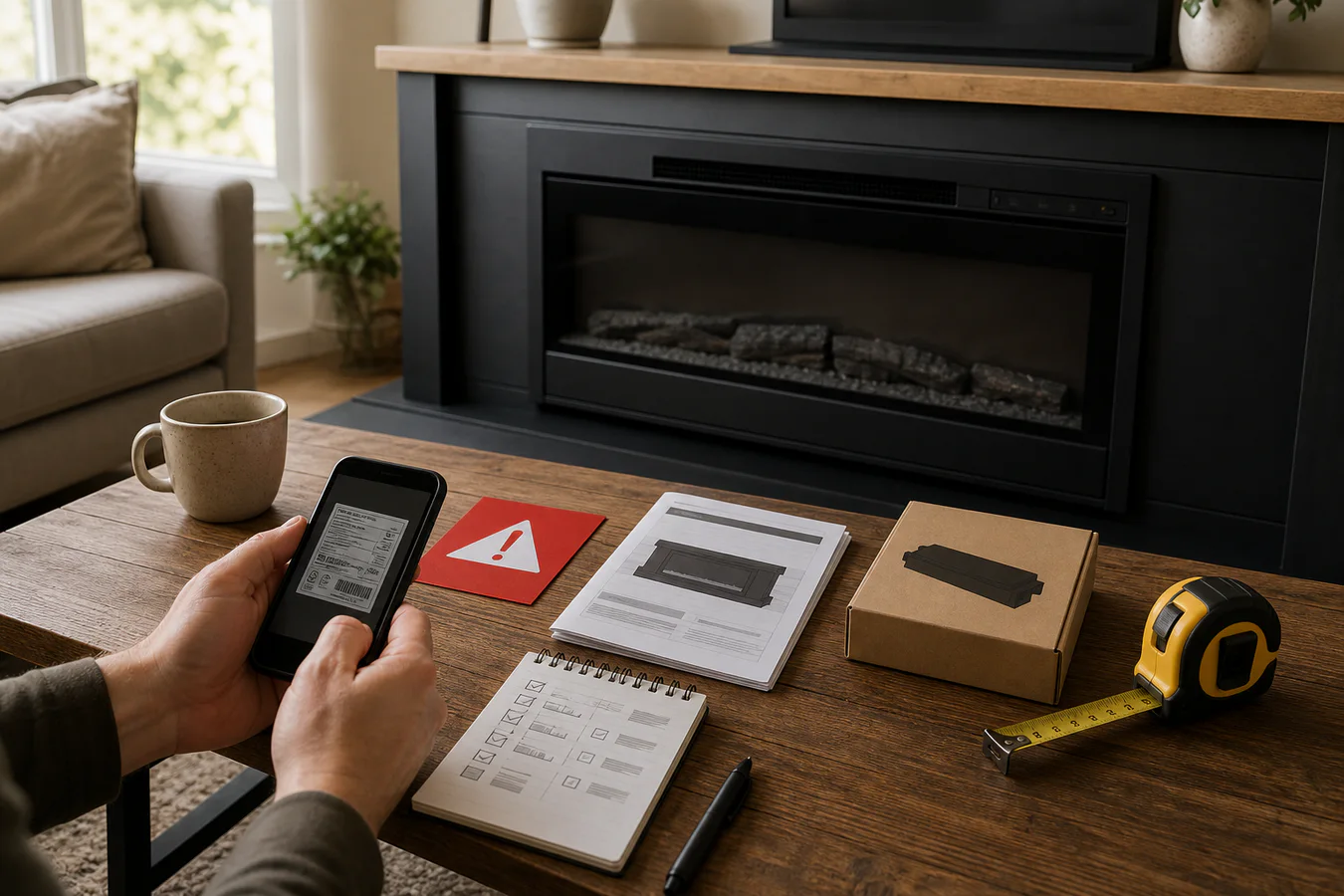
Photograph every accessible identity label without removing a panel. Copy punctuation and suffixes rather than shortening the model to the familiar series name. Preserve the country of purchase, approximate purchase date, installation type and the title or revision of each document you find. If the label is concealed behind a built-in unit, do not turn identification into an unplanned removal job; start with purchase records, existing photos and manufacturer support.
Use this router before choosing a repair action:
| What the record shows | The next path | What closes that path |
|---|---|---|
| Full model, serial/date code or market is still missing | Identify the unit first | Manufacturer confirmation or a matching identity label and current document |
| An official recall matches the exact model and its date/serial scope | Stop and follow the recall | The recall owner’s stated remedy—not a troubleshooting result |
| The exact owner manual gives an external setting, control, cleaning or reset step for this symptom | Use the manual’s owner check | Record the exact step and result; do not extend it beyond the document |
| The manual directs the condition to service, or only a service manual covers the internal work | Send it to manufacturer support or qualified service | A service owner, scope and quote tied to the exact model |
| The correct parts document supplies a part number and the supplier confirms it for the model/revision | Get the exact part and quote | Part identity, availability, quantity, labor/access and warranty effect |
| The part is unavailable, the authorized service path cannot be reached, a recall provides a replacement/refund remedy, or a real repair quote is now available | Compare replacement fit | Existing opening, power, finish work, controls and total project consequences |
The specification names on the rating label should stay intact. If a voltage, wattage, model field or installation term is unfamiliar, the electric-fireplace specifications guide explains how those fields affect fit without translating them into a guessed part or diagnosis.
The same symptom can lead to four different owners
“No heat” sounds specific until it is placed inside one exact model’s documents. In the current SimpliFire Allusion Slim service manual for SF-ALLS40, SF-ALLS50, SF-ALLS60 and SF-ALLS72, the no-heat path can include thermostat mode, a tripped thermal switch, a heater-disengagement control, the main control board or the heater assembly. The same service manual says that it is intended to assist a qualified service technician and points to the installation manual for the parts list and part numbers.
That is not a universal list of electric-fireplace causes, and it is not permission to open a different appliance. It demonstrates why the owner can change as the evidence becomes more specific:
- an ordinary setting described in the exact owner manual may remain an owner action;
- a model-documented protective response may require the exact reset or support route in that document;
- an internal component path in a service manual belongs to the service boundary stated by its manufacturer;
- an exact numbered component can move to parts availability and quotation only after the model and document match.
Keep symptom work with its registered owner instead of rebuilding a general fault tree here. If the unit repeatedly stops, preserve what shut off and use the repeating-shutdown guide. If the flame effect is the failed function while heat or controls still work, sort the effect system first. A sound that changes by operating mode belongs in the noise guide. A completely dark unit needs the actual power and control path recorded before anyone calls it a failed board.
The purpose of those pages is to produce better evidence. The repair page begins where that evidence must be assigned to the correct document, person and part trail.
A recall cancels the troubleshooting plan
A recall match is not another possible cause to put at the bottom of a list. It changes the action.
The US Consumer Product Safety Commission’s November 2023 recall for a Twin-Star Style Selections infrared quartz electric fireplace is deliberately narrow. It covers model 42HF295FGT manufactured before January 2023 with date codes 0521, 0322, 0422, 0522, 0622, 0722 or 0822. The CPSC says affected consumers should stop using and unplug the unit and contact Twin-Star for a refund. It recorded 24 overheating, fire or smoke reports, including two property-damage reports and no reported injuries at publication.
This does not establish that every Twin-Star or Style Selections fireplace is recalled. The model and the date-code scope both matter. It does show why the label check belongs before a generic reset or repair: when the identity matches the official scope, the published remedy replaces the troubleshooting plan.
Search the current CPSC and manufacturer recall owners using the exact model and available serial/date information. Save the recall URL and observed date with the service record. If the model is close but the date code is missing, ask the recall contact to resolve the identity rather than assuming that “close” means included or excluded.
The part number matters more than the part name
“Blower,” “control board,” “remote” and “heater” are descriptions, not compatibility records. A part can look right and still belong to another width, voltage, control revision or product generation.
Dimplex’s current troubleshooting FAQ tells owners to find troubleshooting guides and replacement-parts lists in the Parts and Service Manual by entering the model number, and to include both the model and serial number when asking customer service for help. The SimpliFire service manual above makes the other half of the boundary visible: its replacement instructions are for named SF-ALLS models and qualified service, while the matching installation manual controls the part numbers.
Before requesting a part or repair quote, preserve:
- the full brand and model/SKU, including every suffix;
- serial number, date code, market and approximate purchase date;
- exact owner, service or parts document title and revision;
- the manufacturer’s part number, description and quantity, if one is actually published;
- the symptom state and the documented owner action already tried;
- whether the unit is plug-in, hardwired, wall-mounted, recessed, built into furniture or otherwise difficult to access;
- the supplier or manufacturer confirmation, availability date, return terms and effect on warranty;
- who is authorized to install the part under the controlling document.
If the only failed object is the remote, the remote-replacement guide keeps model, receiver and control-system identity together before ordering. The same principle applies to every other component: no exact part number means the parts path is still a manufacturer question, not a shopping task.
Build the service request before comparing repair with replacement
A useful service request allows another person to price the actual job without re-creating the case from the beginning. Put the evidence in one record:
| Record field | What to provide |
|---|---|
| Appliance identity | Brand, full model/SKU, serial/date code, purchase market and label photos |
| Failure state | What works, what does not, when it changes, and every code, odor, shutdown or household-power event |
| Controlling documents | Exact owner/service/parts manual title, URL and revision; note which one assigns the next action |
| Work already performed | Only the owner-manual step actually completed and its result; otherwise write “none” |
| Recall and warranty | Current recall search result, warranty status and the owner of any remedy |
| Part and access | Exact part number if confirmed, availability, installation/service boundary and how the unit is mounted or built in |
| Quote | Parts, labor, access/finish work, lead time, service warranty and what remains excluded |
Do not invent a universal percentage at which replacement becomes “better.” The comparison becomes real only after a part is confirmed or unavailable, a service owner accepts or declines the work, or an actual quote exposes parts, labor, access and timing. A recall remedy may create its own replacement or refund route; it should not be converted into a private cost formula.
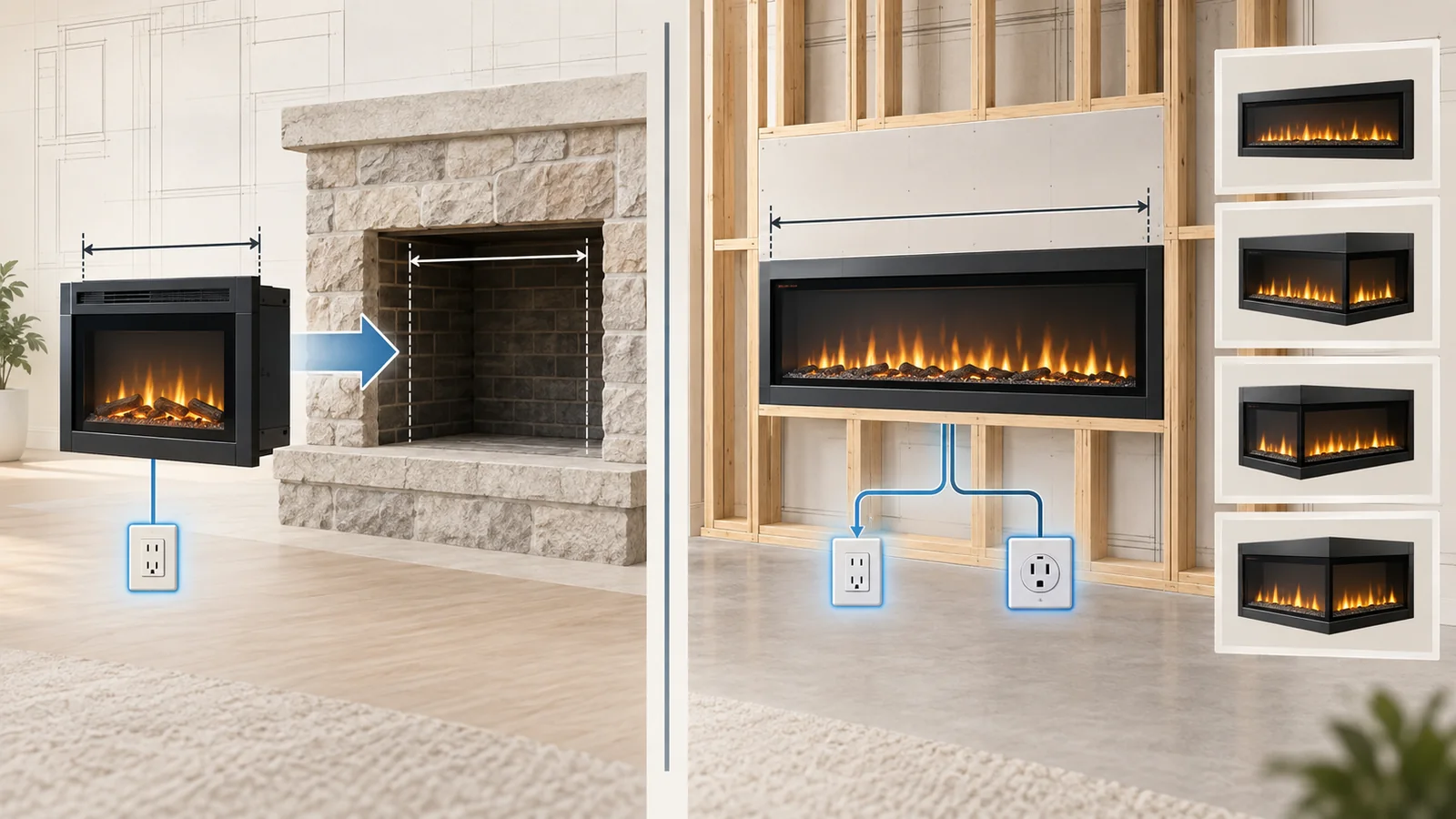
When replacement does enter the conversation, compare the whole project rather than the price of a new firebox alone. Preserve the existing opening, overall front, ventilation and clearance rules, electrical path, trim or furniture integration, control expectations and finish work. The specifications guide is the handoff for translating those fields into a replacement-fit record.
If the model, document or exact part trail breaks, do not bridge the gap with a generic component or an unsourced teardown. Send the unresolved field to the manufacturer or the qualified service owner named for that appliance. A repair plan is ready when the next person can see exactly which unit, document, remedy or part controls the work—and a replacement comparison is ready only when the evidence shows why that repair path could not close.