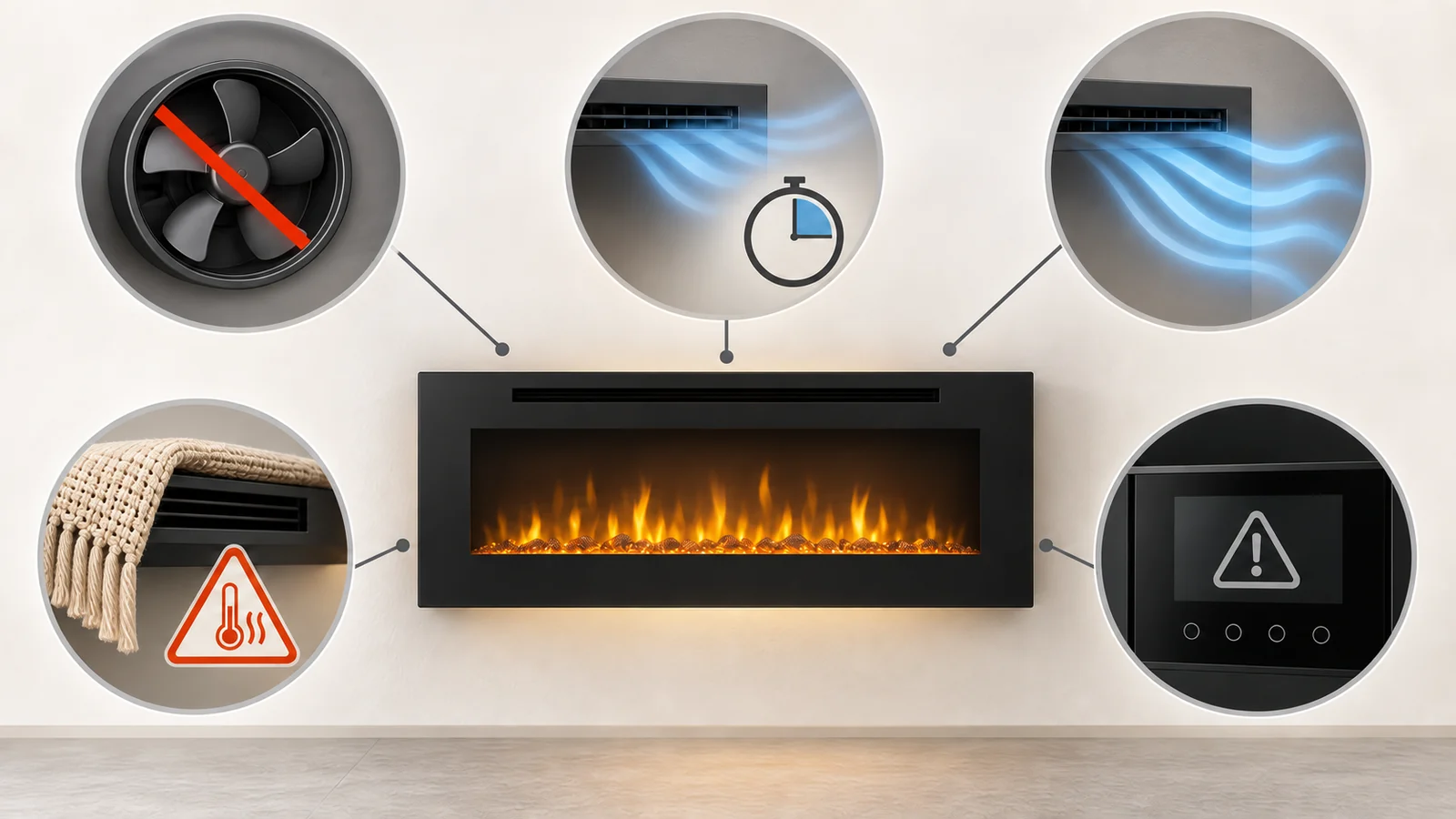
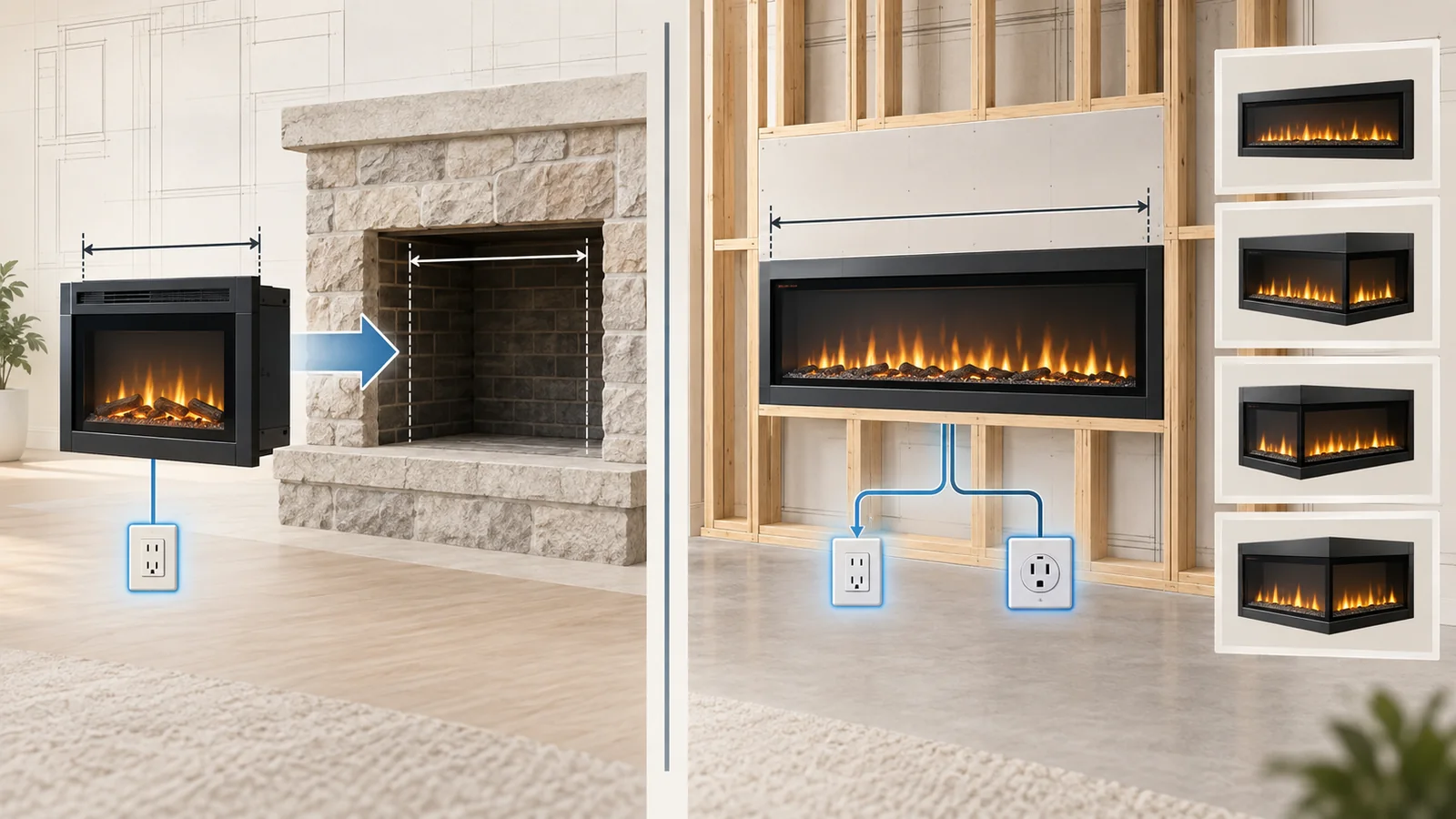
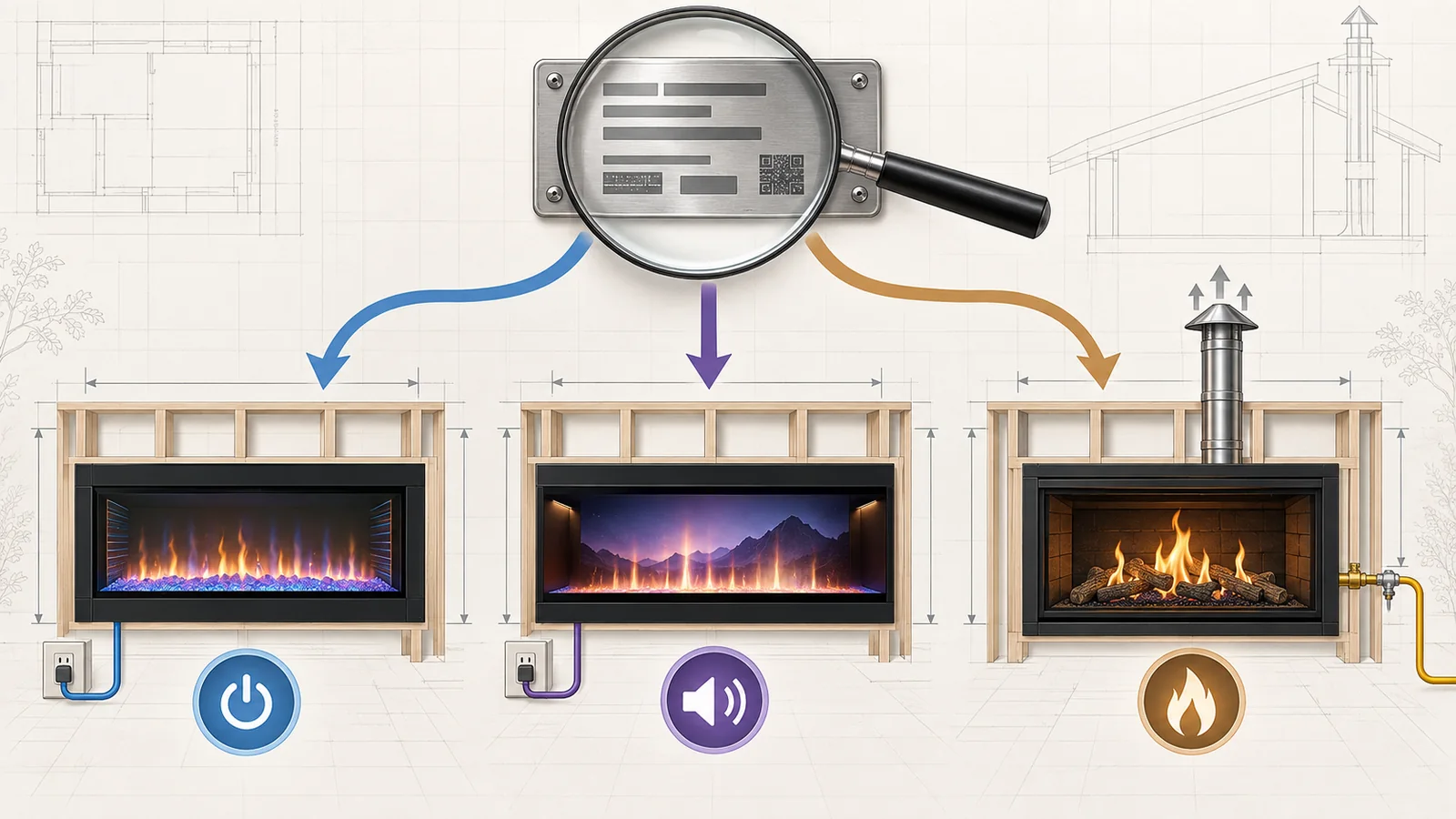
One current Twin Star product title calls the same Duraflame object an electric log set and a faux-logs insert. That overlap is the problem in miniature: insert can describe something placed in an existing hearth without proving that it is a closed metal firebox.
For a useful identification, record three things separately. First, note how the object connects to the room: open logs in a hearth, a closed chassis, a cabinet on legs, or a firebox inside furniture. Second, copy the complete model or SKU. Third, find the Twin-Star product or support document that controls that exact identity.
The Duraflame name identifies the licensed brand. It does not make dimensions, controls, manuals or replacement parts transferable between a log set, firebox, stove and furniture package.
Why an “insert” search produces open electric logs
Twin Star’s current page for a Duraflame electric log set uses “Faux Logs Insert” in the product title and describes faux logs placed in an existing fireplace. The visible relationship is an open grate and log bed using the hearth behind it, not a rectangular firebox supplying its own enclosing shell.
A second first-party Duraflame log-set page also describes placement in an existing fireplace, but discloses a different heat system and room-area claim. Even within the log-set branch, the shared brand and placement do not authorize one product’s ratings or controls for another.
This gives the word insert a narrow use in those titles: the product is inserted into an existing hearth. It does not establish firebox cutout dimensions, trim coverage, a replacement chassis or a compatible manual. For those open-log products, the electric log-set guide owns the hearth and visual-background decision.
The point is not to rename the seller’s page. Keep its exact title as source evidence, but give the object a working type based on what is physically there.
The support trail leaves Duraflame.com
Duraflame’s current support page says that Duraflame electric fireplaces and heaters are manufactured and distributed under brand license by Twin-Star International. It directs electric-product help to Twin-Star and also says Duraflame does not operate an online store.
That produces three different roles that should not be collapsed:
| Role | What it can establish | What it cannot establish alone |
|---|---|---|
| Duraflame brand owner | The current license and support handoff | The identity, fit or document for an unidentified electric unit |
| Twin-Star product/support owner | An exact product page, manual, service path or model response | A match when the model label is missing or different |
| Retailer or marketplace listing | A candidate SKU, seller description, current offer and photos | Official support ownership or cross-model compatibility |
Build the case around the label rather than the logo. Preserve every character in the model/SKU, any serial number or date code, the purchase market, voltage and wattage fields, and the exact title and observed date of the Twin-Star source. If furniture and firebox each have a label, keep both.
If the model is hidden behind a built-in or furniture assembly, start with purchase records and existing label photos. Identification is not a reason to begin an unplanned removal. Once the identity is available, the manual-matching guide explains how to reject a near-name or wrong-generation PDF.
Classify the connection before the appliance
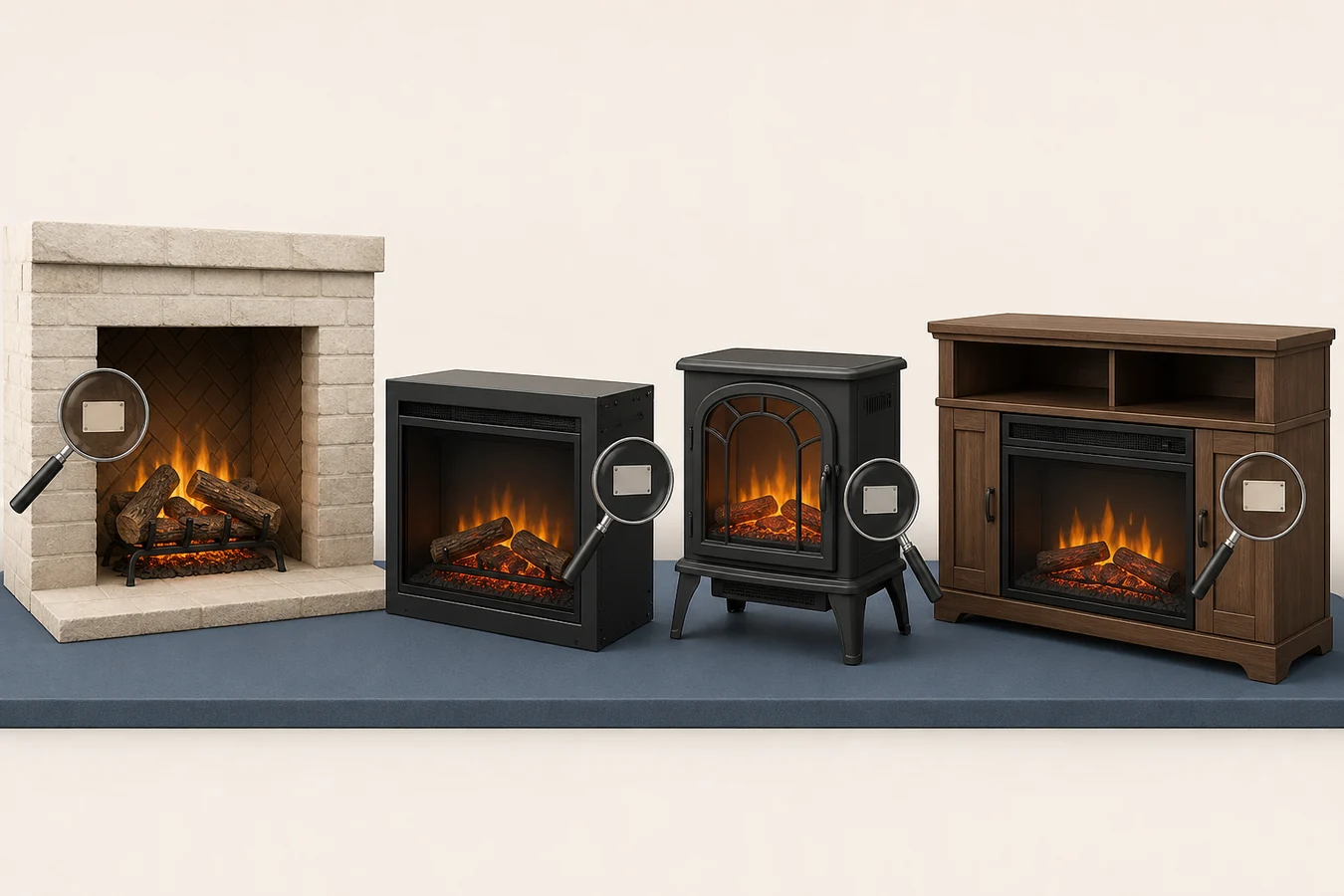
A flame photo is a poor classifier because logs and an ember bed appear in several forms. The product’s connection to the hearth, chassis or furniture is more useful.
| What is physically connected | Working type | Do not transfer yet | Next record to find |
|---|---|---|---|
| A grate and faux logs sit openly inside an existing hearth; there is no enclosing firebox shell | Electric log set | Firebox opening, trim or near-name insert manual | Full log-set model and its exact product/manual owner |
| Flame bed, heater and controls are enclosed in one rectangular metal chassis | Insert or firebox | Another nominal width’s opening, voltage or control set | Chassis model, overall dimensions, required opening and manual |
| A complete cabinet stands on legs as a room appliance | Stove heater | Hearth-insert fit, built-in clearance or log-set instructions | Stove model, supply rating, controls and support document |
| A surround, shelf and firebox arrive as one fireplace-looking assembly | Wall-mantel package | Mantel dimensions from the firebox alone | Package model plus any separate firebox identity |
| Media storage and a TV-supporting top surround the firebox | TV-furniture package | TV load or cabinet fit from the firebox name | Furniture model, firebox model and a document for each |
| A compact room heater lacks a fireplace view, log bed or firebox relationship | Non-fireplace heater | Any conclusion from this electric-fireplace page | The exact heater model and support owner |
Twin Star’s current heating catalog itself separates wall mantels, electric fireplace inserts, wall-hanging fireplaces, heaters, stoves and log sets. Current Duraflame pages also show a freestanding stove heater and an infrared-quartz stove heater as branches distinct from open log sets. Their cabinet relationship sends them to the freestanding electric-fireplace guide. The infrared wording still requires the exact-model field review in the infrared quartz guide; it does not convert a stove into an insert.
If the rating-label fields are unfamiliar, use the electric-fireplace specifications guide to separate model, electrical input, dimensions and installation terms. Reading a field is different from borrowing it from a nearby product.
Furniture creates a two-label case
Twin Star maintains a Duraflame wall-mantel product page and a TV-stand page describing media furniture with an included 23-inch electric fireplace. Those are not merely larger shells around the same generic “insert” decision. The cabinet and the appliance can carry different obligations and, on an actual unit, may carry separate identities.
Keep a two-part record:
| Furniture record | Firebox record |
|---|---|
| Complete package or cabinet model | Full firebox model/SKU |
| Overall width, depth, height and assembly owner | Firebox overall dimensions and any required opening |
| TV size/load rule, storage, anti-tip and furniture hardware | Voltage, wattage, controls, clearances and appliance warnings |
| Package manual and parts owner | Owner/service/parts document for the exact firebox |
| Approved firebox relationship stated for the package | Replacement or compatibility confirmation for that package |
The mantel-package guide owns the surround relationship. The TV stand versus built-in guide owns the media-furniture commitment. Neither can be closed by a firebox’s nominal width alone.
If the cabinet label survives but the firebox label does not, the replacement question remains open. If a listing names the firebox but omits the furniture SKU, the TV and assembly obligations remain open. A seller photo cannot supply the missing half.
A fact must keep its owner all the way to the decision
Before carrying a specification out of a page or PDF, ask whether the product form, exact model and source owner still describe the same object.
| Fact being carried forward | Required identity chain | Mismatch disposition |
|---|---|---|
| Dimensions, opening, trim or furniture footprint | Form + full model + exact measurement reference | Keep fit unresolved; a nominal size or similar photo cannot close it |
| Voltage, input, heater type or controls | Rating label + exact model + current product/manual scope | Do not transfer a heat claim, remote function or control sequence |
| Manual, remote or replacement part | Exact model/generation + document role + support confirmation where needed | Treat a near-name PDF or visually similar remote as a clue only |
| Product availability or successor | Exact SKU + market + current owner + observation date | An archived or sold-out listing does not name a compatible replacement |
Three common mismatches now have direct answers. When a listing says insert but shows open logs on a grate, keep the log-set classification. When a stove listing has no readable model, the form is known but every model-specific claim remains on hold. When a TV console has furniture and firebox labels, preserve both; a replacement must close the package relationship, not merely share a nominal width.
If the only disputed object is a handset, the remote guide keeps the transmitter, receiver and fireplace identity together before shopping. If the task has moved from identification to a fault, the electric-fireplace repair guide routes the exact model toward an owner-documented check, support, an exact part request or a replacement comparison.
The record is ready when the visible connection, full label and controlling Twin-Star source agree. If one breaks, preserve the break. It is the decision to pause—not a blank to fill with the nearest Duraflame title.