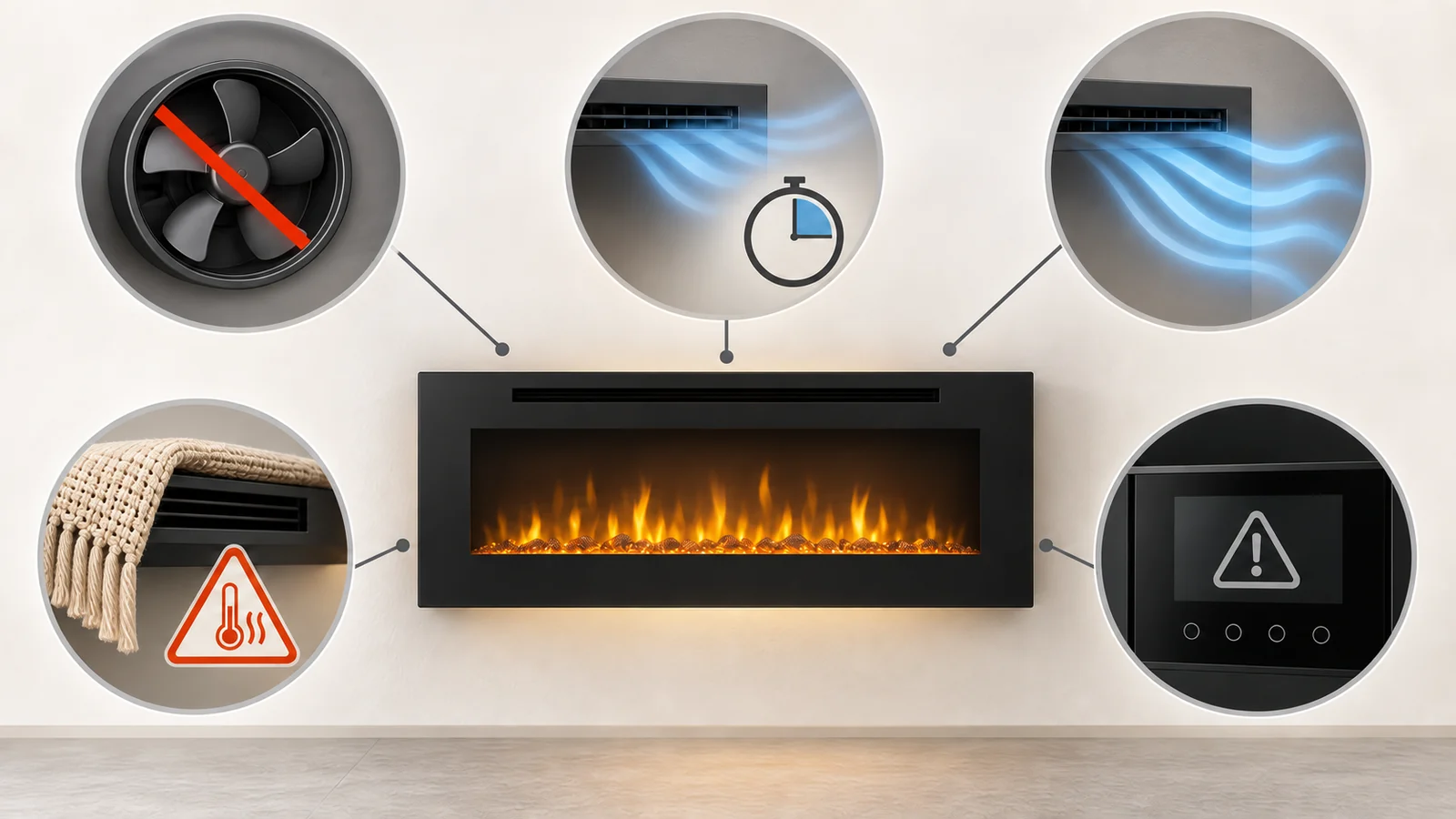
An LED badge can be accurate and still tell you almost nothing about which electric fireplace belongs in your room. LED may illuminate a flame image, an ember or media bed, a separate downlight—or several of those at once. It does not identify the fireplace format, heater, electrical connection or repair path.
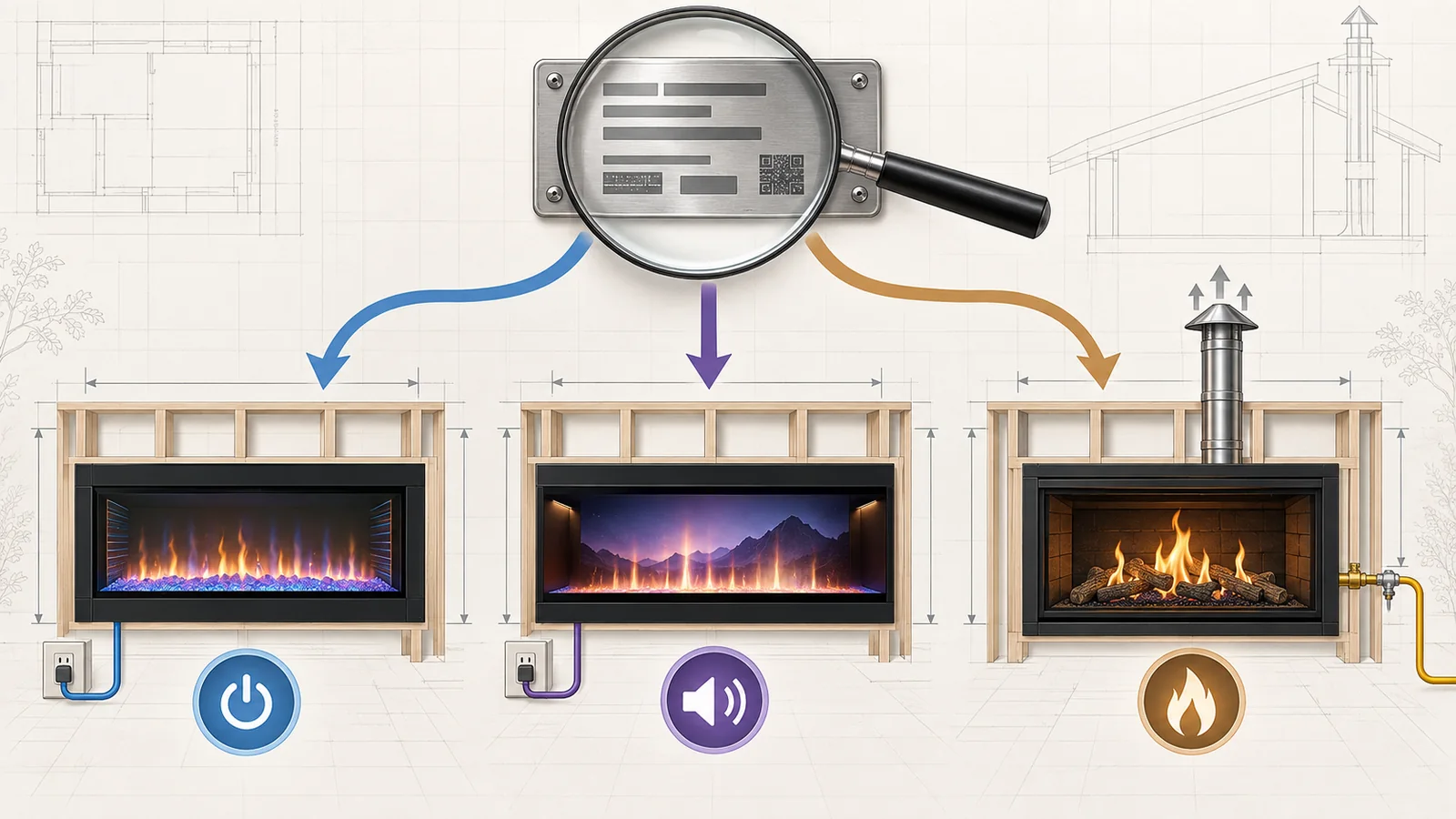
Before comparing products, attach the claim to one exact model. Record what each light layer does, which controls own it, whether the visual system can run without heat, and what the current manual says about service. Then compare fit, power and heater data as separate fields.
If a listing does not expose the model number and a current manufacturer document, the correct result is not “LED fireplace shortlisted.” It is EXACT_MODEL_HOLD.
The LED badge collapses five different questions
| Decision field | What a useful exact-model record contains | What “LED” alone cannot prove |
|---|---|---|
| Visual method | The documented way light becomes a flame image, including any screen, reflector, media or water-vapor layer | Depth, realism, viewing angle or whether another technology is involved |
| Light channels | Flame, ember/media and accent/downlight listed separately | That every visible light changes together—or can be controlled at all |
| Control states | Panel, remote or app ownership; color, brightness and speed; flame-only and heat-only behavior | Independent controls, memory behavior or a usable fallback |
| Fireplace contract | Exact model/SKU, wall or opening relationship, dimensions and current manual | Wall-mount, insert, built-in, stove, mantel or outdoor eligibility |
| Heat, power and service | Heater output and modes, voltage/connection, and owner-versus-service lighting authority | Heat performance, low total running cost, LED lifespan or owner-replaceable parts |
Treat these as non-compensating fields. A product cannot make up for an unknown opening requirement with more flame colors, and a detailed heater specification cannot tell you whether the ember strip is a service part.
Three LED fireplaces can create three different systems
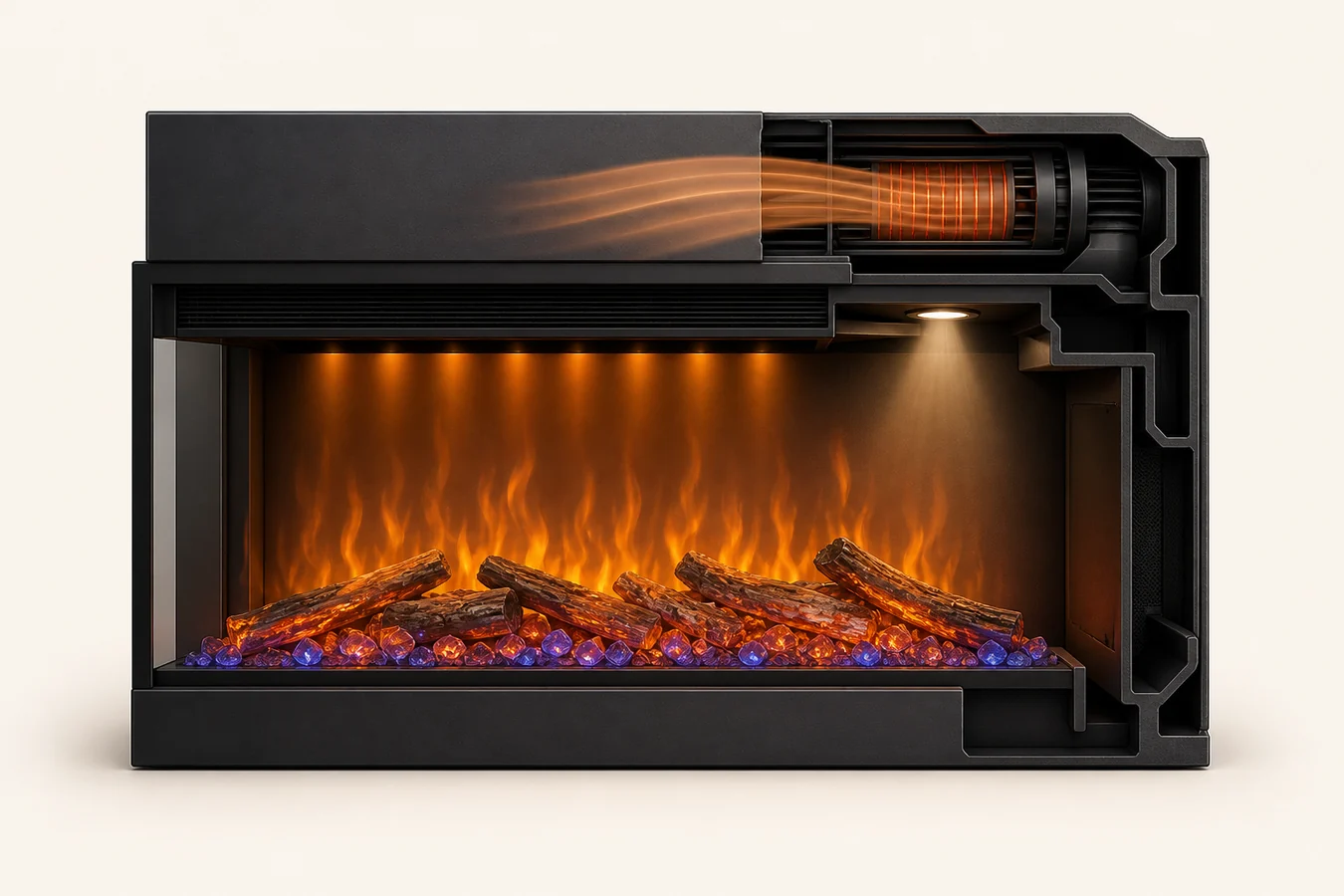
Dimplex’s current Vital Essence owner describes LED flame technology as layered lighting across the ember bed, with selectable color combinations plus speed and brightness controls. Its Ignite Evolve owner describes a different named system in which layered LED lighting interacts with driftwood and crystal-media reflections. Both use LEDs; the light’s optical job is not identical merely because the component name is shared.
Touchstone makes another distinction visible. Its current collection comparison separates flame settings, ember-bed settings and, on some collections, downlighting. The number of combinations also changes by collection. “Color-changing LED” is therefore not a portable control specification.
Dimplex Optimyst supplies the sharpest boundary: the manufacturer says that system combines water vapor with advanced LED lighting. A shopper who filters only for LED could place a light-and-media system beside a water-vapor system without noticing the refill, water, air and maintenance questions that now enter the project.
These examples are not a realism ranking. If the purchase turns on daylight performance, side views, reflections or the flame-off appearance, use the realistic electric fireplace viewing guide under matched room conditions. If it turns on logs, crystals or stones, the decorative-media compatibility guide keeps appearance separate from model-approved media.
Read the controls as separate channels
A feature list can say “multicolor LED flames” while leaving the ember bed, downlight and heater on different controls. Build the record from the exact product page and manual, not from a collection card.
Touchstone’s current Sideline 72 product owner identifies SKU 80015, three flame-color options, a ten-color ember bed, variable flame speed, 120V plug-in or hardwire compatibility and independent flame/heat states. Those are useful facts because they are tied to one SKU. They cannot be copied to a different Sideline size or series without that model’s owner.
The current Sideline Elite series manual illustrates why the control record needs separate rows: flame color, LED ember light and heater have distinct buttons and states. A model can also remember or reset a visual choice differently depending on its documented power state. “App controlled” or “remote included” still does not tell you which settings survive without the app.
For a connected model, test the local panel or supplied remote on paper before treating the phone as the primary path. The smart electric fireplace control guide owns app, account, connectivity and fallback questions. The broader electric fireplace system map shows why supply, controls, visual effect and heater should remain separate even when one interface reaches all four.
Heat, power and fit are not LED specifications
LED describes a lighting component, not the appliance’s complete electrical load. A fireplace may let the visual effect run without the heater, but the exact owner still controls whether heat exists, how it is selected, what output is documented and how the product connects to power.
Vital Essence’s current family page says that the fireplace can provide heat or run flame-only. Touchstone’s Sideline 72 page describes supplemental heat and both flames-without-heat and heat-without-flames operation. Those are model or family claims—not a result implied by the letters LED. Another product may be heat-free, may omit heat-only operation or may give different control ownership.
Format is just as independent. SimpliFire’s current catalog uses LED language across products with wall-mounted, built-in, linear and outdoor relationships. Its Built-In product owner describes a traditional flush design that can operate with or without heat. That does not turn another LED product into a flush built-in, nor does it supply the opening for one.
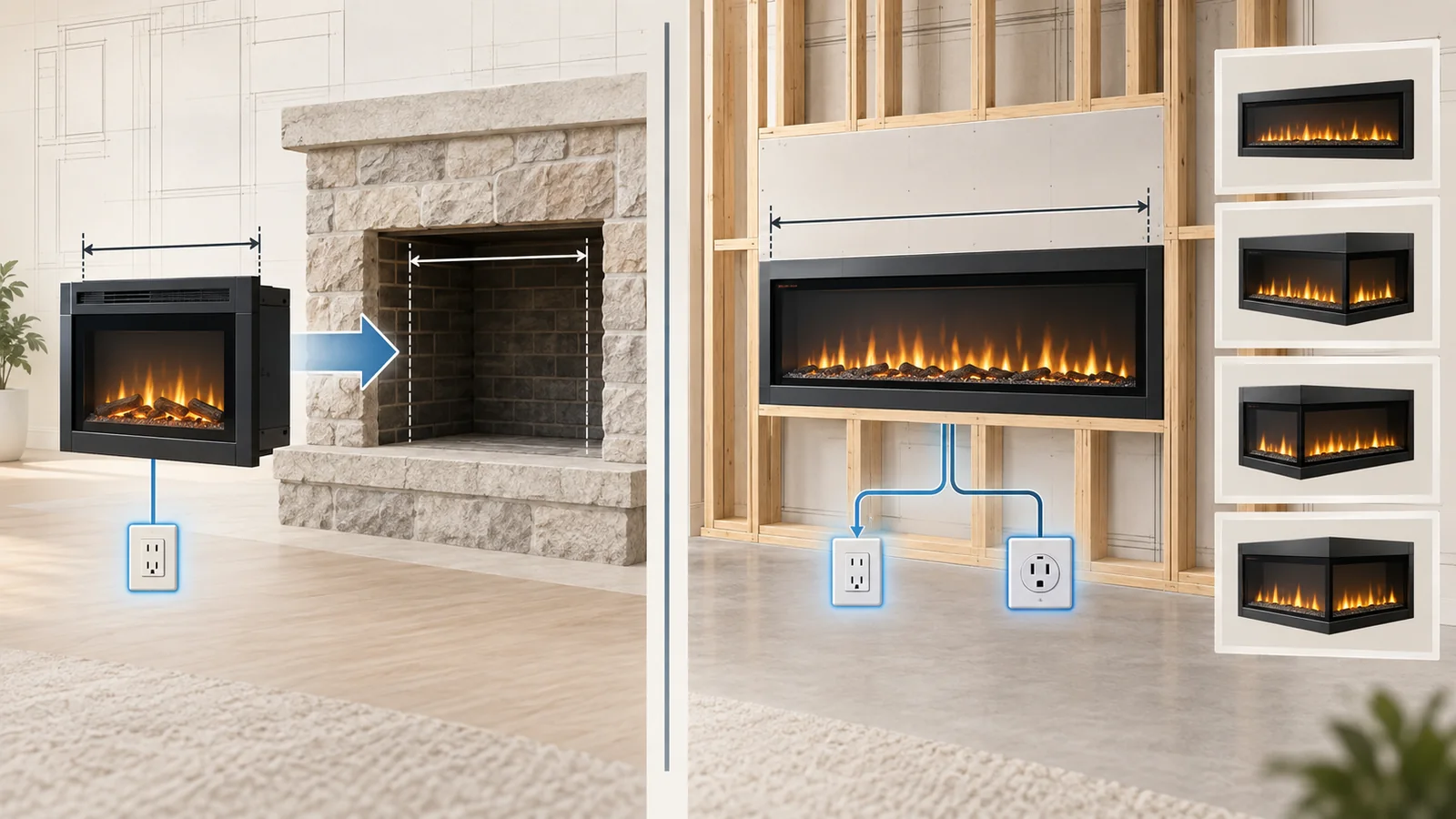
Before ordering, move the exact model into the electric fireplace specifications guide. Keep body and opening dimensions, installation relationship, voltage, plug-in or hardwired path, watts, heater output and service access beside the manual that owns them. Leave any absent field blank; a lighting badge is not permission to infer it.
Serviceability is the last lighting field
“LED” is not the same claim as “owner-replaceable LED.” A product may expose a lamp, light strip or module in service documentation while giving the owner no removal procedure. Another may treat the lighting assembly as a manufacturer or qualified-service part. Marketing language about long life does not close parts availability, access, labor or the rest of the fireplace’s service life.
If a light is already dim, dark, frozen or showing the wrong section, stop using this buying guide as troubleshooting. The electric fireplace bulb and LED replacement guide starts with the exact model, failed layer and current manual, then separates owner-replaceable lighting from integrated or service-only assemblies.
For a pre-purchase record, finish with five facts: exact model/SKU, every named light layer, each layer’s controls, flame-only and heat-only behavior, and the document that owns lighting service. Add the separate format, heat and power fields. When one of those entries is still a retailer adjective, the product has not failed—but the LED claim has not finished the decision.