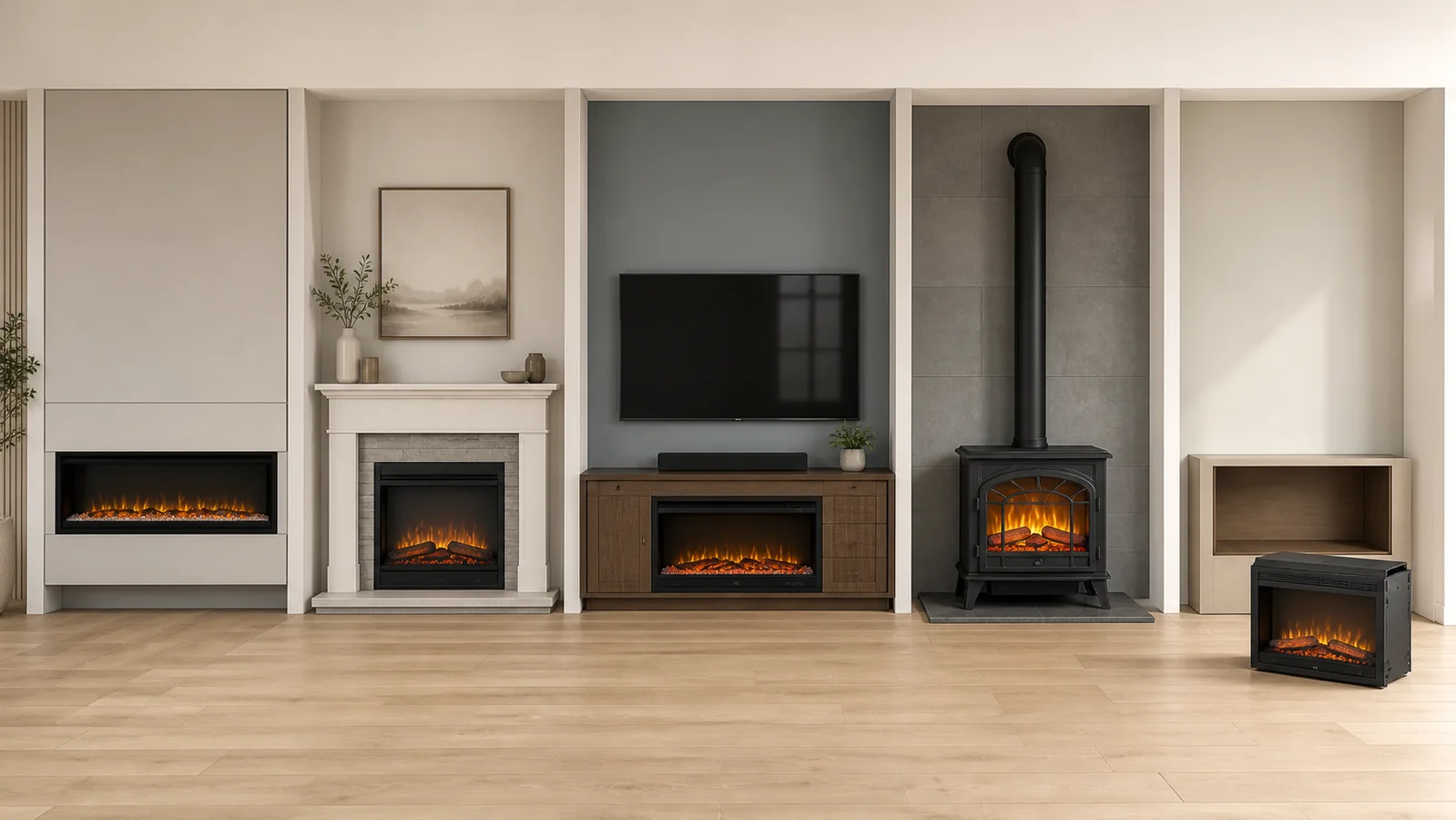
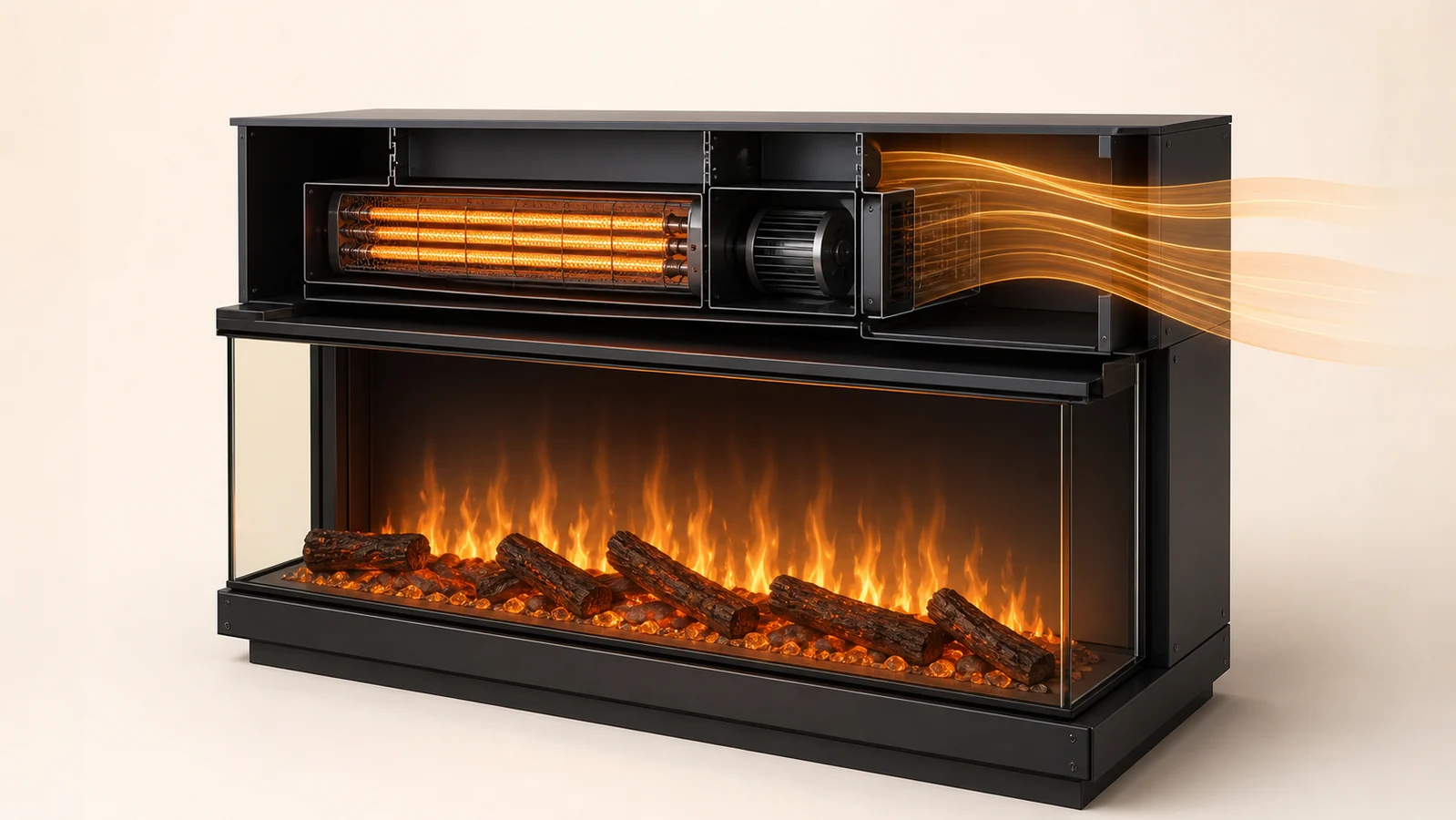
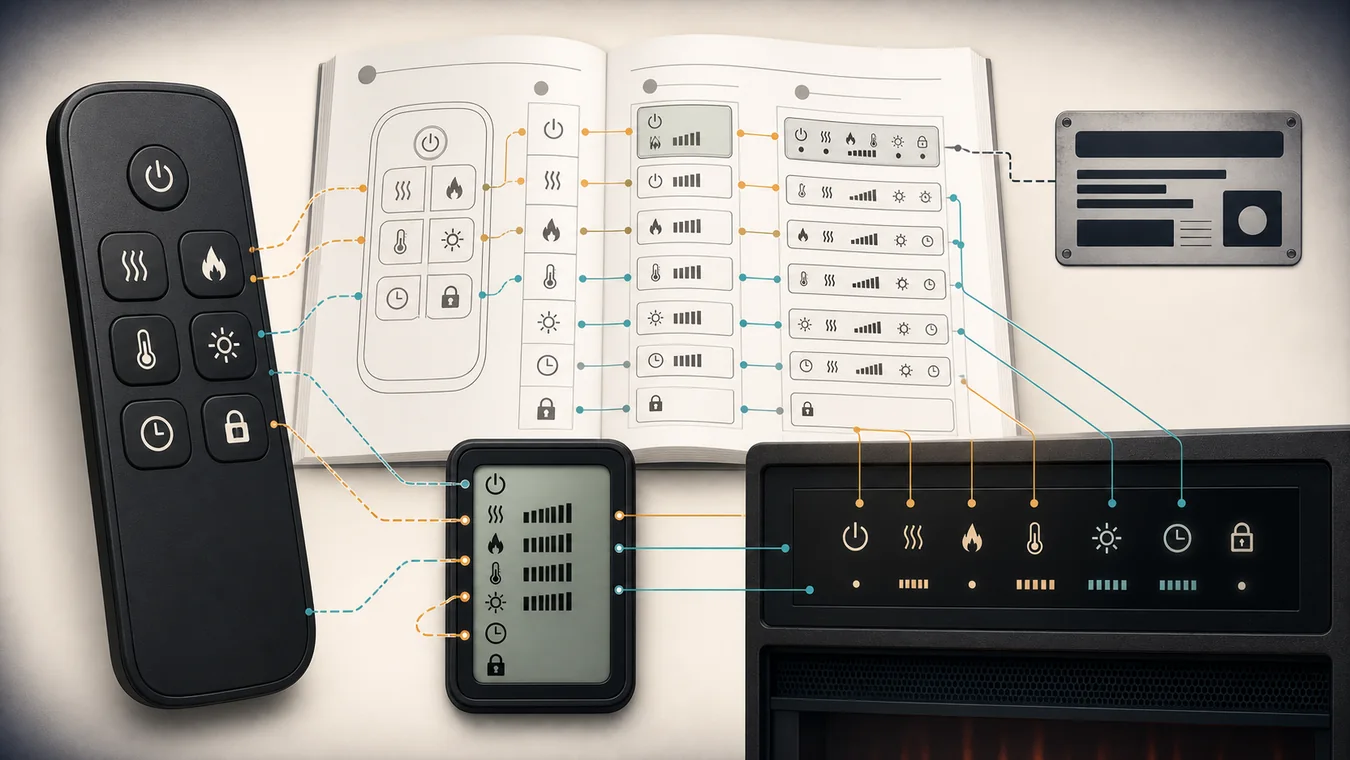
An electric fireplace does not have one category-wide operating diagram. For one exact model, trace four paths: what supplies and controls it, what creates the visible effect, whether a heater moves air through the room, and what the wall or furniture must preserve for power, airflow and service.
Those paths may share controls, but they do not connect the same way on every product. Flame without heat can be a normal mode. Heat without flame is allowed on some models and blocked on others. A water-vapor scene, a mechanically moving effect and a digital display also create very different obligations even though all three products are sold as electric fireplaces. The current owner or installation manual—not the category label—settles each connection.
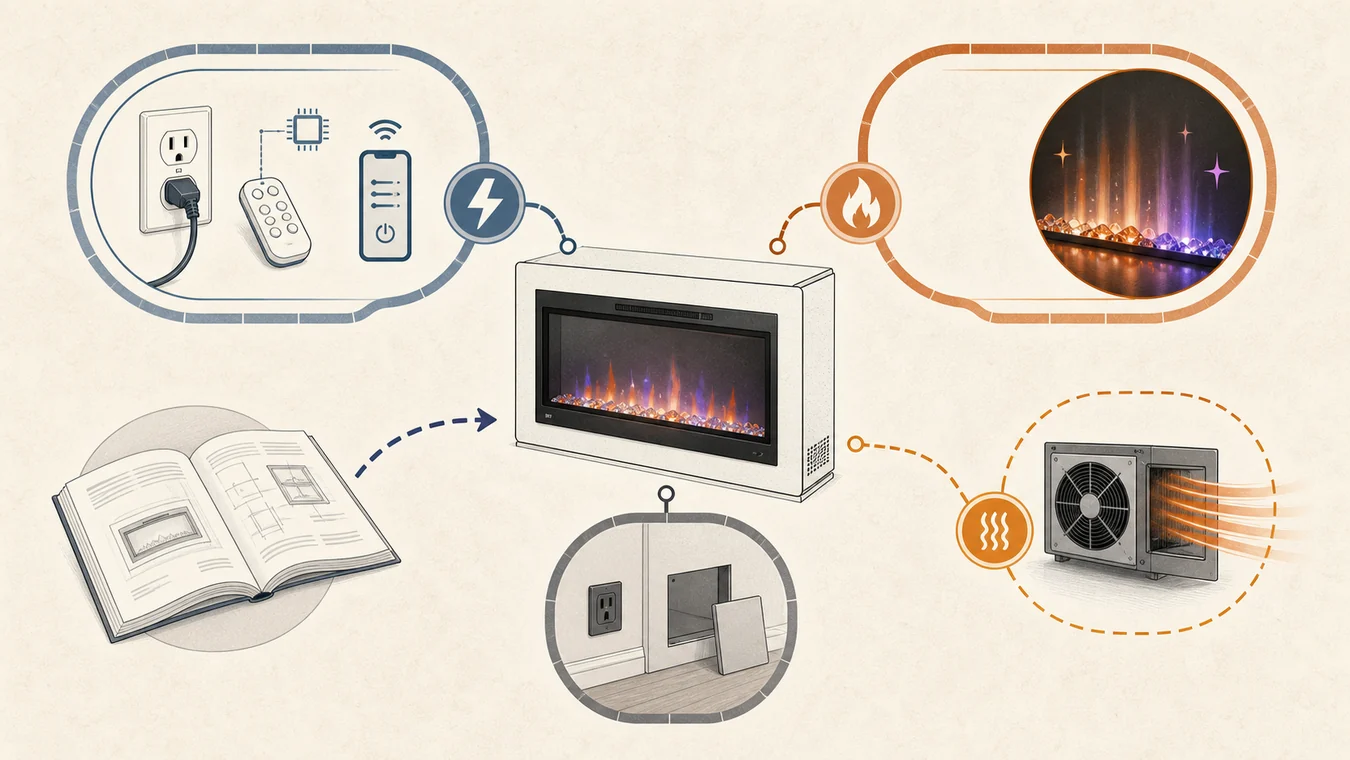
Build the map from four paths, not one cutaway
| Path | Copy from the exact model owner | Decision it changes |
|---|---|---|
| Supply and control | Plug or hardwired entry; voltage; any master switch; local, remote, app or wall controls; documented relationship between flame and heat commands. | Whether the planned power and control route can produce the modes you expect. |
| Visual effect | The manual’s own nouns for light, motion, mist, display, logs or media; settings and owner maintenance. | What the scene actually depends on and which appearance or maintenance claims are relevant. |
| Heater and airflow | Heater present or absent; documented type and rating; thermostat or heat controls; intake and outlet locations. | Whether the appliance has a useful heating job and whether the room can keep its air path open. |
| Room and service | Wall-mount, recessed, built-in or furniture format; opening and finish boundaries; power-entry location; access panel, front or glass removal; service owner. | Whether the installation can preserve operation and future access after the finish is complete. |
Start with the full model or item number, market and document revision. Manufacturer indexes often split visually similar products into different manuals; the Touchstone manual index is one current example. If those identity fields are missing, use the electric fireplace manual guide before borrowing any diagram or control sequence.
The electric fireplace specifications guide is the companion field owner. The four-path map uses those fields to explain one appliance; it does not replace the exact dimensions, electrical values or clearances needed for a fit decision.
The control path decides what can run by itself
The phrase “flame and heat are separate” is useful only when the exact source says how separate. Touchstone’s current Sideline 28 item 80028 page says that model can run flames without heat and heat without flames. Its control path therefore supports two independent outputs.
That relationship does not transfer even to every Touchstone fireplace. The official Sideline Steel manual for items 80013, 80047 and 80048 says the flame effect must be on for the heater to operate. “Touchstone” and “Sideline” are still too broad; the exact item and manual family control the answer.
SimpliFire’s Inception SF-INC36 owner and installation manual documents separate flame-on, flame-off, heater-on and heater-off controls. That proves the command surfaces for SF-INC36, not the internal logic of another SimpliFire model.
Write the relationship plainly: visual only allowed, heat only allowed, flame required before heat, or not documented. Then record which control surface owns each command. If the question is how to reach a documented normal state rather than how the architecture is arranged, the normal startup guide owns that next task.
A flame image can come from very different machinery
On the Sideline Steel family, the manual’s troubleshooting language names a flame motor and flame rod. That is one documented light-and-motion arrangement. It does not prove that every electric flame uses a spinning reflector, nor does it give an owner permission to open the case.
Dimplex describes Optimyst Linear differently: ultrasonic technology turns water into fine mist and LED light makes the mist visible as a moving three-dimensional effect. That visual path introduces water state, mist output and model-specific maintenance that a dry reflector explanation cannot cover.
The Inception manual describes a digital display along with top and bottom LEDs. Here the visible scene has display and lighting states rather than one category-wide “flame bulb.” These examples are enough to show why the visual path needs an exact noun from the manual.
That noun changes the questions you ask, not just the description you repeat. It may change off-state appearance, viewing behavior, media options and maintenance ownership. The realistic electric fireplace guide owns the separate question of how the scene holds up from the room’s actual viewing positions. If a visible effect has already failed, use the flame-effect troubleshooting router rather than turning this architecture map into a repair procedure.
Heat adds an airflow path, not just a wattage number
A heater is an optional second job. The current Sideline 80028 owner page identifies a 1,300-watt coil-wire heater with a blower and a front heating vent. Those facts belong to item 80028. They show that its heat path includes an electrical load, a heating element, moving air and an outlet that the wall plan must not obstruct.
Other models can use different ratings, voltage options, control logic and outlet locations. Some products provide a visual effect without heat; others include heat that remains supplemental rather than a whole-room replacement. A wattage value alone does not tell you whether the room loses heat faster than the appliance can add it, whether the circuit can support the load, or whether the thermostat location represents the occupied area.
Keep the architecture answer narrow: record whether heat exists, how the exact manual allows it to start, and where air enters and leaves. Then give output, room suitability and operating cost to the electric fireplace heat guide. This prevents a visual-system explanation from quietly promising a heating result.
The wall becomes part of the operating system
An electric fireplace can avoid a combustion flue and still depend on the room. The room supplies electricity, preserves air movement and leaves the access route described by the manufacturer. Covering an outlet, intake, front heater vent, junction box or required service path changes how the installed appliance can operate.
The Sideline 80028 page allows wall-mounted or recessed placement and identifies a 120-volt plug-in product with a front heating vent. The Sideline Steel manual permits either a grounded plug connection or hardwiring for its named models. Inception’s current manual documents 120- and 240-volt wiring choices plus model-specific finishing boundaries. These are three exact records, not interchangeable installation instructions.
Format therefore belongs in the explanation. A wall-mounted appliance can expose a different cord and service route from a built-in firebox finished into a wall. The electric fireplace types guide helps choose that installation relationship before one model’s dimensions are treated as a plan.
Also record what must remain reachable after installation: local controls, the documented electrical disconnect, removable glass or front, water fill point when applicable, heater intake and outlet, and the access route assigned to service. If the manual does not identify the route, the map is incomplete; a clean rendering of the finished wall cannot fill it in.
What the four-path map stops you from assuming
“LED electric fireplace” describes too little. It may identify part of the visual path while saying nothing about the heater, power entry, mounting format or service access. “Ventless” answers the combustion-vent question; it does not erase the room-air path of a fan heater. “Flame works without heat” does not prove that heat can work without flame. Each claim closes one field, not the whole model.
A complete explanation should let you say, in ordinary language, what receives the command, what creates the scene, whether heat is a separate available job, where air moves, and what the installation must leave available. If one of those paths is blank, you do not yet know how that model works—you only know what category it is.
Use the missing path to choose the next owner: format goes to the types guide, heat performance goes to the heat guide, and exact electrical, dimensional or clearance fields go to the specifications guide. That keeps one unanswered field from becoming a guessed product feature or a finished-wall problem.