Yes—many electric fireplaces contain a real electric heater. The glowing logs or flame image are not what warms the room; a separate heating element and, on many models, a blower produce the usable heat. Some products are decorative only, and the available combinations of flame and heat vary, so confirm the controls on the exact model.
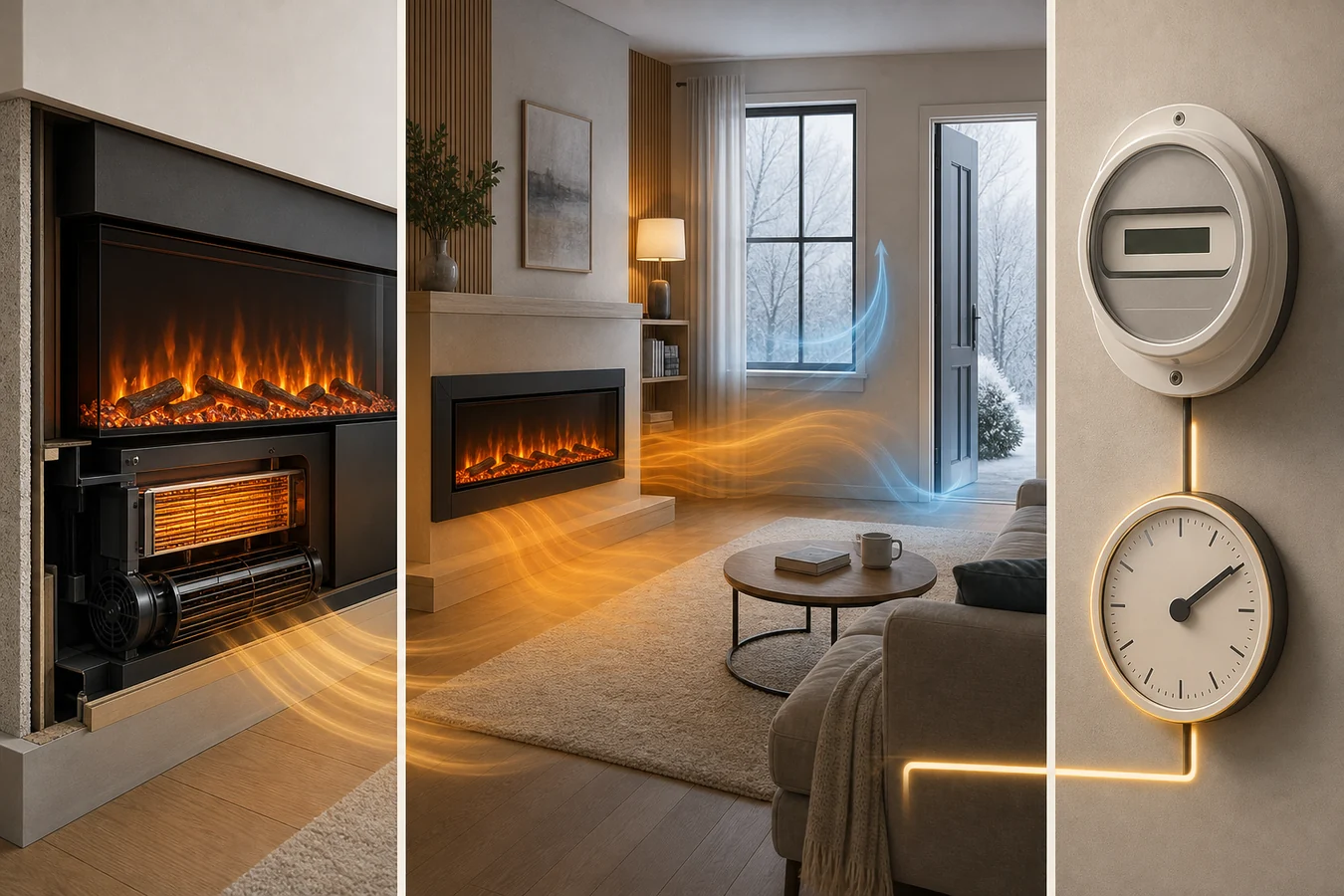
“Gives off heat” is still not the same as “will heat this room.” Make the buying decision in three parts: the appliance has an output ceiling, the room has a heat demand, and the utility charges for the electricity used over time. A product is a plausible supplemental heater only when all three fit the job you expect it to do.
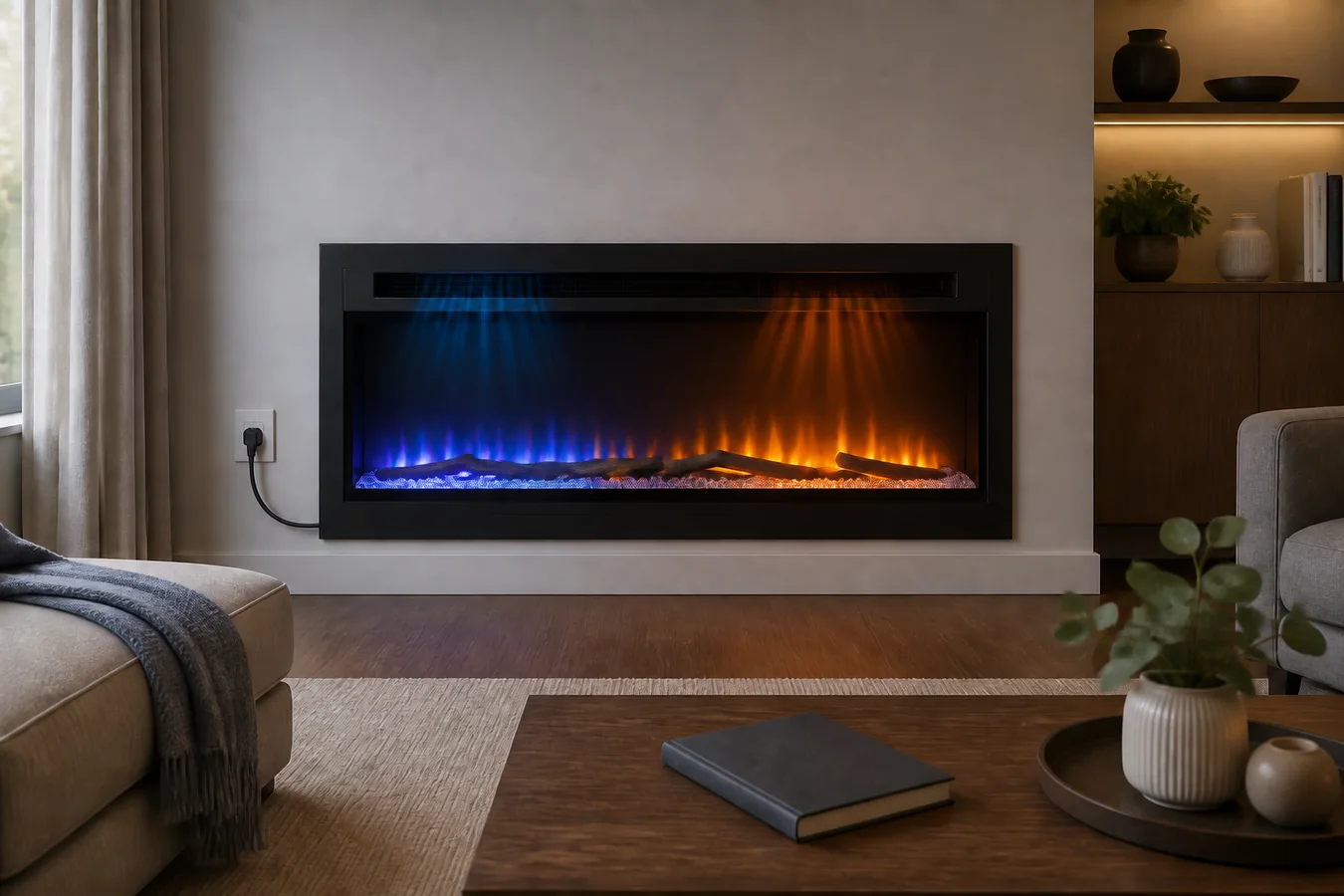
The flame does not set the heat level
An electric fireplace can look fully lit while its heater is off. That separation is what makes year-round ambience possible, but do not assume every model offers flame-only, heat-only, low heat and high heat in the same combinations.
The current Napoleon Lumi manual gives a useful exact example. Its control table lists the heater and blower separately from flame color and brightness. On that series, the flame must be on before the heater can run; the heater control then turns the heater and blower on or off. Another model may use different logic. The lesson is to read the operation table, not infer a mode from the product category.
Look for four lines before treating a fireplace as a heater:
- a heater output or power value for the configuration you will actually use;
- the allowed flame/heat control combinations;
- the thermostat or temperature-control behavior, if any;
- the location of the heater outlet and intake that must remain usable in your layout.
If the documentation shows only decorative power or never describes a heater, the answer for that product is no. If the heater exists but its exact mode is unclear, the answer is unresolved—not a reason to borrow a specification from a similar-looking model.
Read the rating plate as a ceiling, not a room promise
A rating plate can tell you how much electrical power the appliance may draw. It cannot see your windows, ceiling, doorway or winter weather.
| Field | What it can establish | What it cannot establish |
|---|---|---|
| Voltage and connection | Which documented electrical configuration supplies the appliance | Whether the proposed circuit or site wiring is suitable without checking the full manual and site |
| Maximum watts | The upper electrical input rate for the named configuration | The flame-only draw, thermostat duty cycle or room temperature rise |
| BTU per hour | A heat-energy rate stated or derived for that configuration | A guaranteed square-foot coverage or comfort result |
| Heat settings | The available output choices the manual actually names | That “low” means the same watts on another model |
| Thermostat/control | How the appliance calls for heat or cycles under documented conditions | How often it will run in your room |
| Heater outlet and intake | Where warm air leaves and room air enters | That furniture, trim or a television can occupy nearby space |
The U.S. Energy Information Administration defines 1 kilowatt as 1,000 watts and a kilowatthour as 1 kilowatt used for one hour. It also uses 3,412 Btu as the energy equivalent of 1 kWh. On that unit conversion, 1.5 kW sustained for one hour corresponds to 5,118 Btu of energy. That is an arithmetic ceiling for the input rate, not evidence that every 1,500W fireplace changes every room by the same number of degrees.
Current products also show why “electric fireplace output” is not one fixed specification. The Napoleon Lumi manual lists 120V and 1,500W maximum for the named NEFL36/42/50/60H-WW series. Napoleon’s current Elevation X page lists configurations at 120/240V, 1,500/3,000W and 5,000/10,000 BTU. Those values belong to those products and configurations. A 240V option on one series cannot be assigned to another 120V model.
When a retailer says a unit “heats up to” a certain area, keep the rating plate in one column and the coverage claim in another. The first is a product input/output fact. The second depends on assumptions about the room that may not be visible on the product page.
A room can lose heat faster than the fireplace adds it
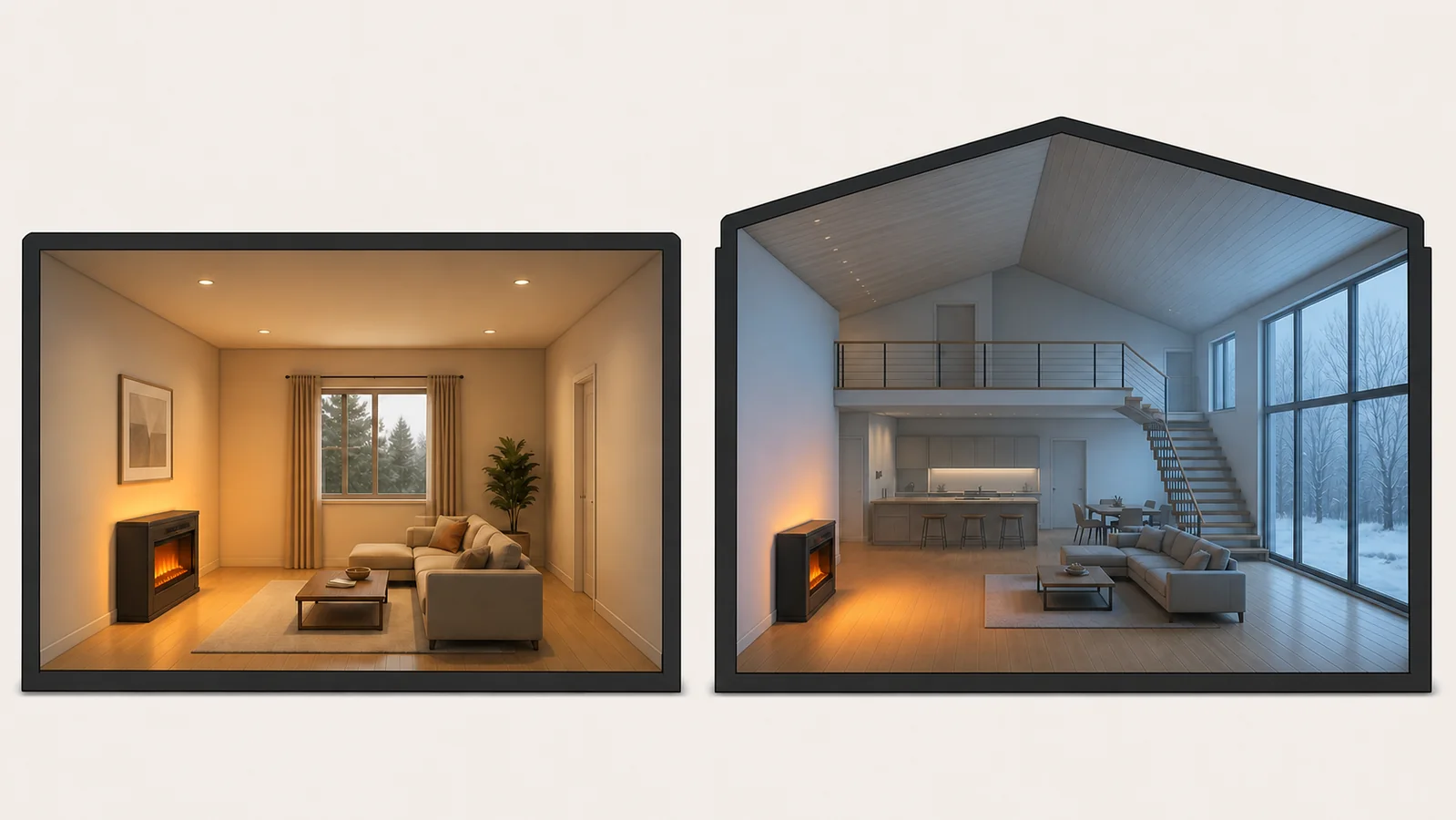
Heat is leaving while the fireplace is adding it. The result depends on the indoor-outdoor temperature difference, insulation, air leakage, windows and exterior doors, ceiling height, room volume and whether warm air can escape into adjacent spaces. U.S. Department of Energy guidance describes heat moving through the building envelope—walls, roof, floor, foundation, windows and doors—and through gaps between building components.
That is why two rooms with the same floor area can react differently to the same appliance. A closed interior room may retain a modest input; a high-ceiling room with a large cold window and open stair may not. Floor area is useful for describing the room, but it is not a heating-load calculation.
Use the intended job to decide how much proof you need:
| Heating job | What must be true | Sensible verdict before purchase |
|---|---|---|
| Ambience with no added warmth | The exact model has a documented display mode with the heater off | Ambience only: heat output does not need to drive the choice |
| Take the chill off one occupied zone | Warm air can reach the occupied area, the heater path stays open and modest supplemental heat is acceptable | Plausible supplemental: compare exact output, controls and noise/airflow behavior |
| Maintain a closed room near a set temperature | The room’s heat loss at relevant weather is below available output and the control can maintain the chosen range | Load check required: a square-foot badge is not enough |
| Warm an open plan or adjacent rooms | Heat must cross large openings while the source still covers losses in the original room | High uncertainty: do not buy from a single-room coverage claim |
| Serve as primary or outage heat | Output must cover the full design load and electricity must remain available | Wrong default job: a decorative fireplace with supplemental heat should not be assumed to provide either role |
Placement still matters after the output fits. If a television shares the wall, carry the exact heater outlet and required separation into the electric fireplace and TV wall plan. Moving the body for appearance can change where warm air travels or whether an opening becomes blocked.
Price heater-on time, not just clock time
Use the rate on your current utility bill or tariff, not a generic national number. EIA data show that electricity prices vary by locality and customer type; time-of-use pricing, tiers and bill adjustments can make a local rate more useful than an average.
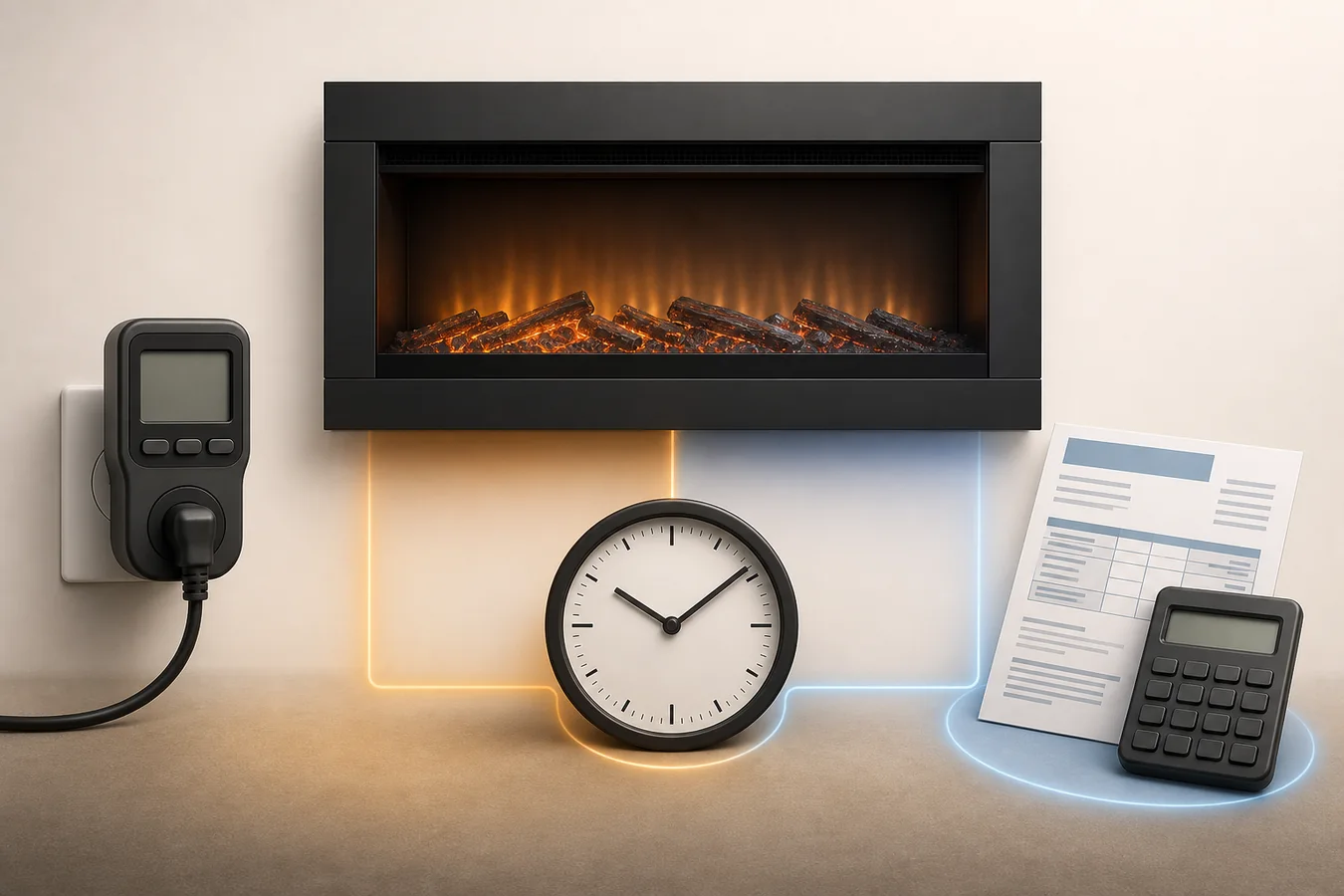
For one known heater input, the planning formula is:
Maximum heater cost = (rated watts ÷ 1,000) × electricity rate per kWh × heater-on hours
An exact 1,500W configuration running at full input for one hour uses 1.5 kWh. Its cost for that heater-on hour is:
1.5 × your applicable local rate per kWh
That is not automatically the cost of every clock hour the fireplace is visible. A thermostat may turn the heating element on and off, while the flame display and controls continue to use electricity. Conversely, a cold or leaky room may keep calling for heat. For a maximum budget, assume the named heater input runs for the full period. For a measured estimate, separate elapsed display time from actual heater-on time.
Do not estimate flame-only cost by subtracting a guessed heater wattage from the rating-plate maximum. Use a separate manufacturer figure for the visual mode or a suitable measured value. If neither exists, leave flame-only draw unknown. A calculator cannot repair a missing input; leave the estimate blank rather than replacing it with an average.
Zone heat saves only when another load actually falls
An electric fireplace can warm the room you are using without distributing heat through the whole house. That creates a possible zone-heating strategy, not an automatic saving.
If the central thermostat and schedule stay unchanged, the fireplace is an additional electrical load. The room may feel warmer, but the added energy should not be described as reduced heating cost. A saving becomes plausible only when the fireplace lets the household reduce another heating load—such as lowering a whole-home setting—without creating comfort, moisture or freeze risks elsewhere.
The comparison also depends on the system being displaced. ENERGY STAR explains that an air-source heat pump moves heat and can deliver up to three times more heat energy than the electricity it consumes. An electric-resistance fireplace creates heat from electrical input instead. Calling the fireplace “100% efficient at the room” therefore does not prove it is cheaper per unit of useful heat than a heat pump, nor does it settle a comparison with gas, oil or another fuel at local prices.
Write both sides of the counterfactual:
- With the fireplace: its heater kWh, the rooms occupied and the comfort result you need.
- Without the fireplace: what the existing system would actually do differently during the same period.
If the second line does not change, the fireplace is buying extra comfort or ambience. That can be worthwhile; it is simply not an energy-saving claim.
Give the fireplace one heating job
Before comparing flame effects or brands, finish this sentence:
I want [ambience / local warm-up / room temperature support] from [exact model and electrical configuration], with a maximum heater input of [watts and documented BTU], in a [closed/open and known/unknown heat-loss room], at no more than [local cost per heater-on hour], while my main heating system [changes in this specific way / does not change].
Every blank changes the decision. Unknown room demand does not stop an ambience purchase, but it does stop a promise that the fireplace will hold a temperature. An unchanged main system does not make the product a bad choice, but it changes the cost claim from “saving” to “additional comfort.”
If you have not yet chosen whether the appliance belongs in an existing opening, on a finished wall, inside a new cavity or on the floor, settle that physical relationship with the electric fireplace types guide before comparing heater specifications. A strong heater rating cannot rescue the wrong product format.
The right purchase is not the fireplace with the largest room badge. It is the exact configuration whose documented output matches one declared job, whose room uncertainty is acceptable and whose maximum local operating cost you are willing to pay.