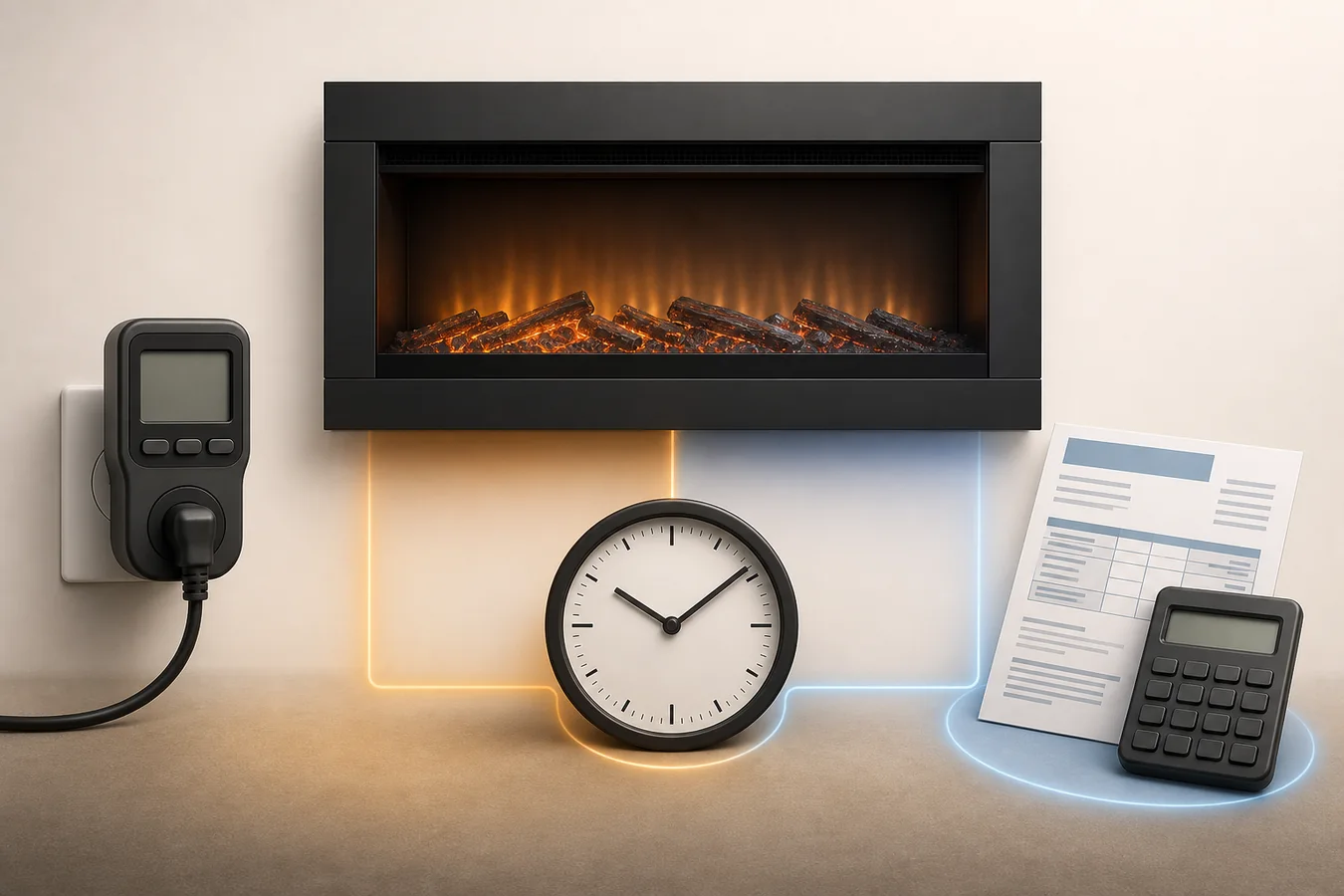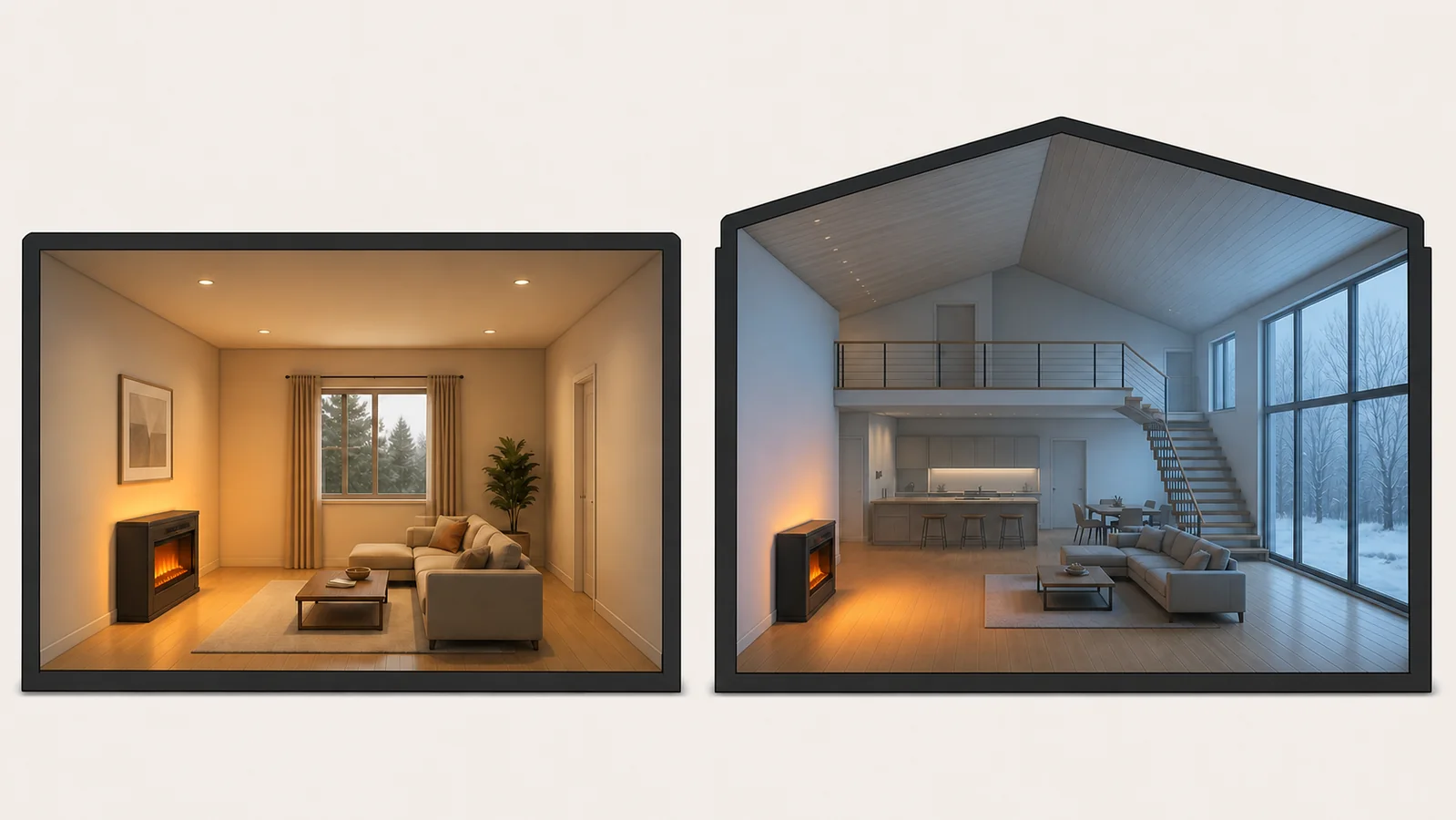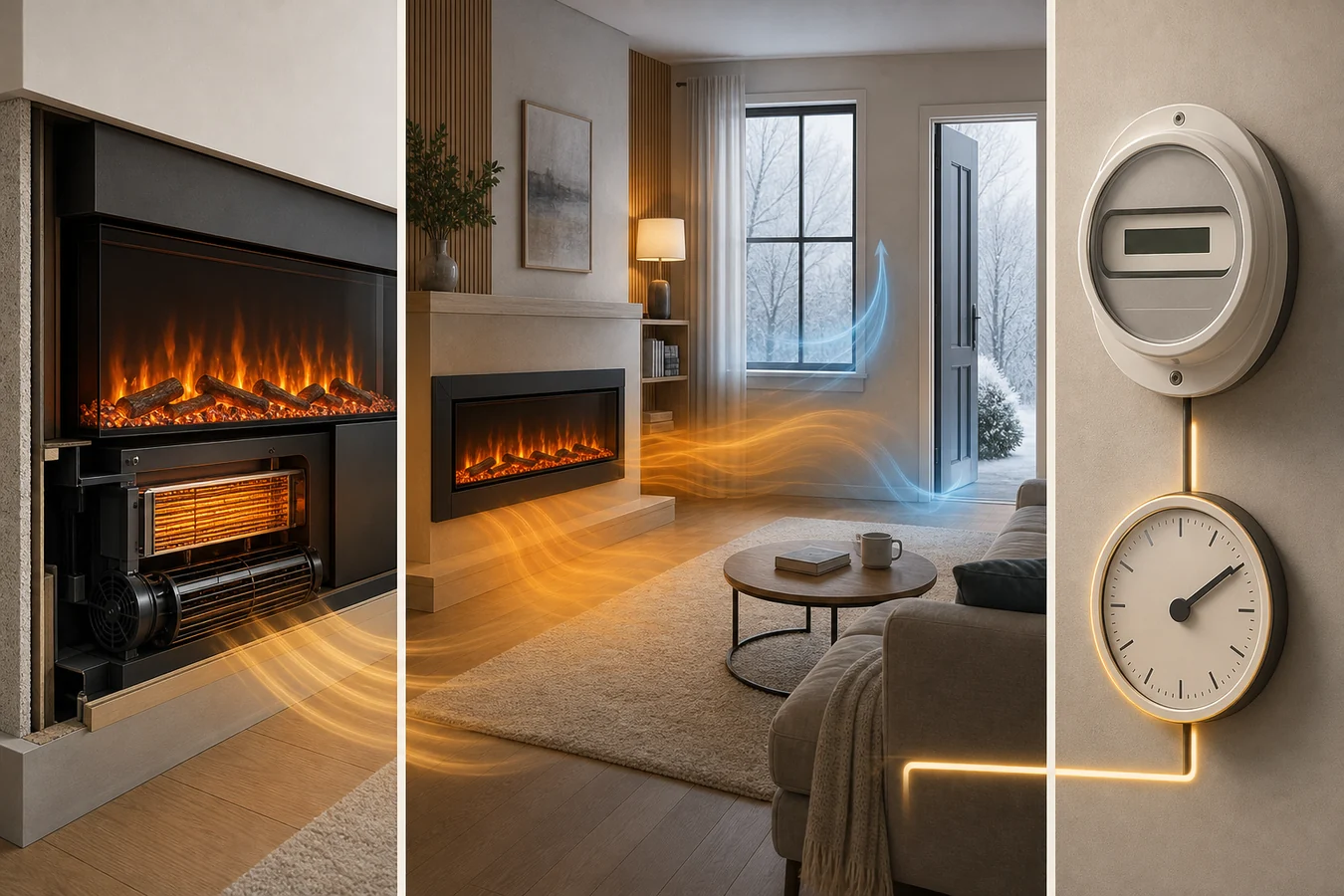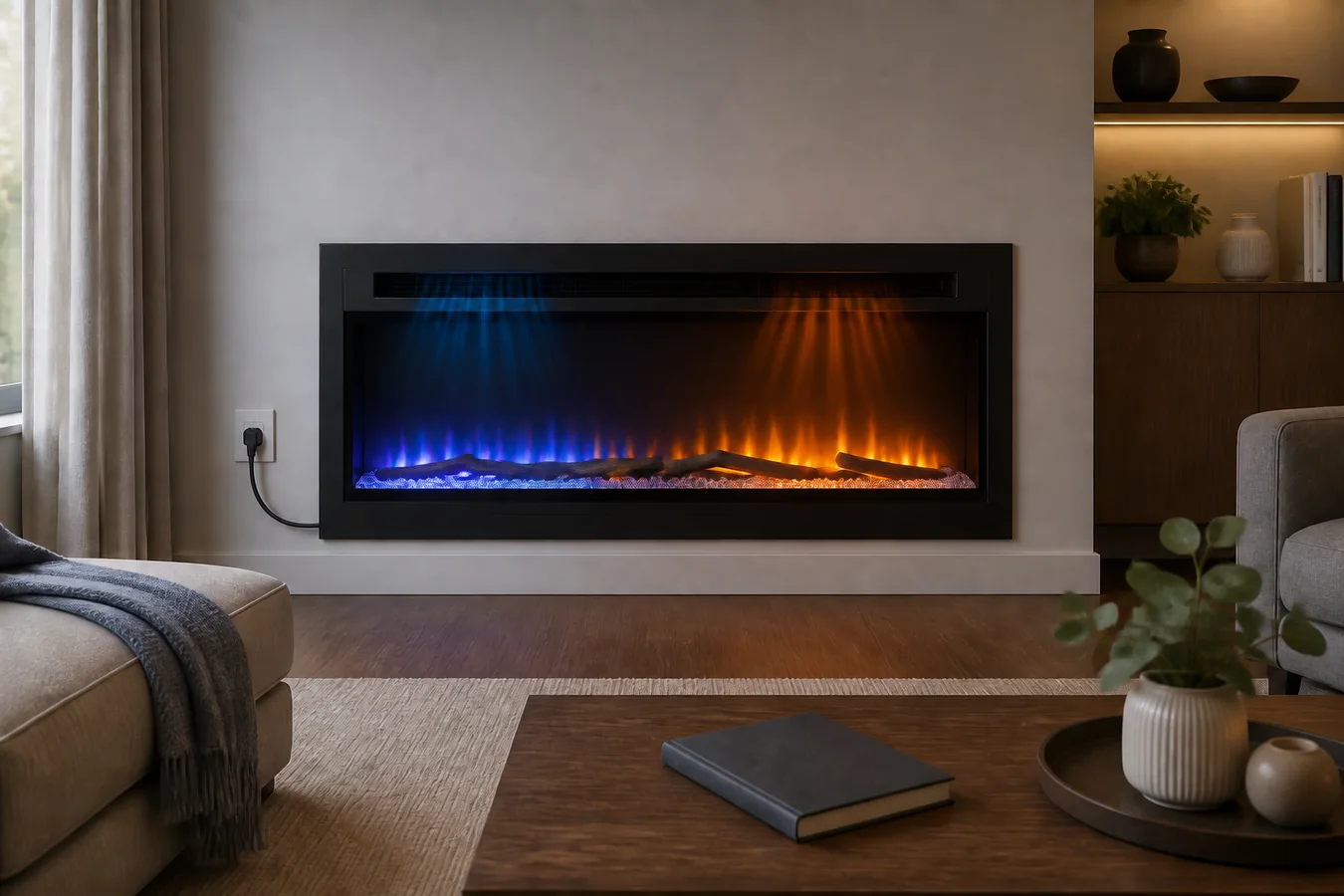
An electric fireplace has no wood, gas flame or combustion exhaust in normal electric operation. That removes a major class of risk, but it does not make the appliance automatically safe in every room or every mode. The heater can create hot surfaces and hot airflow. The plug, outlet and internal electrical parts still carry load. A blocked vent, damaged cord, wet unit or recalled model can still create a fire, shock or burn hazard.
The useful answer is therefore conditional: an electric fireplace can be suitable to use when its exact model is installed, connected and operated as its current manual requires. Identify whether the unit is showing the flame effect only or running the heater, then check the connection, airflow, surfaces, room exposure and condition. If the model or manual is unknown, do not fill the gap with another fireplace’s clearance or cord rule.
Separate the flame effect from the heater
Many electric fireplaces let the simulated flame run without heat. That distinction matters, but “flame-only” is not the same as “electrically off.” When the exact manual documents separate controls, display-only mode removes heater output from the current state; it does not erase a damaged plug, a faulty outlet, water exposure or a recall. Our guide to how electric fireplace heat mode changes the decision explains the output side. Here, mode is the first safety branch.
| Current state | What is active | What still has to be true | Decision now |
|---|---|---|---|
| Off | No requested flame or heater output | The unit is undamaged, dry, not recalled and disconnected as the manual requires for service or long storage | Use the manual before the next operating state |
| Display-only | Simulated flame or lighting; heater documented as off | Correct connection, sound cord and outlet, clear ventilation openings, intact glass and approved location | Suitable only as the exact manual documents |
| Heater on | The display plus heating element and usually a fan | All electrical conditions plus model-specific clearances, unobstructed airflow, hot-surface control and supervision | Use only after the room passes the heater-state checks |
| Abnormal | Odor, unusual noise, repeated breaker trip, hot or loose outlet, damaged cord, cracked glass, water exposure or recall evidence | Nothing should be assumed from the flame display | Stop use and route the exact condition to the manufacturer, recall remedy, electrician or qualified service owner |
Do not use the color of the flames, a remote icon or the absence of fan noise as proof that the heater is disabled. Use the control description and indicator behavior in the applicable manual. If the product does not document a separate display-only state, record the mode as unknown.
Let the exact manual overrule the internet
Generic safety articles often present one clearance or one extension-cord rule as universal. Current manuals show why that is unreliable. Three real product families publish materially different instructions:
| Exact owner document | Connection instruction | Heat and room instruction | What the example proves |
|---|---|---|---|
| Touchstone Sideline Elite, rev. 20250312 | Wall receptacle only; no surge protector, extension cord or relocatable power tap for the named series | Manual warns of hot operation, supervision and a named 36-inch front combustible clearance | A series can bind outlet, surface and clearance rules together |
| SimpliFire Format36, rev. H 6/26 | Never use an extension cord or relocatable power strip for the named appliance | Manual states hot surfaces, supervision and a three-foot front combustible clearance for the named appliance | The current owner revision supersedes older conditional cord wording |
| Dimplex Revillusion manual | No extension cord; direct connection to an appropriate wall receptacle | The trim around the heater outlet becomes hot during heater operation; the manual gives a three-foot front clearance | The heated surface may be a defined outlet area rather than every visible panel |
Read the Touchstone Sideline Elite manual, current SimpliFire Format36 manual and Dimplex Revillusion manual as scoped examples. SimpliFire’s current revision H says never to use an extension cord or relocatable power strip; the same owner URL previously served revision G with conditional cord language. A gauge or wattage copied from that older revision is not current permission. The three current examples agree about extension cords, but their hot areas, clearances and connection details remain product-specific.
Plan the outlet so an extension is unnecessary. If the applicable manual is missing, conflicting or unclear for the installed configuration, obtain the current document from the manufacturer. Silence is not permission for an extension cord, outdoor placement, overnight heat or an improvised connection.
The outlet can fail before the fireplace does
A normal flame display does not prove that the plug-to-outlet connection is healthy. The Touchstone manual tells owners of the named series to stop if the outlet or faceplate becomes hot and to have a qualified electrician inspect or replace a faulty outlet. It also warns against cracked outlets, loose connections and insecure plugs. Those observations are useful without turning the reader into an electrical diagnostician.
Before use, look for a plug that seats normally, a cord routed as the manual permits and an outlet that is not loose, discolored, cracked or unusually warm. A repeated breaker trip, melted plastic, scorch mark, damaged insulation or persistent electrical odor is not a cue to reset and try again. Turn the unit off, disconnect it only if that can be done safely, and route the condition to the responsible electrician, manufacturer or service provider.
Plug-in and hardwired units do not share the same field check. A corded model is limited by its approved receptacle and cord instructions. A hardwired model depends on the installed circuit, disconnect and connection work. Use the plug-in versus hardwired connection guide to identify the path; electrical installation and abnormal outlet conditions belong to a qualified electrician, not a generic fireplace article.
Airflow and hot surfaces decide who can share the room
Heater mode changes the room around the fireplace. Exact manuals repeatedly prohibit blocking air intakes and exhaust openings. A deep mantel, furniture, curtain, throw, bedding or decorative object can be outside the simulated flame and still interfere with the heater’s air path or sit in a hot discharge zone.
Map four items from the model manual: where room air enters, where heated air leaves, which trim or glass areas can become hot, and where the manufacturer measures clearance. Keep the measurement origin intact. “Three feet from the front” for a named unit is not the same statement as three feet from every edge, every wall or every electric fireplace.
Do not promise that the glass stays cool. The Touchstone document describes the fireplace as hot during heater operation and recommends supervision and a physical barrier when at-risk people are present. Dimplex identifies the heater-outlet trim as a hot area for its named product. For children and pets, the practical question is not whether an advertising page says “cool touch”; it is whether the exact hot areas, controls and airflow can be kept out of reach during the intended mode. If not, use display-only when documented, change the room setup or do not operate the heater.
A television adds a separate placement problem. The electric fireplace under-TV placement guide owns the model-specific heat path, mantel and TV-clearance decision. A visually generous gap in a photo is not a temperature or warranty result.
Water, damage and recalls are stop signals
An indoor fireplace does not become an outdoor unit because it has no gas flame. The cited Touchstone, SimpliFire and Dimplex manuals prohibit outdoor use for their named products and warn about bathtubs or water containers. If a unit has been wet, submerged or exposed outside its rating, do not dry the visible surface and assume the electrical system is restored. Follow the exact manufacturer’s inspection or replacement route.
Use the same fail-closed rule for a damaged cord or plug, cracked or missing glass, a dropped appliance, an unexplained malfunction or an unauthorized modification. A safety feature such as a temperature cutoff is a backup described by the owner; it is not permission to block airflow, ignore abnormal heat or continue operating damaged equipment.
Finally, search the exact brand and model in the CPSC electric-fireplace recall category and the manufacturer’s current recall page. A confirmed recall changes the answer even when the unit appears normal. Stop using it and follow the stated remedy; do not substitute a visual inspection for the recall owner’s instructions.
Decide the use state before bedtime
The related question “Can I leave an electric fireplace on overnight?” cannot be answered from the simulated flame alone. CPSC’s January 2026 winter guidance tells users to turn portable heaters off while sleeping and to plug electric space heaters directly into a wall outlet. CPSC explicitly presents that advice under portable heaters. Apply it to a portable fireplace-heater in that scope; do not silently convert it into a complete rule for every recessed or hardwired model.
For any other electric fireplace, the exact manual must address unattended operation, timers, thermostats and shutdown behavior. A timer can issue a command; it cannot verify that the outlet remains sound, a curtain has not moved, a pet cannot reach a hot outlet or the air path stays clear. If the manual does not clearly support the proposed unattended state, choose heater off. Where a separate display-only mode is documented, it may answer an ambience goal, but the electrical, damage and location gates still remain.
| What the record shows | Decision | What closes the next gap |
|---|---|---|
| Exact model and current manual; documented mode; approved connection and room; no damage, recall or abnormal condition | Use in that documented state | Recheck after a room, connection, mode, manual or recall change |
| Connection and appliance are normal, but a curtain, furniture, TV, child/pet access or airflow path conflicts with the manual | Change the room or setup | A documented layout that preserves the exact clearance and airflow path |
| Display-only is documented, but heater-state clearance or supervision is not ready | Keep heat mode off | The room and supervision plan required for heater operation |
| Loose, hot, cracked or discolored outlet; damaged cord; repeated breaker trip; abnormal electrical odor | Electrical hold | Qualified inspection and the exact model’s connection requirements |
| Water exposure, cracked or missing glass, dropped or modified unit, malfunction or confirmed recall | Stop use | Manufacturer, recall remedy or qualified service disposition |
| Model, manual, mode or rating is uncertain | Manual required | Exact label identity and the current owner document for that product and region |
A defensible answer fits in one sentence: “This is exact model ___, operating in ___ mode, connected by ___, with the manual’s airflow, clearance and supervision conditions met, and no damage or recall evidence.” If a blank is filled by a generic article, a product photo or another model’s rule, the current result is not “safe enough.” The blank is the decision.