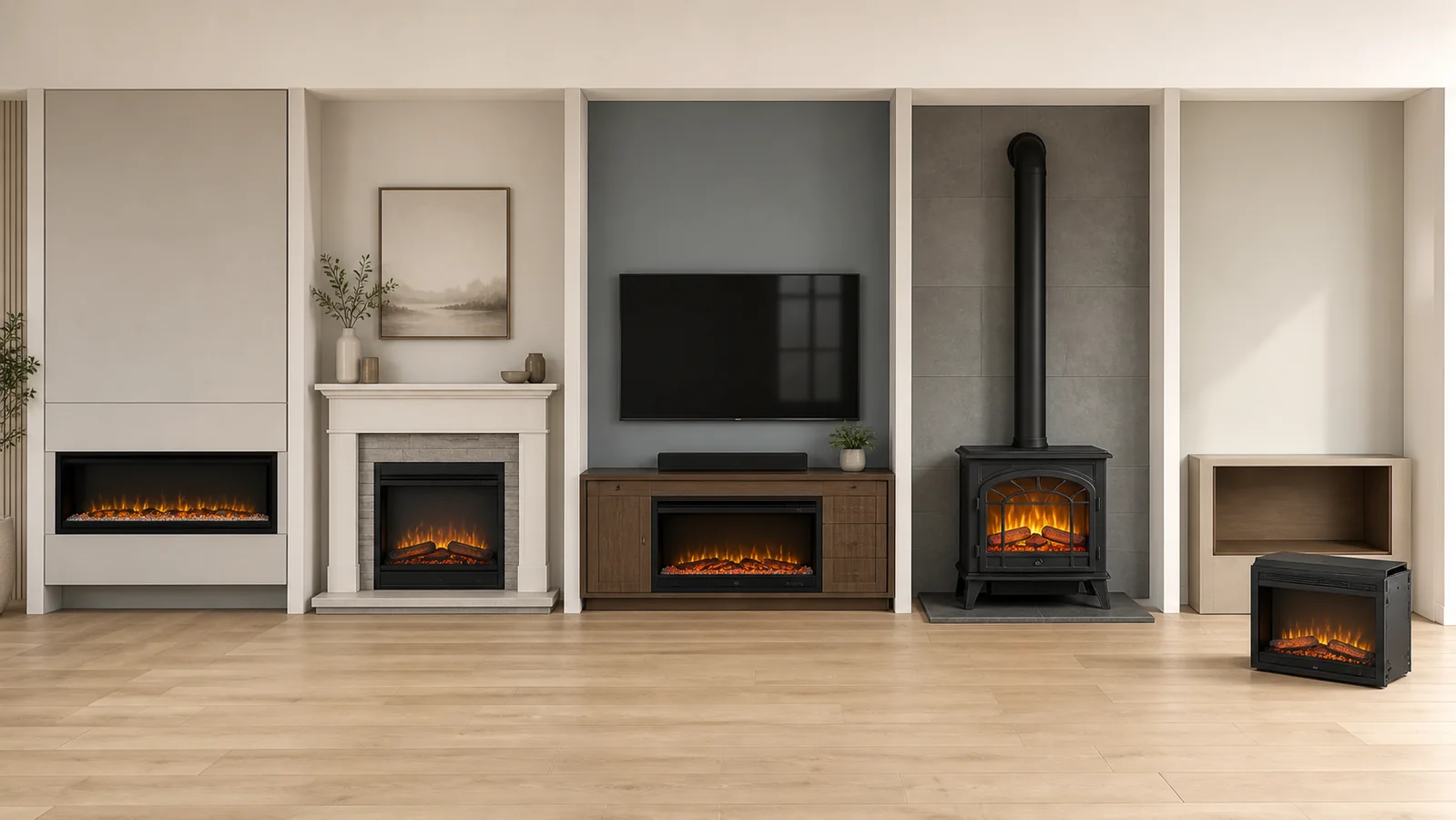
Revillusion is not enough information to order a fireplace. Dimplex currently uses the name across two different product relationships: an enclosed built-in electric firebox and an open plug-in electric log set. Inside the built-in line, the current brochure splits the 24-inch Deluxe from the 30-, 36-, 36-inch Portrait and 42-inch models. A size, finish tile or family name can therefore send you to the wrong dimensions, power path or document.
Start with the branch. A log set belongs in a suitable existing opening and plugs into an outlet; a built-in firebox becomes part of a prepared enclosure and may involve hardwiring. Then capture the full current sales model, finish suffix and exact manual. Only after those fields agree should you compare appearance, price or heat.
The useful outcome is one order line whose model, body, opening, electrical path, controls and source revision all refer to the same product. If a seller cannot produce that line, the product is not ready for the shortlist—however convincing the flame video looks.
The name in the search box is not the model on the order
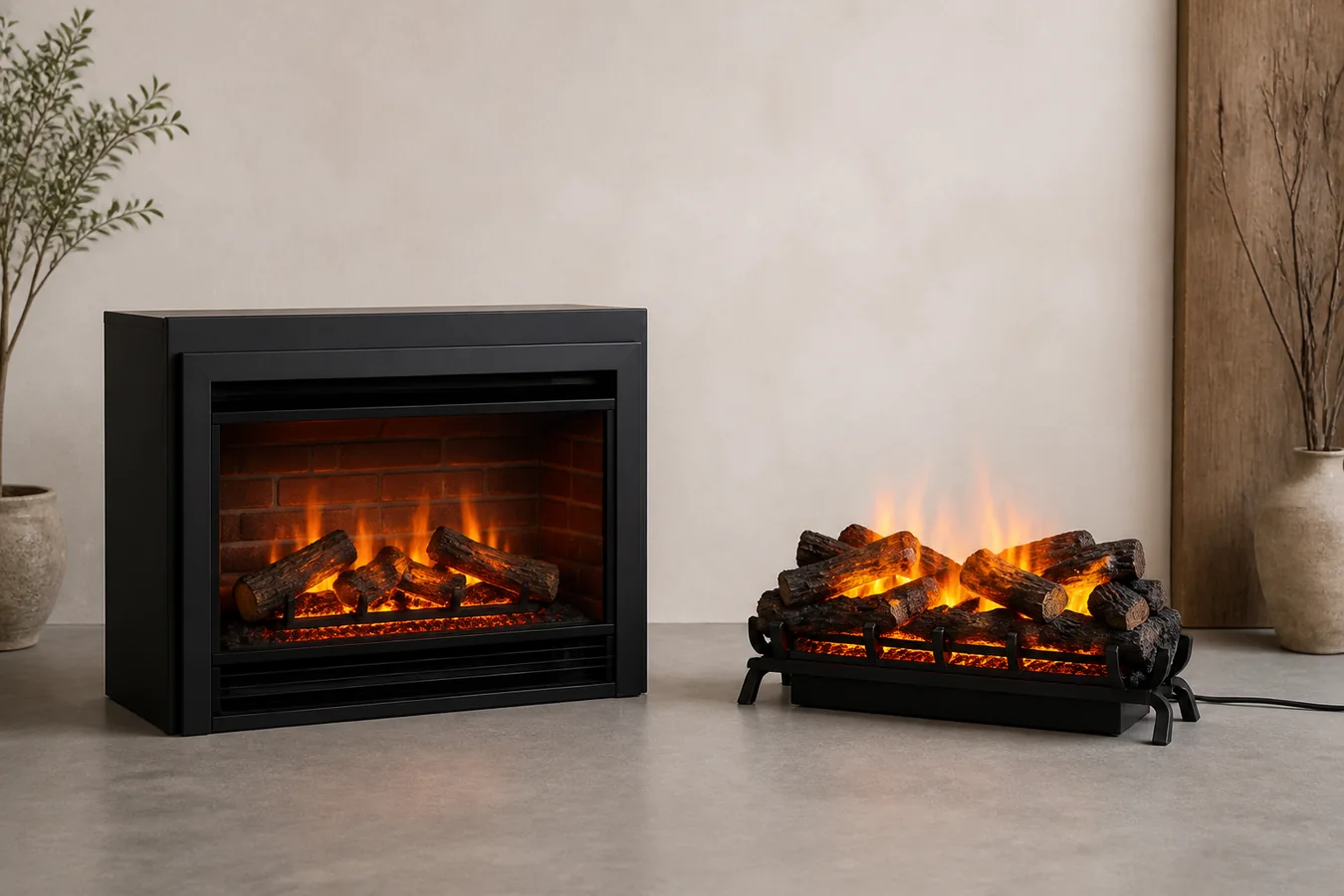
Dimplex’s current Revillusion family page explicitly sends visitors down two paths: Revillusion Built-in Electric Firebox and Revillusion Plug-In Electric Log Set. Those are not two finishes of the same chassis.
| Identity field | Built-in firebox | Plug-in log set | Hold when… |
|---|---|---|---|
| Room relationship | Complete enclosed appliance for a new or prepared enclosure | Open log set placed in a suitable existing fireplace, cabinet or media opening | The listing says only “insert” or “Revillusion” |
| Current family detail | Current pages list 24, 30, 36, 36 Portrait and 42, with multiple backers | The exact log-set model and its own manual control fit and power | A built-in size table is being used for a log set |
| Model identity | Current brochure uses REV size codes plus finish suffixes | The opened log-set manual identifies RLG25 | The model/order code is missing or abbreviated |
| Installation evidence | Exact model manual plus body, installation, service and finish fields | Exact log-set manual plus body, recommended opening, outlet and placement fields | Only a retailer dimension or family brochure is available |
| Ready result | Exact built-in model and document agree | Exact log-set model and document agree | Any branch, code or source-generation field conflicts |
That first row eliminates a common category mistake. An open electric log set may be a sensible way to reuse an existing hearth, but it does not become a built-in firebox because a merchant calls it an “insert.” Conversely, a complete built-in box is not sized from the empty-opening recommendation in a log-set manual.
If the project begins with an existing hearth and visible logs are the priority, the electric-fireplace logs guide explains how an open log set differs from a complete insert. If the project begins with a new enclosure, stay on the built-in branch and preserve the exact model before drawing the wall.
A 24 is not merely the smaller 30
The current Dimplex Revillusion family brochure does more than arrange the fireboxes by width. Its comparison table places the 24-inch model under Revillusion Deluxe and the 30, 36, 36 Portrait and 42 under Revillusion. That tier break carries different heat and wiring summaries.
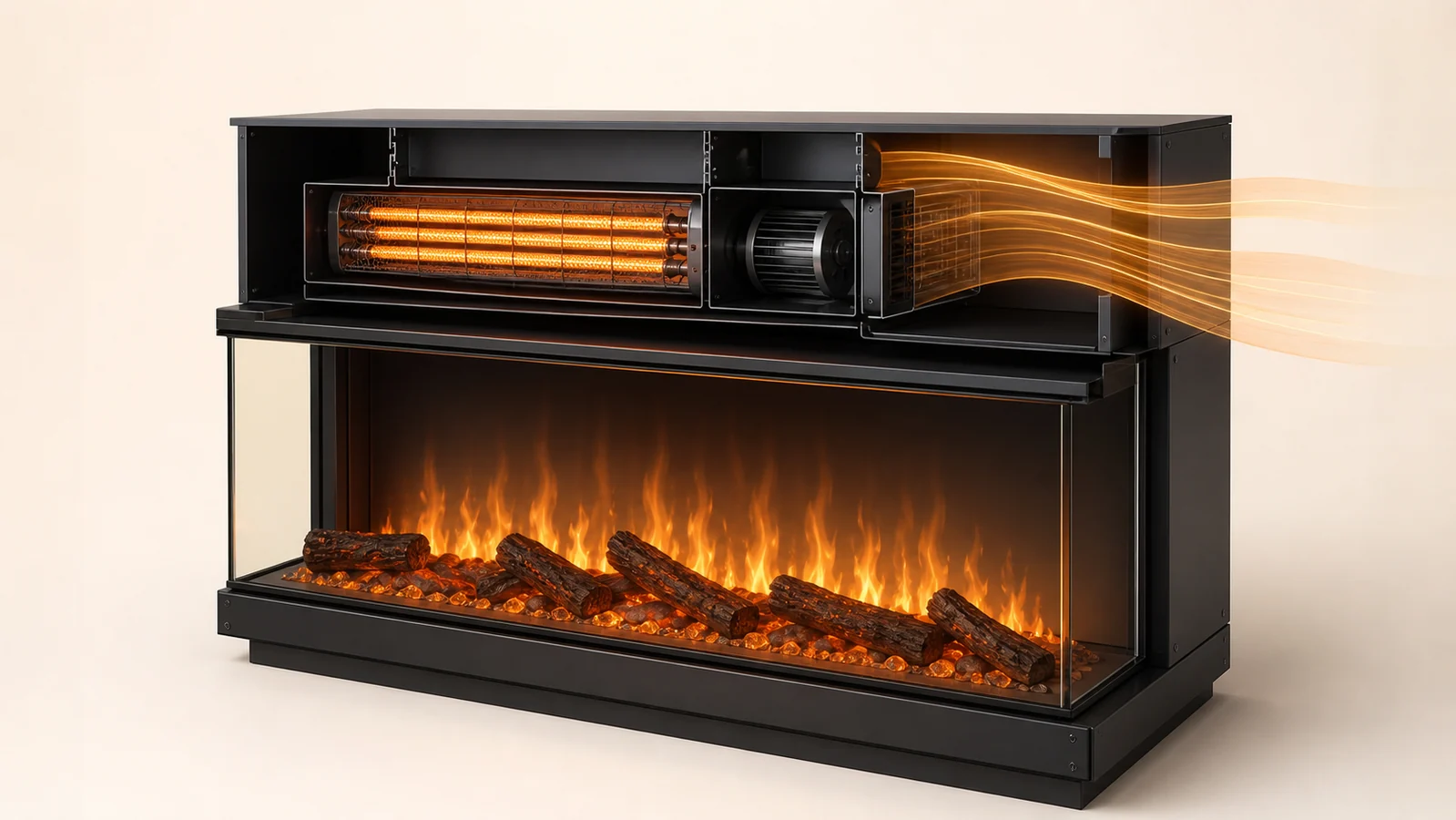
For the 24 Deluxe, the brochure lists 120 V, 1,500 W and 5,118 BTU, with plug-in wiring and an option to hardwire. For the larger Revillusion column, it lists 120/208/240 V, 1,375/1,975/2,575 W and 4,400/6,745/8,794 BTU, with hardwiring and an optional 120 V plug kit included. Those are brochure comparison fields, not permission to wire from a table: the exact ordered model, current manual and local electrical work still control.
The practical point is that moving from a 30 to a 24 is not a simple reduction of the same product. The tier, heater description, wiring relationship and accessory choices may change with it. A shopper who has a 25-inch-wide space should not select “24” and assume every other row shrinks proportionally.
The 36 and 36 Portrait make the same warning in a different way. The current brochure lists both at 37 1/8 inches wide and 12 1/8 inches deep, but the Portrait body is 31 inches high versus 26 1/2 inches for the standard 36. Nominal width alone cannot tell a cabinetmaker which opening to prepare.
The suffix can change the identity without changing the opening
The current brochure lists four backer families—Weathered Concrete, Black, Herringbone and Neutral Brick—and encodes them in sales models such as REV30-WC, REV30-BL, REV30-HB and REV30-NB. The finish suffix is part of the exact order identity even when the main firebox dimensions remain in the same size row. It also determines which visual interior and bundled or accessory description you should expect.
There is a second code issue that matters more than color. The current brochure uses REV sales codes. Dimplex’s opened built-in owner manual 7214620100R04 names RBF30, RBF36, RBF36P and RBF42 variants. The support resource is useful for the models printed on its cover, but it does not prove that a newly listed REV code is electrically or mechanically identical to an older RBF code.
Do not translate between those families by eye. Ask the seller or Dimplex for the manual linked to the exact order number you will receive. Record both the sales model/order number and the manual’s covered-model list. If the code on the quote is absent from the document cover, return source conflict hold instead of borrowing a close-looking manual.
The same discipline applies to accessories. A trim kit, plug kit, glass pane or alternate log set must name the exact compatible model or family owner. Matching the nominal inch or finish name is not enough.
The opening needs the document, not the nominal inch
The current brochure demonstrates why the word “size” is slippery. It lists the REV30 body at 31 1/8 × 26 1/2 × 12 1/8 inches, while its installation table shows separate A–F fields. REV36 and REV36P share a nominal width, but the portrait version changes the vertical body and installation relationship. Those rows are useful for shortlisting; they are not a substitute for the drawing and instructions linked to the exact ordered model.
The RLG25 log set has a different relationship again. Its owner manual 7214560100R08 lists a 25.6 × 19.0 × 13.0-inch body, then recommends an opening at least 26 inches wide, 22 inches high and 15 inches deep for viewing. It also requires clearance for air circulation beneath the unit and says not to place it in an existing fireplace opening prone to dampness. Those numbers belong to RLG25; they are not the opening for a 24-inch Deluxe built-in.
Keep four fields separate: appliance body, manufacturer installation or minimum-opening field, finished visible face, and removal/service path. The electric-fireplace specifications guide provides the neutral field set. For an existing masonry opening, use the insert-size guide to compare the narrowest measured width, height and depth with the exact model—not the size in its marketing name.
Once one built-in model survives, the electric-fireplace framing guide can turn the current manual into a construction handoff. Until then, do not send REV36 or “36-inch Revillusion” to a framer. Send opening fit hold and specify which drawing or dimension is missing.
Power and controls expose the source conflict
Branch and tier change the power conversation. The RLG25 manual specifies 120 V, 12.5 A, 1,500 W and plug-in wiring. It says to plug the unit directly into a wall receptacle, not an extension cord or relocatable power tap, and notes a 15 A, 120 V circuit. The larger built-in family has a different current brochure summary and named RBF manuals with direct-wiring sections. Treating every Revillusion as “just plug it in” is therefore unsafe and inaccurate.
Heat claims need the same restraint. The brochure’s watt and BTU rows describe rated configurations, not a guaranteed room result. Decide whether the fireplace is primarily visual or expected to provide supplemental heat, then compare the exact model and voltage with the heat and running-cost guide. Do not let a broad “up to 1,000 square feet” marketing line decide the circuit or the room plan.
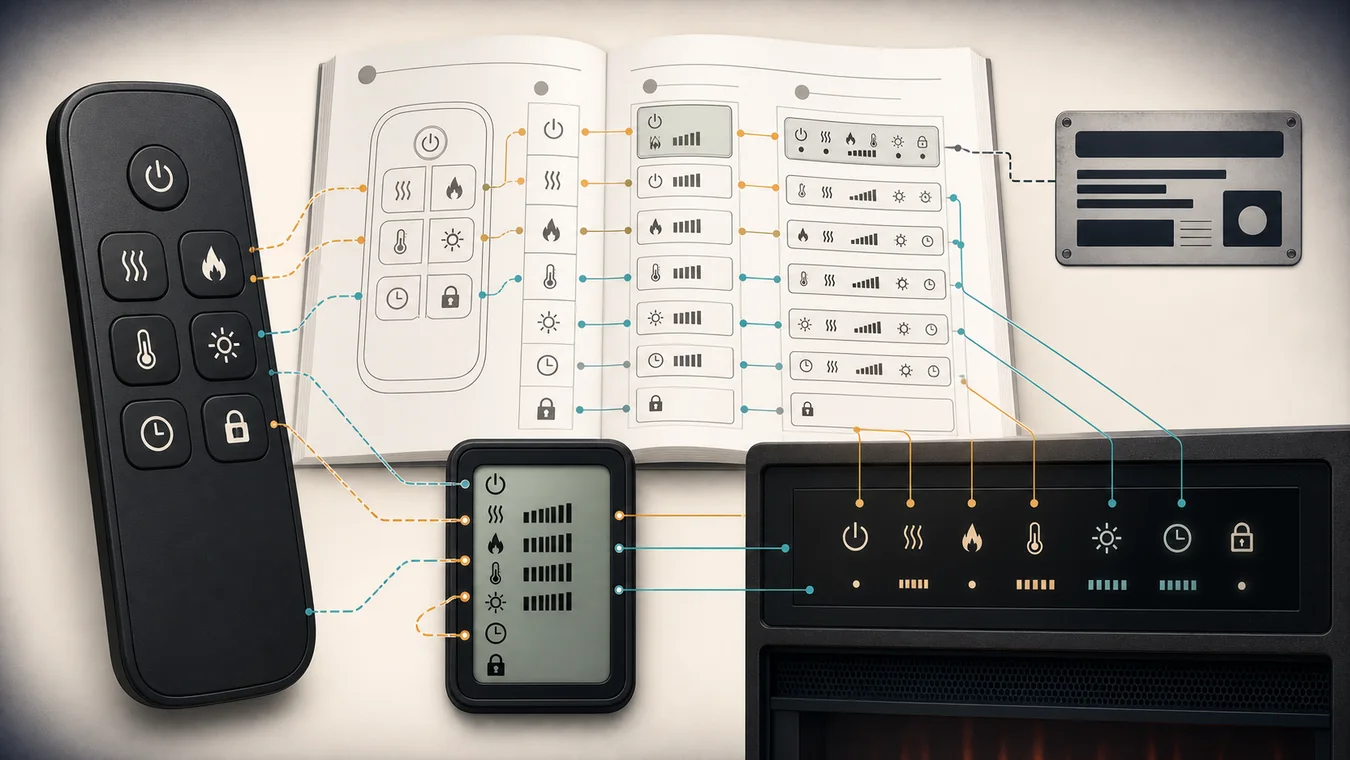
Current Dimplex sources also disagree on app ownership. The 2026 family brochure shows marks in a Flame Connect App row for both series columns. The current Weathered Concrete product-family page says control is available from the unit or included remote and that no apps or pairing are needed. That conflict is useful evidence: it tells you not to promise app control—or its absence—from the family name.
Resolve controls against the exact quoted model and its current manual. Record what works from the unit, what works from the included remote, whether an app is documented for that specific model, and what remains available if an account, phone or network is unavailable. If the product page, brochure and manual do not agree, obtain written model-specific clarification or return power/control hold.
Put one complete product line on the order
Before comparing price or flame preference, write the candidate as a single source-bound line:
[built-in firebox or plug-in log set] — [full current sales model and order number] — [tier + nominal size/portrait + finish suffix] — [current exact-model manual and revision] — [body + manufacturer opening/installation fields + finished face + removal path] — [voltage, wiring and heat configuration] — [unit, remote and exact-model app status] — [compatible trim/media/accessories]
Each blank has a different consequence. A missing branch returns family branch required. A code not printed in the chosen document returns source conflict hold. Missing body/opening or service geometry returns opening fit hold. An unresolved voltage, connection or control path returns power/control hold.
Only a line with all fields tied to the same current product earns model shortlist ready. That status does not say a Revillusion has the best flame or that it fits every traditional fireplace. It says the family name has finally been replaced by something orderable: one exact product, one controlling document, one opening relationship and one ownership path.