Electric fireplace installation cost is only comparable after you define what the price buys. Current US guides illustrate the problem: HomeAdvisor leads with a normal installed-project range and an average, HomeGuide publishes a broader headline range, while Electric Fireplaces Direct presents installation alone and explicitly excludes the fireplace. Those figures can all describe legitimate projects, but they are not the same basket.
For a usable budget, separate the appliance from the work first. Then make every quote state its mounting or fitting, electrical, framing and drywall, finish, permit and access, and removal or conversion scope. Compare totals only after those lines match. Until then, a lower bid is merely a shorter list.
Compare the basket before the number
The fastest way to misuse a national cost range is to treat “installation” as a standardized product. It is not. One source may include the fireplace and basic labor. Another may discuss labor, wall work and electrical service while explicitly excluding the appliance. A custom media wall may bring cabinetry, tile and low-voltage work into a number that still carries the same electric-fireplace label.
| Current source | Published price scope | What the basket does | How to use it |
|---|---|---|---|
| HomeAdvisor, updated June 20, 2026 | Normal-range headline plus an average | Mixes type rows described as unit-only or including installation, plus wider custom work | A broad installed-project reference, not a substitute for inclusions |
| HomeGuide, January 2, 2026 | Broader type-level headline range | Calls the type table installed cost but marks the freestanding row as unit-only | A type-level screen whose footnotes matter as much as its headline |
| Electric Fireplaces Direct, July 9, 2026 | Installation-only planning range | Explicitly excludes the fireplace, taxes, shipping and optional furniture or mantel packages | A work-only reference, with retailer interest and local-rate limits preserved |
| Same retailer guide, custom-wall branch | Separate, materially wider project range | Adds wall framing, media wiring, cabinetry, tile, stone or millwork | Evidence that a feature wall is a larger construction basket, not a pricier basic mount |
The ranges are planning signals, not competing bids. Their disagreement tells you which question to ask first: Does this price include the fireplace? Follow with the exact work and material boundaries. A national average cannot inspect your panel, open your wall, match your finish or read your municipality’s permit rules.
Translate a national range into a project format
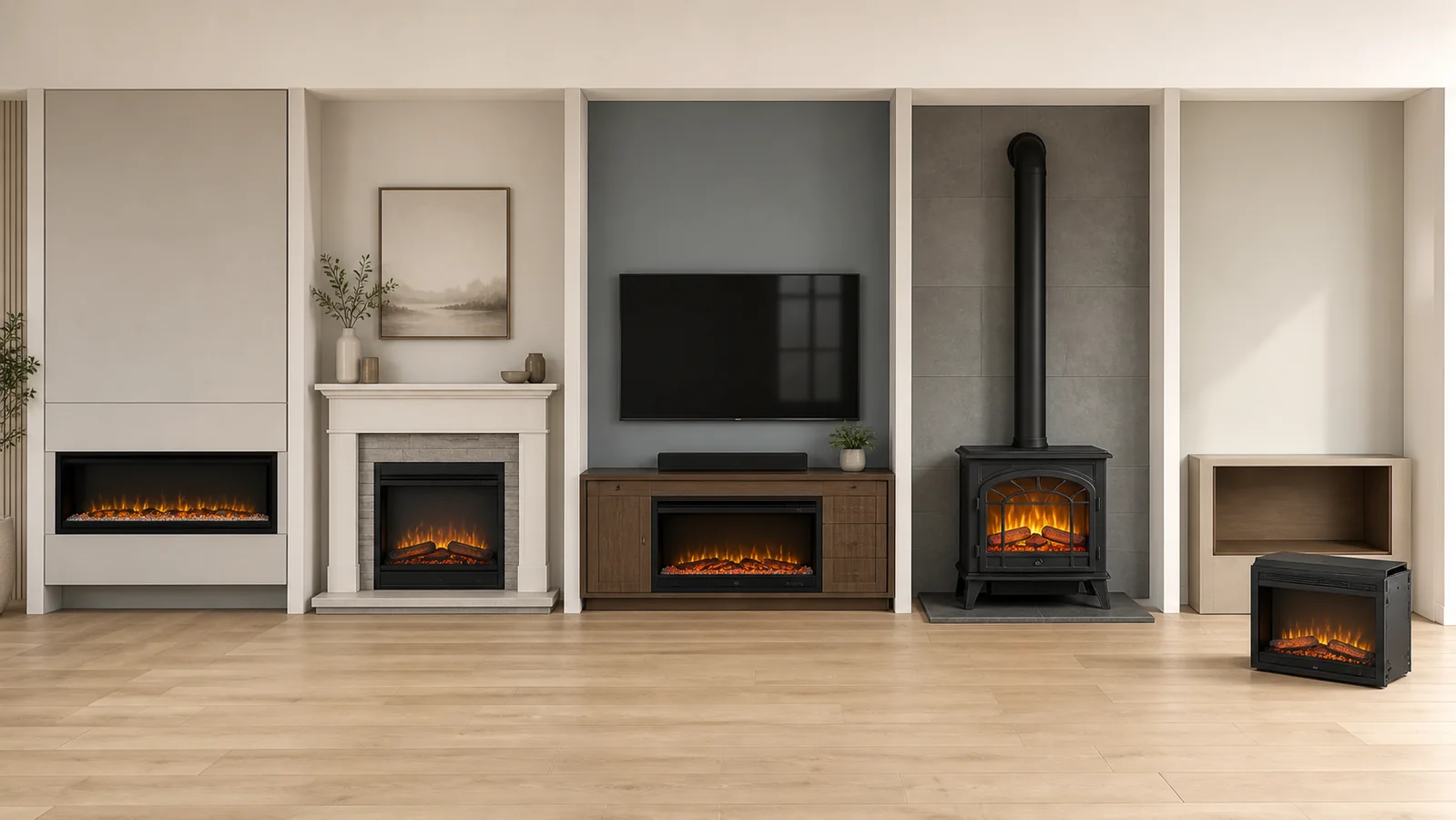
Project format explains more than the word “electric.” A freestanding unit placed near a suitable existing receptacle may need little installation work. A wall-mounted unit adds attachment and leveling; a new power location changes that basket. An insert must be fitted to an existing opening and may need trim or opening preparation. A recessed unit adds an opening, wall work and a planned electrical route. A built-in feature wall can add several trades after the fireplace itself is already secured.
Choose that format before asking for a number. The types of electric fireplaces guide starts with the floor, wall or existing opening. If the choice is specifically between hanging the unit and putting it into the wall, use the recessed-versus-wall-mounted comparison to settle the physical path. Neither decision supplies a local price; it defines the work that a price must cover.
Do not let a product label smuggle construction into the quote. “Recessed fireplace” might mean setting a unit into an opening that another trade already built, or it might mean supplying and finishing the entire bump-out. “Insert installation” might assume a clean, square, powered opening, or include minor preparation and trim. Write the starting condition and finished condition in ordinary language.
Normalize every bid into seven scope lines
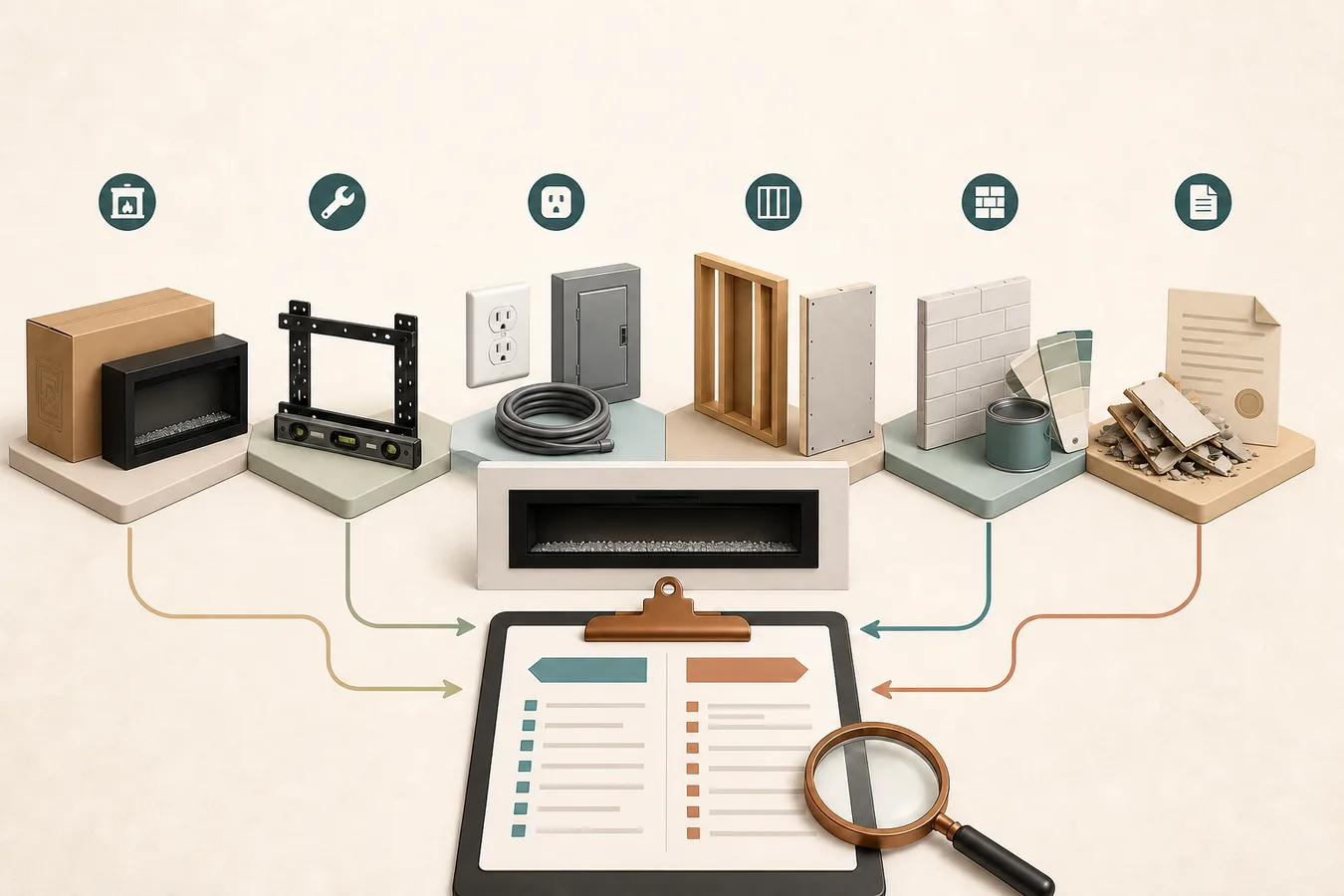
Give the same seven lines to every bidder. Each line should say included, excluded, allowance or pending site review. An allowance needs an amount and a description; “as needed” is not a comparable scope.
| Scope line | What the written quote should name | Evidence to attach | Why totals move |
|---|---|---|---|
| 1. Fireplace appliance | Owner-supplied or contractor-supplied; exact manufacturer, model/item and package | Product record, current price basis and package contents | A labor-only bid and a unit-included bid are different baskets |
| 2. Mounting or fitting | Freestanding setup, wall attachment, insert fitting, recess placement, trim and hardware | Wall/opening condition and exact installation method from the manual | A prepared opening is not the same job as creating or correcting one |
| 3. Electrical | Existing receptacle, relocated/new outlet, dedicated circuit, hardwire, panel work, permit and inspection responsibility | Exact-model requirements plus licensed site assessment | Power availability and routing can add a separate trade and wall access |
| 4. Wall construction | Opening, framing, blocking, drywall cut, patch, access panel and structural correction | Site dimensions, wall type and current model drawing | Setting an appliance and building its enclosure are separate operations |
| 5. Finish | Prime/paint, trim, mantel, tile, stone, shiplap, cabinetry, hearth and transitions | Material selection, area, edge details and responsibility for supply | Finish material and trade labor can exceed basic mounting work |
| 6. Permit, access and protection | Permit/inspection owner, floor and room protection, access limits, cleanup, debris and return visits | Local requirements and site-access notes | Travel, protection, inspection and restricted access consume real project time |
| 7. Removal or conversion | Old appliance/mantel removal, gas-line responsibility, chimney/firebox work, repair and disposal | Pre-bid photos plus qualified on-site findings | A replacement or fuel conversion begins before electric-fireplace installation |
This matrix does not force every job to contain all seven categories. It forces every quote to disclose what happens to each category. A clean exclusion is useful; an invisible exclusion is where budget comparisons fail.
Let the exact model write the electrical allowance
“Electric fireplace” is not an electrical specification. Freeze the exact model before the final electrical bid. The electric-fireplace specifications guide provides the neutral fields to capture, while the plug-in-versus-hardwired guide explains why an available connection method is a project decision rather than a way to hide a cord.
Manufacturer documents show why the identity matters. Touchstone’s manual index maps different item-number sets to different PDFs. Dimplex’s RBF24DLX manual keeps framing, electrical and service information inside one exact-model document. Neither source supports borrowing another model’s opening or power plan because its nominal width looks close.
Ask the electrician to price the path that the current exact manual and site allow: use of an acceptable existing receptacle, a new or relocated outlet, a dedicated circuit, hardwiring, panel work, and any permit or inspection. The electrician—not a national article—confirms code, capacity and routing. The quote should also say who opens and closes the wall; otherwise the electrical number and drywall number can exclude the same repair.
Price the finished wall as its own job
A fireplace can be installed while the room remains unfinished. Basic drywall patching, a painted bump-out, full-height tile, stone slabs, cabinetry and a mantel are different deliverables. Electric Fireplaces Direct publishes a separate, materially wider range for a custom fireplace wall because that basket can include framing, media wiring, cabinetry and finish work—not because the electric appliance suddenly needs luxury mounting.
Write the finish boundary by surface and edge. Who supplies the tile? Who prepares the substrate? Are outside corners trimmed, mitered or covered by millwork? Does paint cover the patch or the whole wall? Is the mantel included, and is TV/media work a separate contractor? “Finish by others” can be perfectly acceptable when the other scope is already priced; it is dangerous when it is discovered after the fireplace crew leaves.
The wall also has to preserve the exact model’s finish relationship and service route. Use the electric-fireplace framing guide to transfer the current manual’s opening, body, trim and access information. Do not let a finish drawing become the source of appliance dimensions.
Separate conversion work before contractors arrive
Replacing an existing gas or wood-burning fireplace is not simply an insert price with demolition added later. The site may involve an old appliance, surround or mantel; gas-line responsibility; a firebox or chimney condition; electrical access; patching; disposal; and decisions about what remains visible. Those facts can require different qualified trades and local authority.
Resolve that boundary before requesting comparable electric-installation bids. If the fuel choice itself is still open, settle the existing gas, chimney and electrical infrastructure before treating either option as quote-ready. For the quote, ask who inspects and makes safe the existing system, what removal is included, what repair is assumed, and where the electric installer’s responsibility begins. Do not ask an electric-fireplace article for a gas-line, chimney or permit conclusion.
If contractors cannot price the conversion from photos and records, schedule a pre-bid visit rather than inserting a hopeful allowance. The visit has value when it turns an undefined exclusion into a written starting condition.
Make exclusions compete on paper
Place the quotes side by side and ignore their totals for the first pass. Compare appliance identity, installation method, electrical path, wall work, finish, permits/access and removal/conversion. Where one quote says “included” and another is blank, do not assume the blank is free. Ask for a revision or carry a named allowance.
Then compare commercial details that affect the same scope: tax, delivery, deposit, change-order basis, schedule, cleanup and responsibility for damage or rework. A bidder may legitimately exclude a trade it does not perform. Your task is to make that exclusion visible and priced somewhere else before choosing the apparent low bid.
The comparison is ready when every quote names the same exact fireplace, starts from the same site condition and reaches the same finished condition. If the model, electrical path, wall, finish, permit or conversion line is still unresolved, the next useful number is the written allowance for that gap—not another national average.