Cleaning starts with a less obvious question: which surface are you actually looking at? A black frame, reflective viewing panel, air opening and ember bed can sit inches apart while following different care instructions.
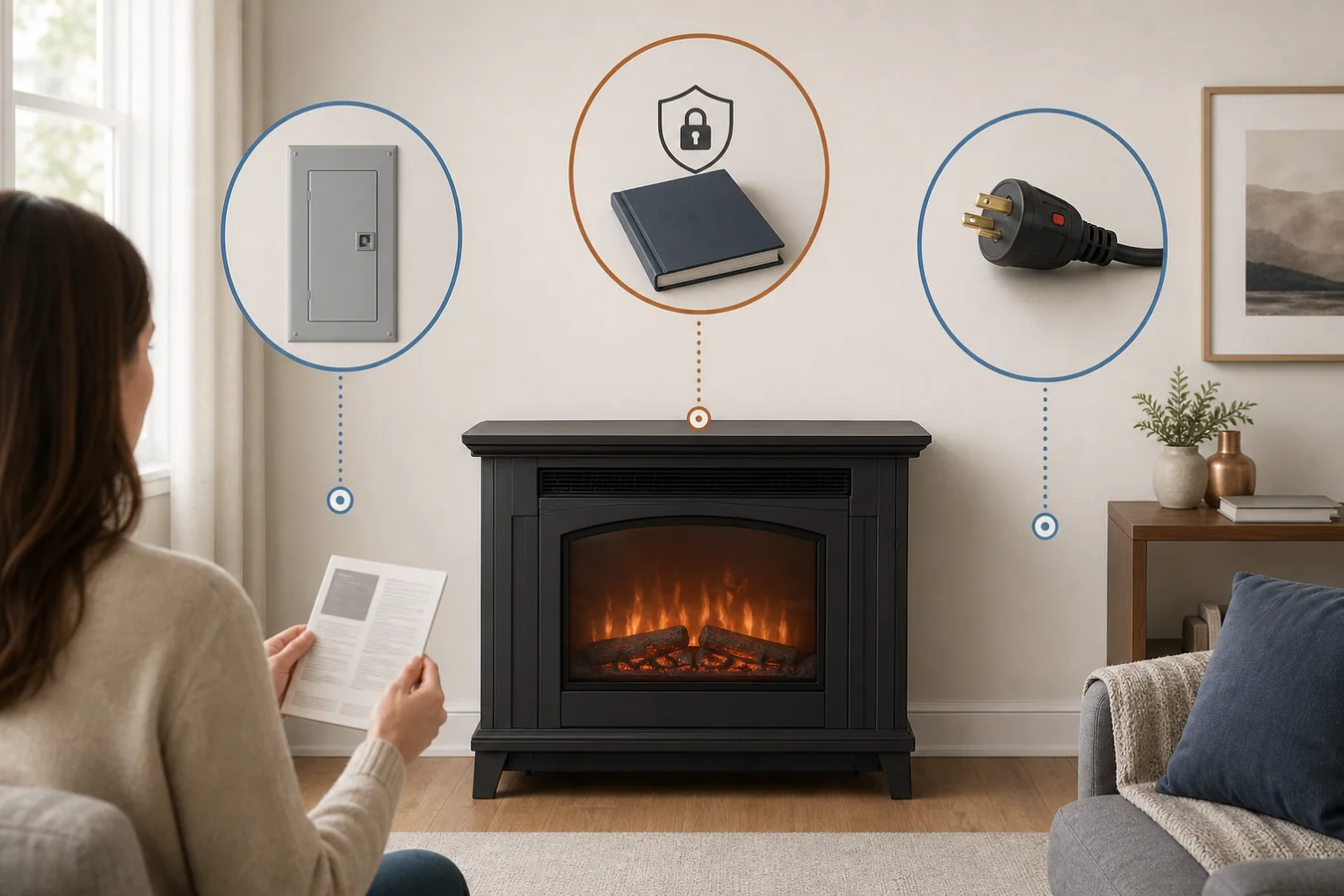
Find the exact model and current owner manual before choosing a product or moving a part. Disconnect power by the path that document specifies, and wait for any model-stated condition. Then use the manual’s own noun for the surface—painted finish, metal, glass, plastic, media, reservoir or something else.
If the document does not identify both the material and owner access, the safe result is not a guessed cleaning method. It is a hold for the manufacturer or current manual.
Name the surface before you choose the tool
| Area in front of you | Evidence needed before cleaning | Allowed direction | Hold when |
|---|---|---|---|
| Painted, coated or metal exterior | Exact model manual names the finish and care method | Use only the named exterior method and moisture limit | The coating or permitted product is unknown |
| Viewing panel | Manual names the material and says whether owner removal is part of routine care | Clean in place or remove only as the exact document directs | The panel only looks like glass, has an unknown film or coating, or removal is not explicit |
| External air opening | Manual identifies the opening and an exterior cleaning method | Work from the accessible exterior only | Reaching dust requires a panel, tool insertion or heater-compartment access |
| Logs, crystals or ember media | Manual treats the exact media assembly as owner-accessible and gives a sequence | Preserve the recorded order and reassembly condition | Media is retained, wired, attached or not described as removable |
| Internal or service panel | Owner document explicitly grants routine access—which many do not | Follow only that owner procedure | The document says service, no user-serviceable parts, or gives no owner instruction |
| Tank, sump or other water system | Exact water-vapor manual identifies the component, water requirement and care method | Use that model’s water-system path | A dry-firebox guide is the only instruction available |
This is a routing table, not a list of universal techniques. It also explains why the broader electric-fireplace specifications guide matters here: model identity and document ownership are maintenance inputs, not paperwork after the fact.
The illustration below separates possible layers. It does not declare that the viewing panel, media or grille on a particular fireplace can be removed.
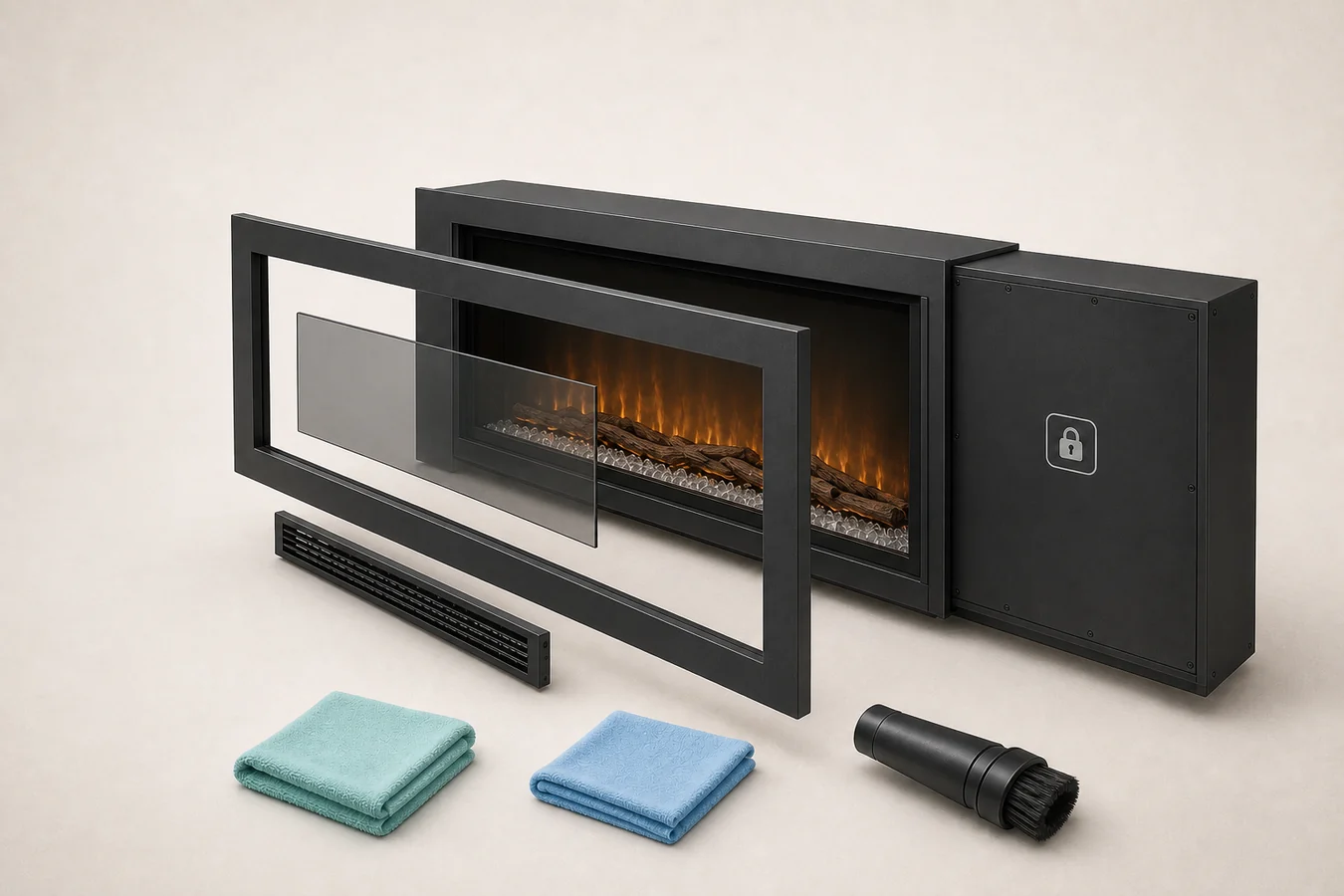
The manual decides whether the front is a window or a door
A transparent or reflective front gives you a view; it does not give you a material specification. Some documents call out glass and a glass-cleaning method. Another model may use different wording, a coating, a partially reflective surface or an assembly the owner is not meant to remove.
Begin with the rating label or exact SKU, then retrieve the current document. The electric-fireplace manual guide explains how to reject a near-match manual when product names and photos look alike. For cleaning, the useful lines are the ones that name the surface, approved method, access sequence and power condition.
Touchstone’s current manual index routes owners to model documents. In the exact manual for models 86273 and 86275, metal, glass, vents and plastic receive separate instructions, while panel opening is outside user maintenance. That is strong evidence for those two models and for the need to classify surfaces. It is not permission to remove the front of a different fireplace.
Document type matters too. An owner manual can grant routine access; a service manual can describe work reserved for service personnel. Finding a diagram in the second document does not expand the homeowner procedure in the first.
A cleaner can be right for one finish and wrong for the next
The 86273/86275 manual illustrates the mismatch clearly. It assigns glass cleaner to a cloth rather than the appliance, a vacuum or duster to vents, and a mild dish-soap solution to named plastic parts. It also warns against abrasive cleaners. Those distinctions belong to the listed models, but they show why “use one damp cloth everywhere” and “spray the glass” are not reliable category-wide rules.
Dimplex’s current care guidance also starts with the exact owner manual and disconnected power. Its general exterior-care advice stays deliberately modest. The specific finish instructions still need to come from the document for the fireplace in front of you.
Record four things before a cleaner touches the appliance: the manual’s surface name, whether removal is owner-authorized, the permitted product or tool, and any dry or reassembly condition before power returns. A household cleaner being safe on ordinary windows or furniture says nothing about a fireplace coating.
Do not add a universal weekly, monthly or seasonal interval when the manual does not. Dust load, room conditions, water use and manufacturer maintenance requirements vary. A visible condition can prompt a document check; it does not create permission for a deeper method.
Dust at an air opening is not permission to enter the heater
An external intake or outlet can collect dust while remaining distinct from the internal heater compartment. If the owner manual allows an exterior vacuum, brush or duster, keep the action at the accessible face and within its tool instructions. Do not remove a grille or feed a tool through an opening merely because dust is visible behind it.
The distinction is easier to keep when “vent” is not used as shorthand for every opening. The guide to whether electric fireplaces need venting separates combustion venting from room-air paths. Cleaning an authorized exterior air path does not make an electric fireplace a vented combustion appliance, and it does not turn the heater interior into an owner-maintenance area.
If heat output changes, a shutdown repeats, a breaker trips, or there is a burning odor, smoke, visible damage or unexpected water, stop routine cleaning. The repeating-shutdown guide preserves those observations and routes the next owner without converting an exterior dust check into a parts diagnosis.
Decorative media belongs to its own record
Crystals, logs and ember material can look loose even when their placement, retention or lighting assembly is model-specific. Move them only when the exact owner document includes removal in routine care and shows how the arrangement returns. Photographing the documented layout for your own reference can preserve order, but it cannot create access permission the manual does not grant.
Do not wash, soak, vacuum or apply cleaner to media unless the exact instructions say to do so. The electric-fireplace crystal guide owns media compatibility; this page owns only whether the installed media is documented as user-accessible for cleaning.
When a log, wire, light element or retained part would need to move, leave the assembly in place and ask the manufacturer what owner maintenance applies to that model.
Water-vapor fireplaces leave the dry-firebox path
A water-vapor flame effect introduces a reservoir, tank, sump or other water-handling system. Dry dusting advice cannot decide its water type, draining, scale-control product or service interval.
Use the exact water-vapor manual for every wet component and keep chemicals outside the system unless that document names them. The water-vapor electric-fireplace guide explains the technology boundary; the model manual remains the cleaning authority.
Write the cleaning card before anything moves
Put the decision in one line:
Model and manual revision — named surface — owner access allowed or not allowed — permitted product or tool and moisture limit — removal and reassembly condition — power-return condition — manufacturer or service owner if unresolved.
For example, a complete line can say that the exterior finish is named, owner-accessible and assigned a particular manual-approved method, while the viewing panel remains unresolved until the manufacturer confirms its material. The two surfaces do not need to share an outcome.
If the material, access instruction or cleaner field is blank, leave that surface alone. If damage, smoke, a burning odor, unexpected water, cord or plug damage, or breaker behavior appears, keep power disconnected and place the observation with the responsible manufacturer, landlord, electrician or qualified service provider.