Before comparing flame colors, picture the last day of the lease. What has to be patched, disconnected, unanchored, carried down the stairs or left behind? That reverse view exposes more than the word portable ever will.
An electric fireplace can be ventless and still require a wall bracket. It can plug in and still be wrong for the available outlet. It can arrive as furniture and still include an anti-topple restraint. The apartment-ready choice is the exact model whose property permission, installation relationship, power path and route back out all agree for one location.
Do not ask whether electric fireplaces are “allowed” as a category and then shop from that answer. Put the exact model, room, fasteners, electrical relationship and move-out work into the same record. A missing controlling fact is a reason to pause the order, not a blank to fill with a retailer’s renter-friendly label.
Start with removal day, not the product label
Three words cause most of the confusion. Ventless describes the lack of a combustion exhaust path; it does not say what happens to the wall. Plug-in describes one possible electrical connection; it does not prove that the intended receptacle, circuit or cord route works. Freestanding describes how the appliance is supported; the exact manual can still impose surface, spacing and power conditions.
Write the removal sentence before the purchase sentence. “Lift it, unplug it and carry it out” is one relationship. “Detach the supplied restraint, move a 144-pound cabinet, repair the approved anchor point and carry two documented components out” is another. “Remove a bracket and restore its fastener holes” is different again. A recessed cavity or hardwired connection adds work that may not belong to a renter at all.
If you own the unit, the question does not disappear; the responsible owner may change. Building rules, an association, shared-wall restrictions or the person responsible for electrical and finish work can still control the proposal. The types of electric fireplaces guide can help name the physical format. This page begins where that format meets one apartment’s permission and exit plan.
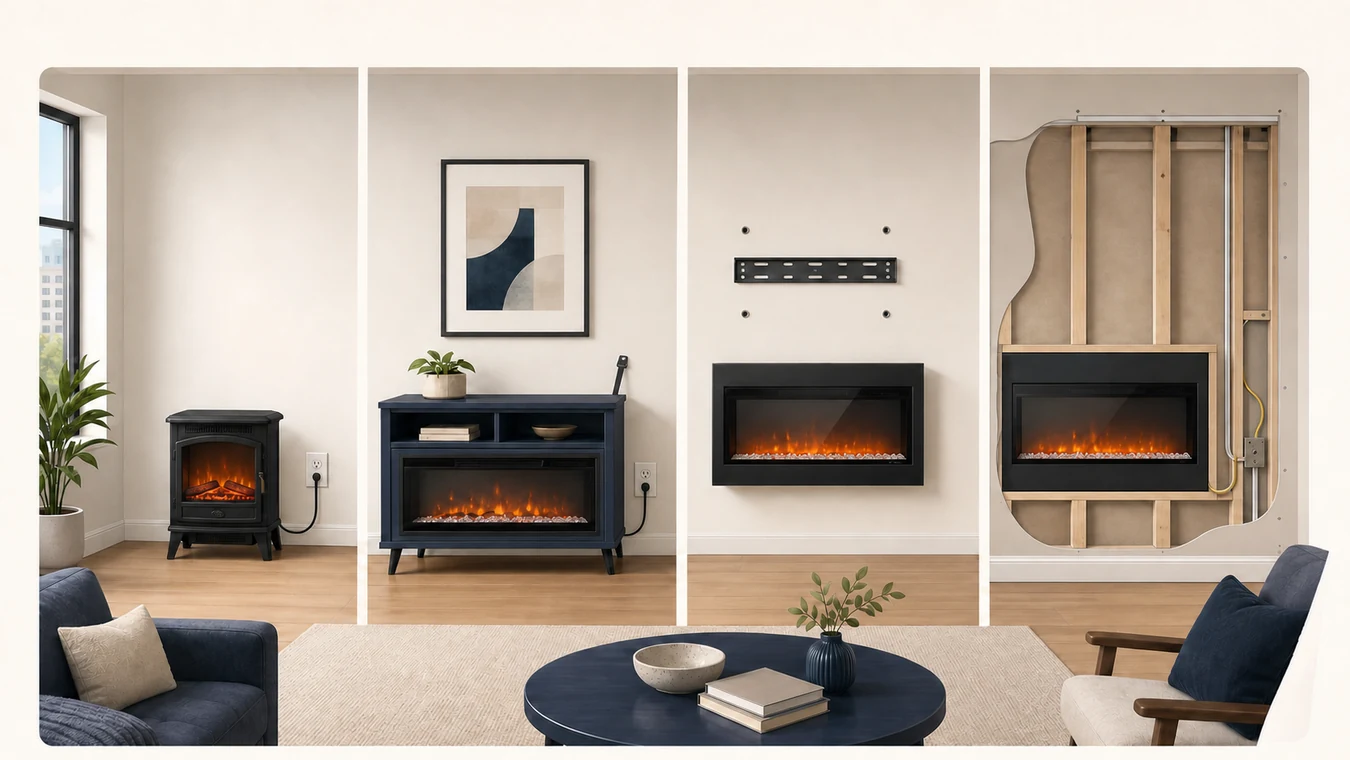
Four apartment paths leave four different traces
Use this map to classify the exact product relationship—not the room photo on a sales page. “Most reversible” is not an approval. It means fewer site changes remain to verify.
| Proposed path | What changes in the apartment | Evidence needed before ordering | Move-out burden |
|---|---|---|---|
| Freestanding stove or floor unit | Floor position, direct power route and heater inlet/outlet space; usually no wall bracket unless the exact instructions say otherwise. | Exact manual, permitted supporting surface, full operating envelope, cord exit and reachable approved receptacle. | Unplug and carry only after weight, grip points, doors and stairs close; keep any model-specific restraint or assembly condition. |
| Fireplace furniture or media console | Full cabinet footprint, assembly area, power route and any supplied anti-topple restraint or wall anchor. | Complete package SKU, assembled and carton dimensions/weights, top-load rules, restraint instructions, outlet location and written approval for the attachment when required. | Detach only as instructed, preserve service access, and prove the cabinet or approved components can leave without treating decorative parts as handles. |
| Surface wall mount | Bracket, fasteners, verified wall support, visible projection, power route and eventual hole repair. | Exact mounting section, hardware/support requirements, owner approval for the named wall and a defined restoration standard. | Remove appliance and bracket in the authorized order, then complete the agreed wall repair; “surface mounted” is not “no alteration.” |
| Recessed or hardwired installation | Wall opening or built-out enclosure, finish work, possible electrical work, clearances and service access. | Written authorization for the complete project plus the current manual and the people responsible for structural, electrical, finish and restoration work. | Highest commitment: disconnect, expose or remove finish as authorized, extract the appliance and restore the assembly; hold for a renter unless this entire path is expressly owned. |
One current product shows why the relationship matters. Touchstone’s Sideline 28 item 80028 page lists the appliance at 28 inches wide, 16 1/2 inches high and 5 inches deep, with a 22-pound product weight and a 120-volt plug-in supply. It also lists both wall-mounted and recessed use, while publishing a separate rough opening. A compact, plug-in appliance can therefore lead to two very different wall projects.
The current Sideline owner manual gives separate recessed and wall-mounted procedures for the models it covers. That distinction is the useful fact; it is not permission for either path in your apartment. If wall mounting survives the property gate, the wall-mounted electric fireplace guide owns the wall support, bracket, projection, airflow and removal checks.
Ask for permission with an exact proposal
“Can I have an electric fireplace?” invites an answer that is too broad to buy against. A property manager may picture a small floor appliance while you mean a bracketed wall unit. A condo board may allow furniture but require approval for fastening into a shared wall. The useful request makes the proposed change visible.
Attach or identify the exact product page and current manual. State the room and wall or floor position. Name the relationship—freestanding, furniture with a restraint, surface mounted, recessed or hardwired—and list every hole, bracket, anchor, opening or electrical change shown by the manufacturer. Add the cord/outlet plan and who would perform any work. Finish with the proposed removal and restoration at move-out.
Ask the responsible property party to confirm that exact proposal in writing, including any conditions. Keep the response with the product record. A general statement that electric fireplaces are allowed does not resolve wall attachment, an anti-tip device, a new electrical connection or the required finish after removal.
This is an evidence request, not a substitute for interpreting your lease, building rules or local requirements. If the responsible party cannot identify the approved work, the result is property-approval hold. Change to a relationship with fewer unresolved site changes or wait for the exact answer; do not let the product label answer for the property.
The power route can veto the room
A standard plug on the product does not make every wall position usable. Record the rated supply and wattage from the exact current owner, then locate the actual receptacle and identify what else the relevant circuit serves. If adequacy or electrical work is uncertain, the answer belongs to the responsible property and qualified electrical parties—not to a room-layout workaround.
The Sideline manual cited above tells owners of its covered models to use a wall outlet or receptacle and not a surge protector, extension cord or relocatable power tap. It also says not to run the cord under carpet and not to block the air intake or exhaust. Those are manual-family facts, not a universal substitute for the candidate you are considering.
The broader risk is not theoretical. A current U.S. Consumer Product Safety Commission report on portable electric-heater use describes extension-cord and power-strip use as unsafe practices and notes that limited outlet access often drives them. Use the exact fireplace manual as the controlling product source, and use the room’s real outlet—not an imagined extension path—to decide whether the location survives.
If the candidate offers both plug-in and hardwired options, do not treat them as interchangeable finishing choices. They can change who must approve and perform the work, how the appliance is disconnected and what has to be restored. The plug-in versus hardwired electric fireplace guide keeps those product facts separate. The electric fireplace safety guide owns the wider heater, outlet, air-path and operating decision.
Flame-only use does not erase this record. It may change how a specific model operates, but the appliance still needs its documented supply, mounting relationship and accessible controls. If the approved location cannot support the exact power and air path without improvisation, mark outlet or circuit hold and change the location or candidate.
Walk the fireplace back out before it comes in
The finished product photo is the wrong object for a move. Begin at the proposed final position and work backward through the room door, hall turn, elevator or stair landing, building exit and pickup point. Use the carton record for anything that must travel boxed and the assembled record for anything the manufacturer does not authorize you to break down.
Real Flame’s current Morris Landscape Electric Fireplace TV Stand page provides an unusually complete example. It lists the finished package at 72 inches long, 18 inches wide and 29 inches high, with an assembled weight of 144 pounds. It ships in two boxes: one listed at 76 by 22 by 7.5 inches and 113 pounds, the other at 45 by 8.75 by 21.5 inches and 47 pounds. The package plugs into a standard three-prong outlet and includes an anti-topple device.
Those facts apply to Morris, not to all fireplace furniture. They demonstrate why “comes in two boxes” and “stands on the floor” do not settle the apartment question. The longer carton may fail a stair turn even when the finished cabinet fits its wall. The assembled cabinet may be too heavy for an informal last move. The anti-topple device keeps the wall and its approval in the record even though the product has furniture legs.
For any furniture candidate, read the electric fireplace with a mantel guide as a complete-package decision, then preserve the manufacturer’s assembly and removal order. Do not assume the firebox may be removed for moving just because it was installed during assembly. Do not assume trim, glass, a shelf or an opening is a carrying point.
Small rooms create route problems outside the final footprint. The small-space electric fireplace guide owns the room’s scarce width, depth and movement. Here, the separate pass condition is simpler: every documented package or authorized component must be able to travel back out, and the person responsible for any fastener, disconnection and finish repair must be known before the order.
Keep one apartment record beside the product page
Save one record for one exact model and one proposed location. Product facts come from the current manufacturer owner. Apartment facts come from the controlling property record and your measured route. Do not borrow a missing field from a similar size or another product in the same series.
| Record line | Evidence to keep | Result that lets the candidate continue |
|---|---|---|
| Property owner | Lease/building/association source, responsible contact, written response and conditions. | Exact proposal is allowed, or no approval is required according to the controlling owner. |
| Product identity | Brand, full model/item, market, package SKU and manual title/revision. | Every later fact belongs to the same purchasable object. |
| Installation relationship | Freestanding, furniture, surface mount, recessed or hardwired—as shown by the exact instructions. | One relationship is selected; procedures from another path are not mixed in. |
| Site attachment | Bracket, holes, fasteners, wall support, anti-tip restraint, opening or finish work. | Required attachment is approved for the named location and its removal/restoration owner is known. |
| Power and air | Rated supply, connection method, cord exit, real receptacle/circuit decision, intake/exhaust and required space. | The model works in the location without an unsupported extension, hidden inaccessible connection or blocked air path. |
| Complete object | Operating W/H/D, weight, projections, furniture body, doors/controls and service movement. | The full assembly—not just the fire view—works in the room. |
| Route | Carton count/dimensions/weights, authorized disassembly, doors, turns, stairs/elevator and handling responsibility. | Every documented moving unit can enter and later leave through the real route. |
| Move-out close | Disconnect/unfasten sequence, parts to retain, required wall/floor/finish restoration and responsible party. | The apartment can be returned under the written agreement without inventing a removal method. |
When all eight lines close for the same object, label the record by its real relationship: freestanding plug-in path, furniture package path or surface mount with written approval. A recessed or hardwired proposal can continue only when the complete project and restoration have explicit owners; otherwise it remains not renter-ready. Missing product instructions return exact manual required. A failed outlet or route keeps its own hold instead of being averaged away.
The most useful electric fireplace for an apartment is not the one with the strongest portability claim. It is the one with an exit plan that survives the property rules, the product instructions, the available power and the path through the front door. If those four owners do not agree, the product has not earned the room yet.