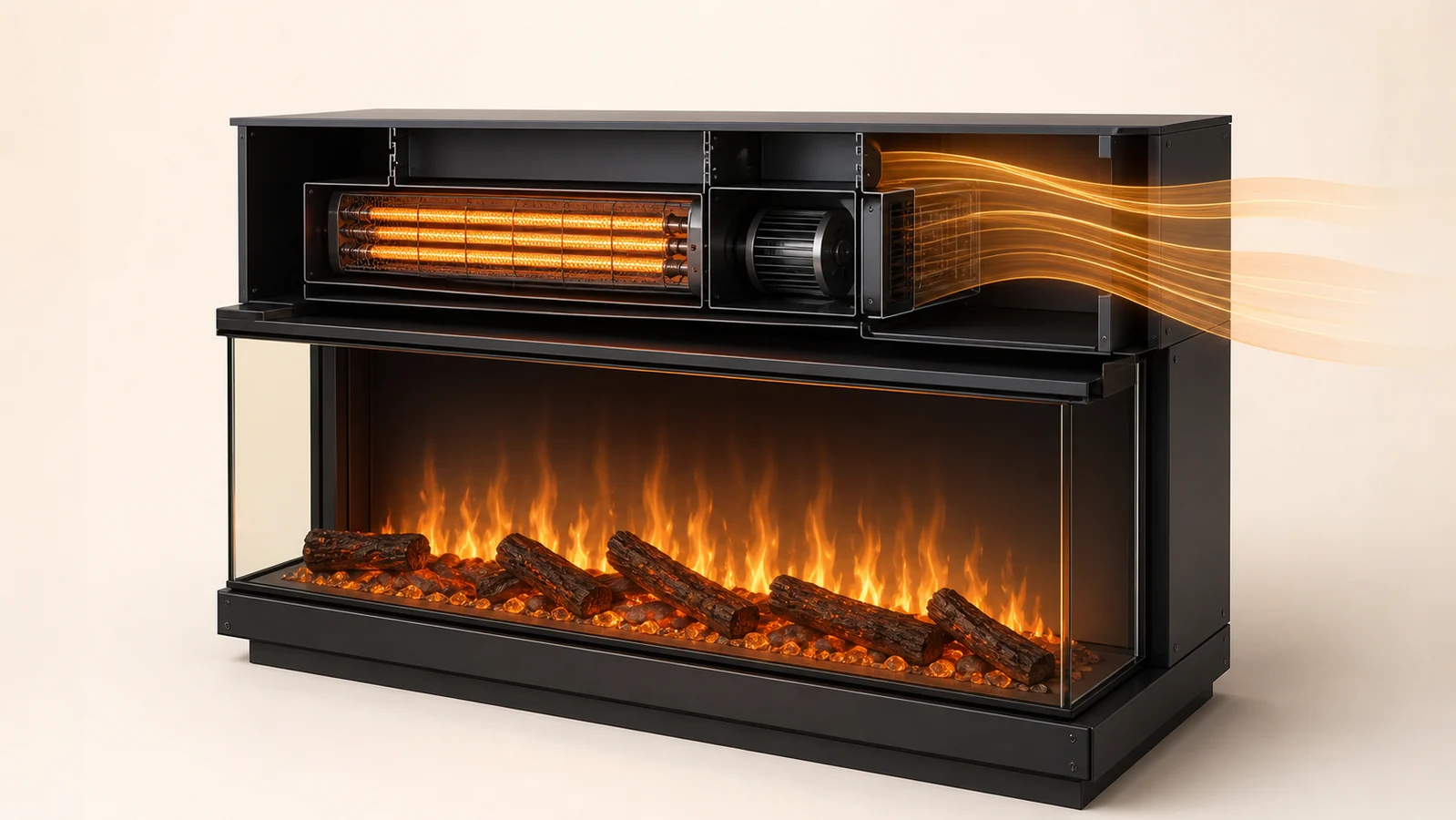
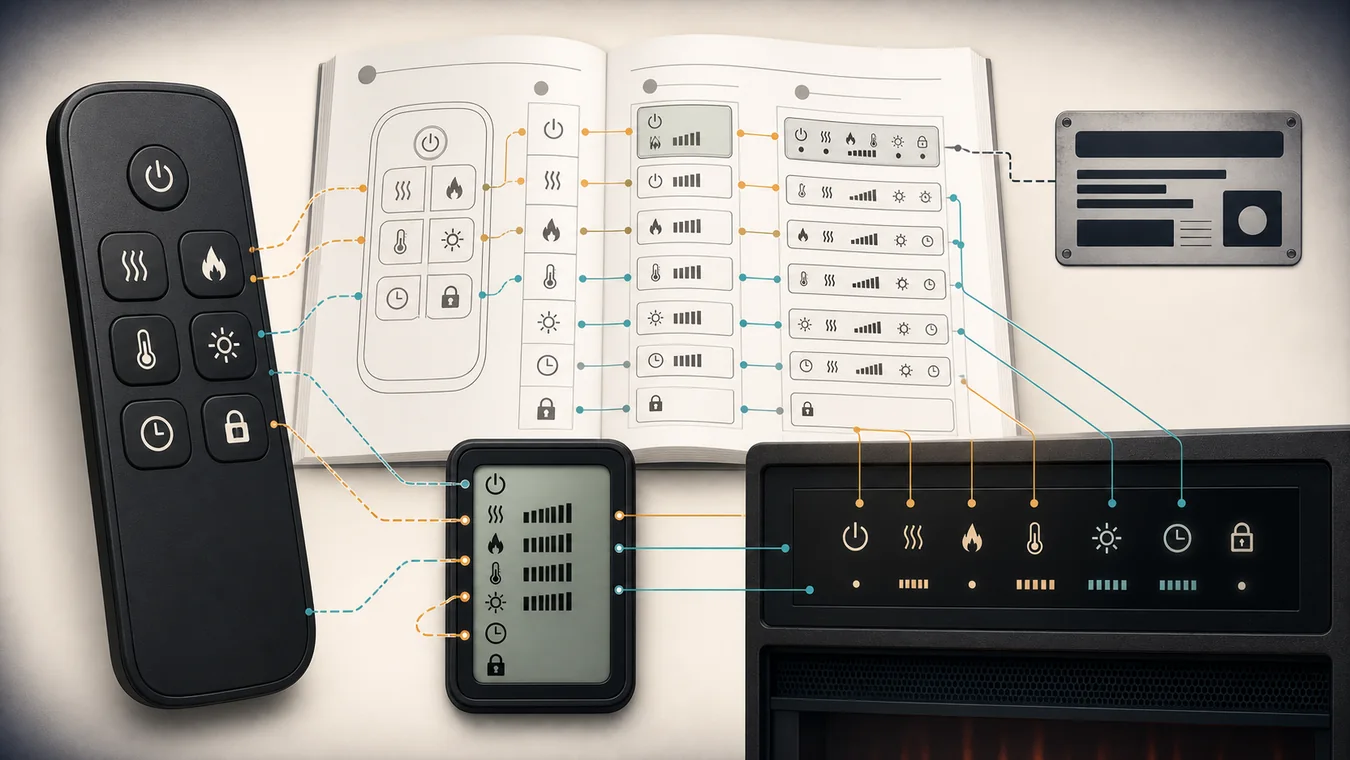
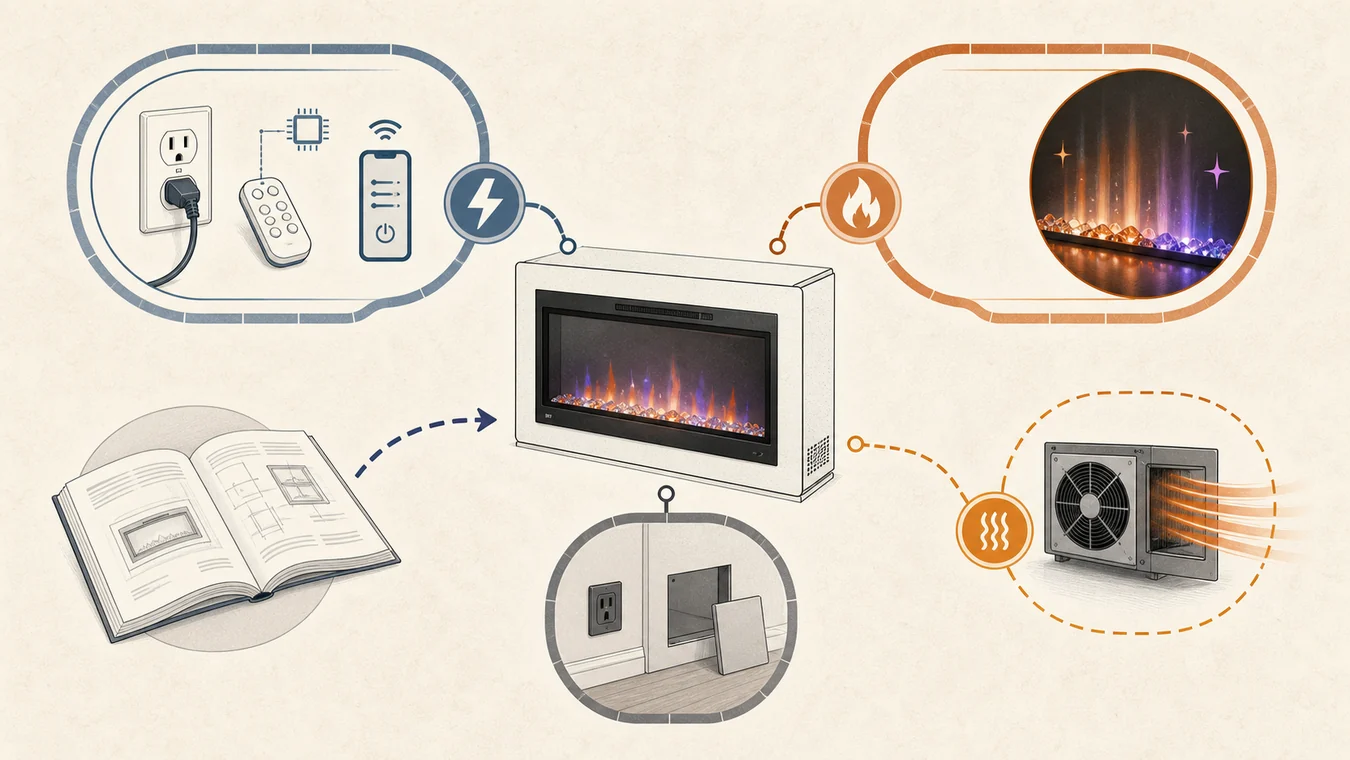
A Real Flame electric fireplace can be three very different things in the cart: an appliance that mounts to or enters a wall, a furniture package built around a firebox, or a replacement firebox meant for selected furniture. Those purchases do not share the same fit questions. Putting them in one shortlist because the flame display looks similar is the fastest way to compare the wrong products.
Choose the physical job first. Then keep the package SKU, firebox identity, dimensions, load rule, electrical path and current manual together. A finish or sale price becomes useful only after that chain describes one real object.
First decide whether the cart contains an appliance, furniture or a component
An appliance purchase supplies the fireplace itself. A current linear insert may mount on a wall, recess into it, or support both paths. Its decision begins with the wall/opening and the permitted power connection.
A furniture purchase supplies a mantel, TV cabinet or stove-like surround with a firebox. Overall depth, top load, storage, rear access and assembly now matter alongside the appliance specification. The firebox may be replaceable, but the package must name the compatible component.
A component purchase supplies the firebox without solving the surrounding structure. It is not a universal insert just because its face appears to fit an opening. The furniture owner, exact component SKU and assigned instructions must agree.
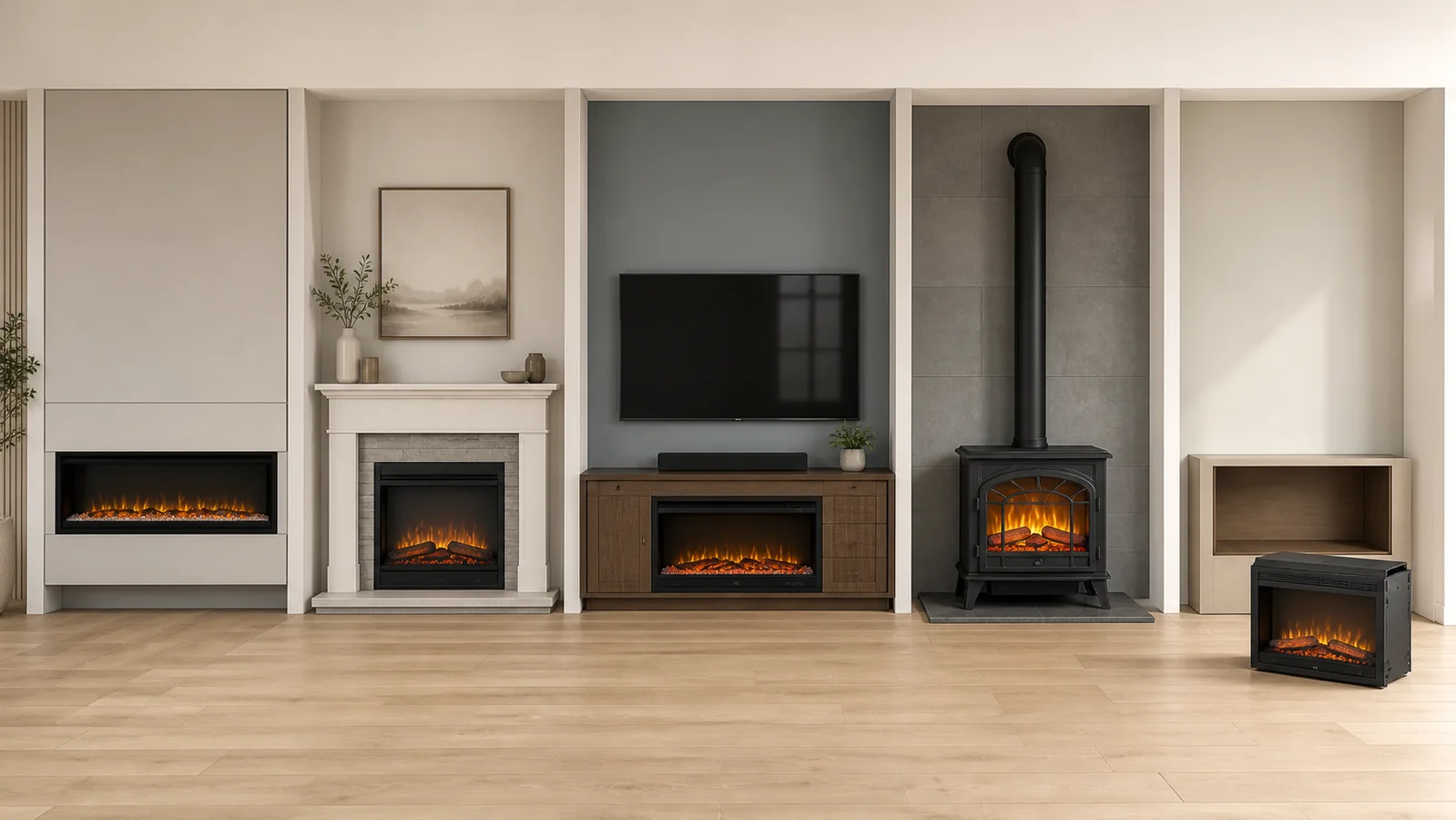
Real Flame’s current indoor, mantel, media-cabinet and wall-mounted collections expose all three purchase objects. The collection names help you browse; they do not perform the compatibility check.
Six room relationships lead to six different checks
| Route | Choose it when | Evidence that must survive | Deeper decision owner |
|---|---|---|---|
| Wall-mount or recessed insert | The appliance belongs on or inside a wall | Exact model, overall and firebox dimensions, wall/recess permission, clearances, plug or hardwire path, manual | Recessed vs wall-mount guide |
| Mantel package | You want a complete furniture fireplace without TV-storage duty | Package SKU, assembled envelope, included firebox, top-surface rule, outlet path, assembly manual | Electric-fireplace type guide |
| TV stand | The furniture must support a television and provide storage | Package SKU, TV size and weight limits, shelf/cable layout, included firebox, anti-tip provisions, manual | TV stand vs built-in guide |
| Freestanding stove-style package | The unit should occupy floor space without becoming a wall build | Footprint, rear/side access, trim-in prohibition, cord/outlet position, included parts, manual | Freestanding guide |
| Replacement firebox | Existing compatible furniture remains and only the appliance component changes | Exact furniture model, approved firebox SKU, opening/interface, power and assigned replacement instructions | Manual identity guide |
| Corner-specific package | The furniture must solve a corner rather than a flat wall | Exact corner model, assembled geometry, firebox, TV/top-load rule and manual | Real Flame corner-model guide |
If the room relationship is still undecided, step back to the types of electric fireplaces guide. If the project is already a wall appliance, the recessed versus wall-mounted guide owns the opening and surface-fit decision.
The routes are not rankings. They prevent a complete cabinet from being compared with an appliance-only insert, or a replacement component from being treated as a finished fireplace.
Current products make the differences concrete
Current first-party pages show why the brand name cannot finish the choice. The examples below are not recommendations; each one demonstrates a different physical commitment.
| Current owner page | Purchase object | Product-specific commitment | Identity to save |
|---|---|---|---|
| 49-inch wall-mount/recessed insert | Appliance | The page permits wall mounting or recessing and plug-in or hardwired use; it lists a 49 × 5.25 × 21.25-inch fireplace and 1,500 W / 12.5 A input | SKU 5555 and its 49-inch manual |
| 42-inch SMART insert | Appliance or assigned furniture component | The page permits wall/recess use and says the firebox can be used with a Real Flame mantel or TV stand; it lists 41.5 × 5.5 × 19.75 inches and 1,500 W / 12.6 A | SKU 5192 plus the exact compatible furniture owner when used as a component |
| Morris standard fireplace TV stand | Furniture package | The page lists a 72 × 18 × 29-inch cabinet, a TV up to 70 inches, a 100-pound top limit and a 39 × 5.75 × 18.25-inch firebox | Package SKU 13058E and Morris manual 13058 |
| Hollis electric fireplace | Stove-style furniture package | The page says it is not intended to be mounted or trimmed in and requires rear access and airflow; the full unit with chimney is listed at 32 × 17 × 65.5 inches | SKU 5005E and Hollis manual 5005 |
| Standard VividFlame firebox | Component | The current page describes it as compatible with selected Real Flame mantels, TV stands and stoves | Firebox SKU 4199 plus the exact selected furniture assignment |
The current 49-inch product owner, 42-inch SMART owner, Morris package owner, Hollis owner and Standard VividFlame firebox owner attach those facts to named products. Do not move a value from one row to another model with a similar face.
The Morris example also shows why “standard” and “SMART” cannot be treated as a cosmetic toggle. The current standard and SMART package pages use different package identities and list different firebox dimensions. Save the exact variant shown in the cart, not just the Morris family name.
A familiar firebox name is not a compatibility certificate
“VividFlame,” “landscape” or “SMART” can describe a family or feature layer. None of those words, alone, certifies a furniture opening. The current Standard VividFlame page narrows its claim to selected Real Flame mantels, TV stands and stoves. The 42-inch SMART page says it can be used with Real Flame furniture, but that still does not name every compatible cabinet.
For a complete package, begin with the furniture product page and record the included firebox. For a replacement, reverse the direction: begin with the exact furniture model, find the manufacturer-assigned replacement component, and require the current instructions to cover both identities. A tape measure can confirm a physical observation; it cannot create manufacturer compatibility.
This boundary matters most when a merchant listing shortens the title. “Real Flame electric fireplace insert” may refer to a wall appliance, the firebox bundled with furniture, or a replacement component. Open the manufacturer owner before assuming which object is for sale.
TV furniture adds a second non-transferable layer. A cabinet’s stated top weight and TV size belong to that cabinet, not to the firebox. Use the TV stand versus built-in guide for that room decision. For a stove-like unit such as Hollis, use the freestanding electric-fireplace guide to preserve floor space and access rather than borrowing wall-installation logic.
Carry one identity chain into the shortlist
Record the chain below for each surviving candidate. A blank is not permission to use a family-level value.
| Link in the chain | Save from the current owner | Reject or hold when |
|---|---|---|
| Purchase object | Appliance, complete furniture package or component | The listing does not say what is included |
| Exact identity | Full product name, package SKU, firebox SKU, market and finish variant | Product page, cart and document use different identities |
| Physical interface | Wall/recess path, furniture assignment, opening or rear-access rule | Fit depends on an inferred opening or blocked access |
| Envelope and load | Assembled dimensions, firebox dimensions, weight, TV/top limit and shelf facts that apply | A dimension or load value came from another package |
| Electrical path | Voltage, amps, watts, plug/hardwire permission and cord/outlet requirements | The intended connection is not permitted by the exact manual |
| Assigned document | Current manual or specification that names the same object | Only a family document or retailer summary is available |
Use the electric-fireplace specifications guide to keep every value beside its unit, configuration and source before comparing candidates. It is the required pillar once the format route closes.
The outcome should be narrow. Use wall/recess route only when the exact appliance and wall path agree. Use mantel, TV stand or freestanding route only when the complete furniture package owns the relevant envelope and load facts. Use replacement-firebox route only when the furniture-to-component assignment is explicit. If the project needs a corner, the current Real Flame corner-model guide takes over. Any identity mismatch remains a format or document hold.
Make the product page and manual describe the same cart
Before comparing finishes, prices or reviews, write one sentence that another person could verify from the same current sources:
The cart contains [appliance / furniture package / component], exact package SKU [ ] and firebox SKU [ ] for [US market/variant]. The current product owner and [manual title/revision] agree on [wall, furniture, floor or replacement relationship], [dimensions and load rule], and [plug/hardwire path]. The next valid comparison is [named route]; [missing field] still holds the purchase if blank.
Use the electric-fireplace manual guide when the listing and document do not obviously match. Do not repair that mismatch with a retailer title or a firebox family name.
Once the sentence is complete, the Real Flame range is no longer one crowded product wall. It is one physical route with an exact object attached. That is the point at which model comparison becomes meaningful.