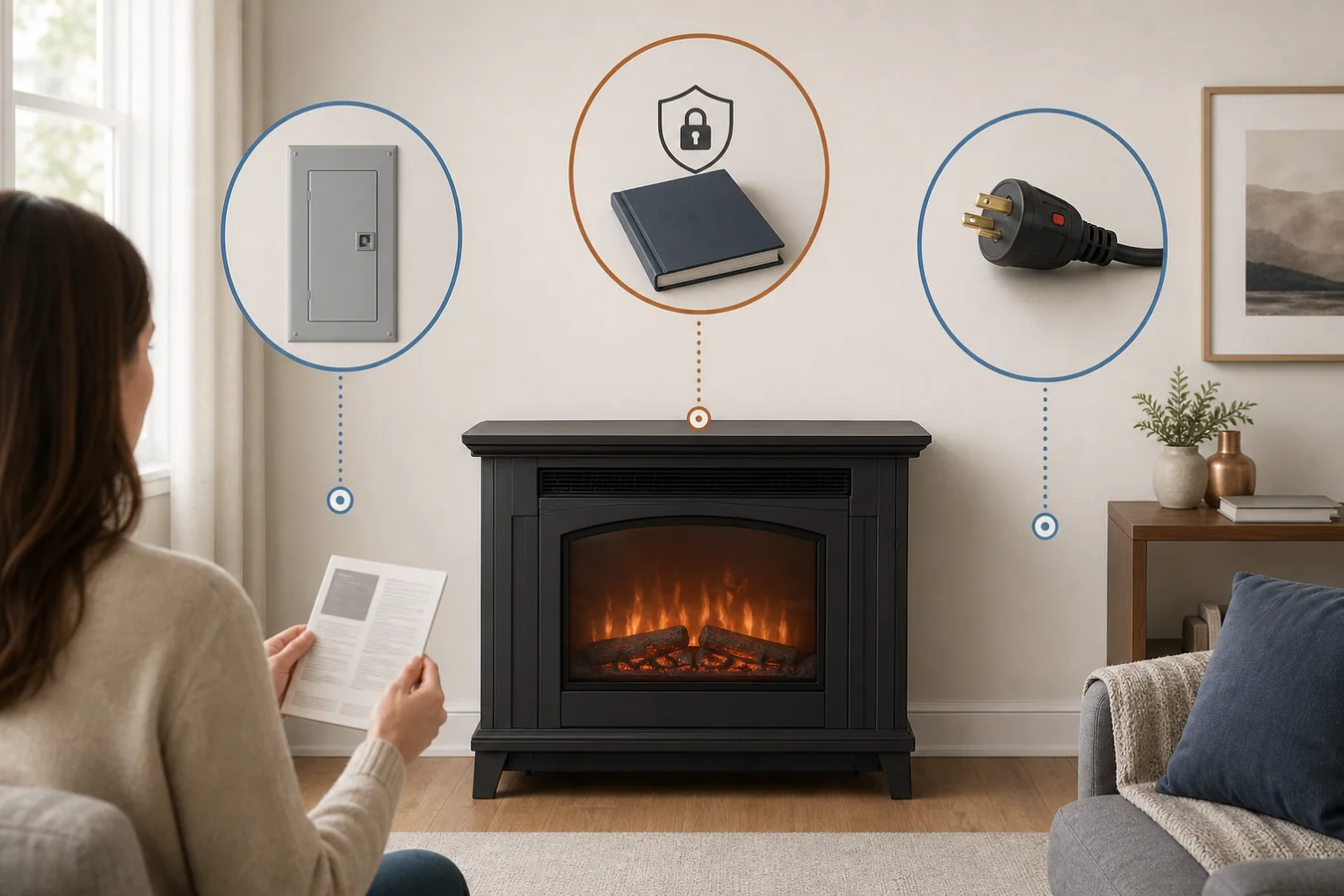
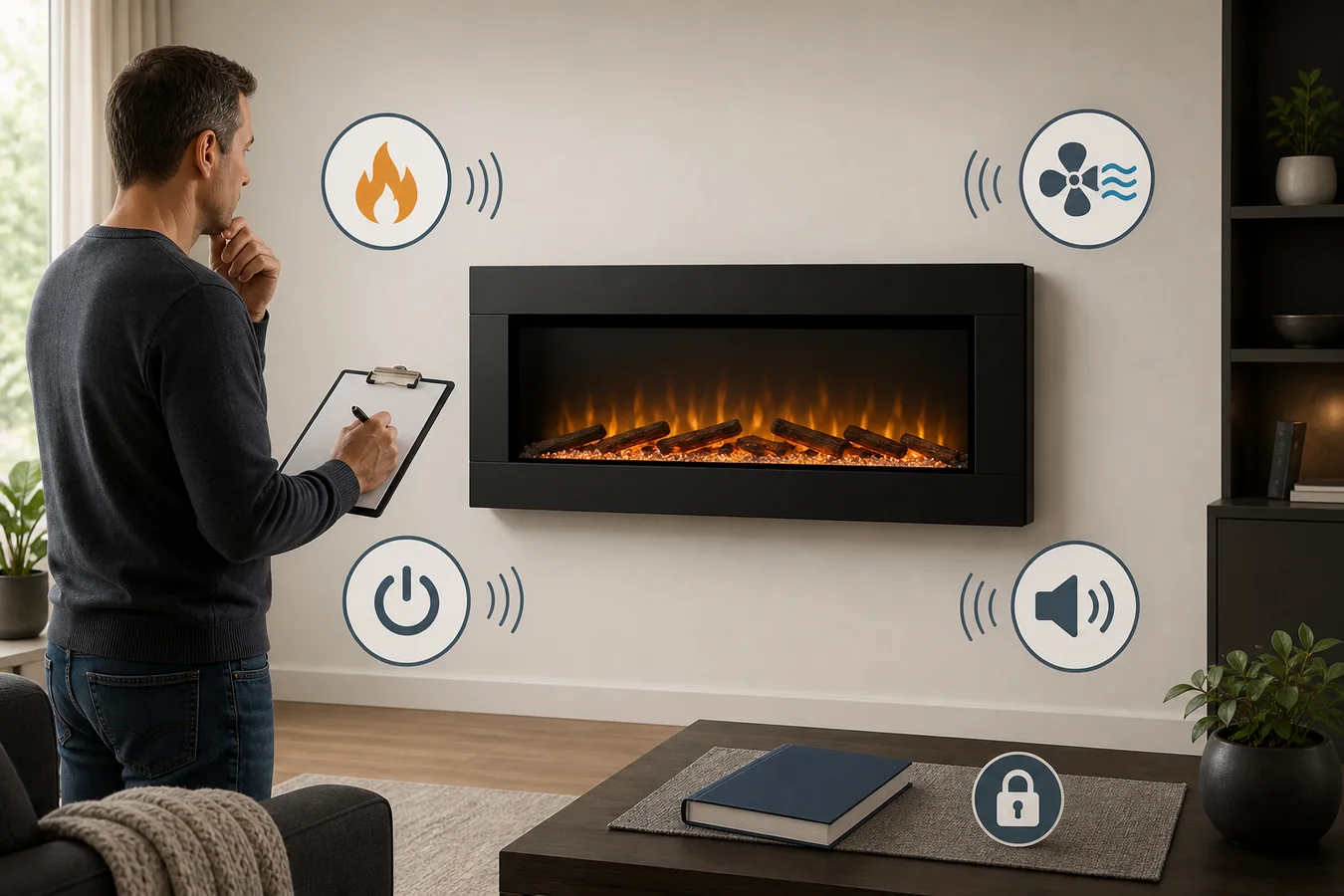
If the attached plug will not reach the wall outlet, do not begin by shopping for a heavier extension cord. Begin with the exact fireplace model and its current official manual. “Heavy duty” describes a cord. It does not give the appliance permission to use one.
The answer can change by model, connection method and manual revision. A plug-in fireplace may still require its factory cord to reach a wall receptacle directly. Another model may have a manufacturer-documented hardwire option. If the document is missing, mismatched or silent, treat permission as unresolved rather than filling the gap with a generic gauge or wattage.
The cord question has six possible outcomes
| What the current record shows | Result | What to do with the location | What not to infer |
|---|---|---|---|
| The exact current manual says wall receptacle only and prohibits an extension or relocatable tap | Direct wall receptacle required | Keep the factory lead within the documented route or change the location/product plan | A heavier or shorter cord creates an exception |
| The exact model has a documented hardwire path | Hardwired path | Put that path into the project and qualified electrical handoff | Any plug-in unit can be converted |
| The current exact-model owner explicitly permits an extension under named conditions | Manufacturer permission required | Preserve the complete wording, model and revision before considering those conditions | The permission transfers to another model |
| The factory lead cannot reach, and no extension permission exists | Relocate or add outlet path | Reconsider fireplace position, choose another documented product path, or have a qualified owner assess a permanent receptacle solution | An adapter or power strip solves the reach problem |
| The plug, outlet or faceplate is loose, damaged or unusually hot, or operation repeatedly trips/stops | Electrical hold | Stop treating reach as the only issue and route the condition to the appropriate manual/electrical owner | A larger cord diagnoses or repairs the cause |
| Model, market, manual or revision does not match | Exact-model manual required | Identify the rating-label model and current owner document | A similar product photo or old PDF controls |
Record both the factory connection and the added device. “Cord: present” is too vague; it can describe the lead supplied with the fireplace or a separate extension on the floor.
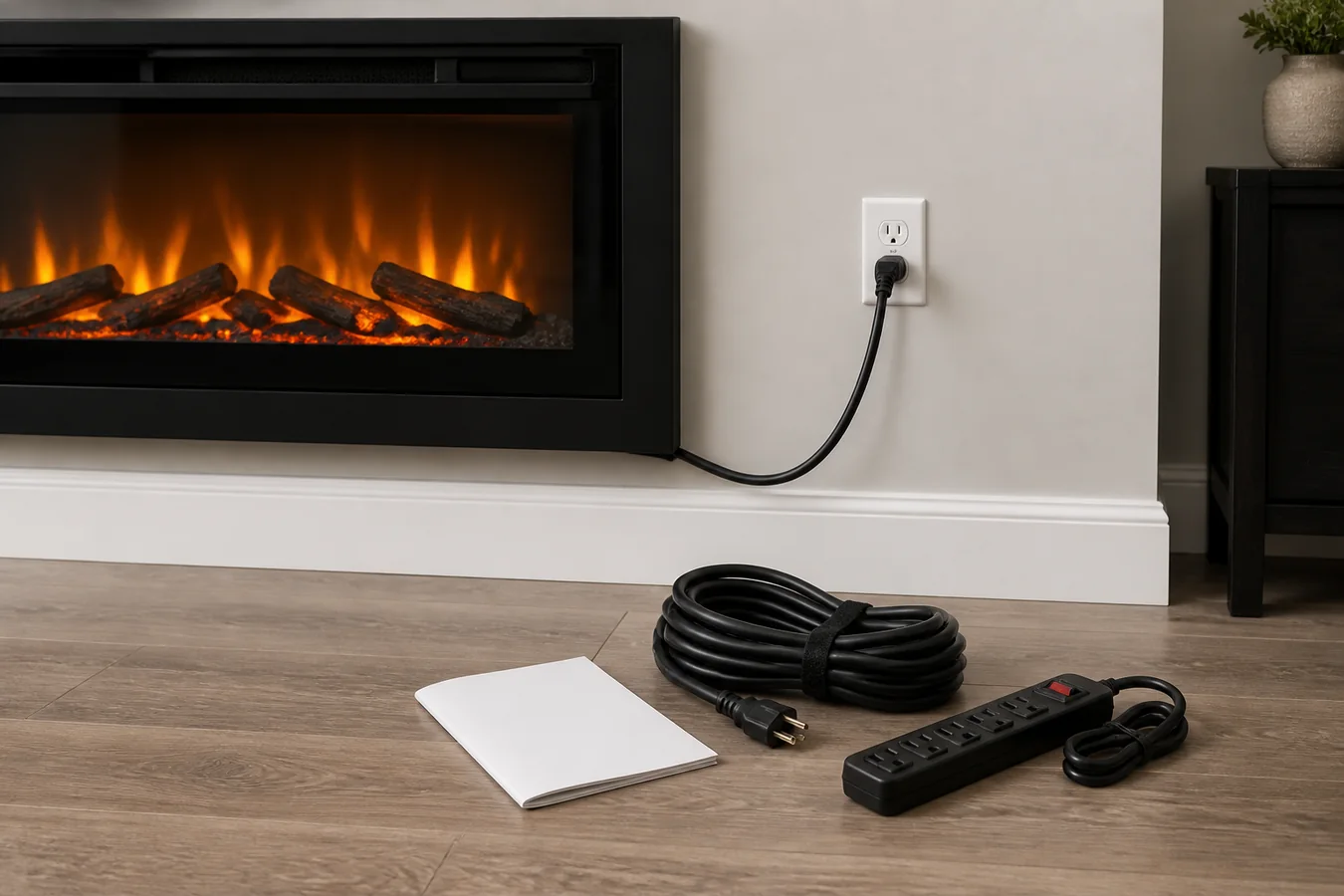
The factory power cord and an extension cord are different objects
A factory cord is part of the product configuration described by the fireplace owner. The manual can specify its plug, receptacle, route, access and whether a hardwire conversion is allowed. An extension cord is a second product and introduces another plug-to-connector junction. The word “plug-in” therefore establishes a connection mode; it does not automatically establish extension compatibility.
Keep those fields separate in the same way the electric-fireplace specifications guide separates voltage, connection mode and heater rating. Copy the exact model number, not the retailer’s shortened family name. Then copy the controlling connection sentence from the current manual. If the product listing says “plug-in” while the manual says “wall receptacle only,” the listing has not granted an extension.
Connection mode belongs to the product decision. The plug-in-versus-hardwired guide explains why some named models are plug-only, some hardwire-only, some document both at one voltage and others change voltage or output by configuration. That page owns configuration selection. Here, the narrower question is whether the already identified path can use an added extension. Do not turn a hardwire option in one model into a conversion plan for another.
The distinction also prevents a common document error. A manual for a near-name model may show a different supplied cord or connection. If the cover, item number, market or revision does not match, use the electric-fireplace manual guide to find the correct owner before applying any cord wording.
“Heavy duty” cannot update an owner’s manual
Current exact manuals show why generic cord recipes are unreliable. Touchstone’s wall-mounted manual, revision 20230118, covers named models 80001, 80002 and 80026. It directs those products to a wall outlet or receptacle and says never to use a surge protector, extension cord or relocatable power tap. It also tells the owner to discontinue use when a matching outlet or faceplate is hot or the plug is loose and to have a qualified electrician inspect or replace the faulty outlet. Those instructions belong to that manual’s models.
The current Dimplex Revillusion owner’s manual supplies another model-bound example: its named family requires an appropriate direct receptacle and prohibits an extension cord. That agreement with Touchstone does not create a category rule. It proves only that two current product owners reached that result for the products they identify.
Revision history makes the point even sharper. At SimpliFire’s document owner, the PDF currently carrying the Format36 rules identifies itself as revision H, 6/26. Its present instruction excludes both an extension cord and a relocatable power strip. That URL once returned revision G, 2/24, whose conditional allowance still echoes through generic web advice. A current Format36 decision belongs to revision H; a gauge or wattage copied from its predecessor cannot act as present permission.
This is why a 14-AWG, 1,875-watt or “shortest possible” recipe cannot be the first answer. Those attributes may describe a cord, but none proves that the current fireplace owner admits the connection. If a matching current manual does contain explicit permission, preserve its entire condition set. Do not extract one rating, ignore the rest or reuse the sentence for a look-alike fireplace.
The broader electric-fireplace safety guide owns room, heater, airflow, water, damage and supervision states. Use it if the question has moved beyond outlet reach. This page does not claim that a manual-matched connection makes every other operating condition acceptable.
If the wall outlet is out of reach, change the project
An out-of-reach outlet is information about the location plan. It is not evidence that an extension cord has become unavoidable. Resolve the physical mismatch before the fireplace is fixed into furniture, a surround or a finished wall.
For a portable or furniture-format product, test whether a different approved placement keeps the factory lead within the manual’s route and preserves required airflow and service access. For a product still on the shortlist, compare an alternative exact model only if its current documents show a connection path that fits the room. Do not compare advertised cord length alone while ignoring receptacle location, service removal and the rest of the installation relationship.
If the exact model documents a hardwire option, move that option into the qualified electrical and installation scope before finishes close. The existence of a hardwire path is not an instruction to alter a cord. It is a manufacturer-owned configuration whose voltage, parts, access and installer language must remain attached to the exact model.
A permanent receptacle solution also belongs to a qualified electrical owner and the applicable site requirements. Give that owner the exact model and current manual plus the intended fireplace location, rather than asking for an outlet based on a product photo. This article does not select the box, circuit, conductor, routing or installation method.
Outlet condition can override all of those planning branches. A loose plug, cracked receptacle, hot faceplate, damaged cord or repeated interruption is not a reason to buy a heavier extension. Preserve the symptom and use the manual’s service route. If the unit keeps shutting off or trips repeatedly, the shutdown guide helps separate a documented setting from an electrical or service hold without guessing the cause.
Keep the sentence that controls the connection
Before ordering the fireplace or closing the wall, keep one line that another person can verify:
Exact model and market — current manual title/revision — factory connection — extension/power-tap wording — physical outlet disposition.
A complete record might say: “Touchstone 80001, US; Wall Mounted Electric Fireplace manual, revision 20230118; supplied three-prong plug; wall receptacle only and no extension/surge protector/relocatable tap; approved outlet is within the planned factory-cord route.” That is not permission for a different Touchstone item.
For Format36, the line must name revision H 6/26 and preserve the current no-extension wording. An old screenshot that omits the cover and revision is not an acceptable substitute. For a model with a documented hardwire option, the record should name that path and its responsible installer rather than simply saying “no cord.”
If you cannot fill the exact model, current document or controlling sentence, the result is exact-model manual required. If the sentence prohibits an extension and the factory lead does not reach, the result is relocate, permanent outlet planning, documented hardwire path or a different product—not “buy the heaviest cord.” The outcome stays useful because it resolves the project decision without pretending an accessory rating can rewrite the appliance owner.