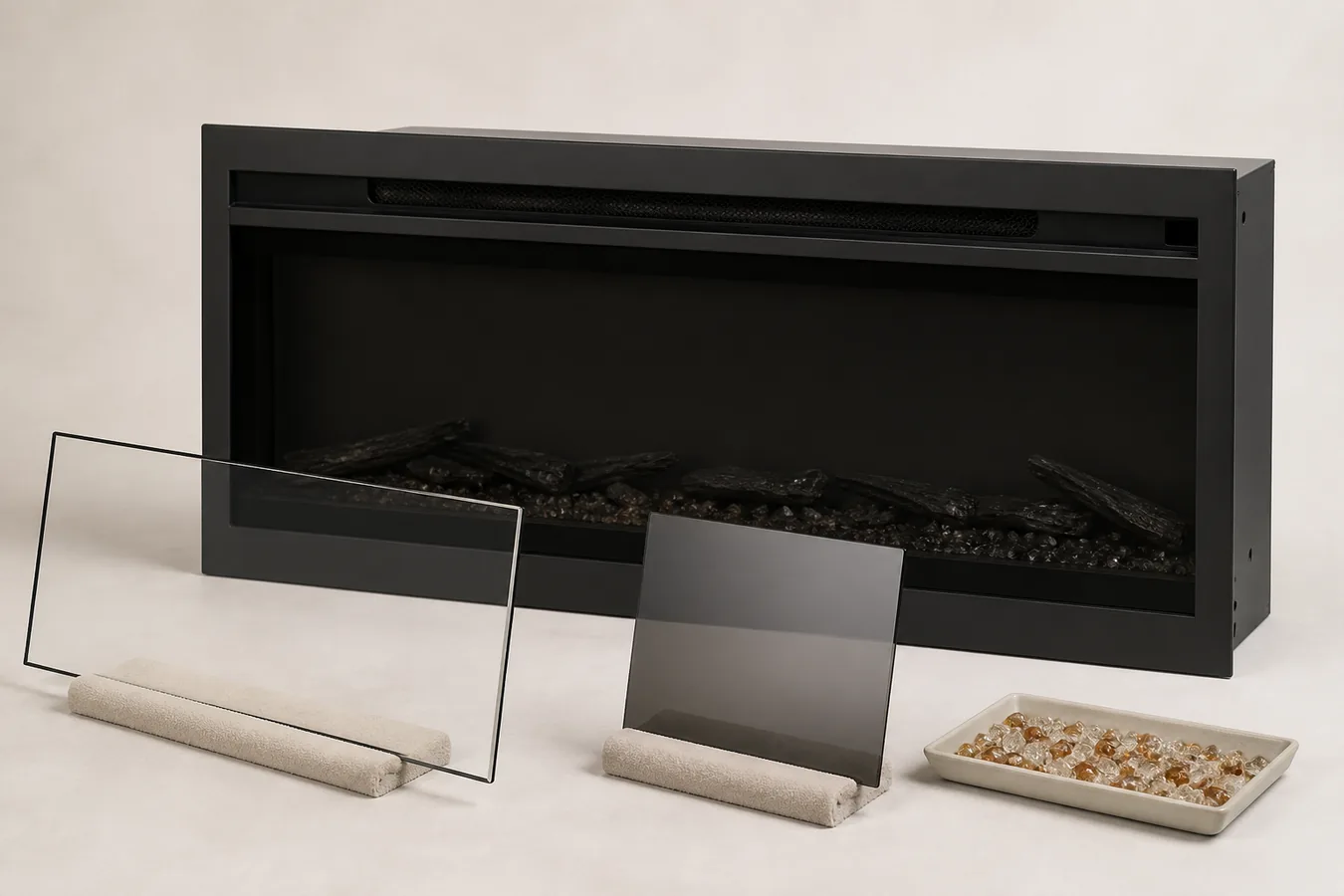
Glass is not a part number. On an electric fireplace, the word may describe a removable outer viewing panel, a back panel, an internal partially reflective sheet, a narrow tray component or the loose decorative crystals in the media bed. A furniture console can add another glass object that belongs to the cabinet rather than the firebox.
Those objects are not interchangeable just because they sit in front of the same flame effect. They can use different dimensions, thicknesses, edges, mounting hardware and replacement channels. A photograph or the advertised fireplace width cannot safely fill those fields.
Before measuring or removing anything, copy the full model identifier and find its current manufacturer document. Then name the glass by its job and position. The useful outcome is not “a piece of glass about this size.” It is “the front viewing panel for this exact model, under this document, with this owner-approved replacement route.”
If the panel is cracked, loose or displaced, do not use this guide to decide whether the fireplace can keep operating. Leave it off and ask the manufacturer or a qualified service provider to assess the exact unit.
Name the glass before measuring it
Begin with the appliance label and the current manufacturer resource owner. Keep brand, complete model or item number, series, market and document revision together. The electric-fireplace specifications guide explains why a nominal width is not a substitute for an exact product identity. The electric-fireplace manual guide can help recover the document before any glass claim is copied.
Now describe what you can observe without disassembly. Is the object the room-facing panel? Is there another sheet behind the media bed that participates in the flame image? Is it a narrow glass tray, or is it loose decorative material? Does it belong to the surrounding TV stand or cabinet rather than the fireplace chassis?
Loose crystals, stones and similar pieces are decorative media. They follow the model-specific compatibility route in the crystals-for-an-electric-fireplace guide, not a panel-replacement route. Dirt, film or a haze with no damage belongs first in the electric-fireplace cleaning boundary. A cleaning question and a replacement question should not silently become each other.
Five owner records, five different scopes
Current manufacturer documents disagree in useful ways. They show why a generic removal sequence or cut-to-size recommendation cannot lead this decision.
| Owner scope | What “glass” means there | What the owner record can close | What stays inside that scope |
|---|---|---|---|
| Amantii Symmetry replacement dimensions | Separate front, back and tray glass records | Published dimensions and thicknesses plus a local custom-cut route | Exact series, nominal-size row and glass position |
| Dimplex BLF3451 service manual | Front-glass assembly and internal partially reflective glass | Distinct service identities and a qualified-service boundary | BLF3451 and the named service manual |
| Dimplex DF3015 / DFB8842 service manual | Front glass and partially reflective glass | Separate replacement objects inside one model-family document | Named models and revision 7400220000R05 |
| Touchstone items 80001, 80002 and 80026 | A hooked front glass panel, separate from decorative crystals | Current owner-manual panel identity and two-person handling recommendation | Those item numbers and revision 20230118 |
| MAD Motion support | Motion-family front glass with its own brackets and fasteners | Current exact-family support route; larger configurations may require multiple people | Motion electric fireplaces only |
Amantii’s parts-and-repair index is especially revealing: replacement-glass records are separated by series rather than pooled into one universal chart. Dimplex’s product-resource owner likewise asks for a model number, product name or series. Touchstone routes item numbers to specific manuals. The source route itself is telling you that “electric fireplace glass” is too broad to order.
The handling differences are evidence of scope, not instructions to combine. A panel that hooks onto one product, a panel retained by brackets on another and an internal reflective sheet inside a service manual do not create an average removal method.
Build a glass identity record
Make one record for one suspected glass object. If a line is unknown, write UNKNOWN; do not turn a blank into an assumption.
| Record line | What to capture | What it decides |
|---|---|---|
| Appliance identity | Brand, full model/item number, series and market | Which manufacturer owner can answer |
| Requested object | Front/viewing, back, internal reflective, tray, decorative media or furniture glass | Whether this is even a panel replacement |
| Position and view | Room-facing side, rear side, internal flame-image plane or media-bed location | Which same-product glass record is relevant |
| Controlling document | Owner manual, service manual, parts page or dimension sheet, including revision/date | Whether the source may control the claim |
| Published dimensions | Length, height or width, units and exact row label | Whether a candidate matches the owner’s panel record |
| Thickness and geometry | Thickness, corner radius, edge treatment or shape only when published | What a length-by-height match still fails to prove |
| Mounting identity | Frame, hooks, brackets, clips, fasteners or assembly name described by the owner | Whether the document describes the panel in front of you |
| Replacement authority | Manufacturer part, manufacturer-published local-cut route or support confirmation | Who is allowed to release the order |
| Handling / service disposition | Owner-manual handling, qualified service, manufacturer contact or no action | Who should do the next physical work |
Add two photographs to a support request when useful: the appliance label and the complete panel in context. A close-up of the damaged corner can supplement them. The photographs document identity and condition; they do not replace a missing dimension, thickness or owner statement.
The viewing-topology guide can help describe the position on a two-sided or multi-view unit, but it does not supply a part number. If the visible problem is really a degraded flame image behind intact glass, keep the replacement order on hold while the exact-model flame system is identified.
One nominal width can contain three glass records
Amantii’s current Symmetry dimension sheet provides a compact proof. On its 50-inch row, the front glass is listed as 1240 × 308 × 6 mm. The back glass is 1247 × 295 × 5 mm. The tray glass is 1264 × 48 × 5 mm. All three belong to the same named series and nominal width, yet none is the same record.
The document also says that, because of the fragile nature of glass, replacement should be custom cut at a local glass shop and is not available directly from Amantii or Sierra Flame. That is a real local-cut route—but only for the series and specifications the manufacturer publishes. It is not permission to copy those dimensions, materials or sourcing instructions onto another fireplace.
Keep units exactly as published. Do not round millimeters into a seller’s nominal inch label, and do not infer tempering, glass type, edge finish or corner geometry from a length/height/thickness row. Ask the document owner to close any field the cutting source requires but the sheet does not state.
Let the owner choose the route
A documented manufacturer part is the cleanest outcome when the parts owner joins the exact model and glass identity. Preserve the part number, applicability and current availability answer together. A similar-looking marketplace panel is not a substitute for that join.
A manufacturer-published local-cut route is also valid when the exact document supplies the necessary specification and explicitly assigns that route. Send the glass shop the original document, not a retyped dimension alone, and ask the manufacturer about any missing material, edge, radius or treatment field before the order is released.
An owner-manual panel may have a documented handling path, but that does not automatically make it a replacement specification. Touchstone’s named wall-mounted manual identifies how its front panel is retained and recommends two people; it does not turn that panel into a universal template. MAD’s Motion support publishes a different attachment pattern. Each procedure stays with its owner.
Internal or partially reflective glass is a strong service-document signal. Dimplex’s BLF3451 and DF3015/DFB8842 service manuals distinguish it from the front panel and place the work inside service documentation. Use that distinction to name the object when contacting support, not to create a cross-model repair tutorial.
If the object is decorative media, return to the media-compatibility decision. If it is part of a mantel, TV stand or cabinet, use the furniture model and its parts owner. If the exact model, glass role, dimension set, mounting identity or replacement authority is still missing, the correct disposition is ORDER HOLD.
The final support request can be one precise sentence: “I need the [glass role] for [brand and complete model], identified in [document and revision]; the published dimensions/thickness are [fields or UNKNOWN], the mounting identity is [field], and I need confirmation of the [part / local-cut / service] route.” That gives the manufacturer something concrete to correct.
Do not let a seller photo close the remaining blank. A sound purchase decision preserves the exact panel identity all the way from the fireplace label to the source that owns its replacement.