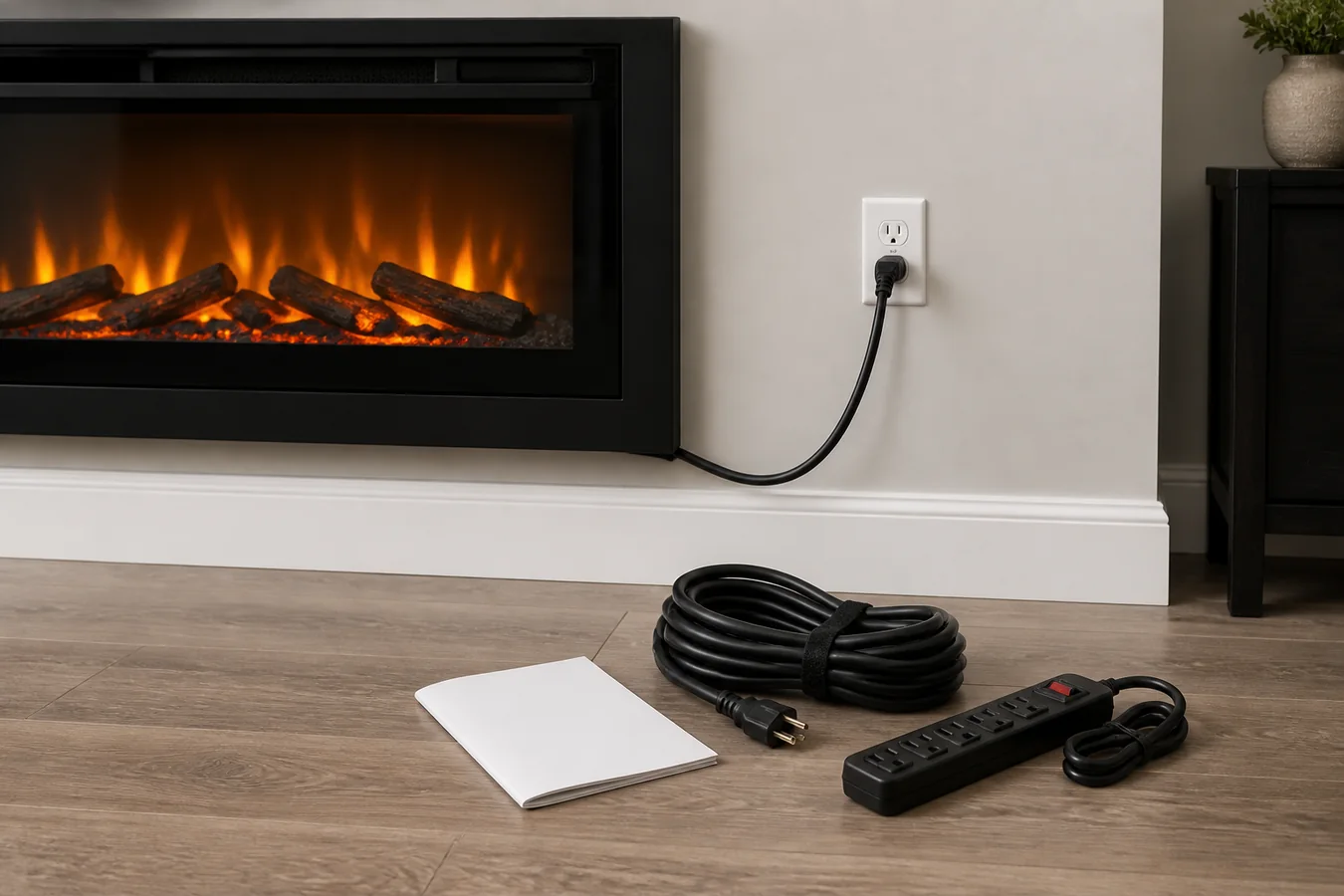
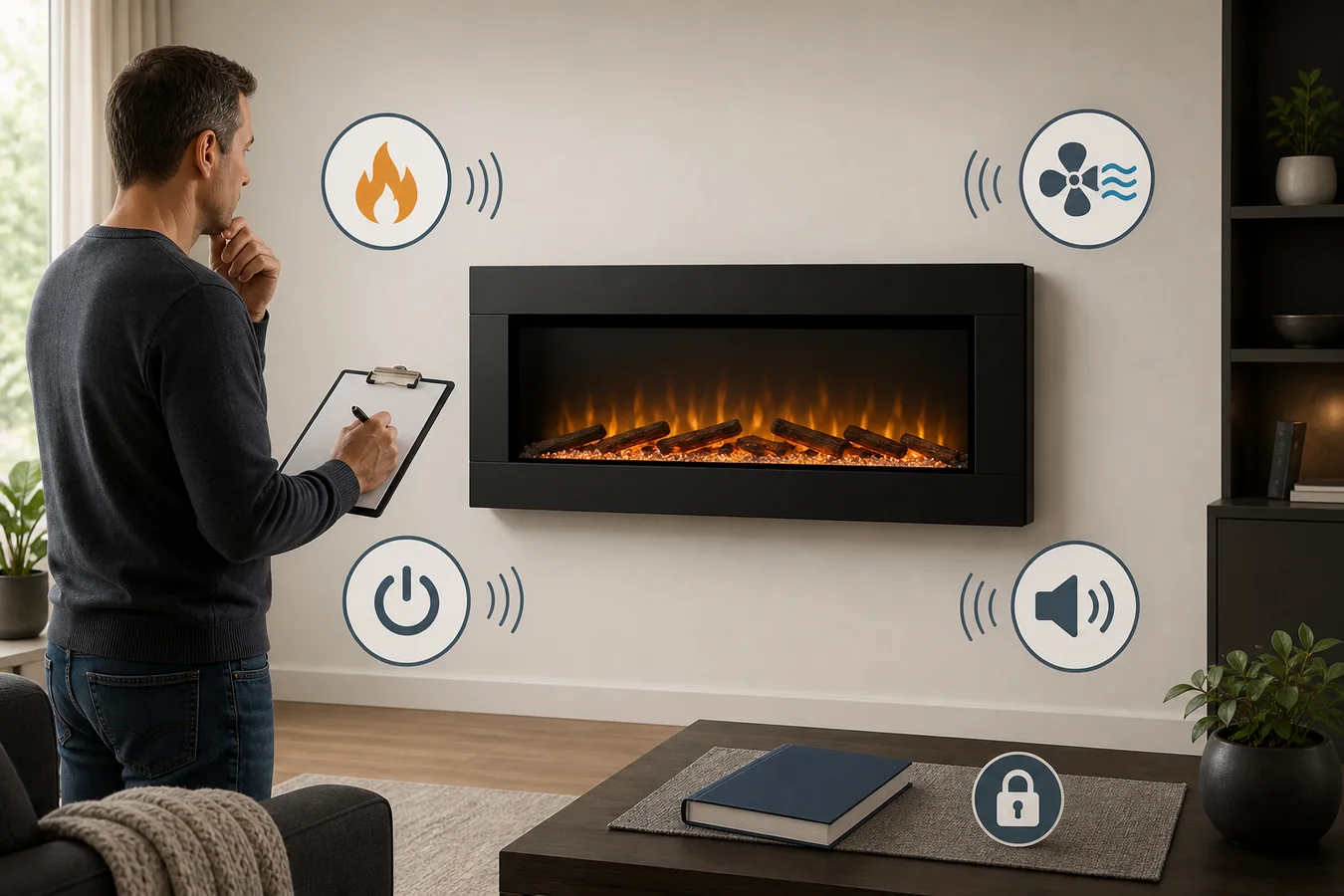
The word “fuse” can point to the home’s electrical panel, to a fused plug or supply lead used in a particular market, or to a component that appears only in service documentation. Until the exact model and document identify which boundary applies, there is no reliable fuse location—and no defensible replacement value.
Start with the rating label, country of sale, plug-in or hardwired connection, and current owner manual. Keep the fireplace closed. A dark display or a blown household fuse tells you that power was interrupted; it does not prove that an internal fireplace fuse failed.
The word “fuse” can belong to three electrical boundaries
Use the controlling document to admit one route. Similar-looking fireplaces and near-match manuals cannot complete the row.
| What the exact record shows | Fuse scope | Who owns the next action | What the record does not prove |
|---|---|---|---|
| The owner or service document says to check the household fuse or breaker panel | House branch circuit | The person authorized to check the household panel; electrician or landlord when the circuit, panel or repeated trip needs qualified attention | That there is a user-replaceable fuse inside the fireplace |
| The exact owner manual specifies a fused plug or supply lead for that model and market | Plug or supply lead | Only the owner action and fuse standard/value stated by that manual; manufacturer support if the lead or identity differs | That another market, plug or fireplace uses the same fuse |
| An exact service manual names an in-line fuse, fused harness or other internal fuse | Internal service part | Manufacturer or the qualified service route named for that model | That finding the part grants owner access or confirms compatibility |
| The document names a thermal protector, cutout or another device but does not call it a fuse | Named device, not admitted as a fuse | Follow the exact owner or service document for that named device | That familiar internet terminology can rename it |
| The fireplace is dark, a household fuse has blown or a breaker has tripped, but no matched document identifies the boundary | Whole-unit or supply event | Exact-manual review, then manufacturer and the appropriate household electrical owner | Which protective device operated or why |
| The model, market, connection or current document is missing | Scope unresolved | Match the appliance identity and current official document before going further | Any location, access method, fuse type or value |
The result can legitimately be “no owner fuse evidence.” That is not a failed search. It prevents a house-circuit symptom from becoming an unsupported instruction to remove a fireplace panel.
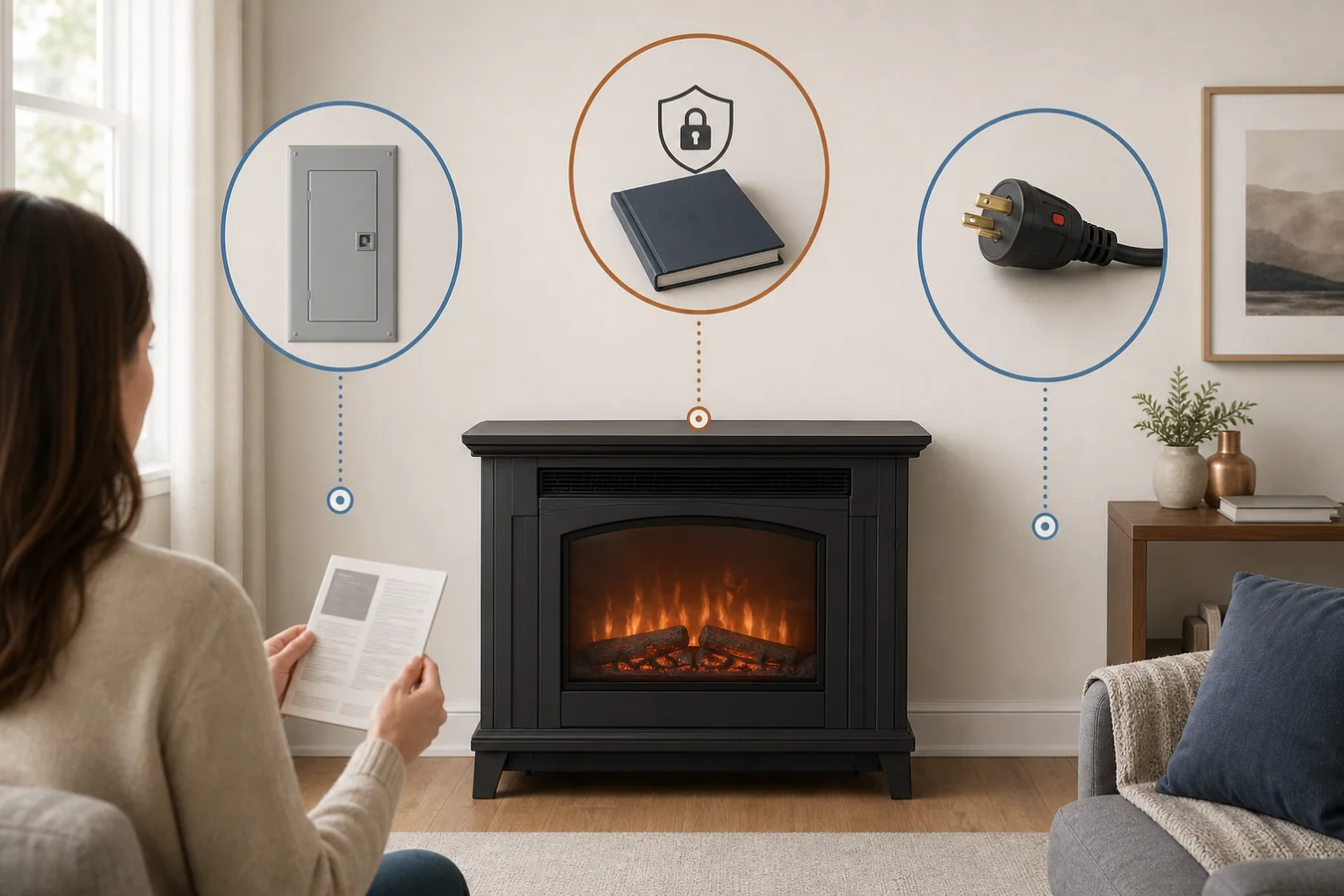
A dark fireplace does not identify the protective device
When the flame, display and controls all go dark, preserve the whole-unit event. Note whether the fireplace is plug-connected or hardwired, whether the household circuit also changed, what was running at the time and whether the event has repeated. If only the heater stopped while the display remained available, that is a different event; the separate guide to an electric fireplace that keeps shutting off owns that classification.
Dimplex’s current Ignite Bold service manual includes a troubleshooting condition in which the circuit breaker trips or a fuse blows when a covered unit is turned on. The useful fact is the scope of the event: power protection operated. It is not proof, by itself, that an internal in-line fuse has failed.
A repeated trip or blown fuse is not a request for a larger fuse or another reset. Leave the unit out of use and give the exact event to the manufacturer and the responsible electrical authority. Smoke, a burning odor, water exposure, visible cord or plug damage, or a hot/discolored connection moves the case to the stop conditions in the electric-fireplace safety guide.
A fused plug is a market-and-manual fact
Some searches use “fireplace fuse” for protection in the supply plug rather than inside the appliance. That branch is real only when the exact owner document names it.
The EF10219 owner manual, for example, specifies a BS 1363 plug and a BS 1362 fuse for the supply lead it covers. Those standard numbers are the boundary: they belong to that documented plug arrangement. They do not establish a fuse location or replacement value for a North American three-prong plug, a hardwired fireplace or another model from the same seller.
If your plug and market do not match the manual, stop at identity mismatch. Do not translate the fuse value into a nearby-looking plug. The plug-in versus hardwired fireplace guide explains how the permitted connection path changes the project and electrical owner; it does not create a fused-plug option that the current manual omits.
An internal fuse in a service manual is still a service path
An internal fuse can exist without being an owner-service item. The exact Dimplex GBF1000-PRO service manual identifies an in-line fuse within a fused wire harness. That proves a service component for GBF1000-PRO. It does not establish the same harness in another fireplace, disclose a universal location or authorize a homeowner to open the case.
The BLF3451 service manual makes the separation especially clear: a house fuse/breaker-panel check is distinct from the document’s internal service work. Two references to “fuse” can therefore belong to different owners even inside one manufacturer’s support library.
Document role matters as much as model identity. An owner manual controls normal user actions. A service manual can help manufacturer support name an assembly or route a technician, but its existence is not permission to borrow a panel-removal sequence, meter test or replacement part. If a search result provides only a service PDF, use the electric-fireplace manual guide to match the full model, market, document type and current official owner before relying on it.
Write an electrical address before a fuse size
Write one line before contacting anyone:
HOUSE, SUPPLY, SERVICE or UNRESOLVED — brand and full model/SKU — country of sale — plug-in or hardwired — exact observed event — household fuse/breaker state if externally known — exact word used in the current document — owner or service document title and revision — whether that document grants an owner action — whether the event repeated.
The electric-fireplace specifications guide helps preserve the rating-label fields without turning a near-match into evidence. Mark HOUSE only when the record points to the household panel, then use the qualified electrical owner or landlord required for that circuit. Mark SUPPLY only when the matched owner manual names the plug or lead. Mark SERVICE when the fuse exists only in service material. Use UNRESOLVED when the records do not yet agree, and send the entire identity/document record to the manufacturer.
Do not write a fuse size beside UNRESOLVED. The address changes only when a current document for the exact model and market supplies the missing relationship; until then, the fireplace stays closed and location, access and replacement remain undecided.