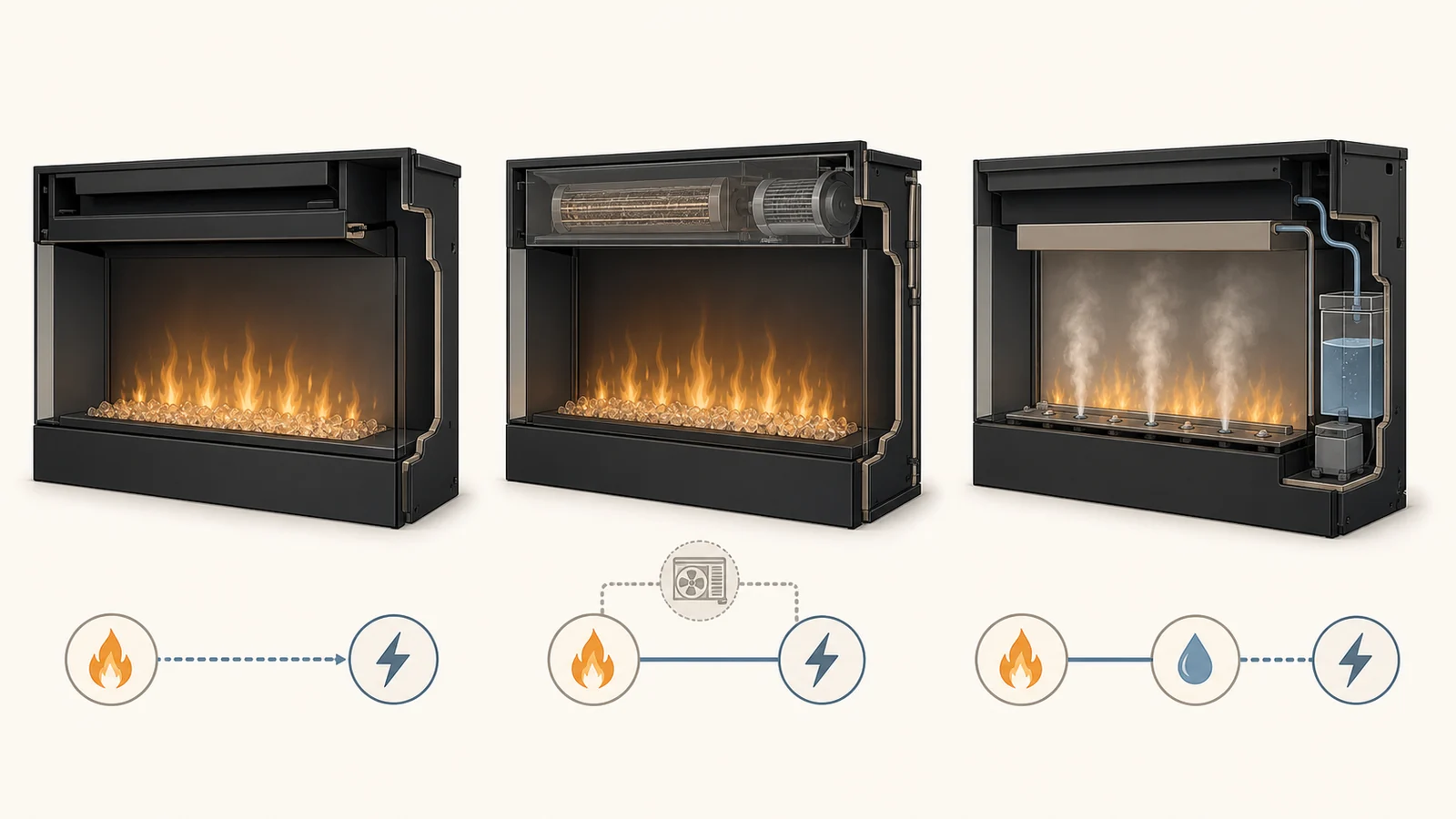
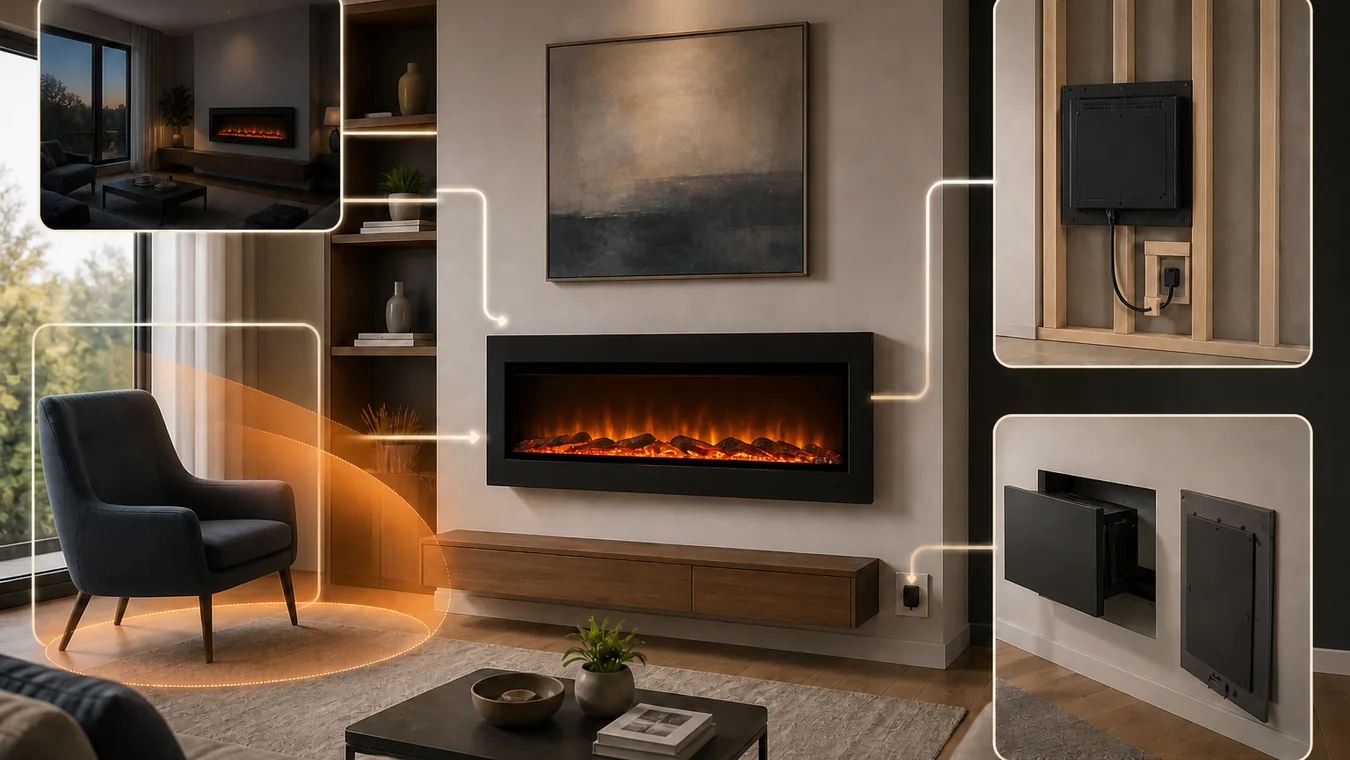
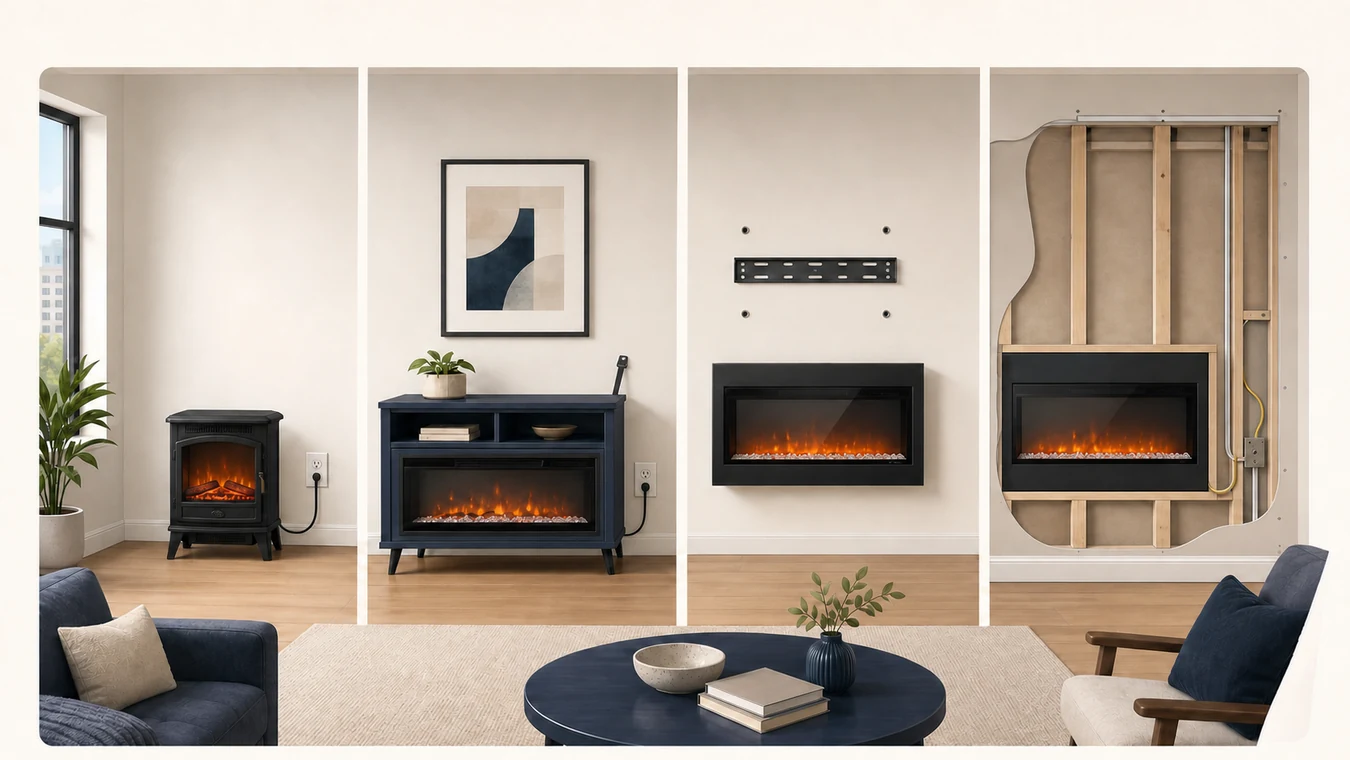
A traditional electric fireplace can be a firebox framed into a wall, an insert fitted to an old hearth, a complete mantel that sits like furniture, a stove on legs, or a log set placed inside an open masonry fireplace. The finished pictures may share logs, brick, dark metal and portrait proportions. Underneath, they ask five different things from the room.
Keep the appearance brief, but choose the physical format before comparing brands. Start with the support the room can provide: an existing opening, a new framed cavity, a furniture footprint, a floor location, or an open hearth. Then make one exact model prove its dimensions, installation mode, power entry, heat and air path, controls and service access. A product is not eligible merely because its listing says “traditional.”
This order prevents the expensive version of a style mismatch: finding a convincing flame and surround, then discovering that the object requires a wall, footprint, opening or service route the room was never meant to provide.
Traditional describes the finished scene, not the support underneath
“Traditional” is useful as a visual brief. It may mean a taller firebox rather than a wide ribbon, a log-and-ember presentation, a dark inner frame, brick-like interior panels, a mantel, or proportions that resemble a masonry hearth. It is not a standardized installation class.
Current owner pages expose the difference. Modern Flames lists built-in clean-face, self-trimming and retrofit-replacement options for its current Orion V2 Traditional family. Regency says its current electric-insert lineup can be placed in an existing fireplace or built into a wall. The visual category survives across both paths; the room contract does not.
If the basic product families are still unfamiliar, use the types of electric fireplaces page first. It separates appliance family, installation relationship and presentation. This page begins one step later, when “traditional” is already part of the brief and the missing decision is what object will deliver it.
Five formats make five different promises to the room
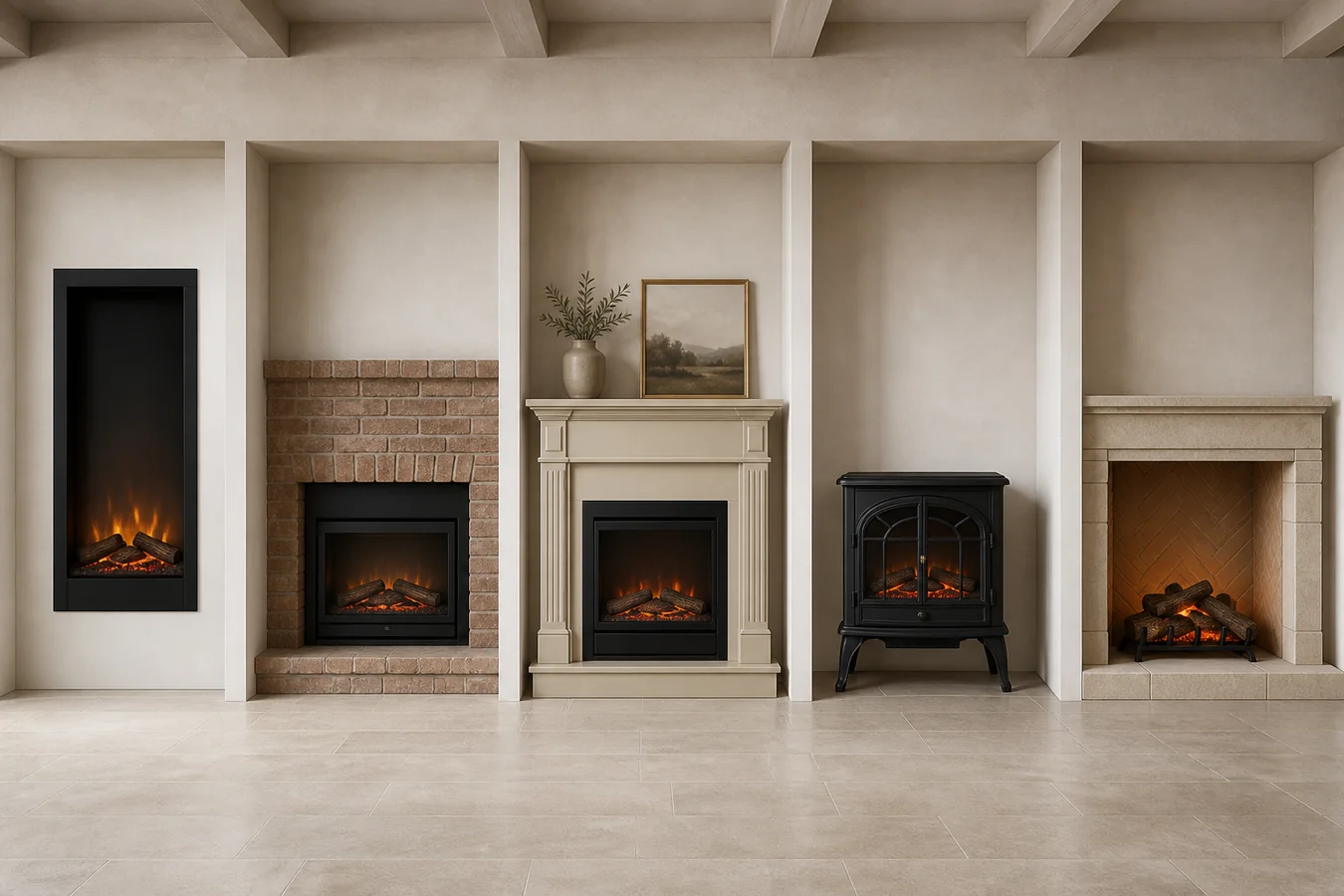
| Format branch | What supports it | What the room gives up | First evidence to obtain | Do not compare it as |
|---|---|---|---|---|
| Retrofit insert | An eligible existing fireplace opening | Opening volume, visible coverage, a power path and future removal access | Exact model plus current opening, faceplate/surround and service documents | A generic built-in based on nominal width |
| Built-in firebox | A new wall, cabinet or enclosure designed around the model | Framing depth, finish boundary, electrical route and a way to service or remove the appliance | Exact current manual and labeled rough-opening/finish details | A drop-in insert merely because the front looks traditional |
| Complete mantel package | The floor, wall restraint and furniture envelope | Full assembled width, height and depth; delivery and assembly route; permitted top use | Exact package SKU, assembled dimensions, included firebox and restraint instructions | The small firebox dimension shown inside the furniture |
| Freestanding stove | Its own feet and the floor | Floor area, outlet reach, air path and model-specific placement space | Exact model manual, footprint, weight, power and air requirements | A portable heater that can go anywhere |
| Electric log set | An eligible open masonry/fireplace setting | Hearth/opening area, backdrop relationship, outlet route and the look of the old firebox | Proof that the listing is a complete appliance plus its exact placement instructions | Replacement logs or an enclosed electric insert |
Choose the row before making a model shortlist. If one candidate is a mantel package and another is a retrofit insert, the comparison is still about room strategy, not which fireplace is better. Their dimensions, support, finish and reversibility do not answer the same question.
An insert and a built-in can share a product family
The word “insert” does not guarantee that an appliance is approved for every existing fireplace, and “built-in” does not always name a separate product family. The current Modern Flames Orion V2 Traditional owner page places three installation options under one family. Regency likewise distinguishes placing its electric inserts in an existing opening from building them into a wall. Those pages establish that both branches exist; only the exact current model document can authorize one branch for a project.
For a retrofit, the old opening remains a controlling object. Record front and rear width where relevant, height, depth and any taper or irregularity using the owner’s labels. Then join the exact appliance to the exact approved faceplate, backing plate or surround that must cover the visible opening. The electric fireplace insert size guide explains why appliance dimensions, opening requirements and trim coverage cannot be collapsed into one nominal size.
A new built-in reverses the dependency. The exact firebox is chosen first, then the wall or cabinet is reviewed around its labeled prepared opening, finish edge, electrical connection, heater outlet, controls and service route. The fact that another installation option exists for the same family does not let a contractor combine both sets of dimensions. Carry the surviving model and document into the electric fireplace framing handoff only after the format is fixed.
This is also where “self-trimming” needs discipline. It can describe how a particular model meets a finished edge. It does not prove that the body fits an old firebox, that a curve is covered, or that the appliance can be trapped behind permanent finish. Those facts stay with the exact manual and accessory record.
Mantel, stove and log-set paths do not belong in one shortlist
None of these three paths normally begins with a new framed wall, but that does not make them interchangeable or equally portable.
A mantel package is furniture first
Napoleon’s current electric-mantel owner describes packages that include an electric fireplace inside a mantel or entertainment-furniture envelope. The firebox is only one component. The assembled package controls how much wall and floor the room surrenders, how it reaches the room, what supports or restrains it, what may sit on top and whether the inner appliance can later be removed.
That makes the entire package SKU the comparison object. A listing that leads with the firebox inches can hide a much larger cabinet. The electric fireplace with a mantel page carries the package into assembled-size, top-use, anchoring, delivery and replaceability checks.
A stove preserves the wall and consumes floor space
Dimplex’s current US electric-stove owner defines the format as a freestanding floor product styled after a cast-iron wood stove rather than a wall-built firebox. That is the real advantage of the branch: the room does not need a framed cavity or a full mantel package.
It is still an appliance, not a decoration that can be placed anywhere. Outlet suitability, intake and discharge space, model clearances, cord route, weight and moving instructions remain exact-model facts. Use the freestanding electric fireplace comparison when the open question is stove versus mantel furniture or media console, rather than borrowing a stove’s compact appearance for the entire freestanding category.
A log set keeps the old firebox visible
Napoleon’s current Woodland owner presents its electric log set as a path for an existing masonry or fireplace opening. That is materially different from filling the opening with an enclosed insert: much more of the original firebox remains part of the finished scene.
The exact listing still has to prove that it is a complete electric appliance, not a box of replacement media. Its dimensions, placement conditions, reflection or backdrop requirements, power route and heat mode stay with that model. The electric fireplace logs page separates complete log-set appliances from enclosed inserts and accessory logs.
Make the style brief specific enough to verify
Once the format is selected, replace “looks traditional” with observations that can be checked on the exact candidate. This keeps the style goal without pretending it is objective or universal.
| Style field | Write down the actual preference | Evidence that can close it | What it must not replace |
|---|---|---|---|
| Overall proportion | Portrait, square-ish or another bounded shape; acceptable visible width and height | Exact viewing and overall dimensions, plus straight-on product imagery | Opening or rough-framing dimensions |
| Fire presentation | Deep log fire, open log set, gas-style box or another named target | Exact included media and current owner imagery/video for that model | A category-wide realism claim |
| Inner scene | Brick-like panels, dark liner, glowing ember bed or an unobstructed old firebox | Exact included panels/media and flame-off view | Product format or installation approval |
| Outer frame | Self-trim, matched faceplate, furniture mantel or site-built finish | Exact SKU and accessory/finish document | An approximate style photo |
| Viewing conditions | Main-seat angle, daylight state and flame-off appearance that matter in the room | The exact unit shown from those conditions | A single polished front-facing clip |
| Market and generation | US model, full suffix, current generation and applicable document | Manufacturer owner and current manual | A Victorian/classic result from another country |
If the remaining question is which flame presentation stays convincing from the real seats and lighting, move that comparison to the realistic electric fireplace page. This format page should not turn a photo preference into an unsupported product winner.
“Victorian” deserves particular care. Search results can cross US and UK product vocabularies, dimensions, electrical systems and availability. Treat it as a style cue until a current US product identity and applicable document are proven. A foreign-market page may clarify what the word looks like; it cannot approve a US model or installation.
Compare exact models only after the format survives
Give every serious candidate the same short commitment card:
| Card line | What belongs on it | Why it changes the decision |
|---|---|---|
| Physical format | Retrofit insert, built-in firebox, complete mantel package, freestanding stove or complete log set | Makes every candidate answer the same room question |
| Identity | Brand, family, full model/SKU, market and applicable document date/revision | Prevents similar names from donating facts |
| Room interface | Existing opening, prepared wall, assembled furniture envelope, floor footprint or open hearth | Identifies what must already exist or be changed |
| Dimensions and finish | Owner-labeled body/opening/rough-opening/assembled fields plus faceplate or finish boundary | Stops nominal size from standing in for fit |
| Power and air | Permitted connection, voltage/circuit context, intake and heater outlet location | Removes placements that block or cannot responsibly power the model |
| Controls and service | Control access, media/glass access and removal path | Prevents a finished surround or cabinet from trapping the appliance |
| Reversibility | What moves with the product and what remains in the room | Exposes the real cost of changing the decision later |
A candidate with a blank format, wrong-market source or missing room interface does not enter model comparison. Resolve that field or move it to a different branch. Once all remaining candidates share one format, their dimensions, flame presentation, controls, heat mode, warranty and owner support finally become comparable without hiding different construction or furniture commitments.
The style brief has not been discarded. It has become safer to use. Instead of asking one product grid to decide architecture, furniture and appearance at once, the room chooses the format, the current document proves the model, and the traditional look is compared inside a set of products that can actually occupy the same place.