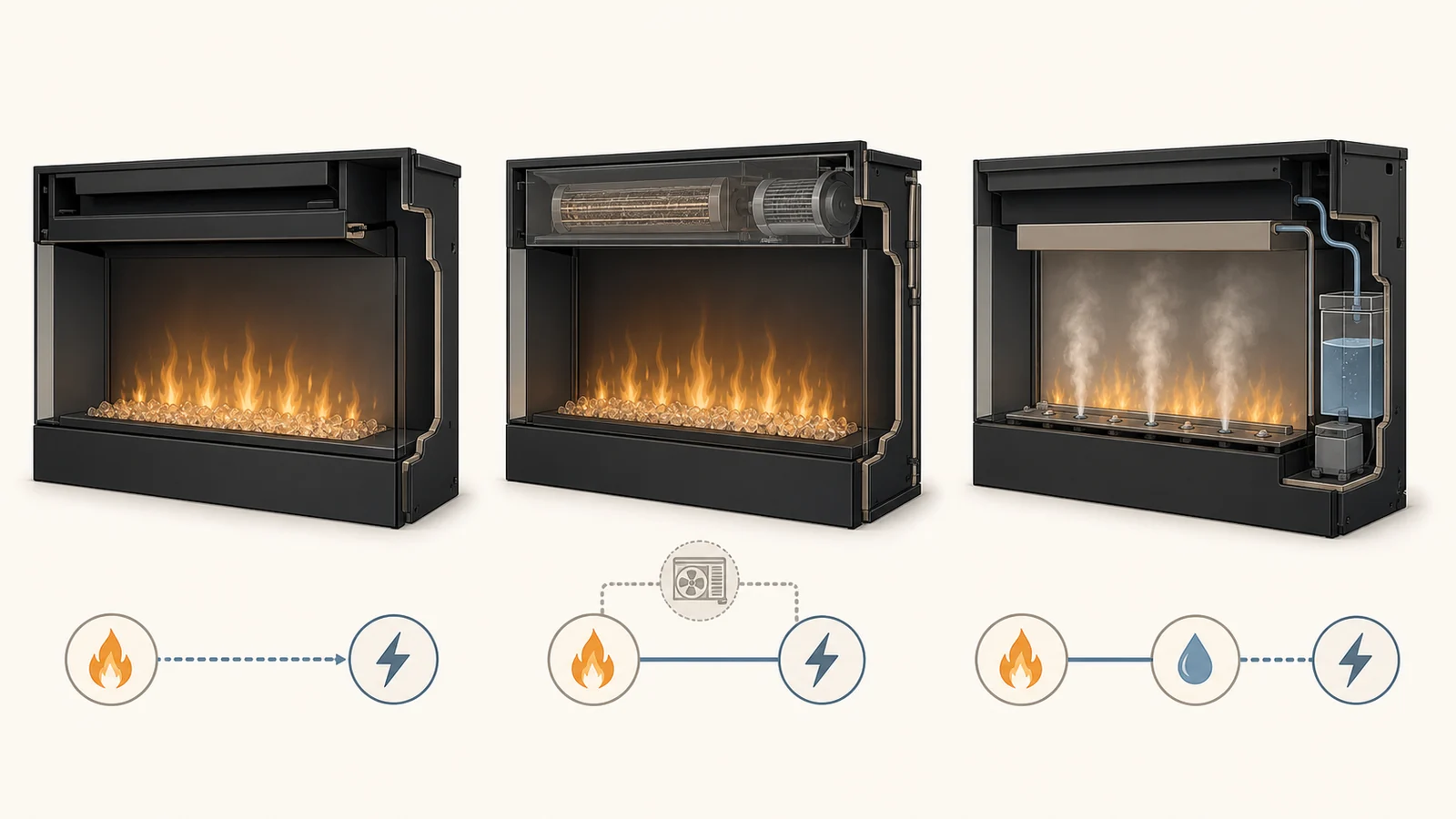
Worth it is not a property of the appliance. It is the result of one fireplace doing one job you actually care about without bringing along a wall project, power problem, heating bill, or service problem you did not price.
An electric fireplace can be a strong purchase for year-round visual ambience, a bounded pocket of supplemental warmth, or a fireplace look where combustion and venting are not part of the plan. It is usually the wrong purchase when the real job is whole-home heat, heat during an outage, or the sound, scent, and behavior of a real fire.
Write this sentence before opening another product page: “I am buying this fireplace mainly to ______ in this room.” If the blank needs three different answers, choose the one that would make the purchase feel disappointing if it failed. That is the primary job your exact model has to pass.
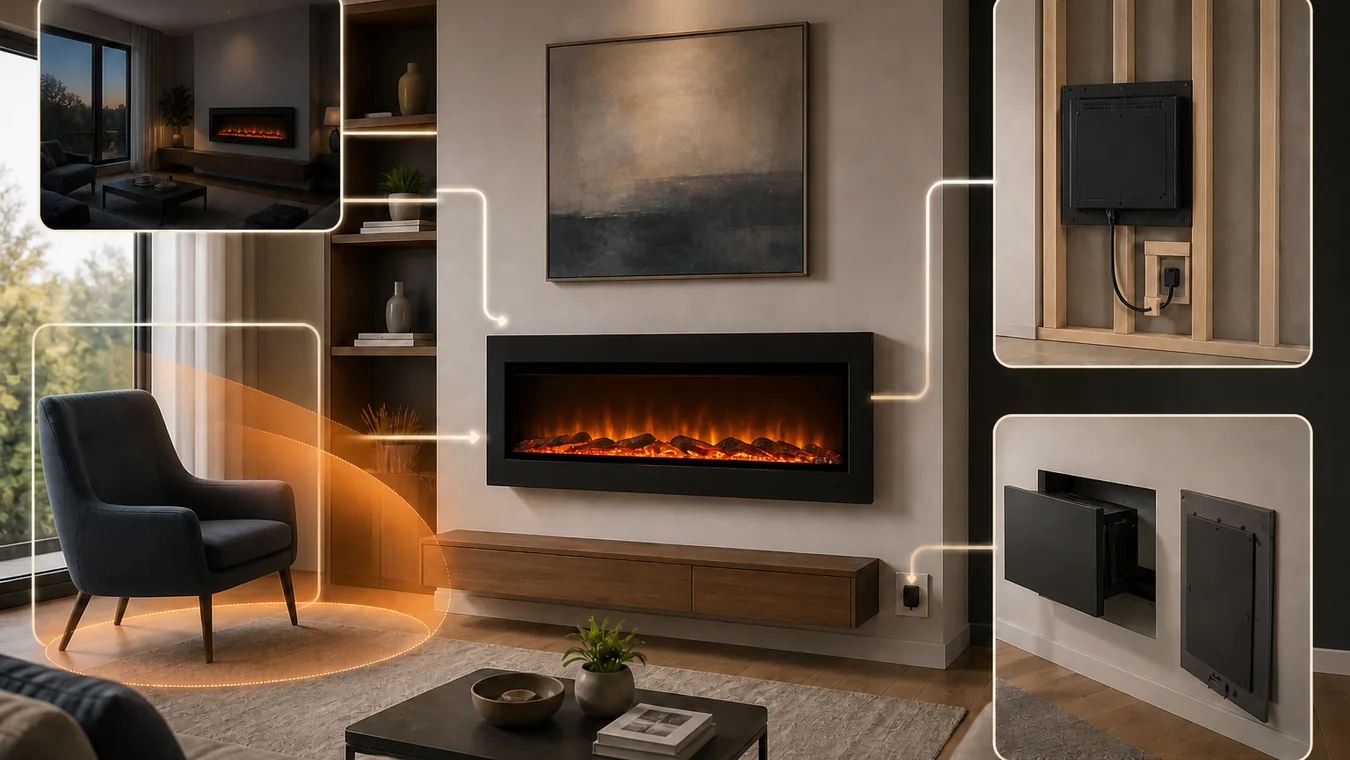
Give the fireplace one job before you price it
A general list of electric-fireplace pros and cons mixes jobs that should not share a verdict. Easy placement matters to a renter. It matters much less to someone already budgeting a framed feature wall. Flame-only operation matters to a warm-climate ambience buyer. It does not rescue a product chosen as emergency heat.
Use the first column to name the job. The next two columns decide whether an electric fireplace should remain in the comparison at all.
| Primary job | Evidence that keeps the option alive | Mismatch that ends the search early |
|---|---|---|
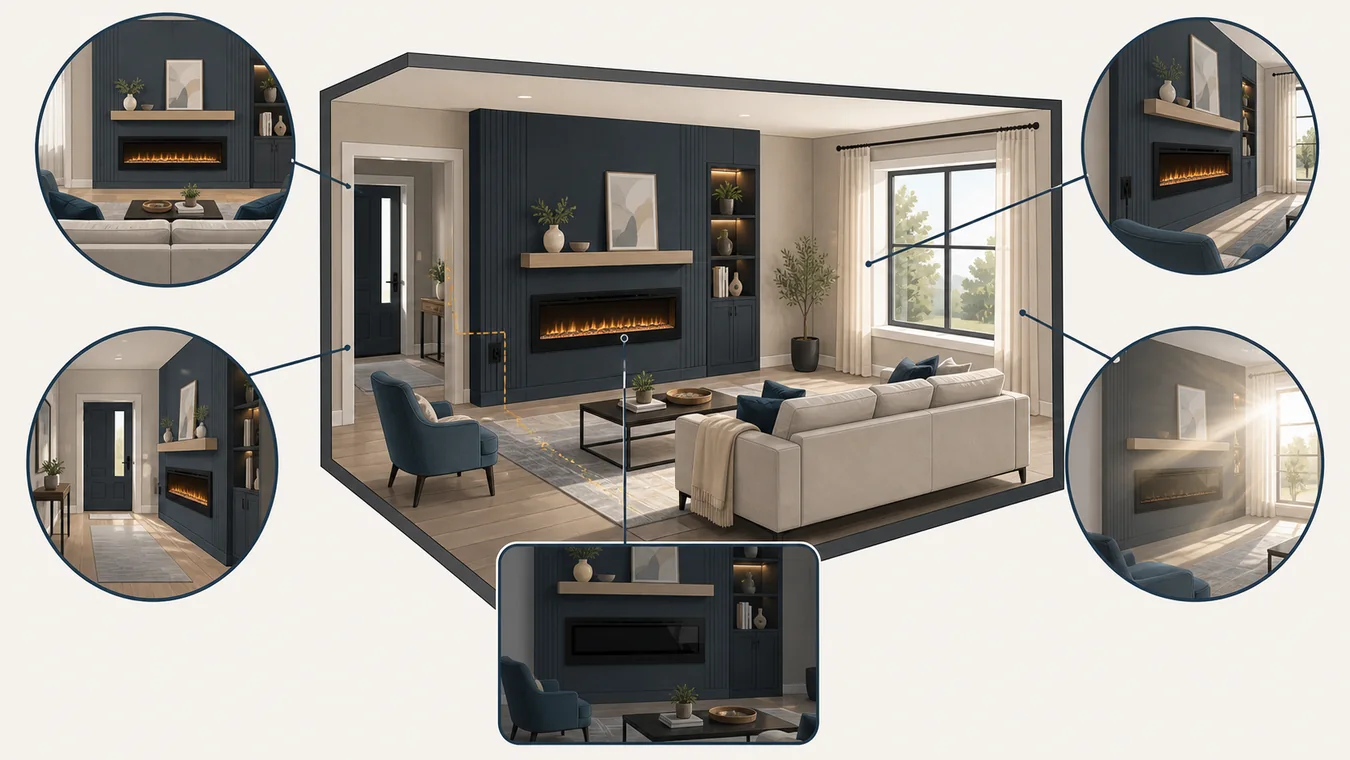
| Add a visual focal point in every season | Exact model offers a flame-only state; its front, depth, mounting relationship and off-state appearance suit the room | You need a real flame, smoke, scent, crackle or combustion experience |
| Warm the occupied part of one room occasionally | Exact manual documents the heater, airflow and controls; the seat is in the useful zone; operating hours and rate are acceptable | You need guaranteed whole-room or primary-home heating |
| Give an unused opening a finished electric focal point | The post-removal opening, power path, trim coverage and service removal all fit one model | A gas appliance, fuel system or unknown factory-built fireplace is still occupying the scope |
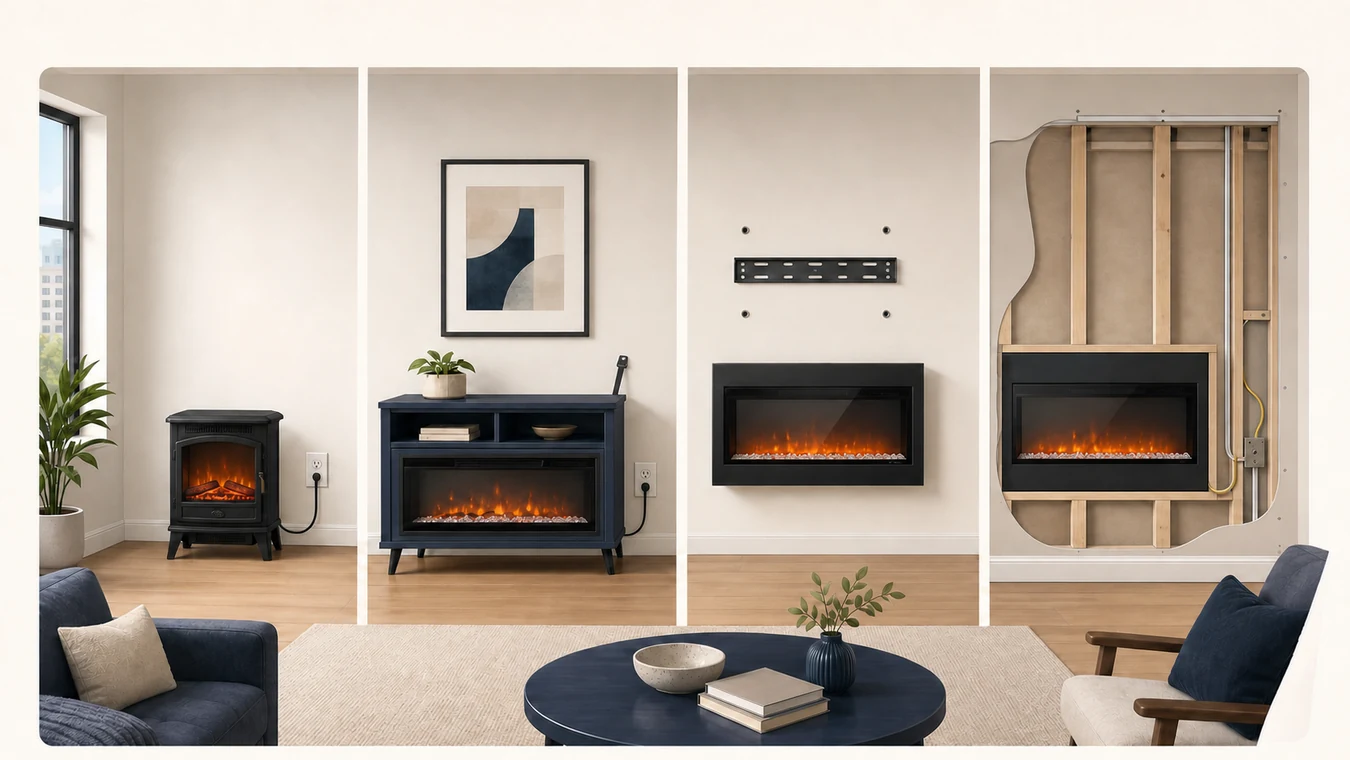
| Add a fireplace without making it part of the building | A freestanding or furniture model fits, uses an admitted outlet path and has a realistic move-out route | The chosen look requires recessed work, hardwiring, anchors or finishes you cannot approve or reverse |
| Create built-in room architecture | The exact firebox, rough opening, finish edge, electrical handoff and access panel are all in the project | The budget includes the appliance but not the wall, electrical, finish or future access work |
If you have not chosen the physical relationship yet, start with the types of electric fireplaces rather than shopping across wall-mounted, recessed, insert, mantel and freestanding products at once. Apartment buyers should also run the separate permission and move-out check; “ventless” does not mean “no modification.”
This is the first useful answer to “Are electric fireplaces worth it?” They can be worth it for a narrow job. The word electric does not guarantee that the job, room, model and project agree.
The cheap appliance can be the expensive project
A product price tells you what the seller charges for the box. It does not tell you what the fireplace costs to become part of the room.
The current Touchstone Sideline 28 item 80028 page is a useful example because one exact product supports both wall mounting and recessed installation. The page also gives separate overall, firebox and rough-opening dimensions and says the flame can run without heat. Those facts do not create one installation price. Surface mounting, building a recess, routing power, finishing the edge and preserving removal access are different projects around the same appliance.
They also show why “look up the watts” is not always a one-click task. On August 28, 2026, that item page listed 1,300 watts, while the current Sideline manual, revision 251114, listed item 80028 at a maximum 1,500 watts. Do not quietly choose the higher or lower number for circuit or cost math. Save both current documents and ask the manufacturer which specification applies to the unit and revision you would receive.
Before calling a project inexpensive, put each commitment on the same receipt:
- the appliance and any model-specific trim, media, mantel or bracket;
- the admitted mounting or fitting work;
- electrical work and its actual owner;
- framing, drywall, finish material and paint;
- demolition, conversion or opening repair;
- delivery, assembly and the route into the room;
- access needed to remove the unit or reach serviceable components later.
The installation-cost guide shows how to compare bids on the same scope. When a model requires a built opening or a qualified electrical handoff, the manual-first installation guide keeps those responsibilities with the right owner. A low sticker price cannot compensate for an unpriced wall.
Heat only earns value when it replaces something you meant to run
A heater does not save money merely because it is inside a fireplace. It creates value only if its limited heat is useful where you sit and if you know what other heating, if any, you intend to reduce.
For one exact model, estimate the heater portion this way:
heater energy cost = (documented heater watts ÷ 1,000) × actual heater-on hours × delivered electricity rate
Use heater-on hours, not simply the time the flame effect is visible. A thermostat may cycle the heater. A flame-only mode may use much less power, but do not invent that draw when the manufacturer does not publish it. If the product page and manual disagree on watts, as they currently do for the example above, the calculation remains on hold.
Your utility bill is the best source for the delivered rate you actually pay. The current EIA residential electricity table provides a state benchmark, but a household bill may include different tiers, time-of-use prices, riders and taxes. The point is not to find one national cents-per-hour answer. It is to expose the rate and number of heater hours your answer depends on.
“Electric resistance turns electricity into heat at the room” is also not the same claim as “this is the cheapest electric heat.” The Department of Energy’s current home-upgrade guidance explains that heat pumps move heat rather than generate it and can reduce heating electricity use by approximately 65% compared with electric resistance heating. If your central system is already a heat pump, a fireplace heater does not become more efficient because it is decorative. It may still make sense for a small occupied zone, but only when using that zone lets you avoid running a larger heating load and comfort remains acceptable.
Power belongs on the value receipt too. The exact manual controls the fireplace connection. For portable electric-heater use, the CPSC’s current winter guidance says to plug electric space heaters directly into a wall outlet rather than an extension cord or power strip. A built-in or hardwired fireplace has a different model-specific path. If the only plan is “we will find an adapter,” heat value has not closed.
For a fuller interpretation of watts, heat claims and room losses, use the electric-fireplace heat and running-cost guide. This page asks a narrower question: does that bounded heater role add enough value to your purchase?
Build the value receipt with one exact model
Do not score the model out of ten. A total score lets an attractive flame compensate for a missing circuit, or a low appliance price compensate for a primary-heat mismatch. Record the fields independently and leave a field blank when the evidence is not available.
| Receipt field | What to enter | Passing evidence | What a blank means |
|---|---|---|---|
| Primary job | One sentence, one room, one main outcome | The job would still matter if secondary features disappeared | You are buying a category, not solving a task |
| Exact identity | Brand, full model or item number, market, current manual | Product owner and manual list the same unit | Specifications and installation claims are provisional |
| Required visual result | Flame format, viewing conditions, off-state and room relationship | Current model evidence covers the views that matter | “Looks realistic” remains a showroom impression |
| Heat boundary | Supplemental role, documented watts, airflow, controls, occupied zone | The model’s limits match the job | Coverage or savings are assumptions |
| Installed commitment | Surface, recessed, furniture or insert relationship; power, finish, access and named owners | Every material task is priced or deliberately accepted | Sticker price is not project cost |
| Operating use | Heater-on hours, delivered rate, season and what other load changes | The math uses your rate and a plausible duty | Per-hour cost cannot support a value claim |
| Service evidence | Warranty scope, current support route, parts or service documentation and access | The owner and removal path are identifiable | “Low maintenance” is hiding an unknown failure path |
| Exit path | How it is removed, moved, repaired around or left in place | The consequence fits your tenure and room plan | Reversibility or replacement cost is unknown |
The receipt returns a narrow answer:
- Worth it for ambience means the exact visual system and installed relationship pass while heat is explicitly secondary or unused.
- Worth it for bounded supplemental heat means the seat, airflow, documented heater, local rate and intended duty all pass. It does not mean primary heat.
- Value depends on rate and duty means the visual job passes, but your operating pattern has not been measured well enough to price the heater.
- Mismatch means the primary job requires outage heat, real combustion, whole-home heat or another outcome the model does not claim.
- Hold means the model, manual, installed scope, service owner or exit path is still unresolved.
The electric-fireplace specifications guide helps normalize identity, dimensions, voltage and heat fields before they enter the receipt. If visual realism is the deciding job, use the matched-view realism guide instead of treating a polished product video as the final evidence.
Three blank fields are enough to postpone the order
The first dangerous blank is identity. A family name, product photo or reseller title is not a full model record. The 1,300-versus-1,500-watt conflict above is exactly why the current product page, current manual and unit revision have to meet before you use a number.
The second is project ownership. Someone has to own the opening, bracket or anti-tip restraint, power connection, finish edge and future access. “Easy to install” is not an owner. If the wall work is still described as “whatever the installer needs,” the project has not been priced.
The third is service and exit. Electric fireplaces avoid chimney sweeping and ash, but that does not prove every light source, fan, control board, glass panel or effect assembly is owner-serviceable. Check the exact warranty and document route; Dimplex, for example, keeps model-specific owner, installation and service documents rather than one universal repair promise. The cleaning guide also separates routine owner care from panels and components the applicable manual does not authorize you to open.
Any one of those blanks can justify a pause. Three blanks mean the order is early, even if every generic pros list sounds positive.
Keep the yes narrower than the makeover
A sound yes should fit in one sentence: “This exact model is worth it for this room’s visual job, with this accepted installation, this limited heater use and this service and exit plan.” That sentence is less exciting than a list of eleven benefits. It is also much harder for the project to surprise.
Save the receipt with the current manual and the model page you used. Reopen only the field that changes when the room, electricity rate, expected heater hours, installation design or move-out plan changes. The fireplace does not need to win every comparison. It needs to perform the one job that justified putting it in the room.