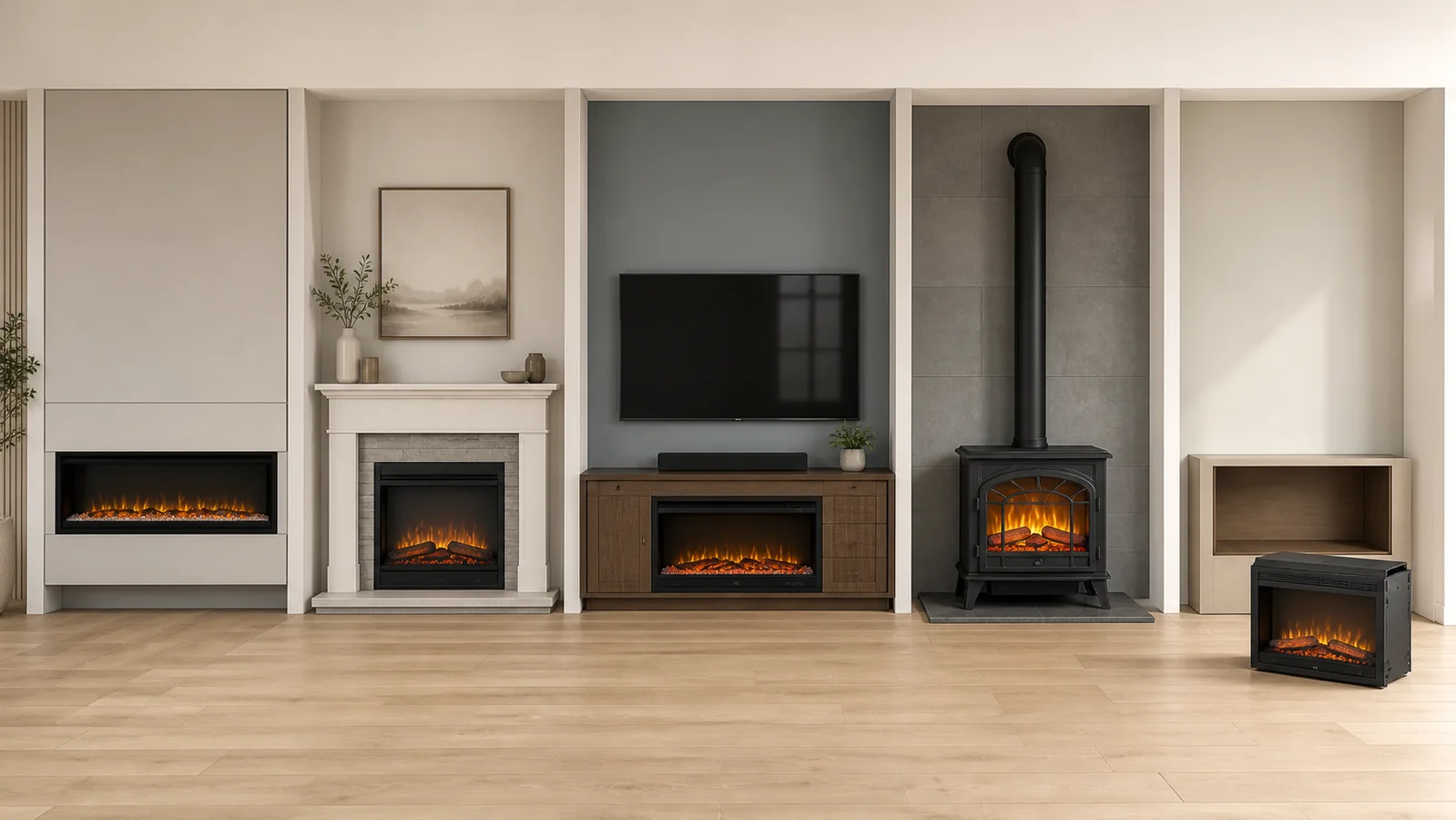
An infrared quartz electric fireplace is not a different kind of flame effect. The phrase describes part of the heater proposition. It does not, by itself, tell you what makes the flames, whether a fan moves air, how much electricity the unit draws, how quiet it is, or whether it will deliver the comfort promised for your room.
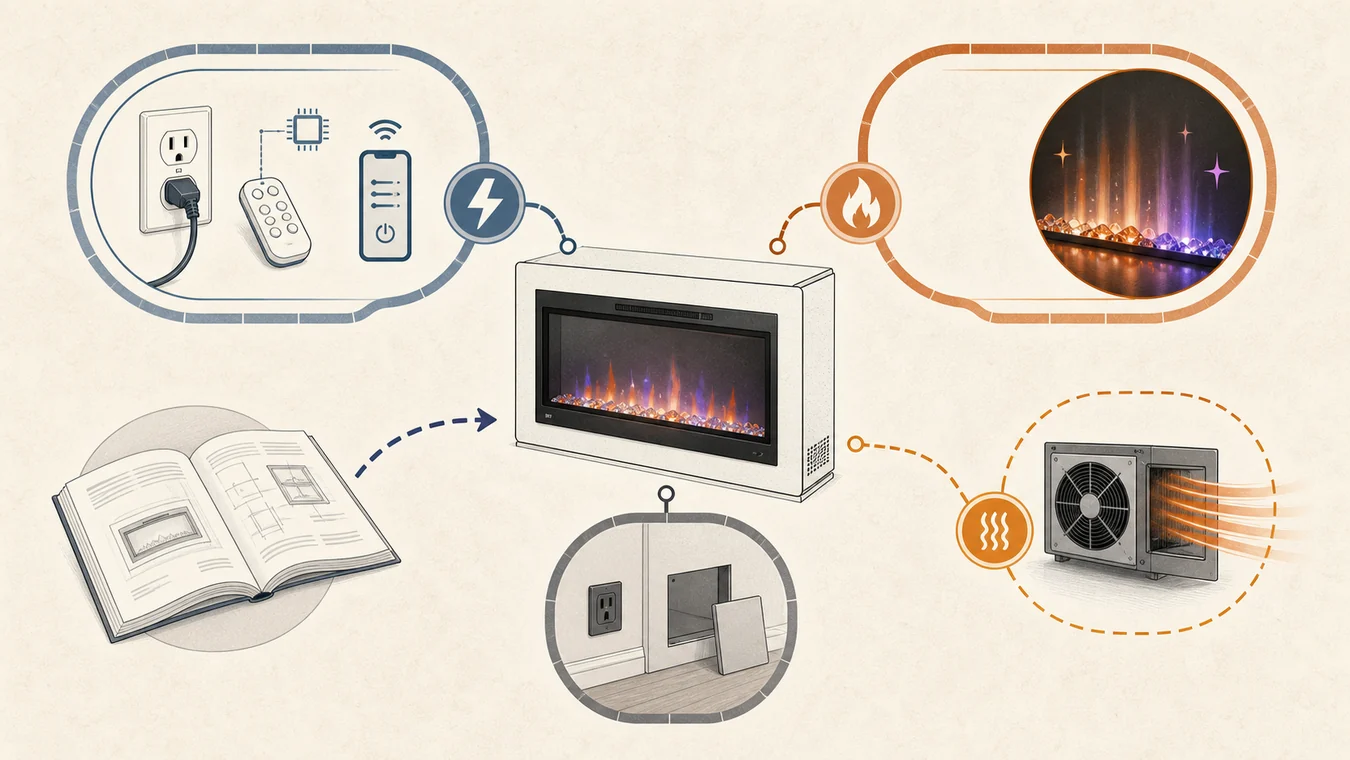
That makes the product label useful but incomplete. Before comparing two fireplaces, connect the label to one exact model and its current manufacturer page or manual. Then record the heater element, fan and airflow path, electrical input, stated output, controls, flame-only behavior and the full wording of any room-coverage claim. If those fields are missing, the candidate is not yet comparable.
Read “infrared quartz” as one field, not the whole verdict
Retail buying guides often present fan-forced and infrared quartz as two heating categories. That is a useful first sort, but it can encourage a false either/or. A manufacturer may use an infrared quartz element and still document a fan or another heat-delivery component. It may also combine technologies inside one named product.
The distinction that survives across products is narrower: the visible flame path and the heater path are separate questions. An LED, mechanical reflector, mist system or digital display can create the scene while another assembly provides optional heat. The exact controls decide whether those jobs can run independently.
If you need to understand the whole appliance rather than this one heater label, use the four-path electric-fireplace guide. Here, the goal is smaller: translate the label into enough product facts to make one fair comparison.
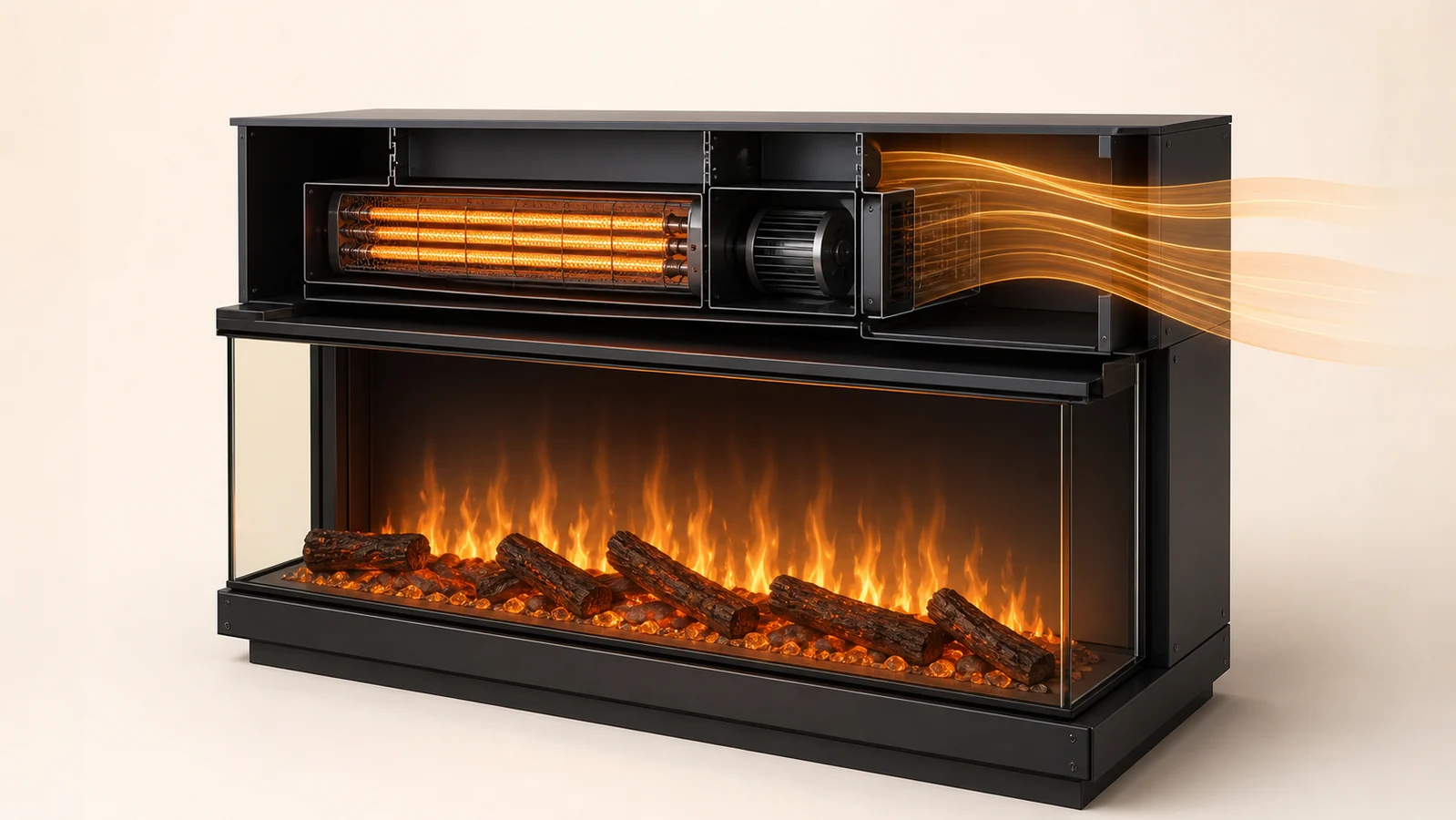
The illustration shows one possible fan-assisted infrared heater above a separate visual chamber. It is not a cutaway of a real product and does not claim that every infrared fireplace contains a fan.
Three current products show why the label needs a model number
Twin Star’s current duraflame infrared quartz stove page names infrared quartz heat, a thermostat, a timer and a supplemental-zone claim of up to 1,000 square feet. It also says the technology maintains natural humidity. Those are claims attached to that page. The visible page does not provide a complete nameplate and air-path record, so it cannot settle fan, amps, watts or an exact room result on its own.
The current 18-inch infrared quartz insert page adds a different fact: its flame effect can operate with or without heat. It also describes plug-temperature monitoring. The flame-control statement answers one model-page question; it does not identify the flame technology as infrared. Nor does it transfer the same controls to a similar-looking size.
Twin Star’s current Infragen stove page describes infrared quartz elements combined with halogen technology. That is enough to disprove a universal one-element story. It is not enough to tell us what another infrared-labelled fireplace contains.
| Current owner page | What the page establishes | What still needs an exact source |
|---|---|---|
| duraflame infrared quartz stove | Infrared quartz label, thermostat, timer and stated supplemental-zone claim | Full model identity, nameplate input, fan/air path and claim conditions |
| 18-inch infrared quartz insert | Infrared quartz heat, flame with or without heat and plug-temperature protection | Whether another size shares the controls, plus its complete power/output record |
| Infragen stove | A named product combines infrared quartz and halogen technology | Whether that combination exists in any other candidate |
This is why the electric-fireplace manual guide treats the model, market and assigned document as one identity. A family name or retailer thumbnail is not a substitute.
Build the heater-path record before comparing
Open the current manufacturer source for the exact SKU and fill each row. Do not infer a blank from the infrared badge.
| Record field | Evidence to save | Why it changes the purchase | Hold condition |
|---|---|---|---|
| Exact identity | Brand, full model/SKU, market and current assigned manual or specification | Prevents a feature from moving between similar products | Listing and document do not name the same model |
| Heater wording | Manufacturer’s exact name for the element or heater system | Confirms what the infrared/quartz phrase actually refers to | Only a retailer filter or page title uses the term |
| Fan and airflow | Documented fan presence, intake, warm-air outlet and any run-on behavior | Affects placement, sound questions and blocked-air risk | The source does not identify the air path |
| Electrical input | Voltage, amps and maximum watts for the chosen configuration | Defines load and maximum operating-cost input | Values belong to another voltage or model |
| Output | Documented BTU or other output, with the same configuration | Keeps input and output attached to one product | Output is absent or copied from a family page without assignment |
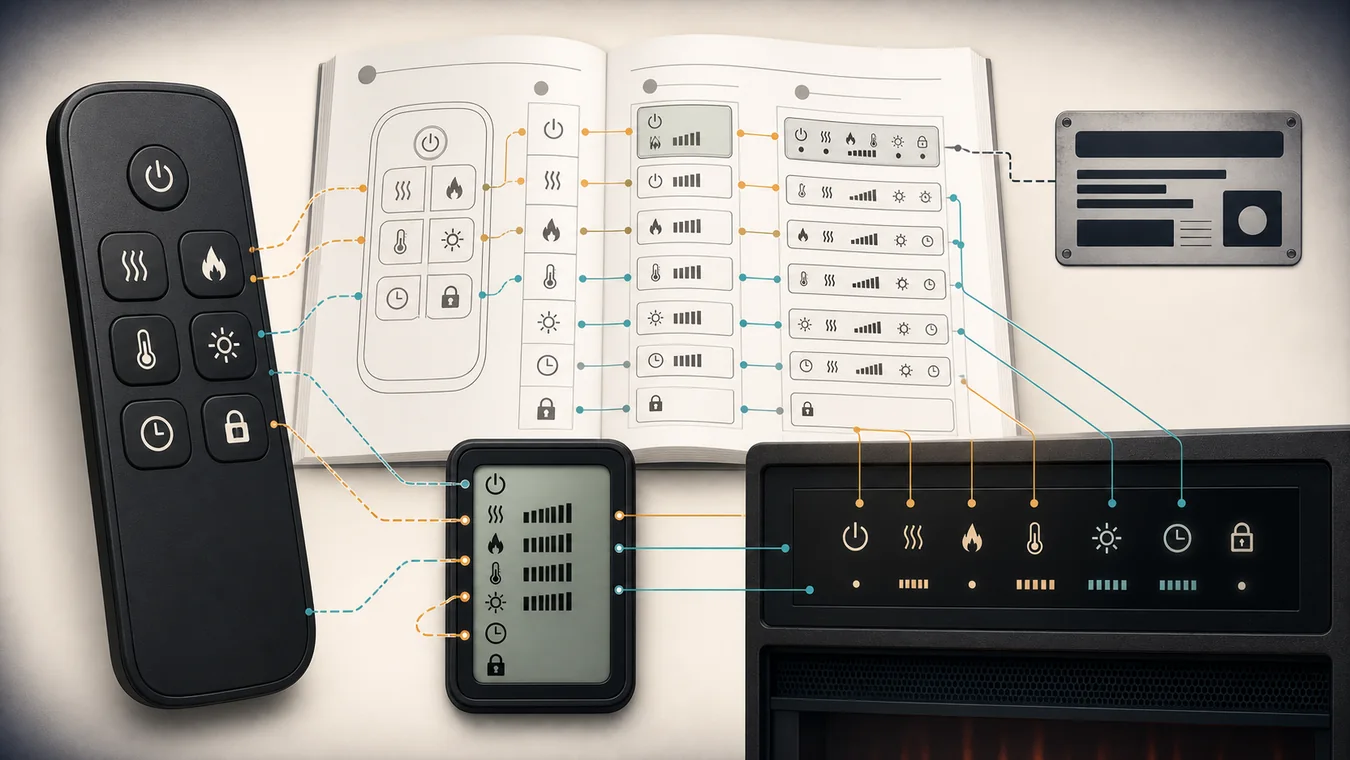
| Controls | Thermostat, heat levels, timer and any heater lock | Determines the available heat states | Marketing says “adjustable” without a control table |
| Flame relationship | Whether the visual effect works without heat, and whether heat can work without the effect | Prevents a heater label from being mistaken for flame technology | Only one direction of independence is documented |
| Room claim | Exact “supplemental,” “up to,” area and condition wording | Shows the scope of the promise rather than a guaranteed result | A bare square-foot number carries the decision |
The electric-fireplace specifications guide explains how to keep values, units and configurations together. If the record is complete but the room question remains open, the 1,000-square-foot claim guide owns that separate judgment.
Four attractive claims still remain unproved
“Infrared uses less electricity.” The label does not prove that. Compare the maximum watts and the control behavior of the exact configurations. A different sensation or heat-distribution pattern is not evidence of lower input. For cost, use the exact watts and expected heater-on time in the heat and running-cost guide.
“Infrared means no fan and no noise.” It may not. Fan presence is an independent document field, and absence of a published decibel value is not proof of silence. If air movement matters, carry the model into the electric-fireplace blower guide rather than guessing from the element name.
“Infrared will not dry the air.” A current product page can make that claim for its product, but the badge alone does not measure the humidity in your room or prove the same result for another unit. Preserve the manufacturer wording and avoid turning it into a site-wide performance promise.
“Up to 1,000 square feet means it will heat my 1,000-square-foot home.” It does not close ceiling height, insulation, outdoor conditions, doors, open stairs or the job assigned to the heater. Keep the area line as a manufacturer claim until the room and expected result are defined.
The visual effect remains outside all four claims. Infrared quartz does not tell you whether the flames come from LEDs, a reflector, mist or a screen, and it does not rank realism. The model’s visual-system source owns that answer.
Let the evidence state—not the badge—decide
A candidate is documented when the exact manufacturer source closes the heater wording, power, output, controls and flame relationship, and identifies the needed fan/air path. It can then be compared on the fields that actually matter to your room.
It is conditional when the heater path is clear but a non-negotiable room, noise, power or installation fact is still missing. Name that field. Do not bury it beneath a favorable coverage claim.
It is on label-only hold when the seller uses “infrared quartz” but the assigned owner document does not close the model identity or heater record. More search-result repetition does not repair that gap.
It should leave the shortlist when the listing and manual refer to different products, the intended air path would be blocked, or the required control relationship is absent. If the power path is unresolved, use the dedicated-circuit guide and the exact manual; do not approve electrical work from a category label.
For a movable heater, current CPSC portable-heater guidance says to keep it at least three feet from combustible materials and plug it directly into a wall outlet rather than an extension cord or power strip. Apply that guidance only to the use it covers, and follow the exact product manual where it is more specific. A built-in fireplace still needs its own installation instructions.
Write one source-verifiable verdict before checkout
Save the result in one sentence:
For [full model and market], the current [manufacturer page/manual and revision] identifies [heater technology], [fan/air path or not documented], [voltage, amps, watts and output], [thermostat and heat modes], and [flame/heat relationship]. Its [complete room-claim wording] supports [the limited job you are asking it to do]; [remaining unknown] must be closed before purchase.
If the sentence cannot be completed, you do not yet have an infrared-fireplace comparison. You have a product badge and a named evidence gap—which is still a better decision than treating the badge as proof of the flame system, operating cost or room result.