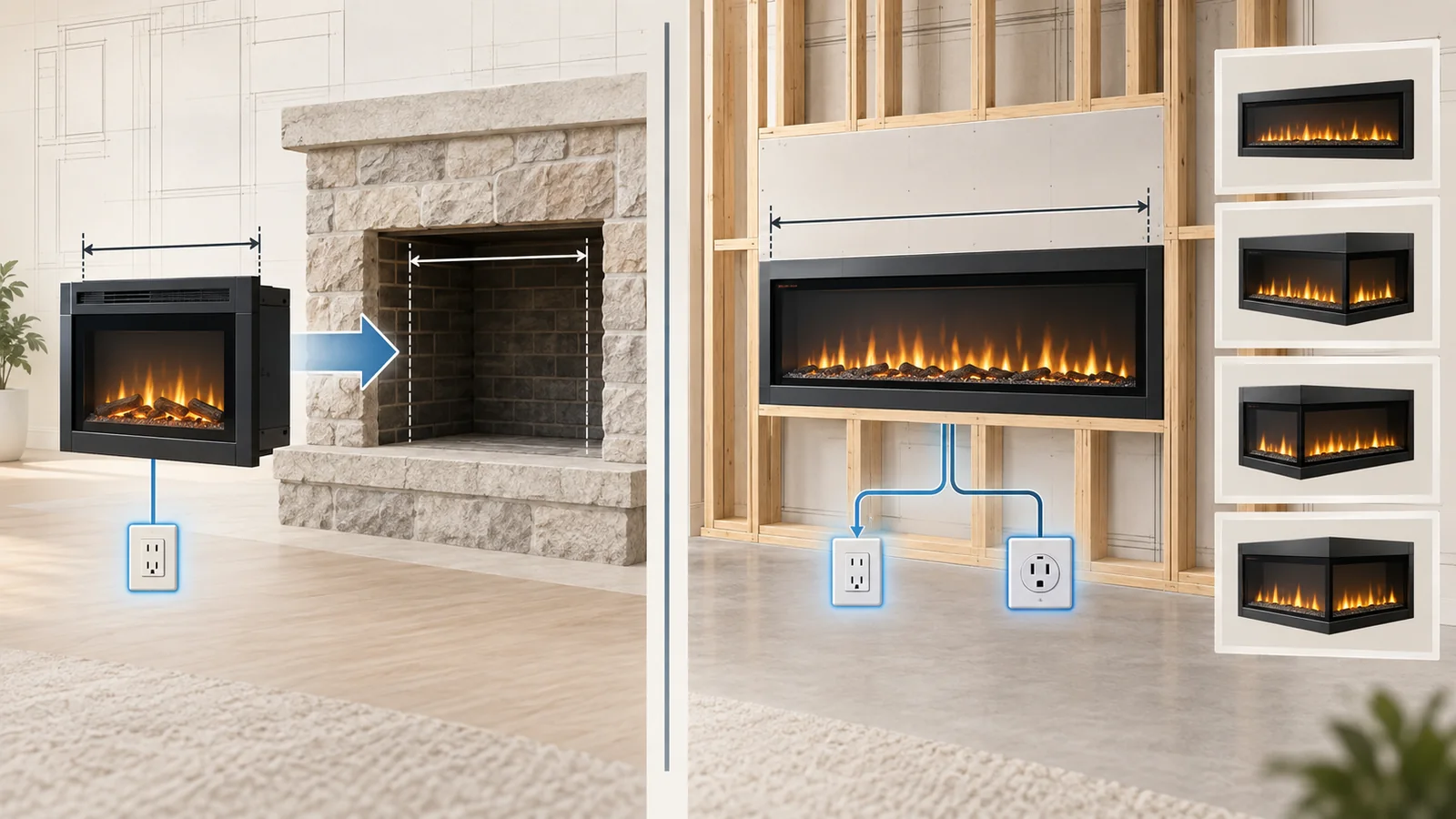
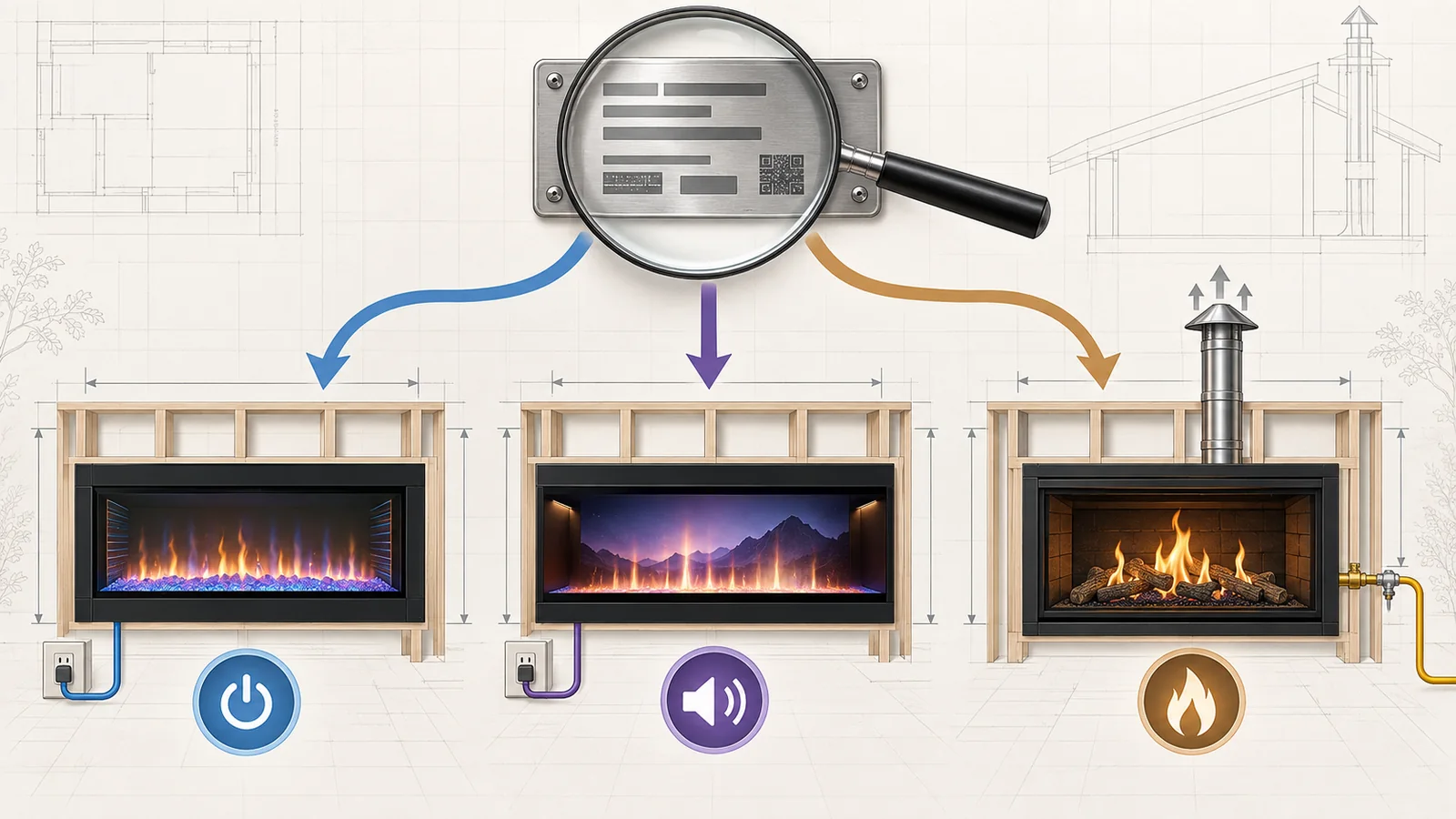
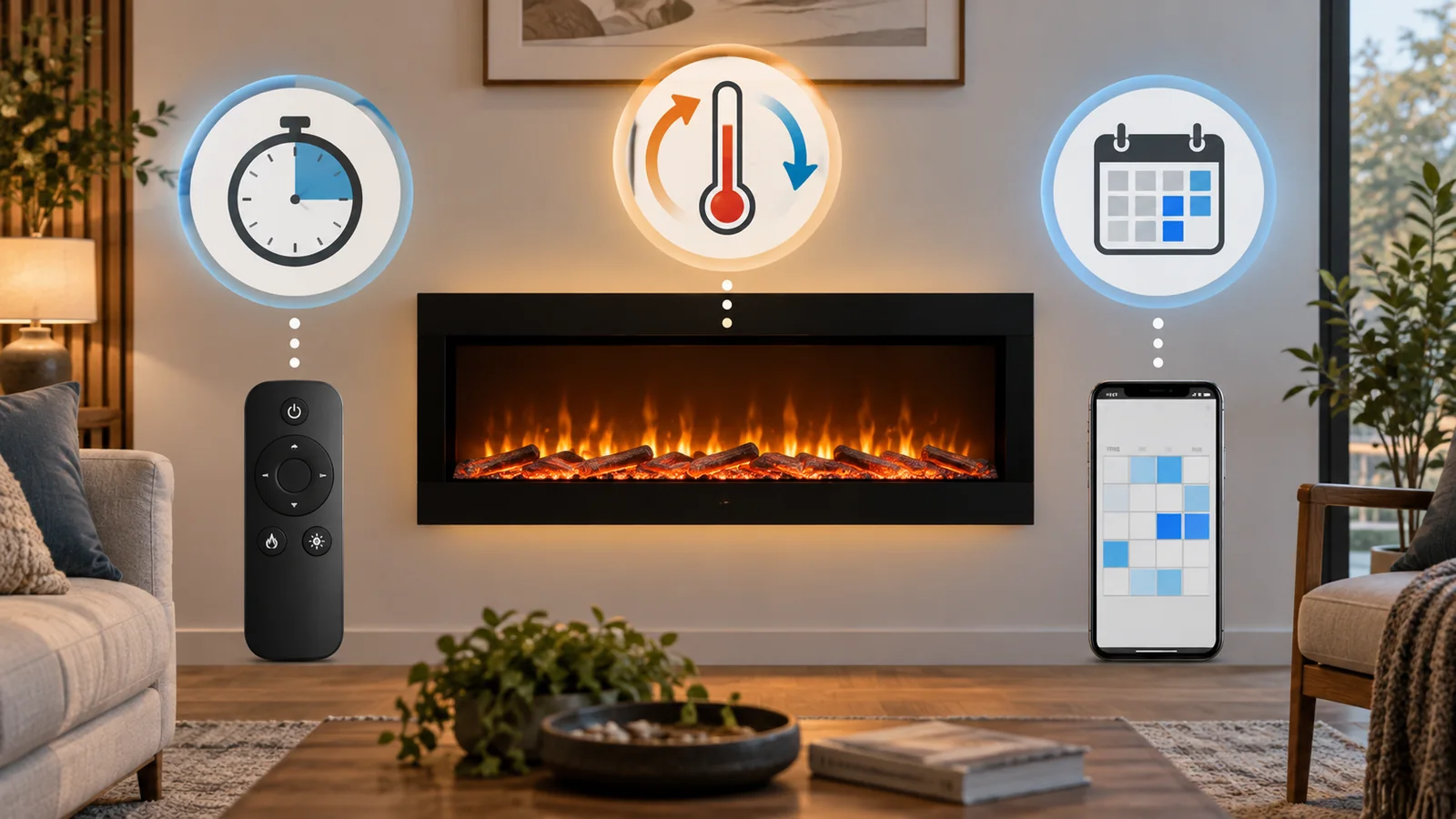
An electric fireplace with no heat is not one diagnosis. If the flame or display still works, the unit may be in flame-only or fan-only mode, the thermostat may already be satisfied, the heater may be locked, the fan may be in a documented transition, a thermal cutoff may have opened, or the installed power configuration may not support heat. None of those observations proves that the heating element has failed.
Start with the exact model and its current manual. Then record the flame, fan, display or code, selected heat mode, set temperature, room temperature and elapsed time after requesting heat. That combination—not a generic reset—decides the next safe step. Do not remove a panel or test live wiring to complete this check.
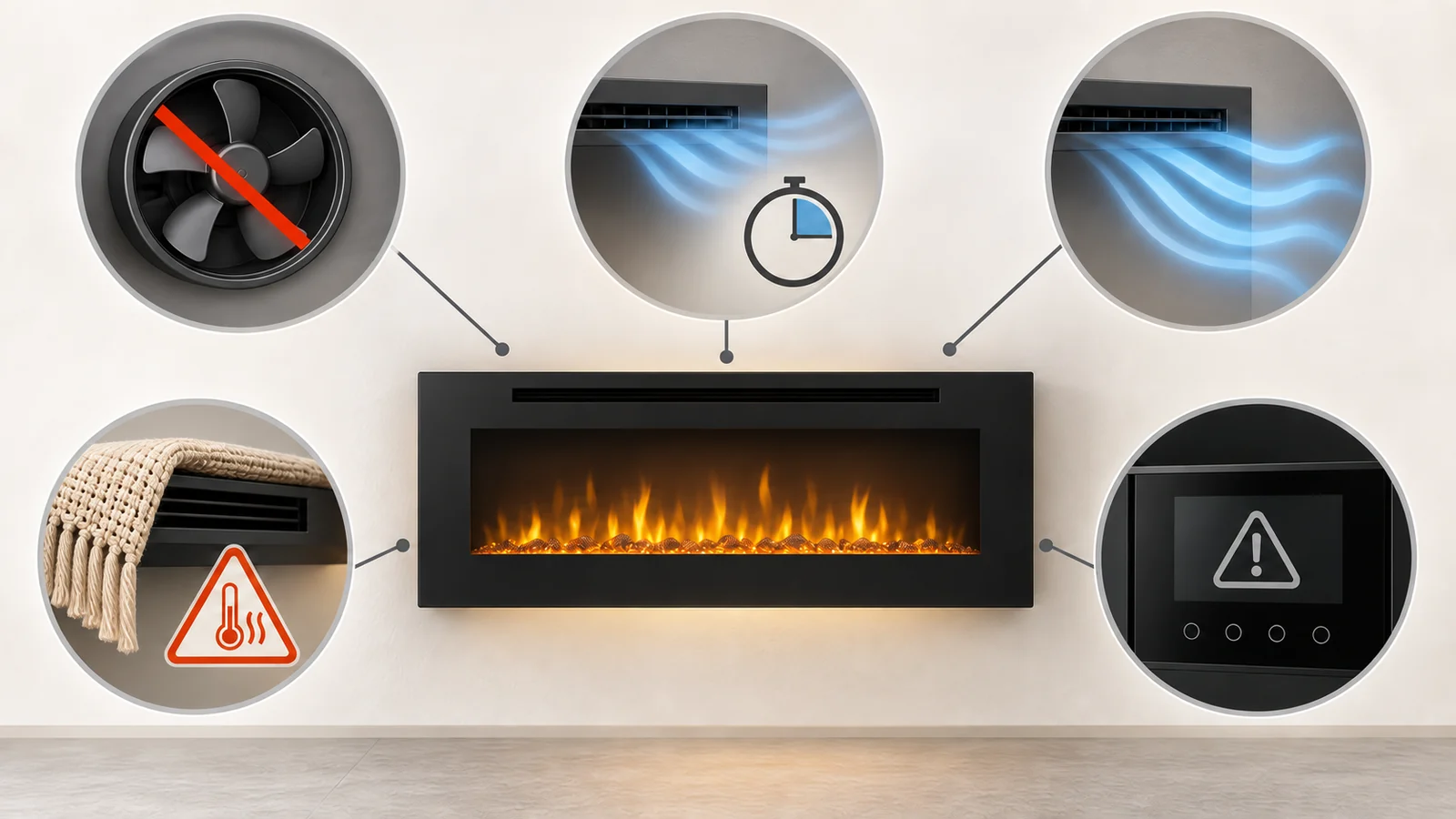
Start by writing down what still works
Use the first row that matches what you can actually see and hear.
| Observed state | Check first | What it can establish | What it cannot establish |
|---|---|---|---|
| Flame or display on; fan never starts | Exact heat mode, heater lock and thermostat display | Heat may not have been requested or may be inhibited by a documented control state | It does not prove a failed blower or element |
| Fan starts with cool air for a short documented interval | Elapsed time in the exact manual | Some models deliberately run the fan before or after heat | Another model’s delay does not apply |
| Fan continues to move cool air | Fan-only mode, temperature setting and exact model/power configuration | The fan circuit is active while heat is not being delivered | The symptom alone cannot identify the internal part |
| Warm air stopped after the unit had been heating | Inlet/outlet condition and the manual’s thermal-cutoff instructions | Airflow or a cutoff belongs in the next branch | Repeated resetting is not a repair |
| Display shows a lock, overheat symbol or code | Copy the characters exactly and open that model’s manual | The manual can assign the next owner | A code from another brand is not a translation |
| No flame, fan, display or response | Leave this page for the whole-unit power path | The task is not heat-only | Heater controls cannot be evaluated until the unit powers |
| Exact product is heater-free or intentionally configured without heat | Verify the model/specification | No-heat operation may be by design | It is not evidence of a fault |
The field names matter. A model number is more useful than “wall fireplace,” and “fan ran cool for four minutes” is more useful than “blower works.” If the specification itself is hard to interpret, the electric fireplace specification guide explains which document owns model, voltage and operating fields.
If the fan never starts, prove heat was requested
A visible flame only proves the visual system is running. Dimplex’s technical support guidance explicitly treats flame and heat as independent functions. Current manuals also show several ways a heater can be inactive without an internal failure.
For the Napoleon Luminex family covered by manual W415-4188 B-0, H-0 means the heater and blower are off, FAN moves air without heat, and LOC indicates that heater operation is disabled. The same manual lets the thermostat hold the heater off when room temperature is already above the setpoint. Dimplex’s Slim manual likewise documents a heater-disabled state and a no-heat result when the temperature setting is too low.
Those labels are examples, not a universal button sequence. Read the symbols on the appliance against its own manual. If you do not have the current document, use the model number to find the electric fireplace manual before trying key combinations from a different remote.
For a plug-connected heater, do not use an extension cord or power strip as a “test.” US CPSC guidance says plug-connected electric heaters should go directly to a wall outlet. A hardwired fireplace follows its installation manual and qualified electrical owner instead.
A short burst of cool air is a clock, not a diagnosis
Cool air immediately after selecting heat may be a transition rather than a failure. Touchstone’s wall-mounted series manual, revision 20230118, says the fan can blow cool air for up to 30 seconds before the heater turns on and for up to 30 seconds after it turns off.
That number belongs to the models covered by that manual. It does not authorize a 30-second assumption for a Dimplex, Napoleon or another Touchstone family. The useful procedure is simply to start a timer when heat is requested and compare the elapsed time with the exact manual.
If the documented interval passes and the fan keeps moving cool air, record “continuous cool air” and recheck the displayed mode, setpoint and model configuration. Do not convert airflow into a heater-element diagnosis. The fan, heater, sensor and control board can have different service owners, and symptom-only part buying can create a second problem.
Thermostat satisfied and heater locked can look identical
From across the room, both conditions look like a flame with no heat. The difference is on the display and in the temperature record.
Write down the displayed set temperature and a reasonable room-temperature reading. If the room is already at or above the setpoint, the heater staying off may be normal thermostat behavior. Raise the setpoint only as the manual describes and observe whether the state changes. If the display shows a heater lock or disabled-heat symbol, changing the setpoint addresses the wrong control.
A thermostat that repeatedly overshoots, short-cycles or reports an implausible temperature is a different task. The electric fireplace thermostat guide covers sensor location, cycling and control logic. This page only needs enough temperature evidence to decide whether the heater is being asked to run.
A cutoff makes reset time model-specific
Heat that worked and then stopped points somewhere different from a heater that never started. Blocked airflow can cause an overheat or thermal cutoff, but the reset method and waiting period are not interchangeable.
| Current owner document | Covered example | Documented owner action |
|---|---|---|
| Touchstone wall-mounted series manual, revision 20230118 | Temperature limiter has opened | Switch off and unplug, wait five minutes, inspect and clear inlet/outlet obstructions, then retry |
| Napoleon Luminex manual W415-4188 B-0 | Thermal cutoff state | Follow the manual’s power-off reset and wait 15 minutes |
| Dimplex Slim manual 7216350000R07 | Err1 cutoff example | Isolate power at the breaker and wait 30 minutes before the documented restart |
Five, 15 and 30 minutes can all be correct—and each can be wrong for your model. This is why “unplug it for ten minutes” is not reliable owner guidance.
Before a manual-authorized reset, let the appliance cool and inspect accessible inlet and outlet areas for blockage without opening the unit. Cleaning must follow the product manual; the vent-cleaning guide keeps surface and access limits separate from internal service. If there is fabric, dust buildup or furniture obstructing the opening, correct the clearance before retrying.
Stop after one exact-manual reset if heat does not return or the cutoff repeats. Also stop immediately for a damaged cord or outlet, scorching, arcing, a burning odor, breaker recurrence or any instruction that assigns service to a qualified person. Repeated shutdown after heat returns belongs in the electric fireplace keeps-shutting-off guide; it should not become a loop of resets.
One 120V model can look alive and still be unable to heat
The Dimplex OLF86-AM specification provides a useful exact-model exception. Its documented 120V path can support the flame/control side while heat requires the model’s 240V connection. A unit can therefore look operational and still provide no heat by design in that power configuration.
Do not generalize that behavior to other fireplaces, and do not use it as a wiring instruction. Verify the complete model suffix, the installed connection and the current specification. If the model is supposed to be on a 240V heating path but the project record is unclear, the next owner is the installer or qualified electrician—not an owner opening the appliance.
A fireplace sold without a heater, or a project intentionally selecting visual-only operation, belongs in the non-heating electric fireplace guide. That is a product/configuration decision rather than troubleshooting.
A display code changes the owner of the problem
Copy the code exactly; do not paraphrase it as “overheat” or “fan error.” Dimplex Slim documentation, for example, gives Err1 a cutoff/reset path but directs Err10 and Err11 fan-related conditions to service. Napoleon’s Luminex manual has its own E-series fault handling. The characters do not transfer across brands or even necessarily across families from the same brand.
If the exact manual assigns the code to service, that is the result. Touchstone’s covered wall-series manual also states that there are no user-serviceable internal parts. A persistent no-heat condition with the controls, timing, airflow and exact reset already resolved may require manufacturer or qualified service diagnosis, but it still does not identify the failed component.
Use the electric fireplace repair guide to organize warranty, service and repair-versus-replace questions. Use the heater-element guide only after an exact parts owner or qualified diagnosis establishes that the element is relevant. Buying a part because the fan blows cold skips the evidence between symptom and component.
Send one complete state record, not “it has no heat”
Before contacting the manufacturer, installer or service person, complete this sentence:
[Brand and exact model], [plug-connected or documented hardwire voltage], flame [on/off], fan [absent/briefly cool/continuously cool/warm then stopped], display or code [exact characters/none], heat mode [exact label], set temperature [value], room temperature [value], observed for [elapsed time], exact-manual reset [method/result or not authorized].
If every field is known, support can begin from a defined operating state instead of asking you to repeat generic checks. If the whole unit is dead, switch to the electric-fireplace-not-turning-on path. If a code persists, a cutoff repeats or the manual transfers ownership, stop there: the record has done its job by identifying the right next owner without inventing a repair.