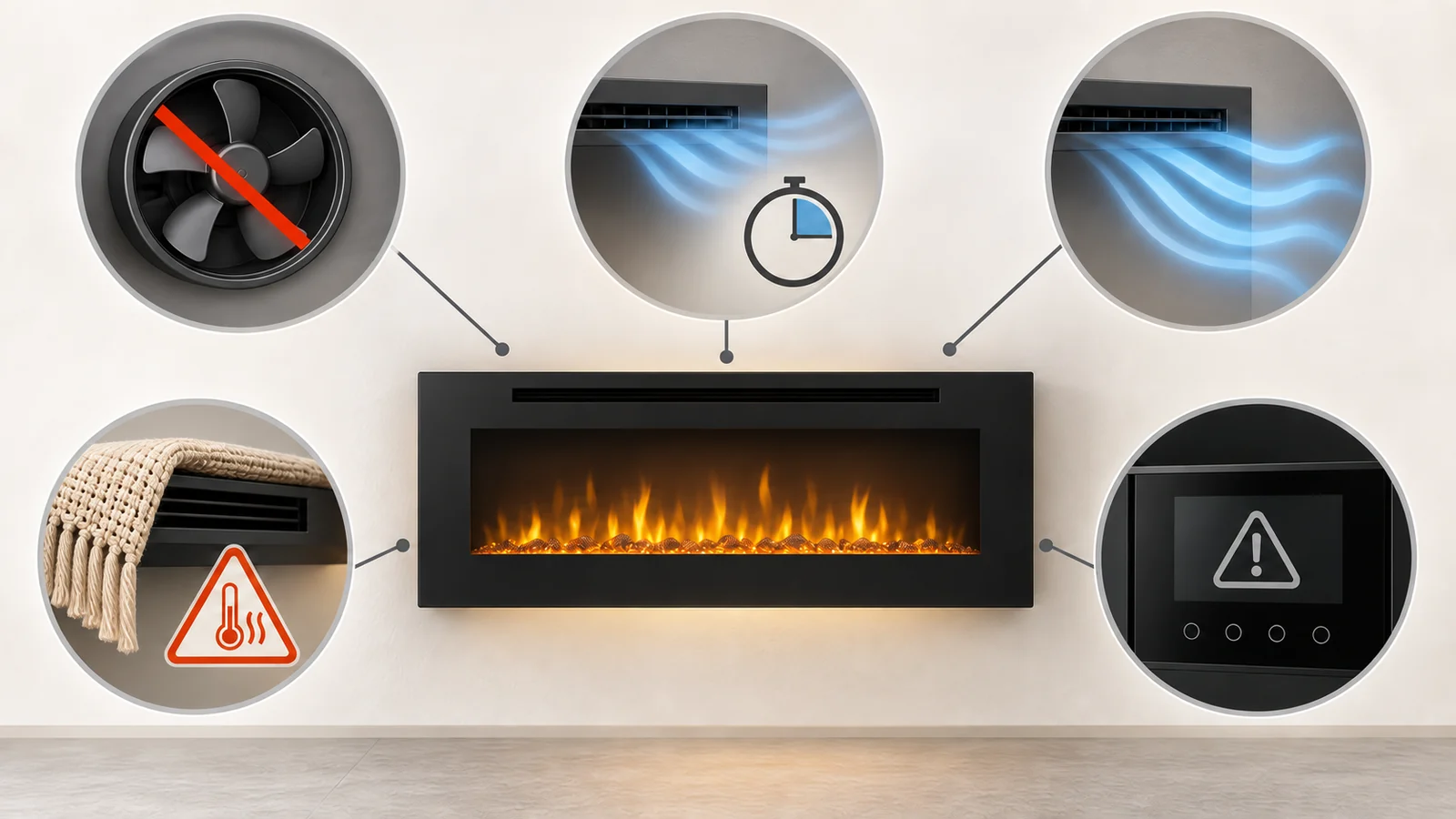
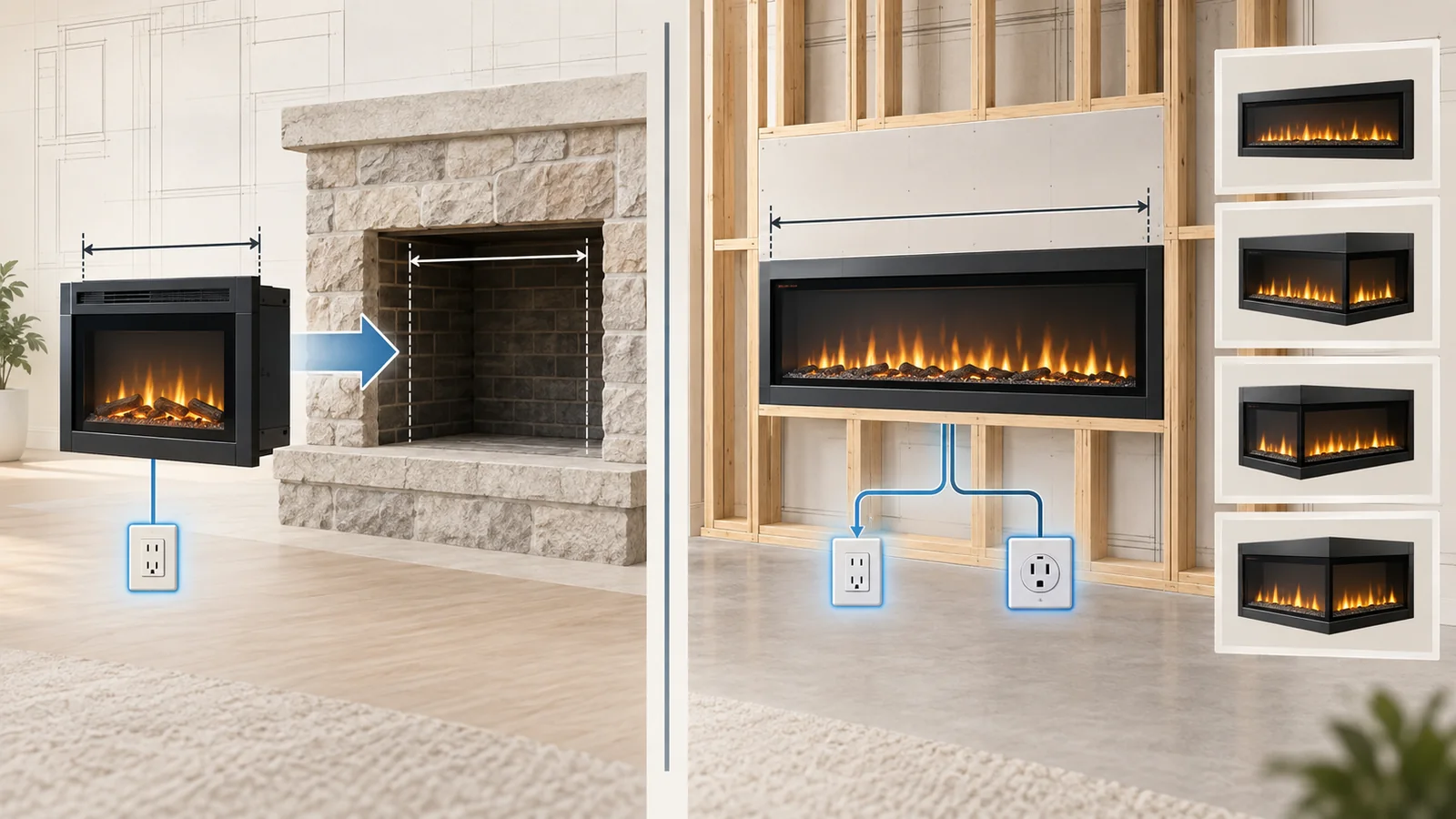
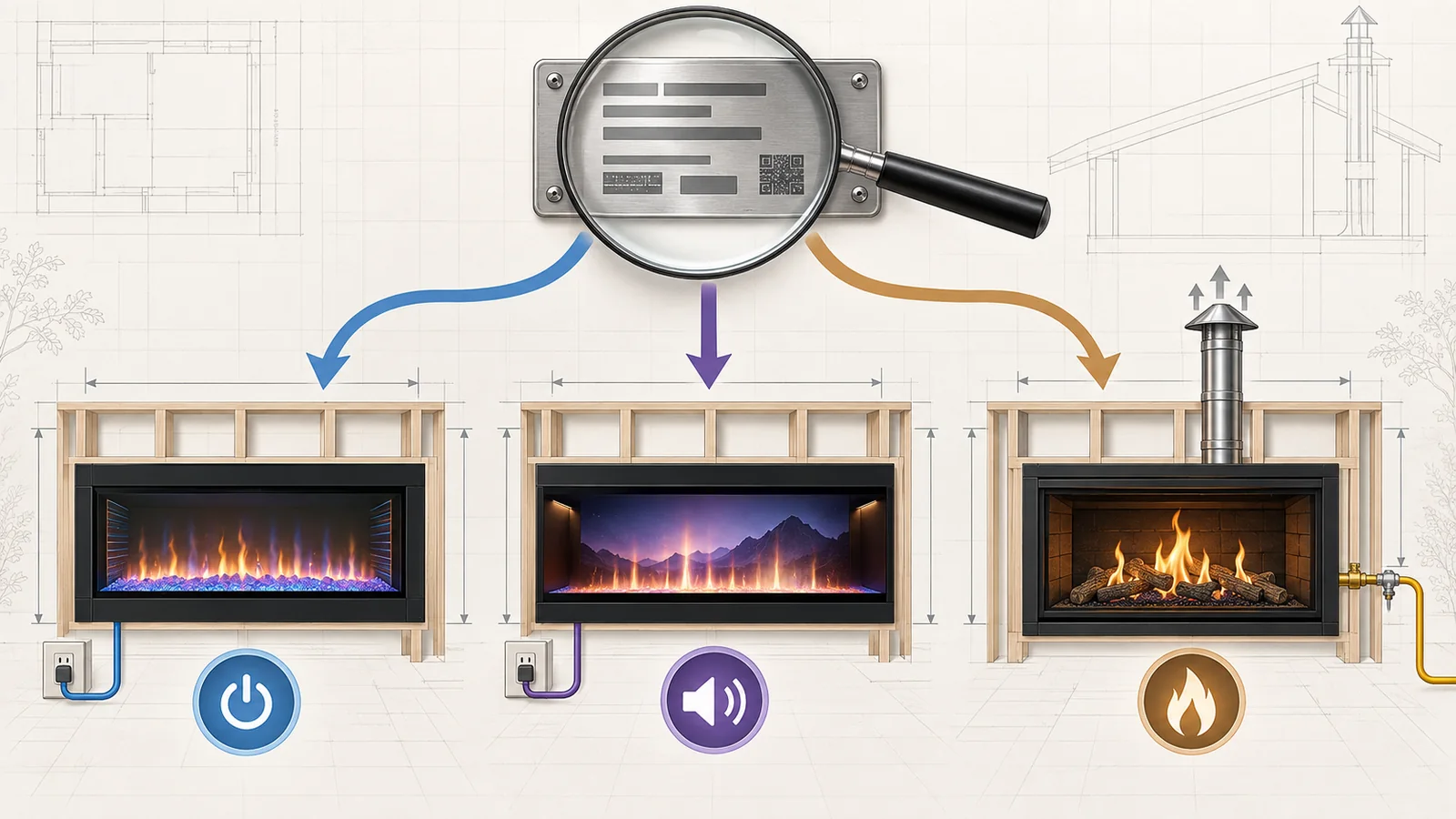
When an electric fireplace is not turning on, start with the last thing that still responded—not the part you suspect failed. Use only the normal start action shown in the exact model’s manual, then treat the onboard control and remote as two separate witnesses. Record whether you see a display, beep, flame, fan or heat response. Those observations determine the next owner.
If neither control channel produces any response, do not begin with remote pairing, flame settings, heater settings or a universal reset. The unresolved path is now incoming supply, an applicable wall or master switch, the appliance’s external control path, or service. Stop before opening the unit, probing voltage or selecting a replacement board.
The last response matters more than the suspected part
“Won’t turn on” can describe a completely dark appliance, a dead remote, a missing flame effect, a heater that stays cold or a unit that starts and then stops. Those states do not share one diagnosis. Write down the last confirmed response before taking another action: perhaps an onboard button beeped, the display lit, the flame appeared, the fan started, or the unit ran before a code appeared.
| Observed state | Last confirmed response | What it does not prove | Next owner |
|---|---|---|---|
| Onboard control and remote are both silent; no display, beep, flame or fan | Known supply evidence outside the appliance, if any | It does not identify a bad board, fuse, cord, outlet or breaker | Exact manual’s incoming-power and control path; manufacturer support or a qualified electrical/service owner if unresolved |
| Onboard control responds, but the remote does not | Appliance control/display response | It does not prove the entire fireplace has lost power | Exact remote identity, battery orientation and model-specific pairing path |
| Controls respond, but the flame effect does not | Display, beep, fan or another appliance function | It does not prove whole-unit no-power or a heater fault | Flame/effect-system state for that model |
| Flame works, but heat does not | Flame/display or fan response | It does not prove the appliance failed to turn on | Heater enable, set point, heat-disable or exact error state |
| The unit starts, then stops or shows a code/lock | The state immediately before the stop, code or lock | It does not prove a first-start power failure or authorize a generic reset | Exact protection, lock, recurring-shutdown or reset instruction |
Be precise about what counts as a response. A briefly illuminated display, a changed icon, a relay sound, moving media or a fan start is evidence that one part of the command path was reached; it is not proof that every function is healthy. Note whether the response happened once or repeats with the same documented control. Also distinguish a control that never responds from one that responds and then returns to its prior state. The first pattern leaves the path open before that control; the second gives the exact manual or support team a transition to interpret. Avoid translating either observation into “bad board” or “bad motor.”
The first row is deliberately unresolved. No light or sound can narrow the path, but silence cannot tell you which hidden component failed. The useful result is a supply/control-owner handoff, not a confident part name. Record the fireplace’s model and connection type before following that handoff. The electric fireplace specifications guide keeps identity, supply and control facts attached to the same product; the manual-matching guide helps reject a near-match document.
The onboard control and remote are two separate witnesses
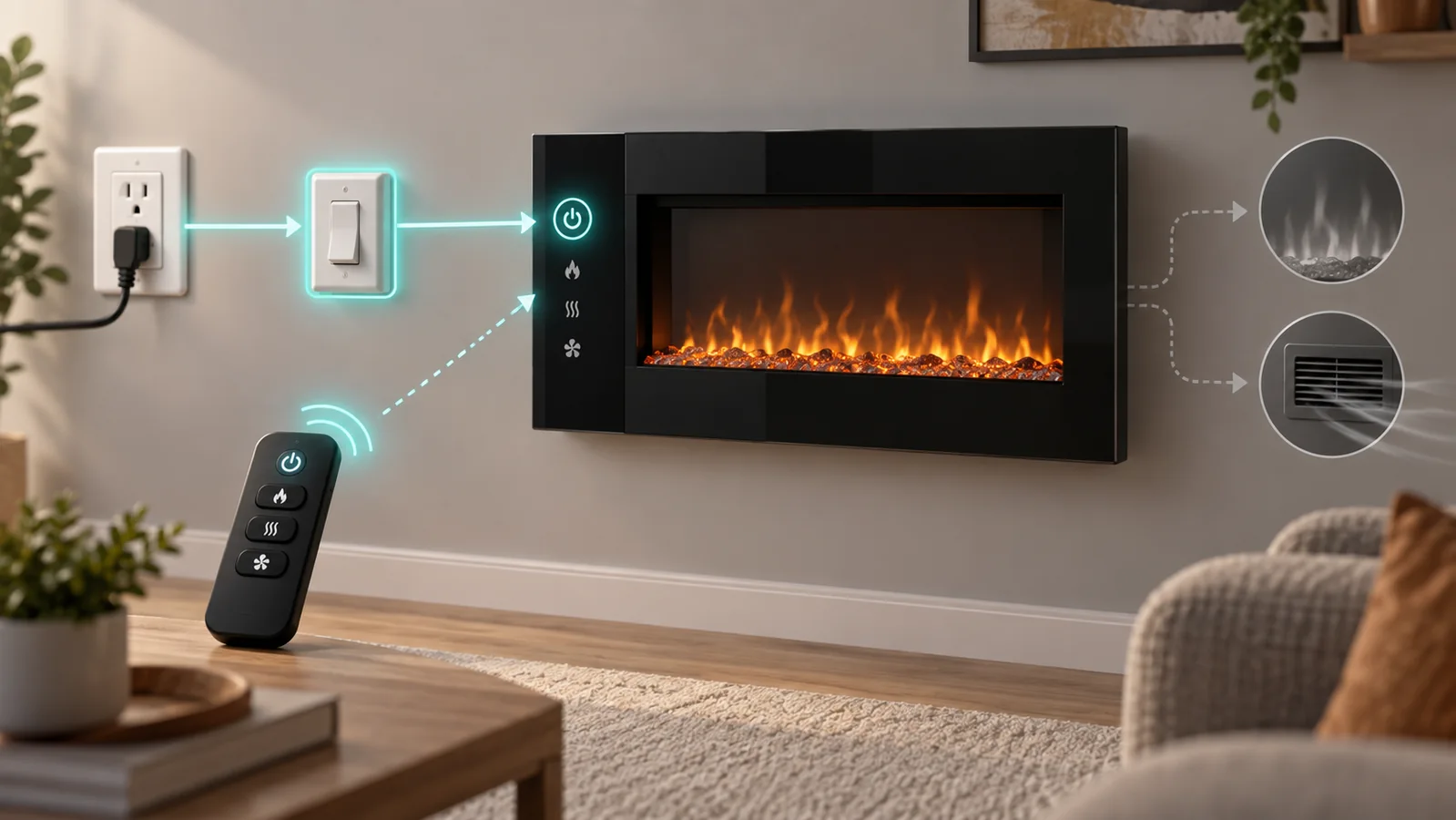
Do not let a silent handset speak for the whole appliance. Stand close enough to use the fireplace’s documented onboard power or standby control, without removing trim or a panel. Then note the response separately from the remote. This is not a competition between two ways to “fix” the unit; it is a clean way to locate the failed interaction.
If the onboard control produces the expected beep, display or effect while the remote produces nothing, the appliance has already given you useful evidence. The next task is remote identity and its exact battery/pairing instructions. Generic “universal” remotes are not proof of compatibility. Use the site’s electric fireplace remote replacement guide for cross-brand matching, or the Dimplex remote guide when the series, model and MOD fields point there.
If both control channels are silent, changing remote batteries may still be reasonable when the exact manual says so, but it cannot close the whole-unit path. Preserve whether an applicable wall switch, master switch or display had responded earlier. If only one of those facts is known, write that as the last response and leave everything after it unresolved.
Two manuals divide “dead” in different ways
The current Dimplex Revillusion Family Installation and User Guide dated March 2025 separates a unit that will not turn on from its manual controls from a unit that will not turn on with the remote. For the manual-control branch, it points to incoming power, correct connection, the main disconnect and a wall switch where one applies. For the remote branch, it points to battery condition and polarity. The same troubleshooting section treats heater disable, heater errors and locked touch controls as different states rather than one no-power problem.
The SimpliFire Allusion Slim manual, Revision D dated June 2026 draws similar boundaries but uses its own product architecture. Its manual-control path includes the plug or hardwire connection and incoming power; its remote path includes batteries, range or an obstructed receiver. It separately handles “flames are on, but no heat is coming out.” Internal control-board and heater-assembly outcomes appear as service endpoints, not evidence that an owner should open the appliance.
These manuals agree on the value of separating response channels. They do not establish one universal switch order, reset time or hidden failed part. Their different labels and branches are the reason the installed unit’s exact manual must own the next action. Dimplex’s current FAQ and documentation page reinforces the same distinction by giving separate support answers for no power, remote batteries/pairing and a locked control symbol.
Supply evidence stops at the appliance boundary
For a completely dark fireplace, first identify whether it is plug-in or hardwired and which accessible controls the exact manual names. A documented master switch can be checked for its visible position. An applicable wall switch can be recorded. A cord, plug or outlet can be observed for obvious damage without dismantling anything. That is still observation, not electrical diagnosis.
Do not infer that an outlet or breaker is healthy because another device seemed to work, or unhealthy because the fireplace stayed dark. Do not move an unidentified breaker merely to see what happens, and do not remove a panel to reach a connection or fuse. A hardwired installation whose circuit cannot be positively identified belongs to a qualified electrical owner. A plug, cord, receptacle or appliance that is hot, damaged, wet, discolored or producing smoke or an abnormal odor has already left the normal start path; follow the exact emergency/disconnection instruction and qualified-support boundary.
That boundary keeps “no response” useful. Your record can say that both external control channels were silent, the connection type is known or unknown, and the last accessible supply/control evidence was a particular switch or indicator. It cannot say that a board, fuse or wire failed. If the exact manual actually assigns a fuse location and owner action, the electric fireplace fuse guide explains why a fuse elsewhere in the supply path must not be confused with an internal service part. When an internal outcome remains plausible, the repair and parts guide preserves model and parts evidence for the service owner.
A protection event needs a before-state
A reset should answer documented evidence, not the vague phrase “it doesn’t work.” Before considering one, ask whether the fireplace was operating immediately beforehand. Did heat run for a while and then stop? Did the display show an error? Did a lock symbol appear? Did the flame remain while heat stopped? Those details move the task away from first-response localization.
A unit that repeatedly starts and stops belongs in the electric fireplace keeps-shutting-off guide, which preserves what stopped and the state immediately before it. A visible flame with no heat belongs in the non-heating electric fireplace guide. Controls that respond while the visual effect remains absent belong in the flame-effect guide.
Only use a reset when the exact manual connects the observed state to that reset and states its sequence and duration. The electric fireplace reset guide separates power-cycle, thermal-cutout, remote and control-state resets so that one manufacturer’s five-minute instruction does not become another model’s rule. Repeated reset need is itself information for support; it is not permission to keep extending the cycle.
Give support one sentence that locates the failure
When the fireplace remains unresolved, a precise handoff is more useful than a longer list of attempted fixes. Fill in one sentence:
“For brand/model ___ under manual or revision ___, I used the documented ___ control; the last confirmed response was ___; the onboard control now ___ while the remote ___; the display, flame, fan and heat states are ___; the unit is plug-in/hardwired/unknown; and the event immediately before this was ___.”
Use “unknown” where evidence is missing. Do not replace it with a diagnosis. The manufacturer’s current support channel can now tell whether the next step belongs to a documented external control, model-specific reset, qualified electrical check or appliance service. Dimplex’s technical-support page, for example, asks owners to start from their product documentation and support route rather than a generic parts assumption.
If you have not yet established whether the initial action itself was correct, return to the electric fireplace turn-on guide. Once the exact documented start action has been tried and produces no response, come back to the record above. Its job is not to announce what broke. It is to preserve the last fact you can prove and deliver the next owner enough information to continue safely.