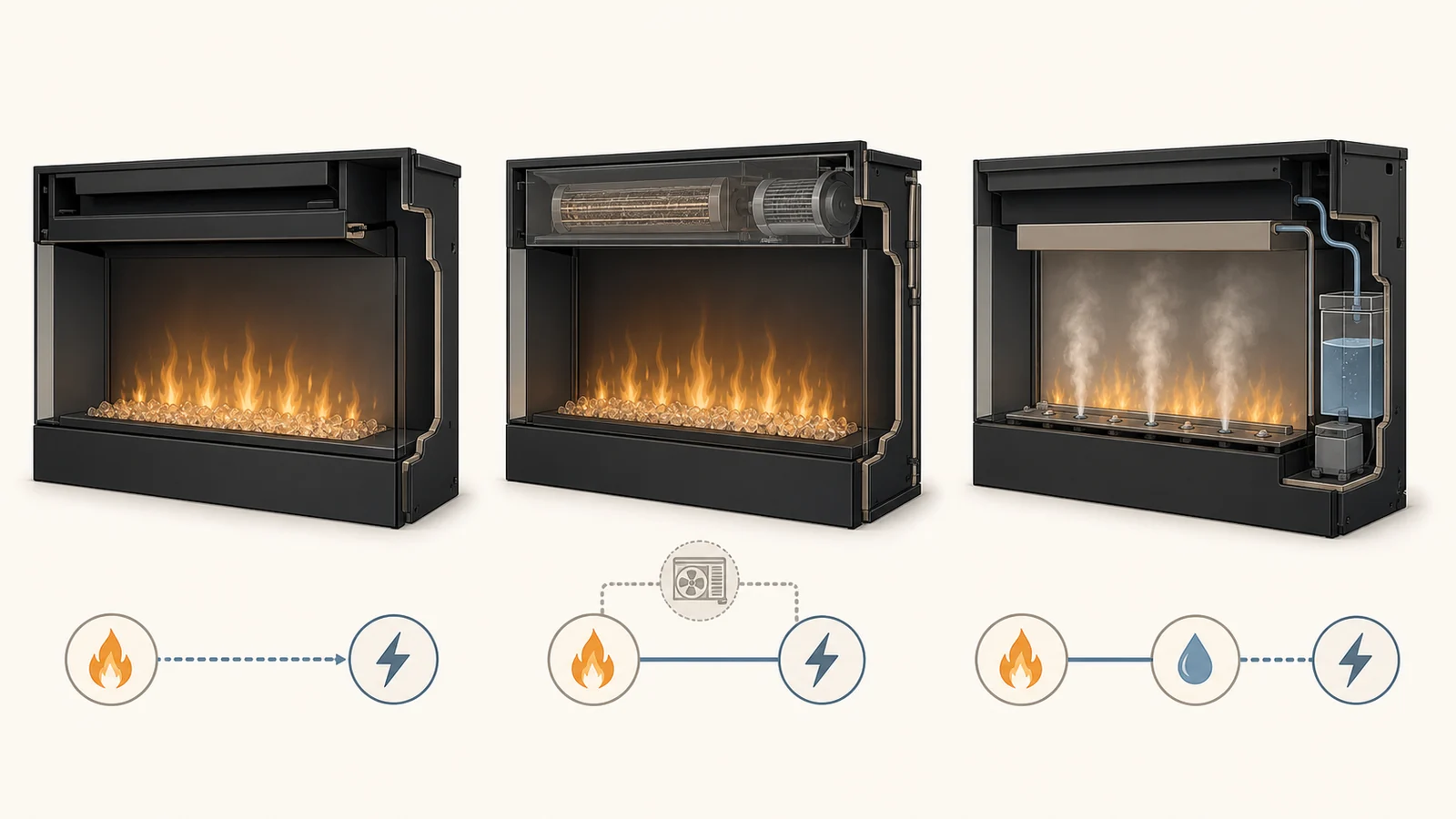
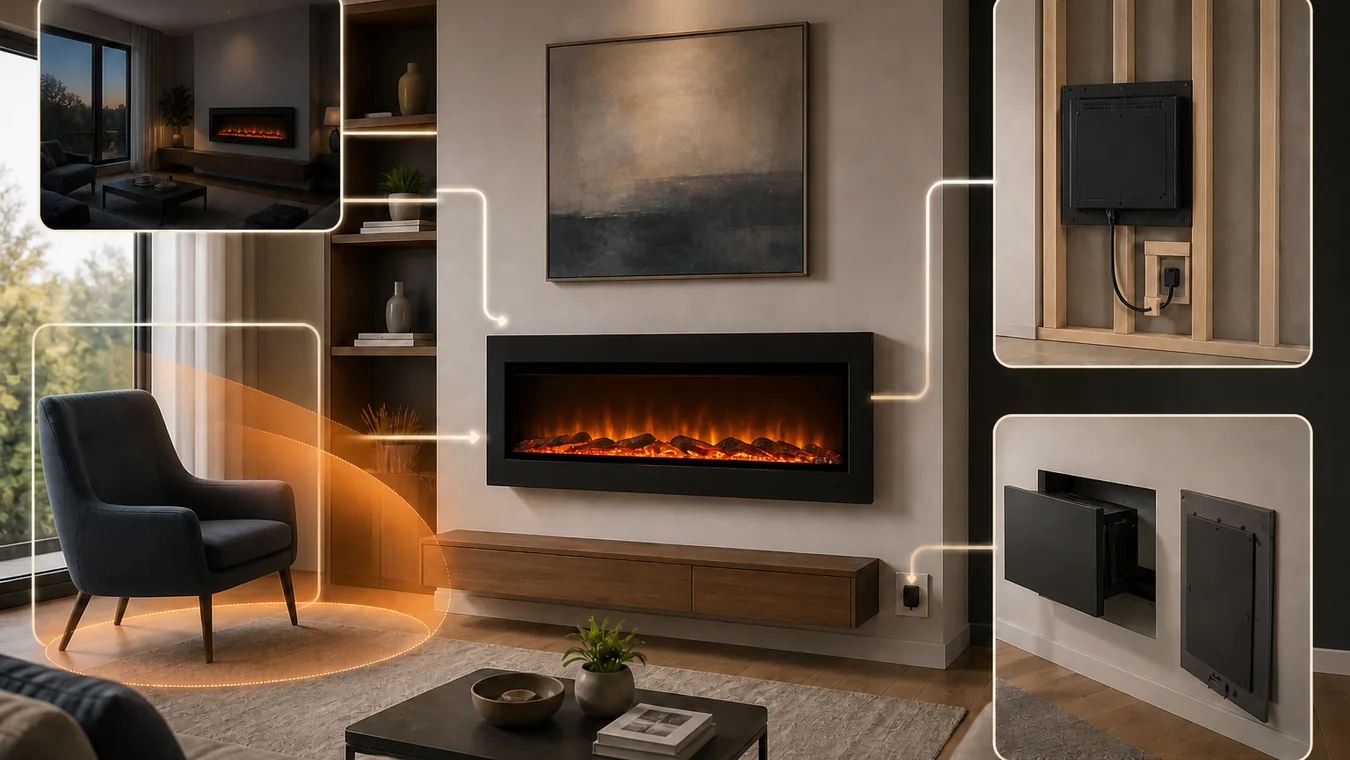
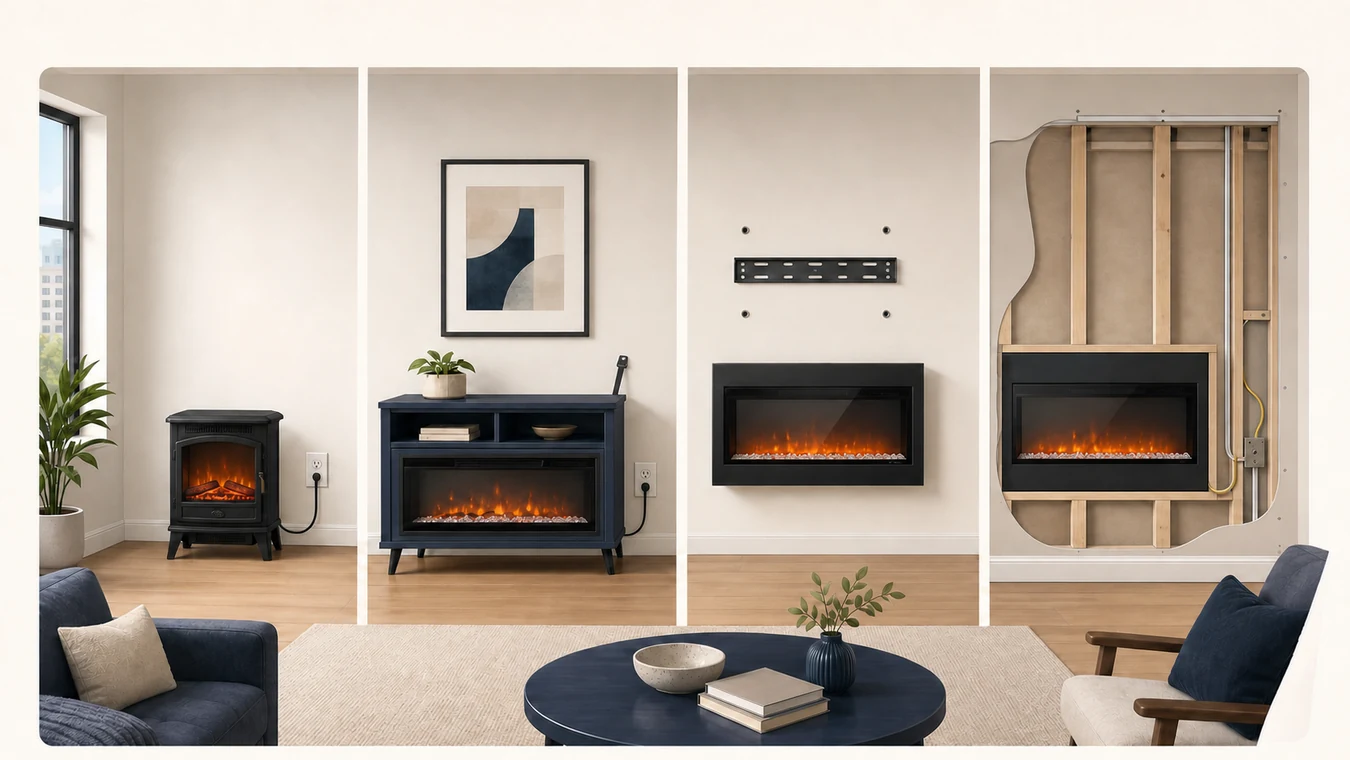
An empty wall is not automatically a fireplace wall. Once the bedroom is in use, that wall also has to accommodate a loose blanket, moving curtains, an open drawer or door, the route you walk in the dark, a power connection and the way the appliance comes down for service.
A wall-mounted electric fireplace for a bedroom is a viable candidate only when one exact model and its current manual agree with that occupied wall. “Bedroom suitable” may open the review. It does not finish it.
Before buying, choose what the fireplace should do after lights-out: remain off, provide flame-only ambience while you are awake, or supply heat while the room is occupied. Do not let a timer, thermostat or app blur those into one operating state.
The bed wall has more jobs than an empty wall
Product photos compress a room into a front view. Bedrooms are lived from the side.
Stand at the foot of the bed and picture the fireplace extending from the finished wall. Now pull the blanket to its loosest realistic edge. Draw the full sweep of the curtain, not the position used for a photo. Open the closest door and every drawer. Walk the normal route between bed, closet and doorway. Those moving edges are part of the wall decision.
The general types of electric fireplaces can help if the wall-mounted format fails, but this page begins after that format has been proposed. The question is whether this wall can keep its bedroom jobs while carrying this appliance.
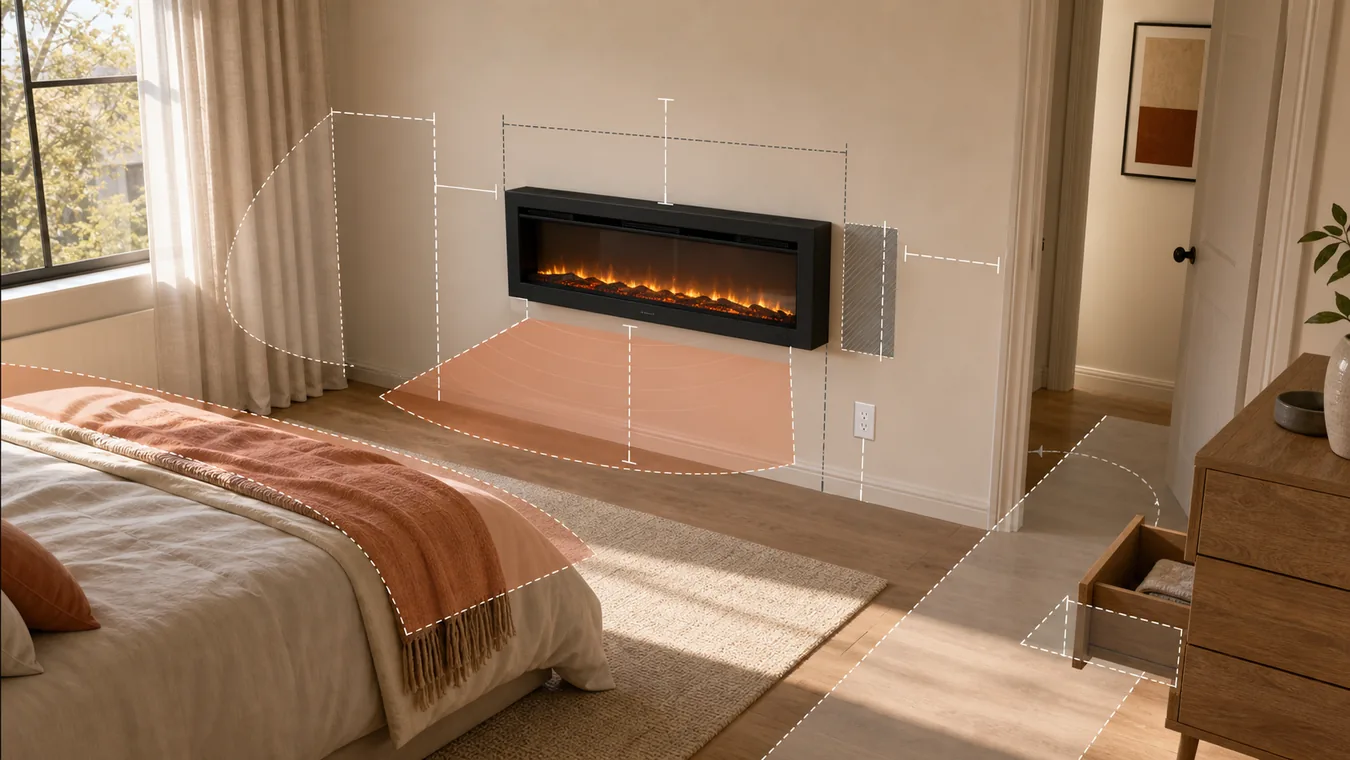
The illustration is a planning view, not a clearance diagram. Its dashed zones show what must be measured from the real room and the exact manual. They are not transferable dimensions.
The existing wall-mounted electric fireplace guide owns bracket support, projection, heat outlet, power and removability for the format in general. A bedroom adds an unusually changeable combustible and traffic boundary: bedding moves, curtains swing, clothes collect, and the route to the door must still work when the room is dark.
Decide what the fireplace does after lights-out
Three bedroom states can produce three different answers for the same appliance.
Awake, flame effect only. Confirm that the exact model can operate its display without heat. Then decide whether its minimum brightness, indicator lights and any sound feature are acceptable. A product page that says “flame without heat” does not prove darkness, silence or a good sleep environment.
Awake, with heat. The heater outlet, intake and model-owned clearances become active constraints. Bedding, curtains and furniture must be measured in their realistic positions, not pushed away for the test. The electric-fireplace heat guide can set expectations, but a wattage or room-area claim never approves this wall.
Sleeping or leaving the room. Treat this as a separate permission question. A timer can stop the appliance later; an app can change a setting remotely; a thermostat can cycle heat. None of those features, by itself, says the intended unattended or sleep state is permitted. The exact manual and the broader electric-fireplace safety guide control that decision. If the manual does not resolve it, leave that operating plan on hold rather than inventing permission.
This split also protects against a familiar shopping shortcut: buying a fireplace for heat, discovering that the nighttime state is unsuitable, and then treating flame-only mode as a consolation after the wall is already committed.
A bedroom label opens the manual; it does not close the decision
Two current manufacturer records show why model identity matters more than a generic bedroom recommendation.
Touchstone lists its Sideline 28, item 80028 as a 28-inch-wide product that can be recessed or wall mounted. The page also identifies independent flame/heat operation, remote control and app control. Those are useful bedroom features, but they are not wall approval.
The current Sideline manual, revision 251114 adds the facts that change the room plan. For the named Sideline models it places the appliance away from traffic and sets a 36-inch front separation from listed combustibles including furniture, bedding and curtains. It also says item 80028 cannot be hardwired, even though the larger family has a hardwire section. A concealed-cable idea borrowed from a sibling model would therefore fail for that exact item.
Napoleon’s W415-1987/E manual for the NEFL50/60/72HF-BT family goes further than generic marketing: the rating-plate text identifies the family as suitable for bedroom and bed-sitting-room installation. The same document still specifies the exact appliance depth, a dedicated grounded circuit, a 36-inch front separation from listed combustibles, an out-of-traffic location and a cord route that does not run under carpet or through a trip path.
That is the useful reading of “suitable for a bedroom.” It makes the model eligible for a room-level review. It does not make every bed wall suitable, transfer the same distance to another model, or prove that heat should run while someone sleeps.
Neither opened manual supplies a cross-brand decibel comparison or a sleep-quality result. If fan sound, indicator light or an optional speaker matters, record the exact control and leave the comfort question unresolved until there is comparable evidence or a return-safe way to evaluate the product. Do not turn “quiet” in a roundup into a measured fact.
Draw the wall as an elevation, not a product rectangle
Use one sheet for the room and the product. A separate room sketch and specification tab make it too easy to compare different reference points.
| Elevation field | Put on the bedroom wall | Take from the exact product owner | If it does not close |
|---|---|---|---|
| Intended state | Awake flame-only, awake with heat, or sleep/unattended plan | Modes, timer/thermostat behavior and explicit use limits | Hold the control or sleep-state plan |
| Occupied wall | Usable wall span and height after doors, trim and furniture | Overall body, bracket or recess relationship and finished projection | Choose a different wall or review a supported recessed path |
| Bed and bedding | Bed edge, pillow line and maximum loose blanket reach | Clearance statement with the manual’s original reference point | Hold heat mode or change walls |
| Curtains and clothes | Full curtain sweep and realistic clothing/storage position | Listed combustible and heat-outlet conditions | Move the conflict or reject the wall |
| Movement | Door swing, drawer travel, walking and egress line | Out-of-traffic placement and appliance projection | Choose a different wall |
| Heat and air | People and objects in front of the proposed location | Exact intake, outlet and clearance owner | Hold heat mode |
| Night controls | Reachable physical control; desired minimum light and sound state | Remote/app/physical fallback, display controls, sound/mute if present | Hold the control or sleep-state plan |
| Power | Outlet/circuit location and a route outside bedding and traffic | Voltage, plug/hardwire permission, circuit and cord instructions | Hold the power route |
| Removal | Space and direction available to lift, open or remove the appliance | Bracket, glass/media access and service instructions | Hold the service path |
Keep the manual’s labels intact. “Appliance depth,” “rough-opening depth” and the distance from the front of the glass are not interchangeable. The specifications guide helps separate those fields; the slim-fireplace depth guide is the next owner when a shallow body still creates a deeper framed or service commitment.
Power must stay on the same elevation. If the exact model is plug-in only, draw the receptacle and the entire cord route. If the manual permits hardwiring, that still is not a homeowner installation instruction. Use the plug-in versus hardwired guide to identify the documented route, then leave site electrical acceptance to the responsible qualified person.
For smart products, draw the fallback, not just the app. The smart electric fireplace guide explains why a network feature should not become the only way to reach a needed control. A bedroom candidate should remain understandable when a phone is charging, the network is down or another person uses the room.
Keep the bedroom routine; change the wall if necessary
The wall passes only when normal bedroom use survives. You should not have to tuck the blanket unnaturally, pin back a curtain, keep a drawer closed, route a cord across the floor or squeeze the walk to the door to make the product fit.
If the room can spare a different wall, move the same exact-model record and run it again. If projection is the conflict and the model supports another installation relationship, send that path back through the manual and responsible project review. If wall width or movement remains the scarce resource, the small-space fireplace guide can reopen the format choice without pretending every compact product is a bedroom answer.
A flame-only awake candidate can remain useful when the heat state fails, but record that result honestly. A missing manual, ambiguous model, blocked outlet, unsuitable nighttime control or impossible service path is not a reason to soften the requirement. It is the field that saved the bedroom from the wrong purchase.