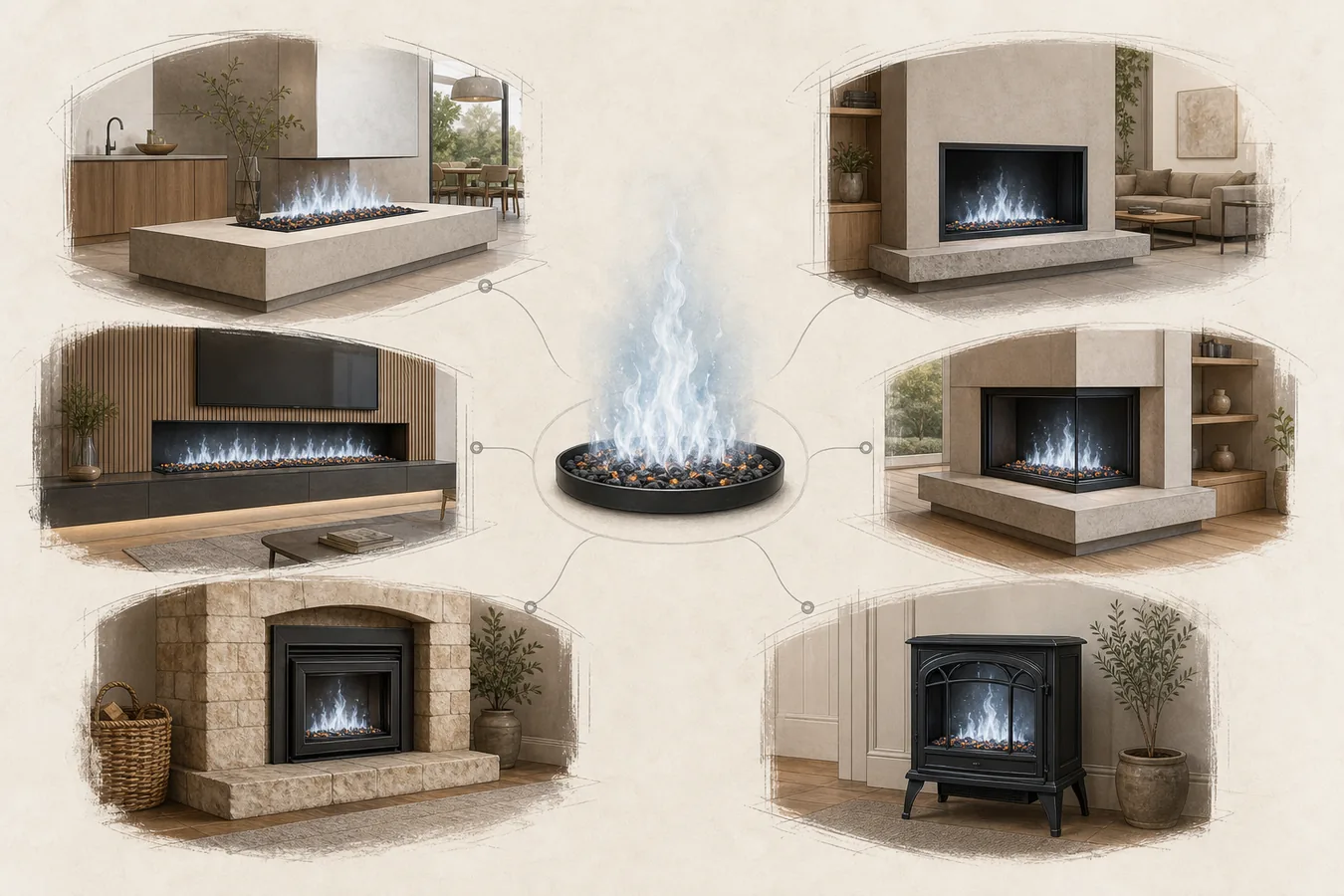
A Dimplex Opti-Myst electric fireplace is not one interchangeable box offered in several widths. Optimyst is the water-mist-and-light flame system shared by products that can have completely different relationships with the room: an open modular flame bed, an enclosed built-in box, a long linear wall unit, a traditional firebox, an existing-hearth insert or a freestanding stove.
That distinction makes the first decision surprisingly simple:
- An unused existing fireplace points first to Revive.
- A freestanding, plug-in room solution points first to Mapleton.
- A custom open flame bed points first to Cassette or RGB Cassette.
- An enclosed 40- or 60-inch built-in box points first to Pro Box or RGB Pro Box.
- A long enclosed wall fireplace points first to Linear.
- A traditional front, corner or bay firebox points first to e-MatriX.
- A compact 30-inch Aura project stays on hold until the exact model document resolves the current page’s conflicting heat language.
This is a shortlist, not an approval. Width, water, heat, viewing sides, power, air and service access still have to agree for one exact model. If the water-vapor category itself is still undecided, first work through the broader water vapor electric fireplace guide. The rest of this page assumes the mist-based effect is already the preferred technology.
Optimyst is not one fireplace shape
The current Dimplex US collection illustrates why a fixed “complete model list” ages badly. Its introduction says there are eight models, while the same live page displays separate named cards for RGB Cassette, RGB Pro Box, Cassette, Pro Box, Linear, e-MatriX, Aura, Revive and Mapleton. That may be a simple difference between counting core families and RGB variants, but Dimplex does not resolve the counting method on the page.
The useful response is not to pick a side. Treat the live collection as a discovery page and the exact product document as the purchasing authority.
The current Optimyst collection does establish one shared fact: these products use water vapor and light to create a three-dimensional flame-and-smoke effect without combustion. It does not establish one shared water connection, heater, control method, enclosure, opening or maintenance route.
Even familiar words need a scope. “Cassette” describes an open modular flame unit. “Pro Box” describes a prebuilt enclosed fireplace. “Linear” describes a long, enclosed wall format. “Revive” is intended for an existing fireplace, while Mapleton is a freestanding stove. Comparing those products only by flame appearance or width skips the part that changes the project.
The same discipline applies to realism. Product photography and a brand video can show the intended effect, but they cannot predict how convincing the mist will look in a particular room or how much sound and routine care a particular owner will accept. The realistic electric fireplace guide keeps that sensory decision separate from this product-family decision.
The opening makes the first cut
Start with what already exists, not with the product carousel.
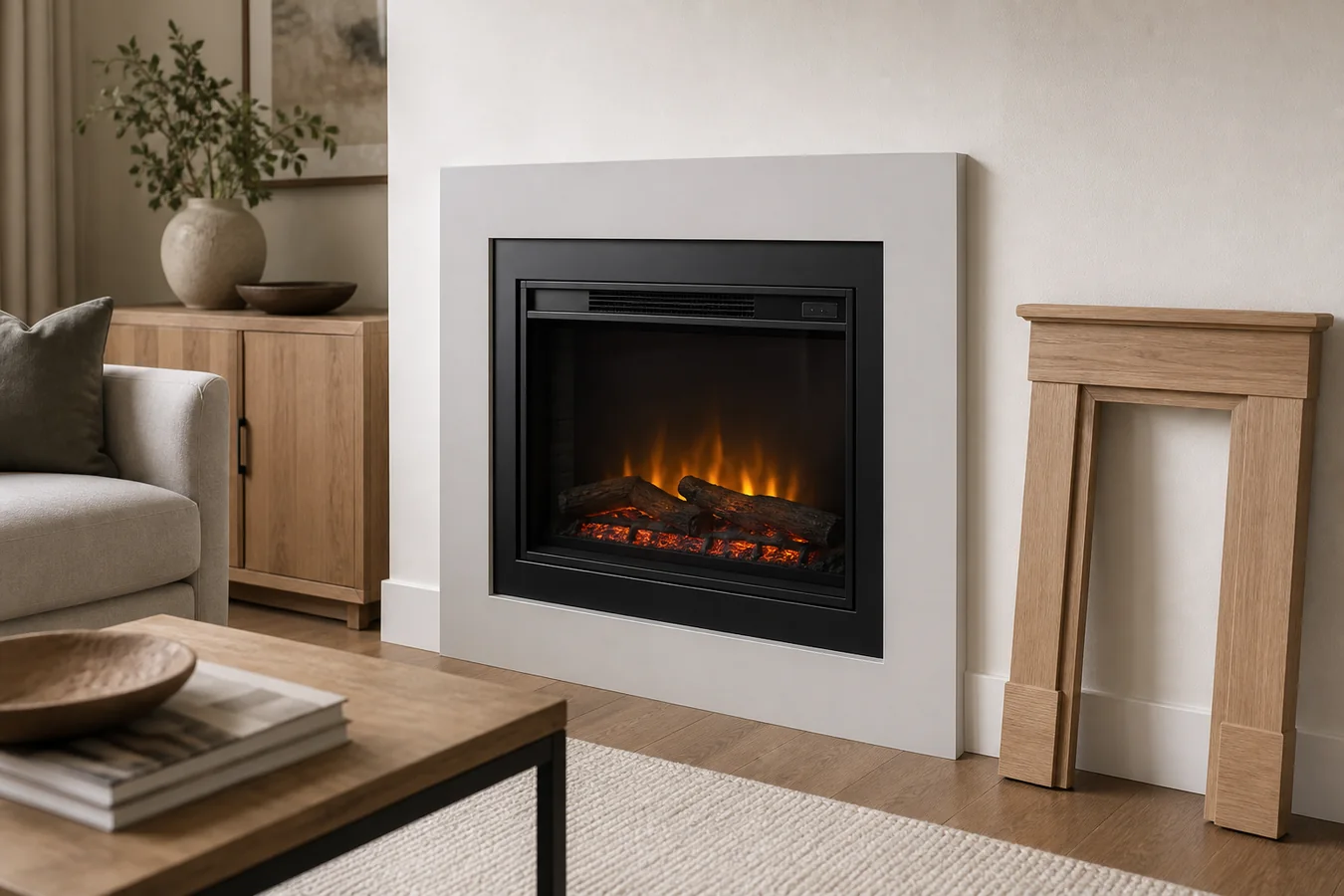
If there is an unused masonry or factory-built fireplace opening that will remain, measure that opening and investigate Revive first. Dimplex presents Revive as a 25-inch insert for an existing fireplace. Its pull-out drawer is part of the choice: the finished hearth must accept the appliance and still allow the refill movement. A decorative surround that makes the front look complete but traps the drawer has not produced a usable fit.
If there is no fireplace opening and no construction is wanted, Mapleton is the structurally distinct route. Dimplex presents it as an 18-inch freestanding, plug-in stove. It uses a removable refill tank, provides optional heat and uses a simple remote rather than requiring an app. The current page says one fill can support up to six hours of flame effect. That is a manufacturer page claim, not a tested household runtime, but it is enough to make refill frequency a visible ownership question before purchase.
A custom island, reception counter, room divider or open hearth begins somewhere else. Cassette products expose the mist flame as an open module that can be built into a custom composition. The current RGB Cassette page describes a 20-inch module, says multiple units can link, provides manual refill or an optional continuous-water kit, and explicitly says the unit has no heat. That combination is valuable when the flame bed itself is the design material. It is the wrong starting point when the project actually needs a finished heated fireplace box.
For an enclosed fireplace, decide whether the desired form is a long contemporary opening, a prebuilt box or a traditional firebox. Linear occupies the long-wall route. Pro Box and RGB Pro Box occupy the prebuilt single- or double-sided box route. e-MatriX occupies the traditional front, left-corner, right-corner or bay firebox route. Those viewing relationships are different products, not glass panels to assume later. The two-sided electric fireplace guide is the place to settle how the room will use each visible face before selecting an exact see-through model.
Aura is a compact 30-inch candidate, but its live page demonstrates why format is only the first cut. The narrative says the effect is created without heat; the FAQ on that same page says Aura includes optional fan-forced heat. Until the exact current model document resolves that conflict, Aura cannot close a heat-dependent project.
Water and heat redraw the shortlist
Every Optimyst flame consumes water, but “uses water” does not describe the work the owner or building must provide.
Manual refill keeps plumbing out of the wall but creates a recurring task and a required access path. A continuous-water option can reduce refill work, but it adds a supply route, shutoff, installation responsibility and future service dependency. Direct-main-water products make that building service part of admission rather than an option.
The current family pages expose three materially different patterns:
- RGB Cassette can be refilled manually or connected through an optional plumbing kit.
- RGB Pro Box can use its internal tank or an optional main-water connection. Linear likewise exposes a manual tank or direct continuous-water route.
- e-MatriX connects directly to the main water supply; its page says a plumbing accessory pack is included.
Do not convert those examples into a family-wide rule. For the non-RGB Cassette, Pro Box, Aura, Revive and Mapleton candidate, copy the water method from the exact current product document. If the listing and document disagree, stop at the document mismatch.
Maintenance access belongs in the same decision. Dimplex’s current Optimyst Cassette service manual includes a water-flow diagram and instructs the service person to disconnect power, empty water-bearing components and turn off source water before maintenance. This article is not a repair guide. The point is architectural: a finished enclosure must not erase access to the components and shutoff the product’s own service path depends on.
Heat varies just as sharply. RGB Cassette is a no-heat flame module. Current Pro Box, RGB Pro Box, Linear, Revive and Mapleton pages describe supplemental heaters. e-MatriX says the flame effect can run independently of heat. Aura’s current page conflicts with itself. A project that requires supplemental heat therefore cannot select a family from a flame photo or shared Optimyst description.
Control preference is another filter, but it comes after the physical and service path. RGB Cassette, RGB Pro Box, Pro Box, Linear and Aura expose Flame Connect app functions on their current pages. e-MatriX exposes a multifunction remote and Bluetooth. Mapleton emphasizes a simple remote without app setup. If local control during an app, account or network failure matters, record that requirement rather than treating “smart” as an automatic upgrade. The smart electric fireplace guide separates app convenience from a resilient fallback.
Sound is model-bound too. e-MatriX and Mapleton pages mention crackling effects; that does not make sound a shared Optimyst feature. If sound matters, verify the exact model’s on/off, volume and memory behavior with the electric fireplace crackling-sound guide before the control decision closes.
A family map for the actual project
The matrix below is a routing map for the current Dimplex US pages observed on August 18, 2026. It deliberately avoids prices, stock and a permanent model count. The final column is the field that can still overturn the route.
| Current family or variant | Start here when the project is… | Water, heat and control facts exposed by the current family page | Do not proceed until… |
|---|---|---|---|
| RGB Cassette, 20 in. | A custom open flame bed, possibly using linked modules | Manual refill or optional continuous water; no heat; app and remote | The exact module count, enclosure, water, power and service plan are documented |
| Cassette, 20 in. | An open modular linear or multi-sided flame composition without a prebuilt box | The collection confirms the open modular relationship; the exact current document controls remaining fields | The full model and current document are matched rather than borrowed from RGB Cassette |
| RGB Pro Box, 40 or 60 in. | A prebuilt enclosed box needing single/double-sided choice and RGB control | Internal tank or optional main water; fan-forced heat; app, remote, onboard and tether controls | Exact size/model, glass/viewing arrangement and service route close |
| Pro Box, 40 or 60 in. | A prebuilt enclosed single- or double-sided fireplace without RGB as the defining requirement | Optional continuous water, fan-forced heat and app/remote functions appear on the current page | The exact model confirms water, heater, controls and viewing kit |
| Linear, 46, 66 or 86 in. | A long enclosed wall fireplace | Manual tank or continuous water; supplemental heat; app control | Exact opening, water choice, power, finish and removal path agree |
| e-MatriX, 32 in. front/left/right/bay | A traditional built-in firebox with one, two or three intended viewing faces | Direct main water; flame independent of heat; remote/Bluetooth; at least 40 sq. in. fresh-air intake below | The exact viewing model, water, air, electrical and service fields are designed into the project |
| Revive, 25 in. | An existing unused fireplace opening | Pull-out refill drawer and fan-forced supplemental heat | The opening, front relationship and full drawer/service movement fit |
| Aura, 30 in. | A compact built-in candidate | Easy refill and app control are exposed; current heat statements conflict | The exact current model document resolves heat and all fit fields |
| Mapleton, 18 in. | A freestanding plug-in stove with no built-in construction | Removable refill tank, simple remote, optional heat; page states up to six hours of flame effect per fill | Placement, outlet, heater role, refill frequency and local clearances close |
A family can fall out for one field even when everything else is attractive. A renter may prefer Mapleton because construction is off the table. A commercial lobby may prefer a continuous-water path because daily refilling is unacceptable. A home project may reject e-MatriX because there is no responsible route for direct water or the required fresh-air intake. An open Cassette design may fail because supplemental heat is part of the brief.
Those are not product defects. They are evidence that the project has finally started controlling the shortlist.
The model document gets the final vote
Once one family remains, switch from family language to exact identity. Record the full model or item number, US market and current installation/user document. A width without a model is not enough; neither is a dealer title that shortens the suffix.
Use the electric fireplace specifications guide to keep the published fields attached to their actual jobs. Capture at least:
- appliance dimensions and the exact endpoints used;
- opening, framing or hearth requirements for the chosen relationship;
- permitted viewing configuration and required glass or conversion parts;
- water source, connection or refill method;
- heater presence and electrical rating;
- fresh-air or airflow requirement;
- local, remote, app or Bluetooth control path;
- refill, cleaning, media removal and service movement;
- current document title, revision/date and model scope.
Family marketing cannot approve a wall, circuit, water connection or existing fireplace. A phrase such as “zero clearance,” “plug-in” or “no venting” still belongs to the exact product context in which Dimplex uses it. It does not waive support, finish, electrical, plumbing, air or local requirements.
The Aura conflict is a useful test. If a product page contains two materially different answers about heat, do not average them or choose the one that suits the room. Mark “heater unresolved,” open the exact model document through Dimplex’s technical-document library, and keep the candidate on hold until the model owner closes it.
One order record ends the search
A defensible order record can be short, but it must be specific:
Project relationship: [existing hearth / freestanding / open custom bed / enclosed box / linear wall / traditional firebox]. Intended viewing faces: [front / left corner / right corner / bay / see-through]. Candidate: [full Dimplex family and exact model, US market]. Controlling document: [title and revision/date]. Opening or placement: [measured project facts]. Water path: [manual tank / internal tank / optional continuous line / required direct main water]. Heat role: [not required / exact heater verified / unresolved]. Power and air: [exact documented fields]. Controls: [local / remote / app / Bluetooth plus fallback]. Refill and service: [how the finished project preserves both]. Open owner: [person responsible for any remaining plumbing, electrical, structural or local field].
The record has only two useful endings. Either every controlling field supports one exact model, or the first unresolved field is named and the order waits. “We chose Optimyst” is not an ending because it identifies the flame system, not the fireplace the room can support.
After the record closes, carry that same model and document into the manual-first installation handoff. The family route has then done its job: it removed the wrong product relationships before framing, plumbing, wiring or a purchase made them expensive.