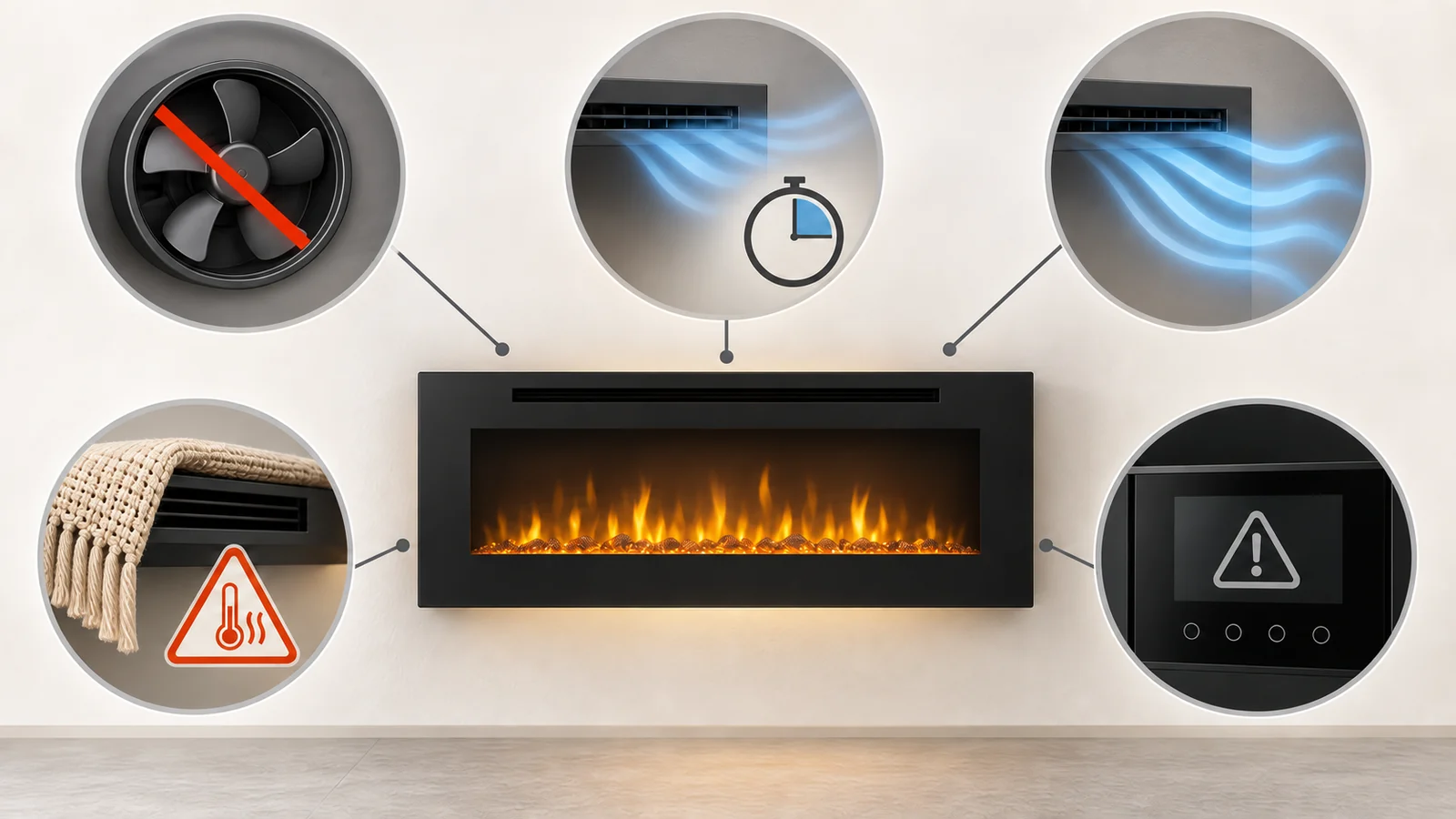
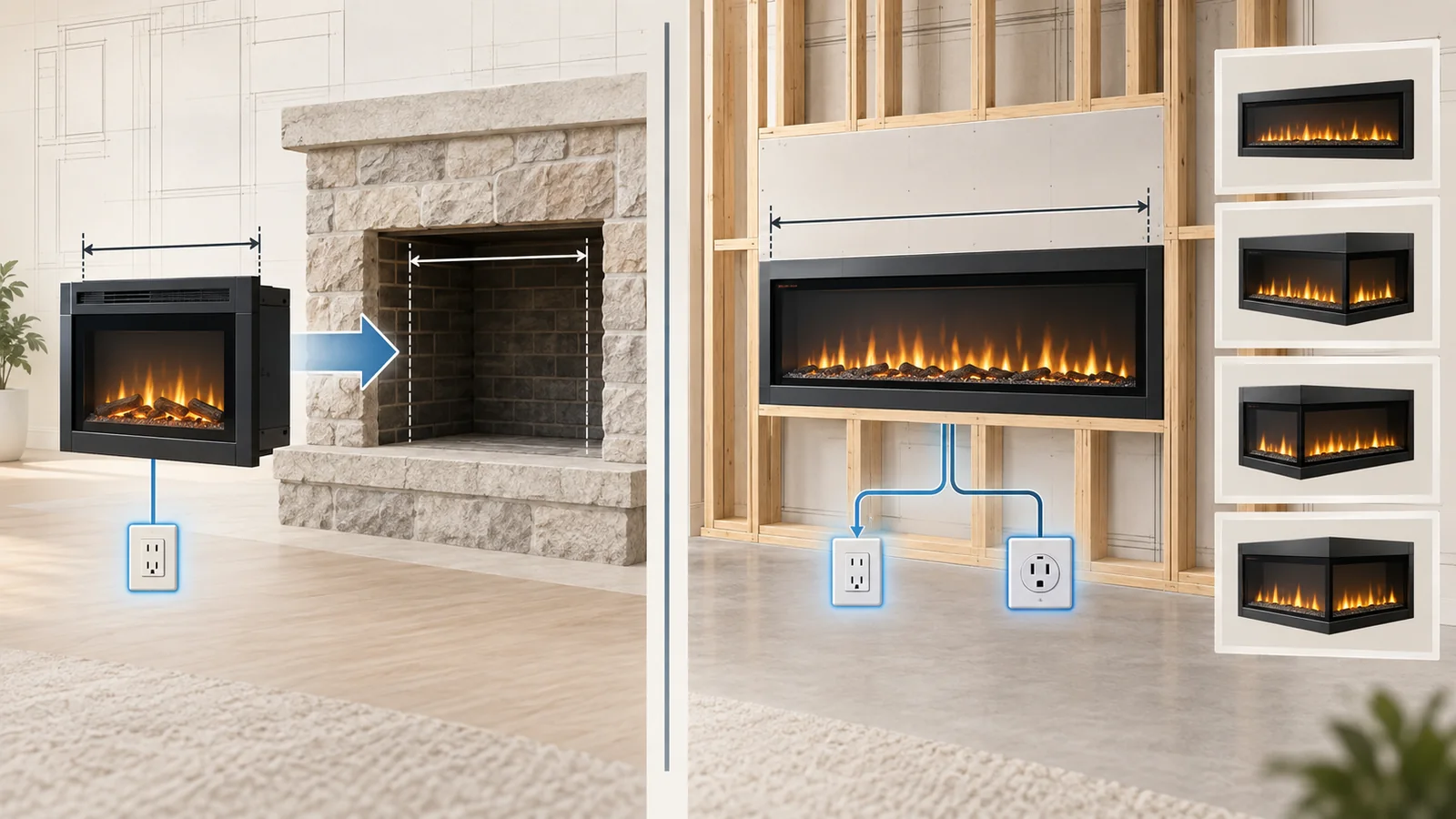
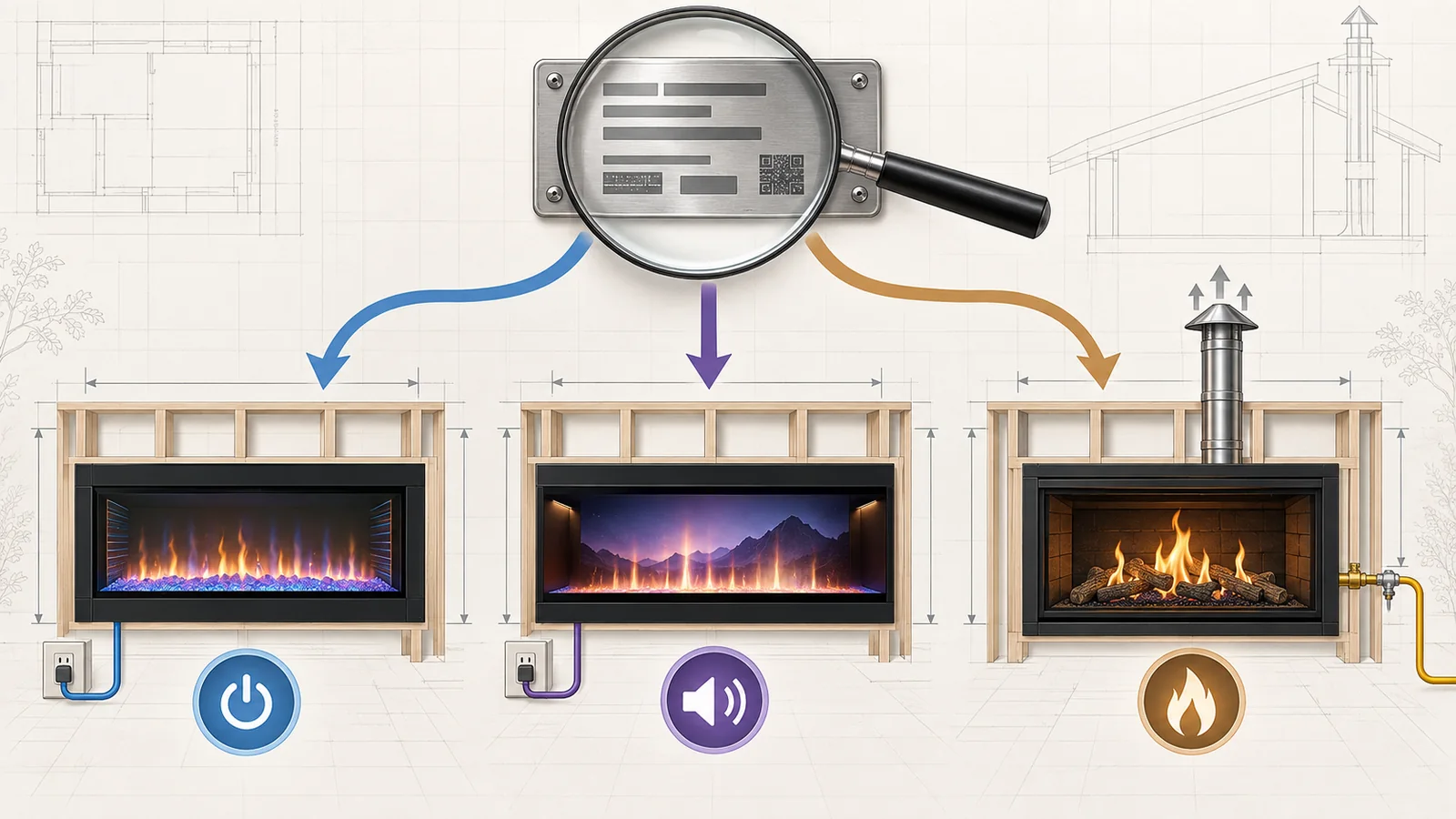
An electric fireplace has no defensible category-wide expiration age. “Last” can mean that the appliance still turns on, that none of its components has failed yet, or that repairing it still makes economic sense. Those clocks rarely stop on the same day.
For a useful answer, start with the fireplace’s exact model and serial number, purchase or manufacturing date, affected function, current warranty, dated parts evidence and installed access. Then decide whether you have a supported appliance, a repairable module, a quote that still needs to be priced, or a replacement comparison. A number such as 5, 10 or 20 years cannot make those distinctions for you.
Decide what “last” means before you count years
First separate three states. Operating life means the unit can still perform the function you expect today. Time to first component failure ends when one part or function stops working. Practical life ends when the evidence, parts, service route or total repair scope no longer justifies keeping that exact unit.
A fireplace can cross one line without crossing the others. The flame effect may still run after the heater stops. A remote problem may leave the onboard controls usable. Conversely, a unit that still operates can become difficult to support after its parts list is retired. Age is context for the record, not the record’s verdict.
| What you observe | Evidence needed next | What age cannot decide | Useful output |
|---|---|---|---|
| No current symptom and the correct owner manual is available | Model/serial, purchase date, current manual, warranty owner and normal owner-maintenance record | Whether a failure is imminent | Continue supported use; preserve the unit record |
| Flame effect changes or stops while other functions remain | Exact manual and parts list for the LED, visual-effect or motor path named for that model | Which module failed or whether it is owner-serviceable | Exact part/service path or qualified diagnosis |
| Heat stops while the flame still works | Exact heater/blower assembly evidence, warranty status and authorized service route | Whether the symptom proves an element, fan, limit or control fault | Qualified service decision or written quote |
| Remote or control behavior changes | Correct remote/receiver/control documentation and model-specific support | Whether a similar remote is compatible or the receiver is healthy | Documented control check, exact replacement path or service handoff |
| Glass, trim or cabinet is damaged | Exact part identity, structural condition and installed-access scope | Whether a cosmetic-looking issue is safe or economical to repair | Exact part plus qualified access/repair decision |
| Several functions fail, parts are unavailable or support cannot identify the unit | Written diagnosis, total repair scope and a like-for-like replacement specification | Whether an old unit is automatically uneconomical | Repair-versus-replacement comparison |
This is deliberately not a failure-rate calculator. Public manuals describe products and service boundaries; they do not provide a universal field-life distribution. Record only what the documentation and the observed unit can support. The site’s electric fireplace specifications guide helps keep model, electrical and installation fields attached to the same appliance rather than mixing facts from look-alike products.
Warranty coverage is not a failure forecast
Warranty length answers a commercial question: who may pay for a covered remedy, for which product or component, during which period and under which conditions? It does not say when the fireplace is expected to fail.
The distinction appears in current first-party documents. The Dimplex XHD owner manual gives the fireplace a two-year limited warranty while surrounds and trims have a one-year limited warranty. It also requires proof of purchase and the product’s model and serial number when service is requested. Those terms tell an XHD owner what evidence and components the warranty covers; they do not turn two years into an XHD lifespan.
Touchstone’s current warranty page states a standard one-year warranty and identifies a two-year term for Sideline Vision models, with separate extended options. It also distinguishes replacement-part support from costs such as installation labor. Again, different coverage is evidence that the exact product and remedy matter—not that one family must outlive another by a predictable number of years.
The Napoleon Element manual likewise assigns stated terms to electrical components, wearable parts and labor. Napoleon’s current support page tells owners to use the exact product manual and routes parts or safety work through qualified technicians and dealers. The actionable facts are the model, covered component, purchase evidence, warranty owner and service path.
Read a warranty in five columns: product/model scope, covered component, start event, duration and remedy. Keep exclusions and required evidence beside them. If the term has expired, write “out of stated warranty”; do not rewrite that as “end of life.” If it remains active, write “coverage may apply”; do not promise approval before the warranty owner reviews the claim.
One failed module may leave a repairable fireplace
The first component failure is not automatically the death of the appliance. A current model’s service material can reveal whether the manufacturer treats major functions as separately identified assemblies.
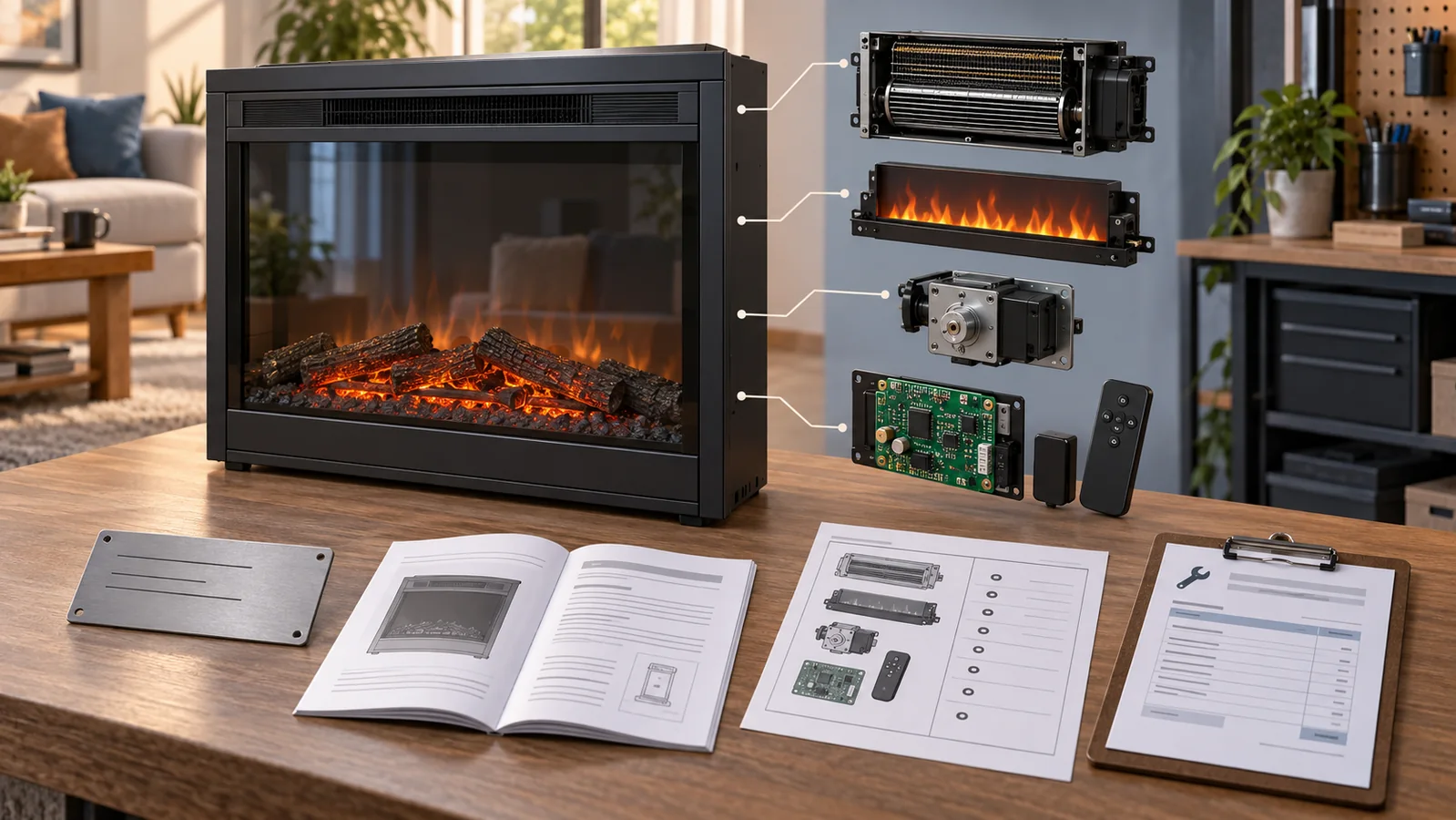
SimpliFire’s current Allusion Slim owner and service-parts manual, Revision D dated June 2026, lists its covered models and identifies parts such as the heater assembly, control box, LED assemblies, motor, receiver, remote, glass and mounting hardware separately. That list does not guarantee that a part is in stock, that a repair will succeed, or that an owner should open the unit. It proves something narrower: for those listed models and that document revision, the manufacturer has described multiple component-level service identities rather than one indivisible box.
That changes the question you send to support. “My fireplace is eight years old; is it done?” gives the service owner almost nothing to resolve. “Model ___, serial/date ___: the flame works, the heat does not, and the current parts document names heater assembly ___; is that assembly currently supported for this unit, and who is authorized to diagnose it?” can produce a part, service or quote decision.
Keep symptoms separate from diagnoses. Heat without flame, flame without heat, intermittent shutdown and a silent handset are different observed states, but none proves a failed component by itself. The electric fireplace repair guide routes electrical, warranty and qualified-service boundaries. For a heat-only branch, the electric fireplace heater element guide explains why the visible symptom still has to be matched to the exact heater assembly and service evidence.
Do not treat a service manual as permission to perform technician work. It can be the right evidence for component identity while the manufacturer, warranty or electrical scope still requires qualified service.
A retired parts list changes the answer without stopping the flame
Parts status can age faster than the appliance. SimpliFire’s official SFE-35 service-parts list says that model was manufactured from December 2006 through August 2013 and marks many major items “No longer available.” This is not evidence that every SFE-35 has failed, nor that all retired electric fireplaces are unrepairable. It is a bounded counterexample: an appliance can remain in a home after its manufacturer’s published parts path has narrowed substantially.
That is why the date and status of the parts document belong in a lifespan record. An old PDF may identify the original component accurately while saying nothing about a current successor, inventory or authorized substitute. A marketplace listing with a similar photograph does not repair that gap.
The correct output can be “original part identified; current replacement not confirmed.” Preserve the document title, revision, model range and original part number, then ask the current support owner whether a recognized substitute exists. The electric fireplace manual guide helps distinguish a controlling current or retired document from a near-match found by title alone.
Touchstone’s current replacement-parts page illustrates the other side of the record: a current manufacturer can provide a model-specific route through customer service. The page is not proof that every part for every model is available today. It is evidence of whom to ask and what model identity the request must carry.
For a fireplace that still operates, a retired-parts finding is a planning signal rather than a shutdown instruction. Preserve the manual and label now. If the unit is central to a built-in design, capture its opening dimensions and electrical requirements before a failure creates time pressure. Do not replace a working appliance solely because a list is old; do not promise easy repair solely because a PDF still exists.
Built-in access can end the economic life before the electronics do
Repairability is not just a part number. A wall-mounted unit that lifts from its bracket, an insert held behind removable trim and a firebox enclosed by custom millwork can expose very different service scopes. The article cannot infer those costs from a product photo or age.
Ask a qualified provider for a written total scope:
part or assembly + authorized diagnostic/repair labor + safe removal and reinstallation + trim, mantel, drywall or cabinet restoration + taxes/fees + downtime consequence
This is a scope formula, not a price formula. Each term can be zero, unconfirmed or material for a particular installation. A cheap component can still lead to an unattractive repair when access and restoration dominate. A costlier assembly may remain reasonable when access is simple and the rest of the system is supported.
Before requesting the quote, document the installation without dismantling it. Record whether the appliance is freestanding, wall-mounted, inserted into an opening or enclosed in furniture; photograph accessible trim and clearances; and identify the exact manual’s removal/service boundary. Use the electric fireplace cleaning guide only for documented owner-accessible care, not as a reason to remove service panels. If glass is the issue, the electric fireplace glass replacement guide keeps exact panel identity, damage and qualified replacement separate from routine cleaning.
Compare the written repair scope with a replacement that preserves the required opening, voltage, heat function, controls and finish—not merely with the lowest advertised fireplace price. If either side lacks installation/restoration scope, the economic-life comparison is incomplete.
Ask support a question they can actually close
A manufacturer or dealer cannot validate “How much life is left?” from age alone. Give the current support owner a compact record that leads to one decision:
- Exact brand, model, serial number and MOD/revision field if the label uses one.
- Purchase date and seller, or the documented manufacturing range when purchase evidence is unavailable.
- Manual/service-parts title, file or revision identifier, model scope and the date you accessed it.
- Current observed state: which flame, heat, sound and control functions work, stated without a diagnosis.
- Warranty owner, term and the evidence you can provide.
- Component or part identity found in the exact document, plus whether current availability is confirmed or unconfirmed.
- Installed form, access constraints and whether a qualified provider has supplied a written total repair scope.
Then ask a closed question: “For model ___ and serial/date ___ in the US market, is component ___ currently supported, who is authorized to diagnose or replace it, and which current document or part supersedes the one I found?”
The answer should leave the unit in one of three useful states. A current manual, support route and no material symptom support continued use. A named assembly, service owner and complete quote support a repair comparison. Unavailable parts, unresolved identity, unsafe access or a total scope that cannot be justified support a like-for-like replacement comparison. If support cannot close a field, preserve that exact hold. A precisely named evidence gap is more useful than a confident lifespan number that was never about your fireplace.